
The rapid evolution of unmanned aerial vehicle (UAV) technology has fundamentally altered modern combat operations, expanding the scope of military applications and significantly enhancing the efficacy of intelligence, surveillance, reconnaissance (ISR), and precision strike missions. As UAVs become increasingly prevalent on the battlefield, the imperative for effective countermeasures has grown accordingly. Among major military powers, significant resources are being dedicated to the development of robust anti-UAV capabilities. Through a deliberate and systematic approach encompassing theoretical research, technological innovation, tactical development, and rigorous training, one nation’s armed forces have made substantial progress in this domain. This analysis delves into the core methodologies employed in strengthening anti-UAV warfare capabilities, providing a detailed examination from the perspectives of equipment development, tactical doctrine, and operational application.
1. Development of Next-Generation anti-UAV Weapon Systems
The foundation of any effective anti-UAV strategy lies in the development of specialized hardware. A comprehensive, system-of-systems approach has been pursued, focusing on four critical functional pillars: detection and tracking, electronic suppression, capture and control, and kinetic destruction.
1.1 Detection and Tracking Systems
Detecting small, low-flying UAVs presents a significant challenge due to their low radar cross-section (RCS) and ability to exploit terrain masking. Advanced sensor systems are crucial for early warning and fire control integration.
$$ R_{detect} = \sqrt[4]{\frac{P_t G_t G_r \lambda^2 \sigma}{(4\pi)^3 k T_s B_n (S/N)_{min}} } $$
Where $R_{detect}$ is the maximum detection range, $P_t$ is transmitter power, $G_t$ and $G_r$ are antenna gains, $\lambda$ is wavelength, $\sigma$ is target RCS, $k$ is Boltzmann’s constant, $T_s$ is system noise temperature, $B_n$ is noise bandwidth, and $(S/N)_{min}$ is the minimum signal-to-noise ratio required for detection. This equation highlights the difficulty in detecting low-$\sigma$ UAV targets.
Key systems developed or in testing include:
- Non-Radiating Optical Radar Systems: Capable of detecting UAVs within a 3-5 km radius, these systems provide targeting data for air defense assets and are nearing the final stages of operational deployment.
- Geodesist-V System: This system utilizes the TB-29V autonomous takeoff and landing unmanned helicopter as a sensor platform. Its primary mission is to locate and track UAVs, transmitting precise trajectory coordinates to ground command posts.
- Sentry Radar-Optical Complex: Integrating a perimeter surveillance radar station with an optical-electronic module, this system can detect small aerial targets, including mini-UAVs, at distances up to 20 km.
1.2 Electronic Warfare and Suppression Assets
Electronic attack forms the core of the “soft-kill” anti-UAV methodology, targeting the UAV’s dependence on communication links, navigation signals, and onboard electronics.
- Directed Energy Weapons: A mobile high-power microwave (HPM) system, reportedly mounted on a Buk missile system chassis, is designed for full-spectrum suppression of UAV electronics at ranges exceeding 10 km.
- Portable Counter-UAV Guns: Man-portable electromagnetic “rifles,” such as the ‘Stupor’ system, emit targeted electromagnetic pulses to disrupt command, control, navigation, and video transmission links. Effective within a 2 km line-of-sight, they cause UAVs to lose contact with operators and potentially crash.
- Area Denial Systems: Systems like Ruberoid and Rosa-AERO provide broader electronic protection. They can detect micro-UAVs at 35 km, perform full-band or directional jamming to sever navigation and telemetry links, and in some cases, spoof GPS signals to guide and capture hostile drones.
The effectiveness of a jamming system can be modeled by the link budget equation for the jamming signal-to-noise ratio at the UAV receiver:
$$ \left(\frac{J}{N}\right)_{UAV} = \frac{P_j G_j G_r(\theta_j) \lambda^2}{(4\pi R_j)^2 k T_{s,UAV} B_{r,UAV} L_j} $$
Here, $P_j$ and $G_j$ are the jammer’s power and antenna gain, $G_r(\theta_j)$ is the UAV receiver gain in the direction of the jammer, $R_j$ is the jammer-to-UAV range, and $L_j$ represents losses.
1.3 Capture and Control Systems
Beyond simple suppression, systems have been developed to actively seize control of hostile UAVs.
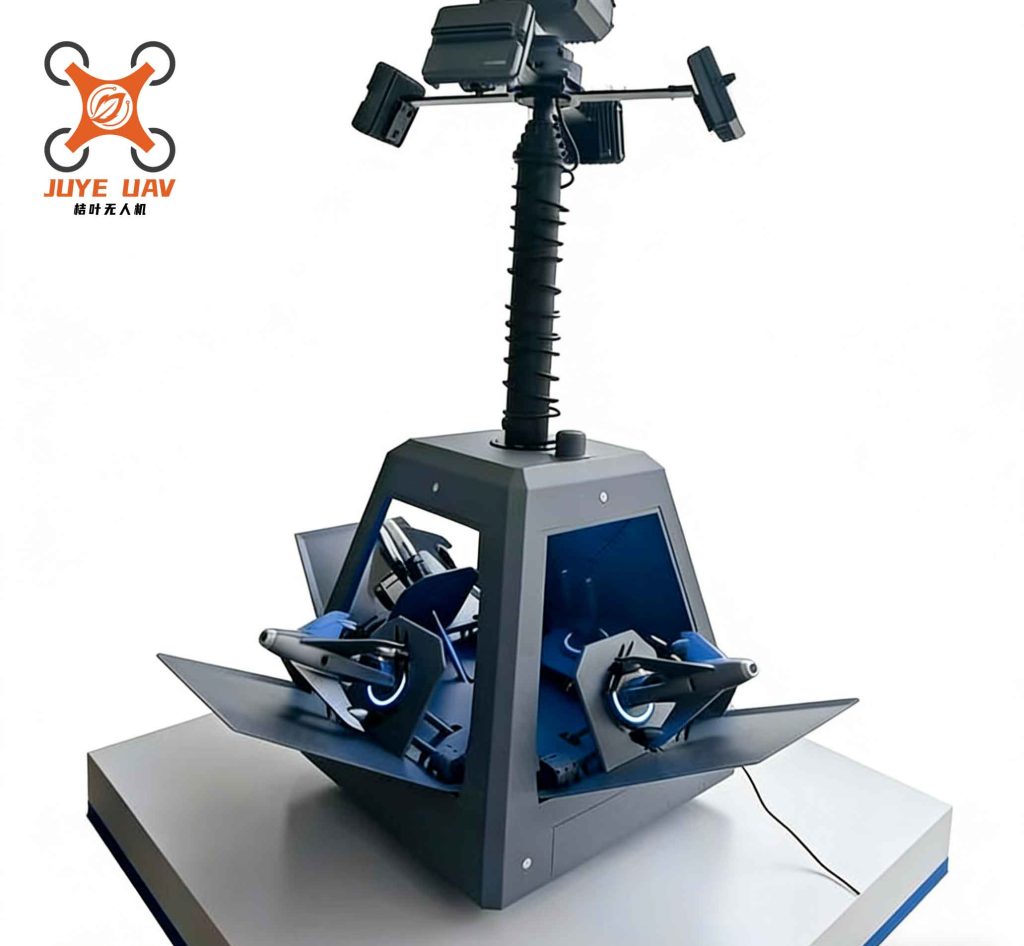
- Emerald Radio Station: This system employs microwave radiation to transmit information, reportedly capable of hacking into and taking control of enemy unmanned systems, including UAVs and ground robots.
- Net-Based Interception: A remote interception system for small UAVs, deployable on aircraft, helicopters, or larger UAVs, launches a sturdy nylon net (approx. 16 m²) to physically ensnare and capture target drones mid-flight.
1.4 Kinetic Destruction Platforms
For direct physical engagement, a layered suite of kinetic effectors has been developed or adapted.
- Dedicated Air Defense Systems: The Sosna anti-UAV air defense system and the Gibka-S short-range system are designed to engage small, low-altitude targets like UAVs and precision munitions at the inner layer of defense.
- Adaptive Munitions: “Smart” artillery shells are under development, designed to detonate in proximity to small reconnaissance UAVs, disabling them with fragments.
- Unmanned Combat Aerial Vehicles (UCAVs): A significant innovation is the development of an unmanned fighter-interceptor. Equipped with firing systems and specialized ammunition, it is designed to autonomously seek out and destroy various types of UAVs in flight, representing a shift towards unmanned-vs-unmanned anti-UAV combat.
| Category | System Name/Type | Primary Function | Reported Range/Capability |
|---|---|---|---|
| Detection | Optical Radar | Detection & Tracking | 3-5 km |
| Sentry Complex | Detection of small UAVs | Up to 20 km | |
| EW/Suppression | HPM “Microwave Cannon” | Full-spectrum electronic suppression | >10 km |
| ‘Stupor’ EM Gun | Disrupt C2 & navigation links | ~2 km (LOS) | |
| Rosa-AERO / Ruberoid | Jamming, spoofing, capture | Detection up to 35 km | |
| Capture/Control | Net Interceptor | Physical capture via net | Close-in (airborne launch) |
| Kinetic | Sosna / Gibka-S | Missile/gun-based destruction | Short to very short range |
| UCAV Fighter | Air-to-air UAV interception | Classified |
2. Formulation and Validation of anti-UAV Tactical Doctrine
Parallel to hardware development, the formalization of tactical procedures and innovative employment concepts has been critical for integrating anti-UAV capabilities into coherent operations.
2.1 Standardization of anti-UAV Battle Drills
In 2017, standardized operational procedures for anti-UAV combat were established. These procedures define the structure, mission, and tactics for joint tactical anti-UAV groups. A typical group comprises two key elements:
- Detection and Suppression Detachment: Equipped with radio reconnaissance and electronic warfare assets.
- Kinetic Strike Detachment: Armed with air defense missile systems, anti-aircraft artillery, and sometimes motorized infantry or sniper teams for enhanced mobility and flexibility.
Their missions are clearly delineated: detecting and reporting UAV coordinates; coordinating fire from anti-UAV units; and executing electronic suppression and/or kinetic destruction of UAVs and their ground control stations (GCS). The doctrinal foundation rests on three core tactical methods, often used in combination:
$$ T_{total} = \alpha T_{EW} + \beta T_{AD} + \gamma T_{Combined} $$
Where $T_{total}$ represents the overall tactical effectiveness, $T_{EW}$ is the electronic warfare tactic, $T_{AD}$ is the air defense fires tactic, $T_{Combined}$ is the integrated tactic, and $\alpha, \beta, \gamma$ are weighting coefficients based on the tactical situation.
2.2 Electronic Warfare-Centric Soft-Kill Tactics
Electronic warfare is considered a highly effective and economical means of countering UAVs, exploiting their inherent vulnerability to electromagnetic interference.
- Paralysis Tactic: This involves jamming the radio frequency (RF) command link between the UAV and its GCS. By identifying the operating frequency and employing barrage or spot jamming, the control loop is broken, rendering the UAV inoperable. The focus can also be on attacking key communication nodes in the GCS network.
- Hijacking/Capture Tactic: A more sophisticated approach involves electronic attack combined with deception. Systems like Rosa-AERO can spoof Global Navigation Satellite System (GNSS) signals, feeding the UAV false navigation data. This allows operators to seize control and guide the captive drone to a predetermined landing zone. The probability of successful hijacking $P_{hijack}$ can be modeled as a function of jamming-to-signal ratio and spoofing signal fidelity:
$$ P_{hijack} = f\left(\left(\frac{J}{S}\right)_{C2}, \text{Fidelity}_{spoof}, t_{response}\right) $$
where $t_{response}$ is the time taken to initiate the spoofing sequence.
2.3 Kinetic Hard-Kill Tactics
Direct firepower remains a decisive and reliable method for anti-UAV engagement.
- Air-to-Ground Strikes (Pre-Launch): This proactive tactic aims to destroy UAVs and their support infrastructure—launchers, GCS, logistics—before they become airborne. It employs artillery, missile strikes, and tactical aviation (attack helicopters, fighter-bombers). Success depends heavily on prior ISR to locate these assets.
- Ground-to-Air Engagement: This is the classic air defense approach. A layered network of systems—from medium-range missile systems like the Buk to short-range systems like Tor-M2, and very-short-range systems like Pantsir-S1 and Igla MANPADS—creates a dense, multi-altitude kill zone. Engagement doctrines emphasize rapid deployment, sector coordination, and massed fires.
- Air-to-Air Interception: Fighter aircraft (Su-27/30/35) and attack helicopters (Mi-28NM, Mi-24) are tasked with hunting and destroying UAVs. Fighters patrol designated zones, using radar and visual identification, then engage with cannons or air-to-air missiles. The Mi-28NM is being upgraded with a compact, high-power laser system designed specifically to thermally damage or blind sensors on UAVs and incoming missiles.
2.4 Integrated “Hard-Kill/Soft-Kill” Combined Tactics
The most potent anti-UAV effects are achieved by seamlessly blending electronic and kinetic capabilities.
- Multi-Element Mixed Task Forces: Permanent or ad-hoc tactical groups combine reconnaissance (radio technical troops), EW, air defense, and sometimes motorized infantry units. For instance, one military district formed a company-sized anti-UAV group with dedicated detection/suppression and strike detachments. Others have added infantry for mobility or snipers for precision fire. These groups train extensively in coordinated detection, jamming, and layered engagement sequences.
- EW-Fires Synergy: In exercises, EW units first suppress or confuse UAV navigation, forcing them into predictable flight paths or holding patterns, which are then exploited by air defense units for easier interception. The synergistic effect $E_{synergy}$ can be conceptualized as:
$$ E_{synergy} = \frac{P_k(EW+AD)}{P_k(EW) + P_k(AD) – P_k(EW) \cdot P_k(AD)} $$
where $P_k(EW+AD)$ is the kill probability with combined operations, and $P_k(EW)$ and $P_k(AD)$ are the independent kill probabilities of EW and Air Defense, respectively. A value greater than 1 indicates positive synergy. - Training for Validation: Large-scale exercises consistently test these mixed tactics. In one example, an EW detachment provided electromagnetic protection for artillery positions while simultaneously jamming simulated enemy UAV communications. In another, a combined group of radio-technical, EW, and air defense troops practiced detecting low-altitude UAVs, jamming them at long range with systems like Pole-21, and engaging them with air defense assets.
3. Enhancing anti-UAV Proficiency Through Exercises and Combat Application
Theoretical doctrines and new equipment are validated and refined through relentless training and real-world combat experience.
3.1 Frequent and Large-Scale anti-UAV Exercises
Military districts regularly conduct dedicated anti-UAV drills. These exercises involve hundreds of personnel and dozens of systems, focusing on complex scenarios such as defending high-value assets against swarms of simulated hostile drones and cruise missiles. The training emphasizes the entire kill chain: detection by radar/optical means; identification; electronic warfare intervention (jamming, spoofing); and finally, kinetic engagement by missile and gun systems. The cumulative experience from these drills is invaluable for developing effective standard operating procedures (SOPs) and improving crew coordination.
3.2 Combat Validation and Adaptation
The most significant validation occurred in defense of overseas military bases. In January 2018, multiple waves of improvised attack drones targeted two strategic facilities. The defensive action showcased a mature, integrated anti-UAV system in practice:
- Detection: The base’s air defense watch system detected the incoming UAVs at a considerable distance (approx. 100 km from launch).
- Electronic Countermeasures: Electronic warfare systems successfully intercepted and suppressed the navigation and control systems of 6 drones, causing them to crash or become controllable.
- Kinetic Engagement: The remaining 7 drones were physically destroyed by Pantsir-S1 gun-missile systems.
- Outcome: The coordinated defense resulted in zero casualties or material damage, successfully neutralizing a complex, coordinated drone swarm attack.
This event was a watershed moment, proving the effectiveness of the layered anti-UAV approach combining soft-kill and hard-kill measures. It demonstrated the critical importance of pre-positioned, integrated systems and specially trained crews capable of rapid, coordinated action.
Conclusion
The methodology for building a formidable anti-UAV capability is multifaceted and requires long-term, sustained effort. The analyzed approach demonstrates a clear pattern: it begins with a thorough understanding of the UAV threat, leading to parallel investments in a diverse portfolio of countermeasure technologies—from sophisticated sensors and EW systems to novel capture mechanisms and specialized interceptors. This technological push is firmly grounded in pragmatic tactical development, where standardized battle drills provide a framework, and innovative combined-arms tactics (mixing EW and fires) are rigorously tested in exercises. Finally, real-world combat experience serves as the ultimate crucible, validating systems and tactics while providing hard lessons that feed back into the development cycle. This holistic strategy—encompassing theory, technology, tactics, and training—has established a comprehensive and effective anti-UAV warfare ecosystem, setting a benchmark for defense against the proliferating threat of unmanned aerial systems.