
As a professional engaged in fire safety management within the petroleum and chemical industry, I have witnessed firsthand the devastating impact of fires, particularly in high-risk environments like oil depots. Fires remain one of humanity’s greatest disasters, and preventing and controlling them in oil storage facilities is paramount to消防 work. Traditional firefighting equipment, such as fire extinguishers, hydrants, fire trucks, and automated systems for alarm, sprinkler, and foam suppression, often fall short in providing comprehensive, all-weather, integrated air-ground fire prevention and control. In this context, the adoption of advanced technological solutions, especially fire drones, has revolutionized emergency response. This article details my experience and insights from implementing fire drone technology in a major oil depot, highlighting its practical applications and benefits through演练 scenarios, technical analyses, and performance evaluations.
The oil depot in question is a national一级 facility located in a coastal region, with a total storage capacity of 388,000 cubic meters, featuring 22 external floating roof tanks, the largest of which holds 50,000 cubic meters. It primarily stores fuel oil and gasoline, classifying it as a三级 major hazard source and a key fire protection unit. To enhance安全生产, the depot maintains a专职消防 team and has integrated cutting-edge fire drones into its消防 framework. These fire drones are equipped with advanced flight control platforms, front and rear video monitoring transmission systems, and comprehensive flight and ground support systems. They enable prolonged aerial surveillance over the entire tank area, providing real-time monitoring and auxiliary救援 in areas inaccessible by traditional means. Their intelligence and sophistication are evident in巡查 path planning, intelligent analysis,定点持续监控, and fire alarm capabilities. Moreover, they play crucial roles in formulating emergency plans, establishing rapid response mechanisms, and documenting and取证 fire scenes.
Regular fire prevention and emergency演练 are conducted at the depot. Through the deployment of fire drones in these演练, significant消防 improvements have been achieved. Below, I elaborate on a specific演练实践, detailing the process, equipment, and outcomes, with an emphasis on the role of fire drones.
Fire Drill Overview and Simulated Scenario
The演练模拟 an incident at Tank TK209, which stores 500号 fuel oil. The physicochemical properties of this fuel oil are as follows: it is a combustible liquid composed of various hydrocarbons and non-hydrocarbons, with a flash point between 60°C and 130°C, an ignition temperature of 250°C, a relative density (water=1) of 0.95-0.98, a relative density (air=1) of 1.54-4, a heat of combustion ranging from 30,000 to 46,000 kJ/mol, insolubility in water, and solubility in solvents like alcohols.
The模拟事件 involves a rupture at the flange on the tank-side of the outlet pipeline valve of TK209, leading to a泄漏 of 500号 fuel oil into the small containment dike. Subsequent lightning strike ignites the leaked oil. The enterprise initiates its emergency预案, but as the fire escalates beyond control, the local government’s emergency预案 is activated, mobilizing municipal消防 forces to contain and extinguish the blaze.
The演练 aims to test several科目: for the enterprise,应急程序,应急响应,消防安全装置设施, and应急人员技能; for government消防 teams, the mobilization of regional forces and the efficacy of消防救援装备.
Equipment and Systems Deployed
The演练 utilizes a range of traditional and advanced systems, summarized in the following tables to provide a clear overview. Notably, the integration of fire drone technology is a centerpiece.
| System | Components |
|---|---|
| Fire Automatic Alarm System |
|
| Automatic Sprinkler System |
|
| Foam Fire Extinguishing System |
|
| Participating Force | Equipment |
|---|---|
| Oil Depot | Fire automatic alarm system, automatic sprinkler system, foam灭火 system,专职消防队伍 |
| Government消防 Teams | Fire drone (1 unit), full-service command vehicle (1 unit), robotic fire monitor (1 unit) |
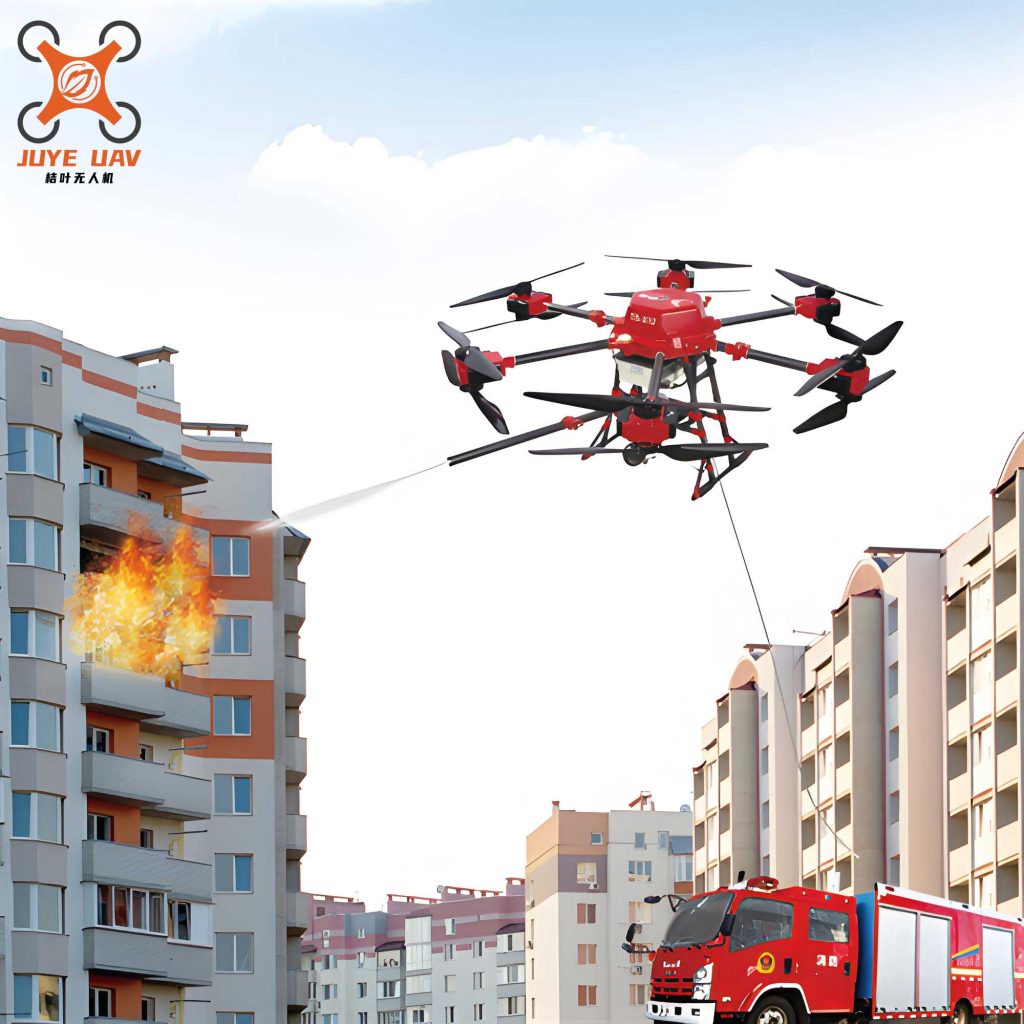
The fire drone, a key technological asset, is equipped with high-definition cameras, thermal imaging, and real-time data transmission capabilities. It operates as part of an integrated air-ground system, enhancing situational awareness and response coordination.
Application Process: Step-by-Step Integration of Fire Drones
The演练 unfolds through a structured process, where each system activates in sequence. The fire drone plays a pivotal role from侦查 to指挥.
1. Alarm Activation
To simulate material leakage, on-site personnel trigger a combustible gas detector using methane, mimicking挥发蒸汽. The signal instantly transmits to the central control room’s combustible gas control cabinet,联动 triggering audible and visual alarms. The cabinet displays that detector TK209-1 exceeds the lower explosive limit, indicating leakage. Concurrently, another team applies hot water to the target tank’s temperature-sensing cable. As heating continues, the signal triggers the fire linkage cabinet system, activating the deluge valve电磁阀 for the sprinkler system.
This process can be modeled using gas dispersion formulas. For instance, the concentration \( C \) of leaked gas at a distance \( x \) from the source can be estimated using Gaussian plume models under certain conditions:
$$ C(x,y,z) = \frac{Q}{2\pi\sigma_y\sigma_z u} \exp\left(-\frac{y^2}{2\sigma_y^2}\right) \left[ \exp\left(-\frac{(z-H)^2}{2\sigma_z^2}\right) + \exp\left(-\frac{(z+H)^2}{2\sigma_z^2}\right) \right] $$
where \( Q \) is the release rate, \( \sigma_y \) and \( \sigma_z \) are dispersion parameters, \( u \) is wind speed, and \( H \) is effective release height. This underscores the importance of rapid detection, where fire drones could later map dispersion patterns.
2. Automatic Sprinkler Operation
Upon heat detection, the signal activates the deluge valve电磁阀, opening the valve cover. Water flows through the消防冷却水管网 to nozzles on Tank TK209 and adjacent tanks like TK210, forming a protective water curtain for cooling. Simultaneously, the signal自动 starts fire pumps via the linkage cabinet. The response time is critical; typically, the system achieves water discharge within 1 minute, with pump pressure reaching 12 kg/cm².
The cooling effect can be quantified by heat transfer. The heat flux \( q” \) from a fire to a tank surface is given by:
$$ q” = \epsilon \sigma (T_f^4 – T_s^4) + h_c (T_f – T_s) $$
where \( \epsilon \) is emissivity, \( \sigma \) is Stefan-Boltzmann constant, \( T_f \) is fire temperature, \( T_s \) is surface temperature, and \( h_c \) is convective heat transfer coefficient. Sprinklers reduce \( T_s \) and mitigate thermal radiation.
3. Foam System Readiness
To avoid contaminating tank contents and pipelines, manual valves on foam mixture lines and foam tank water inlets are not opened. However, the消防 linkage cabinet自动 starts fire pumps, pressurizing the foam mixture network up to foam hydrants and monitors around the target tank and dike, achieving an末端 pressure of 8 kg/cm². This ensures system readiness for actual foam application if needed.
Foam application effectiveness depends on parameters like expansion ratio and application rate. The required foam solution flow rate \( Q_f \) can be estimated as:
$$ Q_f = A \times R $$
where \( A \) is the area of spill or fire, and \( R \) is the application rate in L/min·m². For fuel oils, typical \( R \) values range from 4.1 to 8.1 L/min·m² depending on foam type.
4. Fire Drone Deployment for Reconnaissance
As the enterprise struggles to control the fire, government专职消防 forces arrive. The commander orders the侦查组 to deploy a fire drone for terrain and火势侦查. The fire drone ascends to the事故空域, using its onboard cameras to capture and transmit high-definition images and video from multiple angles. This real-time data provides the commander with clear visuals of the fire’s extent, intensity, and surrounding hazards, informing strategic decisions on灭火作战力量 deployment.
The fire drone’s performance parameters are crucial. Its flight time \( t \) can be expressed as:
$$ t = \frac{E_{battery}}{P_{total}} $$
where \( E_{battery} \) is the battery energy capacity and \( P_{total} \) is the total power consumption, including propulsion, sensors, and communication. Advanced fire drones optimize this for prolonged loitering. Moreover, the drone’s ability to “hover stably” and provide “clear, adjustable-angle views” enhances侦查 accuracy. The use of fire drones here eliminates the “blurred understanding of the fire scene” typical of traditional methods.
5. Full-Service Command Vehicle Integration
The消防 leadership arrives with a full-service command vehicle, establishing forward command. The vehicle utilizes车载系统, GPS positioning, and wireless mobile networks to transmit live火场情景 to both the command vehicle and the government emergency command center. Based on this real-time feed, the leadership directs救援 operations, issuing作战指令 to various应急 groups. The command vehicle also reports to the higher command center, receiving上级指示. This seamless communication, aided by fire drone feeds, ensures coordinated response.
6. Robotic Fire Monitor Engagement
Given that 500号 fuel oil has high heat of combustion, intense辐射温度, and high concentrations of harmful燃烧产物, and considering the massive 50,000 m³ tank, the fire is ferocious. To ensure personnel safety, the指挥部 deploys a robotic fire monitor. This machine approaches the fire,压制 flames with powerful water jets, cooling the着火点 and tank body to support foam coverage and火势控制. The robotic monitor operates effectively despite high辐射热 and smoke, showcasing its advantage in hazardous environments.
The cooling capacity of the monitor can be analyzed via water flow dynamics. The thrust force \( F \) of a water jet is:
$$ F = \rho Q v $$
where \( \rho \) is water density, \( Q \) is flow rate, and \( v \) is jet velocity. Higher pressures, such as the stable 8-12 kg/cm² achieved, enhance reach and impact.
Application Effects and Performance Evaluation
The演练 outcomes demonstrate the efficacy of integrated systems, particularly the fire drone. The table below summarizes the应用效果 of each technological component.
| Technology/Equipment | Application Effects |
|---|---|
| Fire Automatic Alarm System |
|
| Automatic Sprinkler System |
|
| Foam灭火 System |
|
| Fire Drone (1 unit) |
|
| Full-Service Command Vehicle (1 unit) |
|
| Robotic Fire Monitor (1 unit) |
|
The fire drone proved indispensable. Its ability to provide “空天一体化” surveillance made the entire scene “transparent and clear,” with “process态势明朗.” In terms of时效, reliability, and safety, the fire drone充分发挥了特有的优势与作用. For instance, it reduced侦查 time from what could be tens of minutes with ground teams to mere seconds, enhancing response speed. The reliability of data transmission ensured accurate decision-making, while keeping personnel out of immediate danger zones bolstered safety.
Technical Analysis and Formulae on Fire Drone Advantages
To further elucidate the benefits of fire drones, let’s delve into quantitative aspects. Fire drones enhance situational awareness through aerial perspectives, which can be modeled using geometry. For a fire drone at altitude \( h \), the horizon distance \( d \) visible is approximately:
$$ d \approx \sqrt{2hR} $$
where \( R \) is Earth’s radius (≈6371 km). For \( h = 100 \) m, \( d \approx 35.7 \) km, covering vast depot areas. This broad view aids in monitoring multiple tanks simultaneously.
Moreover, fire drones facilitate intelligent analysis. For火情报警, they can use thermal imaging to detect hotspots. The temperature measurement from a thermal camera follows Planck’s law, but for practical purposes, the radiant heat flux detected can correlate with fire intensity. If a fire drone identifies a hotspot of area \( A_{hot} \) with apparent temperature \( T_{hot} \), the estimated heat release rate (HRR) can be approximated using:
$$ \text{HRR} \approx \epsilon \sigma A_{hot} T_{hot}^4 $$
where \( \epsilon \) is emissivity and \( \sigma \) is Stefan-Boltzmann constant (5.67×10⁻⁸ W/m²·K⁴). This allows for early火情 assessment and报警.
In terms of路径规划, fire drones can optimize巡查 routes using algorithms like the Traveling Salesman Problem (TSP) or genetic algorithms. Suppose there are \( n \) inspection points (e.g., tanks). The objective is to minimize total flight distance \( D \):
$$ D = \sum_{i=1}^{n-1} d(p_i, p_{i+1}) + d(p_n, p_1) $$
where \( d(p_i, p_j) \) is distance between points \( i \) and \( j \). Fire drones with autonomous path planning can efficiently cover all points, ensuring no area is missed.
Additionally, the integration of fire drones with other systems enhances overall response efficacy. The combined system reliability \( R_{system} \) for alarm, sprinkler, and drone侦查 can be modeled as a series-parallel network. If each subsystem has reliability \( R_i \), and the fire drone provides redundant侦查, the overall reliability improves. For example, if traditional侦查 has reliability \( R_{recon} = 0.85 \) and fire drone侦查 has \( R_{drone} = 0.95 \), the combined侦查 reliability with both operating in parallel is:
$$ R_{combined} = 1 – (1 – R_{recon})(1 – R_{drone}) = 1 – (0.15)(0.05) = 0.9925 $$
This significant boost underscores the fire drone’s role in enhancing reliability.
Broader Implications and Future Outlook
Annually, numerous fire incidents globally result in substantial casualties, property loss, and environmental pollution. Humanity continuously seeks better ways to prevent, control, and extinguish fires. From rudimentary methods like using pots and pans to carry water, to fire engines, and then to automated systems, firefighting technology has advanced leaps and bounds. The integration of fire drones represents the next evolutionary step, offering空地一体化 capabilities that address previous短板 such as technological落后 and模糊火场情况.
Through演练实践, the application of high-tech fire drones, along with full-service command vehicles and robotic monitors, streamlines the entire emergency response process—from报警,响应,侦检,联动,指挥, to消洗. The result is an integrated air-ground system that is transparent, clear, and明朗 in process态势. The fire drone’s advantages in timeliness, reliability, and safety are fully realized.
As technology progresses, fire drone technology is seeing increasing实践和运用 in emergency演练. However, in消防安全, there remains considerable room for突破, especially in areas like high-rise building fires, where fire drones could be pivotal. For instance, fire drones could deliver extinguishing agents to upper floors or conduct interior侦查 where access is limited. The economic viability, systemic integration, and普及率 of fire drone systems warrant further scientific探讨与论证. Factors such as cost-benefit analysis, interoperability with existing infrastructure, and training requirements need thorough evaluation.
Economically, the total cost of ownership \( C_{total} \) for a fire drone system includes initial purchase \( C_{purchase} \), maintenance \( C_{maintenance} \), training \( C_{training} \), and operational costs \( C_{operational} \). The benefit \( B \) can be quantified through reduced response times, minimized damage, and enhanced safety. A simple net present value (NPV) analysis could be:
$$ \text{NPV} = \sum_{t=1}^{T} \frac{B_t – C_t}{(1+r)^t} $$
where \( r \) is discount rate, \( T \) is time horizon, and \( B_t \) and \( C_t \) are benefits and costs in year \( t \). Positive NPV would justify investment.
Systemically, fire drones must integrate with command-and-control platforms. This involves data fusion from multiple sensors, requiring robust communication protocols. The data rate \( R_{data} \) for transmitting HD video can be estimated using:
$$ R_{data} = f_r \times N_p \times B_p $$
where \( f_r \) is frame rate, \( N_p \) is number of pixels per frame, and \( B_p \) is bits per pixel. Stable networks, as observed in the演练, are essential.
Looking ahead, it is evident that fire drone technology will become increasingly prevalent in消防工作. This adoption will bolster the safety and健康发展 of national economic and cultural endeavors. Future advancements may include swarm fire drones for coordinated attacks on large fires, AI-powered predictive analytics for fire spread, and enhanced autonomy for operations in GPS-denied environments. The continuous refinement of fire drone capabilities will undoubtedly save lives and protect assets.
Conclusion
In summary, the实践与运用 of fire drone technology in oil depot fire safety, as experienced in this演练, demonstrates transformative potential. By providing real-time aerial surveillance, intelligent analysis, and seamless integration with ground systems, fire drones address critical gaps in traditional消防 approaches. The演练 showcased how fire drones enhance侦查,指挥, and overall response efficacy, contributing to a comprehensive空天一体化 framework. While challenges in economic性,系统性, and普及率 persist, the trajectory is clear: fire drones are set to play an expanding role in消防工作 across various industries. Their ability to ensure时效性,可靠性, and安全性 makes them a valuable asset in the ongoing battle against fires, ultimately fostering safer environments for all. As we move forward, continued innovation and adoption of fire drone technology will be key to advancing fire safety standards worldwide.