
The advent of unmanned aerial vehicle (UAV) swarms represents a paradigm shift in modern warfare. We observe these systems—comprising numerous, often low-cost, and highly adaptive drones—transitioning rapidly from conceptual frameworks to tangible, disruptive forces on the battlefield. Their demonstrated efficacy in conflicts from Syria to Nagorno-Karabakh underscores a pressing reality: the traditional paradigms of air defense are being challenged. Consequently, the research and development of robust anti-UAV swarm capabilities are not merely an option but an imperative for national defense strategies worldwide. This analysis delves into the operational nature of UAV swarms, synthesizes the current global landscape of counter-swarm technologies, and projects the future trajectory of this critical arms race, all from our analytical viewpoint.
The Swarm Threat: Proliferation and Progression
The conceptual foundation of UAV swarms is inspired by the collective intelligence observed in nature, such as bird flocks or insect colonies. This biomimicry has been translated into a military doctrine emphasizing overwhelming numbers, distributed intelligence, and coordinated action. The strategic driver is often cited as “Augustine’s Law,” which posits the escalating cost and development time of traditional platforms, making swarms of inexpensive, attritable UAVs a cost-effective alternative. Major powers have spearheaded this research. The United States, through agencies like DARPA and ONR, has pioneered programs like LOCUST (Low-Cost UAV Swarming Technology) for rapid launch and “Gremlins” for airborne launch and recovery, demonstrating a focus on deployment logistics. The deployment of 103 “Perdix” micro-drones from fighter jets in 2016 was a landmark, showcasing advanced autonomous behaviors like collective decision-making and adaptive formation flying. More recently, projects like ACE (Air Combat Evolution) are integrating artificial intelligence to foster trust in human-machine teaming and enable more complex collaborative operations. Other nations have followed suit, with European consortia, the UK, Russia, and South Korea all investing in swarm coordination and autonomy research.
The transition from experiment to execution is stark. The 2018 attack on Russian bases in Syria by multiple coordinated drones marked the first significant combat use of a UAV swarm. This was followed by the 2019 strike on Saudi Aramco facilities and the decisive use of drone swarms by Azerbaijan in the 2020 Nagorno-Karabakh war, where they effectively neutralized advanced air defense systems. These events validate the swarm’s potential for saturation attacks, reconnaissance-strike complexes, and electronic warfare, rendering them a versatile and potent asymmetric threat. The core characteristics that make them formidable also define the challenge for anti-UAV systems: low radar cross-section, use of commercial components, networked communication, and the ability to sustain mission capability even after the loss of several units.
| Platform | Length (m) | Wingspan (m) | Max Speed (km/h) | Weight (kg) | Endurance (h) | Key Features |
|---|---|---|---|---|---|---|
| Gremlins | 4.2 | 3.47 | 980 | ~680 | 1-3 | Air-launched & recoverable, reusable, multi-role. |
| Perdix | 0.165 | 0.3 | 110 | 0.29 | ~0.3 | Micro-UAV, disposable, high-G launch from fast jets. |
| Coyote (Block 2) | 0.91 | 1.47 | 110 | ~6 | 1.5 | Tube-launched, kinetic or proximity warhead, intercept capability. |
| ALTIUS-600 | 1.0 | 2.54 | ~167 | 9-12 | >4 | Modular payloads, multi-platform launch (air, ground, sea). |
The Counter-Swarm Arsenal: A Multi-Domain Approach
The response to the swarm threat has catalyzed a global “anti-UAV” technological race. Nations are developing integrated strategies that combine detection, hard-kill, and soft-kill measures into layered defense systems. We categorize the current technological approaches as follows.
Detection and Tracking: The Critical First Layer
Effective engagement is impossible without reliable detection. Swarms, composed of small, low-flying, and potentially low-observable targets, present a severe sensor challenge. The solution lies in multi-spectral, networked sensing. Modern anti-UAV systems employ a fusion of radar, electro-optical/infrared (EO/IR) sensors, radio frequency (RF) scanners, and acoustic detectors. Radars like the Swedish Giraffe-AMB use active electronically scanned array (AESA) technology to provide wide-area surveillance and high-precision tracking of multiple small targets. RF detection focuses on identifying the communication links between swarm members and their control station. To counter advanced threats, there is a push towards intelligent signal processing using artificial neural networks. These systems can rapidly classify detected tracks, distinguishing between different types of UAVs and even identifying swarm behavior patterns, thereby reducing the decision loop time for operators. A representative detection and engagement sequence can be modeled as a probability chain:
$$ P_{kill} = P_{detect} \times P_{track} \times P_{classify} \times P_{engage} \times P_{effect} $$
Where \( P_{detect} \) and \( P_{track} \) are the probabilities of initial detection and sustained tracking, \( P_{classify} \) is the probability of correct target identification, \( P_{engage} \) is the probability of a successful weapon launch/activation, and \( P_{effect} \) is the probability of neutralization given engagement. Swarm defense aims to maximize each term in this chain while minimizing the cost per engagement.
Hard-Kill Measures: Physical Neutralization
These methods aim to physically destroy or capture the incoming threat.
Conventional Kinetic Systems: Traditional guns, missiles, and autocannons remain relevant, especially for close-in defense. Their challenge is cost-effectiveness and rate of fire against numerous small targets. Innovations focus on precision and smart munitions. Systems like the U.S. BLADE integrate advanced fire control with stabilized guns. “Smart” rifles with tracking scopes aid dismounted operators. There is also significant development in low-cost, intelligent interceptors. For instance, some companies are developing small, radar-guided or electro-optically guided missiles designed specifically for anti-UAV roles. Russia employs layered air defense nets combining systems like the “Pantsir-S1” (which can engage two targets simultaneously with guns and missiles) and man-portable air-defense systems (MANPADS) to create a dense engagement zone.
Directed Energy Weapons (DEWs): DEWs are considered game-changers for swarm defense due to their speed-of-light engagement, deep magazines (limited only by power supply), and low cost-per-shot.
- High-Energy Lasers (HELs): These systems damage UAVs through thermal ablation, burning through structures or key components. Their precision allows for selective targeting to minimize collateral damage. The U.S. Army’s Directed Energy Maneuver-Short Range Air Defense (DE M-SHORAD) system, featuring a 50-kW laser on a Stryker vehicle, is progressing towards deployment. Russia has reportedly deployed the “Peresvet” laser system for base defense, claiming capabilities against drones at several kilometers range.
- High-Power Microwaves (HPMs): HPM weapons offer a wide-area “shotgun” effect ideal for swarms. They emit powerful microwave pulses that fry the electronic components of drones within a cone of effect. The U.S. Air Force’s Tactical High-power Operational Responder (THOR) and its successor, MJOLNIR, are prototypes designed to counter multiple drones with a single burst. The advantage is the near-instantaneous effect against all UAVs within the beam’s footprint.
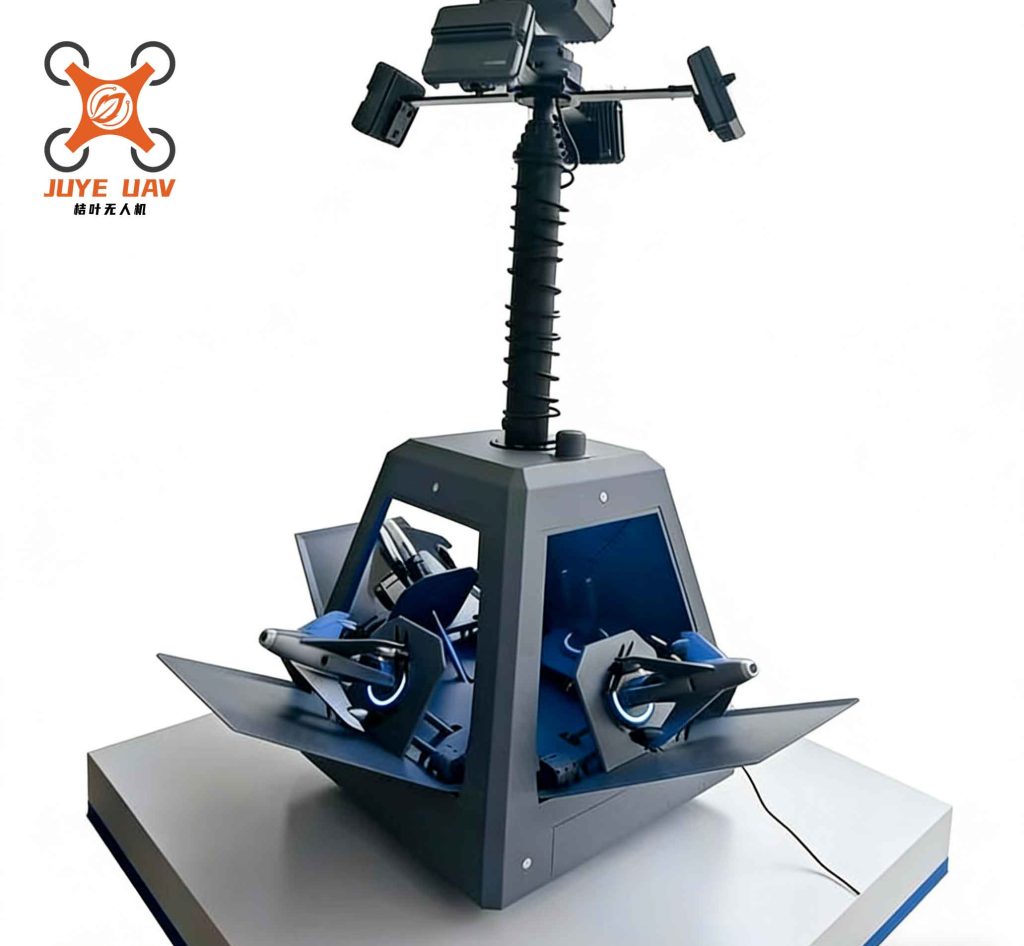
Counter-UAV Drones: This “drone-on-drone” approach uses interceptors to kinetically or electronically engage threats. They can be non-suicidal (carrying nets, lasers, or HPM payloads and returning to base) or suicidal (kamikaze-style). The U.S. MOXFUS program envisions a drone carrying a microwave emitter to disrupt swarms from within. Russia has demonstrated the use of the “Lancet” loitering munition as an airborne interceptor. This method is highly mobile and can engage threats in complex terrain.
Soft-Kill Measures: Electronic Neutralization
Soft-kill methods disrupt the swarm’s functionality without physical destruction, often at a lower cost and with reduced collateral risk.
Electronic Jamming: This is the most common soft-kill technique. It involves broadcasting powerful RF signals to drown out the command-and-control (C2) links and/or Global Navigation Satellite System (GNSS, e.g., GPS) signals used by the UAVs. Portable jammers, often shaped like rifles, allow infantry to disrupt nearby drones. Vehicle-mounted systems, like the Israeli “DroneDome” or Russian “Repellent,” offer greater power and range. Russia’s operational experience in Syria has heavily influenced its anti-UAV electronic warfare (EW) doctrine, leading to the formation of dedicated EW units and the deployment of systems like “REX-1” electromagnetic guns. The effectiveness of jamming was demonstrated in Syria, where Russian forces reportedly captured several drones by disrupting their control links.
Spoofing and Cyber Takeover: A more sophisticated approach involves sending deceptive signals to hijack control or navigation. By broadcasting stronger, false GNSS signals, spoofers can trick drones into following an incorrect flight path, potentially leading them to a safe area for capture or causing them to crash. Cyber-takeover systems attempt to breach the drone’s communication protocol to seize control entirely. Israel’s “EnforceAir” system claims to identify, jam, and then take control of hostile UAVs. The 2011 Iranian capture of a U.S. RQ-170 Sentinel drone is a classic example of successful GNSS spoofing, a tactic adaptable to swarm scenarios.
| Method | Mechanism | Advantages | Disadvantages | Best Against |
|---|---|---|---|---|
| Kinetic (Guns/Missiles) | Physical impact/fragmentation. | High reliability, proven technology, immediate effect. | High cost per kill, limited ammunition, collateral damage risk. | High-value, low-density threats; final defensive layer. |
| High-Energy Laser | Thermal ablation. | Speed-of-light, precision, low cost-per-shot, deep magazine. | Line-of-sight required, atmospheric attenuation (rain/fog), high power demand. | Medium-range engagements against individual swarm elements or key nodes. |
| High-Power Microwave | Electromagnetic pulse. | Area effect, rapid engagement of dense swarms, all-weather capability. | Limited range, potential for fratricide on friendly electronics, requires precise aiming. | Close-in defense against dense, clustered swarms. |
| Electronic Jamming | RF signal interference. | Low collateral damage, scalable power, can affect multiple targets. | Effectiveness depends on enemy’s frequency agility and encryption; may require constant emission. | Disrupting swarm coordination and navigation at medium to long range. |
| Counter-UAV Drones | Kinetic or electronic defeat. | High mobility, ability to engage beyond line-of-sight, adaptable payloads. | Expensive interceptor platform, requires its own C2, can be targeted by enemy. | Complex environments, protecting moving convoys, high-precision capture missions. |
Future Trajectories and Strategic Imperatives
Based on the current technological trajectory, we anticipate several key trends will define the next generation of anti-UAV swarm warfare.
1. Integrated, AI-Powered Battle Management: The future lies not in standalone “silver bullet” systems but in integrated “systems-of-systems.” A seamless sensor grid combining ground-based radars, EO/IR, RF sensors, airborne early warning, and even space-based assets will feed a common operational picture. Artificial intelligence and machine learning will be crucial at two levels: first, in rapidly fusing this multi-source data to accurately detect, classify, and prioritize swarm threats in cluttered environments; second, in recommending or even autonomously executing optimal engagement strategies, dynamically allocating sensors and effectors across the layered defense network. The engagement probability formula evolves into a resource optimization problem for the AI:
$$ \max \sum_{i=1}^{N} P_{kill,i}(s_i, e_i) \quad \text{subject to} \quad \sum s_i \leq S_{total}, \sum e_i \leq E_{total}, T_{engage} \leq T_{threat} $$
where \( N \) is the number of threats, \( s_i \) and \( e_i \) are sensor and effector resources allocated to target \( i \), and \( S_{total} \), \( E_{total} \), and \( T_{threat} \) are total sensor, effector, and time constraints.
2. Convergence of Conventional and Novel Effect Chains: Future defenses will orchestrate synchronized, multi-domain effect chains. A swarm might first be detected by a distributed acoustic sensor net, tracked by a mobile AESA radar, then engaged at long range by a HPM system to degrade its coordination. Surviving elements could be targeted by a laser system, while last-ditch defense is handled by automated kinetic guns and interceptor drones. The synergy between soft-kill (to disrupt and confuse) and hard-kill (to eliminate) will be paramount.
3. Swarm vs. Swarm Engagements and Standardization: The logical extension of counter-UAV drones is the development of intelligent, collaborative anti-UAV swarms. These defensive swarms would operate autonomously to intercept, isolate, and neutralize hostile swarms, creating a new domain of aerial combat. For any of these integrated, multi-vendor systems to function effectively, the establishment of open architecture standards for data sharing, communication protocols, and command interfaces is urgent. Without such standards, achieving true interoperability between sensors, effectors, and command posts from different manufacturers and military services will remain a significant hurdle.
In conclusion, the contest between the “swarm spear” and the “anti-UAV shield” is a defining feature of 21st-century military innovation. The threat is evolving towards greater autonomy, heterogeneity, and scale. In response, successful defense will be characterized by intelligent integration, multi-layered effects, and a commitment to architectural openness. The nations that can most effectively combine advanced sensors, AI-driven command and control, and a balanced mix of kinetic, directed energy, and electronic effectors will possess a critical advantage in securing their skies against the emergent swarm threat.