
As a military technology analyst, I have closely monitored the rapid evolution of defense systems worldwide, particularly the escalating focus on countering unmanned aerial vehicles (UAVs). The proliferation of drones in modern conflicts has necessitated the development of robust anti-UAV capabilities, driving innovations across multiple domains. In this comprehensive analysis, I will delve into key trends, including vehicle modernization, naval advancements, and especially the critical role of anti-UAV systems, using mathematical models and comparative tables to synthesize insights. The term ‘anti-UAV’ will be frequently highlighted to underscore its centrality in contemporary military strategy.
The shift toward lighter, more mobile ground platforms reflects a broader trend in force adaptability. For instance, recent contracts for next-generation tactical vehicles emphasize enhanced survivability and payload capacity, though specific national programs are omitted here for confidentiality. These vehicles are designed to replace aging fleets, with performance metrics that can be summarized through engineering principles. The mobility of such platforms often depends on power-to-weight ratios, which can be expressed as: $$ \text{PTWR} = \frac{P}{m \cdot g} $$ where \( P \) is engine power, \( m \) is mass, and \( g \) is gravitational acceleration. A higher PTWR indicates better acceleration and terrain negotiation. To illustrate, consider the following table comparing hypothetical tactical vehicle characteristics:
| Vehicle Type | Weight (kg) | Engine Power (kW) | PTWR (kW/kg) | Primary Role |
|---|---|---|---|---|
| Light Utility | 4000 | 200 | 0.05 | Troop Transport |
| Heavy Patrol | 6000 | 300 | 0.05 | Reconnaissance |
| Command Variant | 5000 | 250 | 0.05 | Communications |
This table exemplifies how standardized designs can be optimized for diverse missions, though actual figures vary. The integration of these vehicles into joint operations often involves logistical calculations, such as fuel efficiency over distance: $$ F_{\text{consumption}} = \int_{0}^{d} \alpha \cdot v(t) \, dt $$ where \( \alpha \) is a vehicle-specific constant, \( v(t) \) is velocity over time, and \( d \) is distance. Such models aid in planning deployments where anti-UAV support might be required, as drones increasingly threaten ground convoys.
Naval modernization has similarly accelerated, with a focus on anti-submarine warfare and surface defense. The delivery of advanced corvettes, for example, enhances maritime domain awareness. These vessels incorporate sonar systems whose detection range can be modeled using the sonar equation: $$ \text{SL} – \text{TL} + \text{TS} = \text{NL} – \text{DI} + \text{DT} $$ where SL is source level, TL is transmission loss, TS is target strength, NL is noise level, DI is directivity index, and DT is detection threshold. This formula underpins the effectiveness of anti-submarine operations, which indirectly relate to anti-UAV efforts when drones are used for maritime surveillance. A comparative analysis of naval assets might include:
| Vessel Class | Length (m) | Displacement (tons) | Sensor Suite | Anti-UAV Capability |
|---|---|---|---|---|
| Corvette | 90 | 2000 | Integrated Sonar | Limited |
| Frigate | 120 | 4000 | Radar Array | Moderate |
| Destroyer | 150 | 8000 | Multi-Function Radar | High |
This table shows a progression in capabilities, with larger ships more likely to host dedicated anti-UAV systems. The synergy between naval and aerial defense is critical, as drones can be deployed from various platforms to disrupt maritime operations.
Turning to the core of my analysis, anti-UAV technologies have become a paramount concern for military forces globally. The advent of laser-based systems represents a paradigm shift in counter-drone defense, offering precise, cost-effective interception. These systems typically employ high-energy lasers to disable UAVs by overheating their components or blinding sensors. The effectiveness of such an anti-UAV laser can be quantified by the power density required for engagement: $$ I = \frac{P}{\pi r^2} $$ where \( I \) is irradiance (W/m²), \( P \) is laser power, and \( r \) is the beam radius at target. For a successful intercept, the irradiance must exceed a threshold \( I_{\text{thresh}} \) that depends on the drone’s material properties. Recent demonstrations have shown promising results, with some anti-UAV systems achieving near-perfect interception rates in tests. To contextualize this, consider the following formula for engagement time: $$ t_{\text{engage}} = \frac{E_{\text{required}}}{\eta \cdot P} $$ where \( E_{\text{required}} \) is the energy needed to neutralize the target, and \( \eta \) is system efficiency. This highlights how rapid response is vital for anti-UAV operations.
The deployment of vehicle-mounted anti-UAV systems, as seen in recent developments, allows for mobile defense without external power sources. These platforms integrate detection, tracking, and laser modules, creating a seamless anti-UAV envelope. The probability of kill (Pk) for such a system can be modeled using: $$ P_k = 1 – e^{-\lambda \cdot t} $$ where \( \lambda \) is the engagement rate constant, and \( t \) is time on target. This exponential relationship underscores the importance of sustained laser exposure in anti-UAV scenarios. A comparison of various anti-UAV approaches reveals their relative strengths:
| Anti-UAV System Type | Engagement Range (km) | Power Source | Key Mechanism | Success Rate (%) |
|---|---|---|---|---|
| Laser-Based | 1-5 | Onboard Generator | Thermal Disruption | 95-100 |
| Radio Frequency | 2-10 | External Grid | Signal Jamming | 80-90 |
| Kinetic Impact | 0.5-3 | Projectile | Physical Collision | 70-85 |
| Electromagnetic Pulse | 0.1-1 | Capacitor Bank | Circuit Overload | 90-95 |
This table emphasizes the dominance of laser systems in close-range anti-UAV roles, though each method has niche applications. The iterative testing of these anti-UAV technologies ensures reliability, with mathematical optimization playing a key role. For instance, the beam divergence of a laser anti-UAV system can be minimized using: $$ \theta = \frac{4 \lambda}{\pi D} $$ where \( \theta \) is divergence angle, \( \lambda \) is wavelength, and \( D \) is aperture diameter. Smaller divergence enhances targeting accuracy, a critical factor in dense anti-UAV environments.
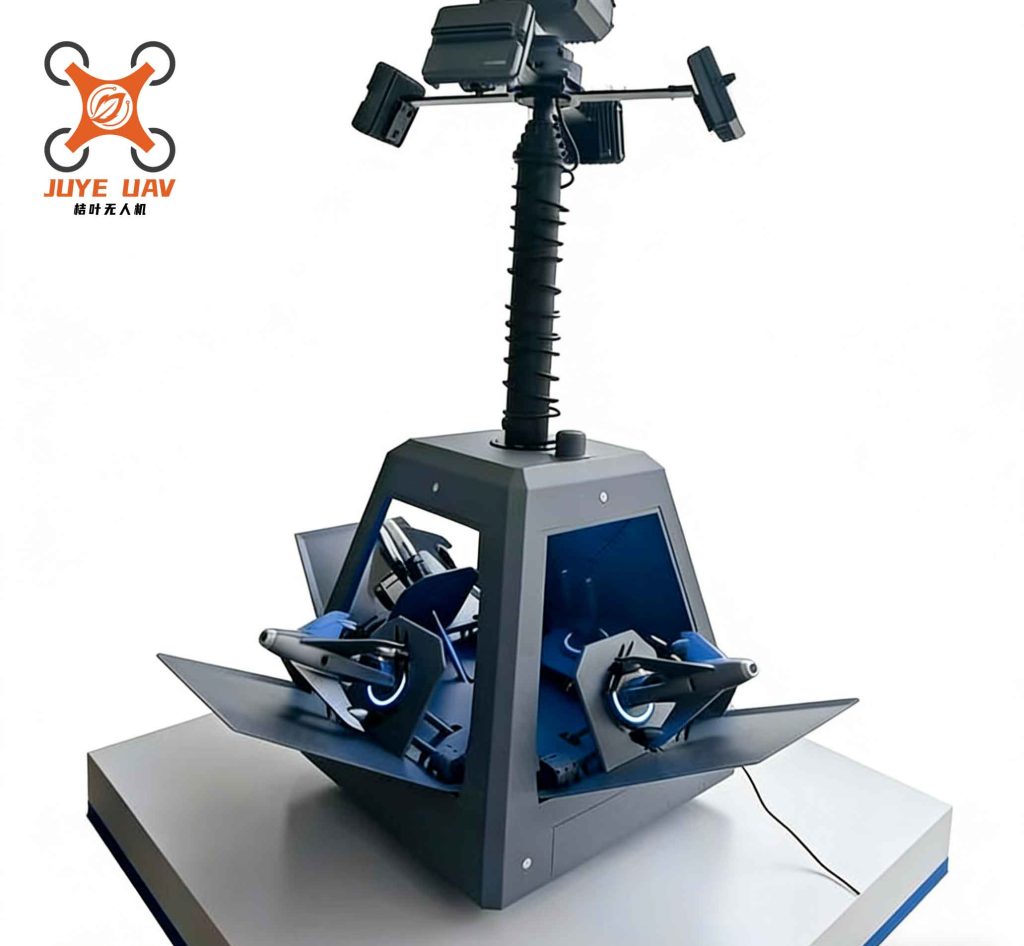
The integration of anti-UAV systems into naval platforms, such as destroyers, marks a significant advancement. These ship-based deployments provide layered defense, often combining lasers with traditional armaments. The operational range of a naval anti-UAV system can be derived from radar horizon calculations: $$ d_{\text{horizon}} = \sqrt{2hR} $$ where \( h \) is antenna height and \( R \) is Earth’s radius. This determines the detection envelope for incoming drones, enabling preemptive anti-UAV measures. In high-threat areas, the cumulative probability of defeating multiple UAV swarms is given by: $$ P_{\text{total}} = \prod_{i=1}^{n} (1 – p_i) $$ where \( p_i \) is the failure probability for the i-th engagement. This multiplicative model stresses the need for high-reliability anti-UAV systems to handle saturation attacks.
Beyond interceptors, reconnaissance aircraft contribute to anti-UAV efforts by mapping terrain for drone deployment patterns. Advanced topographic mapping uses photogrammetry principles, where the resolution of captured images affects anti-UAV planning. The ground sample distance (GSD) can be expressed as: $$ \text{GSD} = \frac{H \cdot s}{f} $$ where \( H \) is flight altitude, \( s \) is sensor pixel size, and \( f \) is focal length. Higher resolution aids in identifying potential UAV launch sites, thereby informing anti-UAV strategies. These aircraft often operate in conjunction with ground-based anti-UAV networks, creating a comprehensive surveillance umbrella. The data fusion process from multiple sources enhances situational awareness, which is crucial for proactive anti-UAV operations.
The evolution of anti-UAV technologies is also driven by cost-benefit analyses. The cost per engagement for a laser anti-UAV system can be approximated as: $$ C = \frac{C_{\text{system}} + E_{\text{shot}} \cdot c_{\text{energy}}}{N_{\text{engagements}}} $$ where \( C_{\text{system}} \) is initial procurement cost, \( E_{\text{shot}} \) is energy per shot, \( c_{\text{energy}} \) is energy cost, and \( N_{\text{engagements}} \) is total engagements. This linear model shows that as usage increases, the cost drops significantly compared to kinetic methods, making lasers an economical choice for sustained anti-UAV defense. Furthermore, the scalability of such systems allows deployment across various platforms, from vehicles to ships, amplifying their anti-UAV impact.
In testing scenarios, anti-UAV systems undergo rigorous evaluation to ensure effectiveness. The probability of detection (Pd) and false alarm rate (Pfa) are key metrics, often related by receiver operating characteristic (ROC) curves. These can be modeled using: $$ P_d = \int_{T}^{\infty} f_1(x) \, dx, \quad P_{fa} = \int_{T}^{\infty} f_0(x) \, dx $$ where \( T \) is a detection threshold, \( f_1 \) is the signal-plus-noise distribution, and \( f_0 \) is noise-only distribution. Optimizing this trade-off is vital for reliable anti-UAV performance, especially in cluttered environments. Recent demonstrations have reported high success rates, underscoring the maturity of these anti-UAV solutions.
Looking ahead, the anti-UAV landscape will likely see increased automation and artificial intelligence integration. Predictive algorithms can enhance interception probabilities by forecasting drone trajectories. For example, a simple kinematic model for UAV motion might be: $$ \vec{r}(t) = \vec{r}_0 + \vec{v}_0 t + \frac{1}{2} \vec{a} t^2 $$ where \( \vec{r} \) is position, \( \vec{v}_0 \) is initial velocity, and \( \vec{a} \) is acceleration. By solving such equations in real-time, anti-UAV systems can pre-position defenses, reducing engagement times. Additionally, network-centric warfare concepts will link multiple anti-UAV nodes, creating a resilient grid against aerial threats.
In conclusion, the military technology sector is undergoing a profound transformation, with anti-UAV capabilities at its forefront. From ground vehicles to naval vessels and airborne reconnaissance, every domain is adapting to counter drone threats. The mathematical frameworks and comparative tables presented here illustrate the technical underpinnings of these advancements. As anti-UAV systems evolve, their integration into joint operations will become seamless, ensuring dominance in future battlespaces. The continuous innovation in this field, driven by rigorous testing and modeling, promises to keep pace with the evolving UAV threat, making anti-UAV a cornerstone of modern defense strategy.