
The proliferation of unmanned aerial systems (UAS), particularly small, commercially available drones, represents one of the most disruptive and asymmetric challenges to modern security and military operations. From targeted kinetic strikes to pervasive intelligence, surveillance, and reconnaissance (ISR) missions, and even psychological operations, the threat spectrum is vast. The global commercial drone market has democratized access to capabilities once reserved for state militaries, placing potent tools in the hands of non-state actors, insurgent groups, and adversaries. This necessitates a robust, layered, and technologically advanced response. The development of sophisticated anti-drone capabilities is no longer a niche concern but a critical pillar of national and force protection. In this analysis, I will delve into the strategic imperatives, technological pathways, and systemic integration required for effective counter-unmanned aerial system (C-UAS) operations, drawing insights from global developments and projecting future trends.
The foundational step in any anti-drone architecture is the reliable detection and identification of the threat. This is a non-trivial challenge given the small radar cross-section, low infrared signature, and slow, low-altitude flight profiles typical of Group 1 and 2 UAS. A multi-sensor, layered approach is essential. This fusion creates a composite track, improving confidence and reducing false alarms. The probability of detection (P_d) in a cluttered environment can be modeled as a function of sensor capability and target characteristics:
$$
P_d = 1 – \exp\left(-\frac{SNR \cdot A_{target}}{N_0 \cdot R^4}\right)
$$
Where \(SNR\) is the signal-to-noise ratio, \(A_{target}\) is the target’s effective cross-section, \(N_0\) is the clutter density, and \(R\) is the range. This formula underscores why small drones (\(A_{target} \to 0\)) at range (\(R \to \text{large}\)) are so difficult to detect with single sensors.
| Sensor Type | Primary Strength | Primary Weakness | Role in C-UAS |
|---|---|---|---|
| Radar (X/Ku-band) | Long-range, all-weather, velocity data | Clutter, low-flying targets | Wide-area cueing, initial detection |
| Electro-Optical/Infrared (EO/IR) | Positive identification, tracking | Weather-dependent, limited field of view | Classification, engagement support |
| Radio Frequency (RF) Sensors | Detects drone & controller comms, non-kinetic | Passive only, requires drone to transmit | Early warning, fingerprinting, electronic support |
| Acoustic Sensors | Passive, low-cost, detects unique acoustic signature | Very short range, environmental noise | Perimeter defense, urban environments |
Following positive identification, the system must decide on and execute an appropriate mitigation response. The choice of effector is dictated by the rules of engagement, operational environment (e.g., urban vs. open field), and desired effect (disable, destroy, or exploit). Mitigation technologies form a spectrum from reversible, non-kinetic methods to destructive kinetic and directed energy weapons.
The Strategic Imperative: Framing the Anti-Drone Mission
The need for dedicated anti-drone strategy stems from the tangible shift in the threat landscape. Incidents are no longer speculative but commonplace, targeting critical infrastructure, public events, and forward-deployed forces. A reactive, piecemeal approach is insufficient. A comprehensive strategy must address policy, acquisition, research, and joint operations. Key strategic actions observed include establishing clear executive authority over all anti-drone activities to synchronize efforts across services and agencies. This prevents duplication and ensures interoperability. Furthermore, dedicated funding lines for anti-drone research, development, test, and evaluation (RDT&E) as well as procurement are critical to move capabilities from labs to the field rapidly. The strategy must also define clear command relationships and rules of engagement for domestic and international scenarios, balancing security needs with legal and safety concerns, especially in shared airspace.
Technological Arsenal: A Layered Anti-Drone Toolkit
The technological response to drone threats is diverse, evolving from traditional kinetic methods to advanced cyber and directed energy systems. A practical anti-drone deployment will often integrate several of these tools to create a defensive shield.
1. Electronic Warfare (EW) and Cyber Measures
These are often the first line of defense, focusing on disrupting the command and control (C2) link or the drone’s navigation (e.g., GPS). The effectiveness of a jamming signal can be described by the jammer-to-signal ratio (JSR) at the target receiver:
$$
JSR = \frac{P_j G_j G_{r}( \theta ) / L_j}{P_s G_s G_{r}( 0 ) / L_s}
$$
Where \(P_j, P_s\) are jammer and signal power, \(G_j, G_s\) are their antenna gains, \(G_r(\theta)\) is the receiver gain in the jammer’s direction, \(L_j, L_s\) are path losses, and \(\theta\) is the angle off bore-sight. Effective jamming requires a high JSR, which is challenging against frequency-hopping or encrypted links. More advanced cyber-kinetic approaches seek to hijack the drone’s communications to take positive control for capture or safe diversion.
2. Kinetic Interceptors
These range from conventional air defense artillery and missiles adapted for small targets to novel solutions like net guns and anti-drone drones. A key challenge is cost-effectiveness; firing a multi-million dollar missile at a $500 commercial drone is not sustainable. This has spurred development of lower-cost kinetic effectors. The interceptor’s required maneuverability can be expressed through the required lateral acceleration \(a_{req}\):
$$
a_{req} = \frac{V_{target}^2}{R} \cdot \sin(\eta)
$$
Where \(V_{target}\) is the target velocity, \(R\) is the range, and \(\eta\) is the angle between the interceptor’s velocity vector and the line-of-sight to the target. High-maneuverability drones demand extremely high \(a_{req}\) from interceptors.
3. Directed Energy (DE) Weapons: Lasers and High-Power Microwaves
DE weapons offer a deep magazine, low cost-per-shot, and precision engagement. Laser systems thermally defeat targets by focusing energy on a small spot, causing structural failure or ignition. The time-on-target \(t\) to achieve a damaging fluence is given by:
$$
t = \frac{F \cdot \pi ( \frac{d_{spot}}{2} )^2}{P \cdot \tau_{atm}}
$$
Here, \(F\) is the required fluence (\(J/cm^2\)), \(d_{spot}\) is the laser spot diameter, \(P\) is the laser power, and \(\tau_{atm}\) is the atmospheric transmission factor. High-Power Microwave (HPM) systems, like the THOR system, produce a wide-area pulse that fries the delicate electronics inside drones. HPM effectiveness depends on field strength (\(E\)) at the target and the target’s susceptibility.
4. AI and Autonomous Swarms for Counter-Swarm
Perhaps the most futuristic yet rapidly advancing area is using intelligent systems to defeat drones. This involves AI-powered command and control (C2) to manage sensor fusion and effector selection in real-time. Furthermore, the concept of “counter-swarm” employs autonomous drone swarms to physically intercept, net, or disrupt hostile swarms. This represents a complex multi-agent engagement problem.
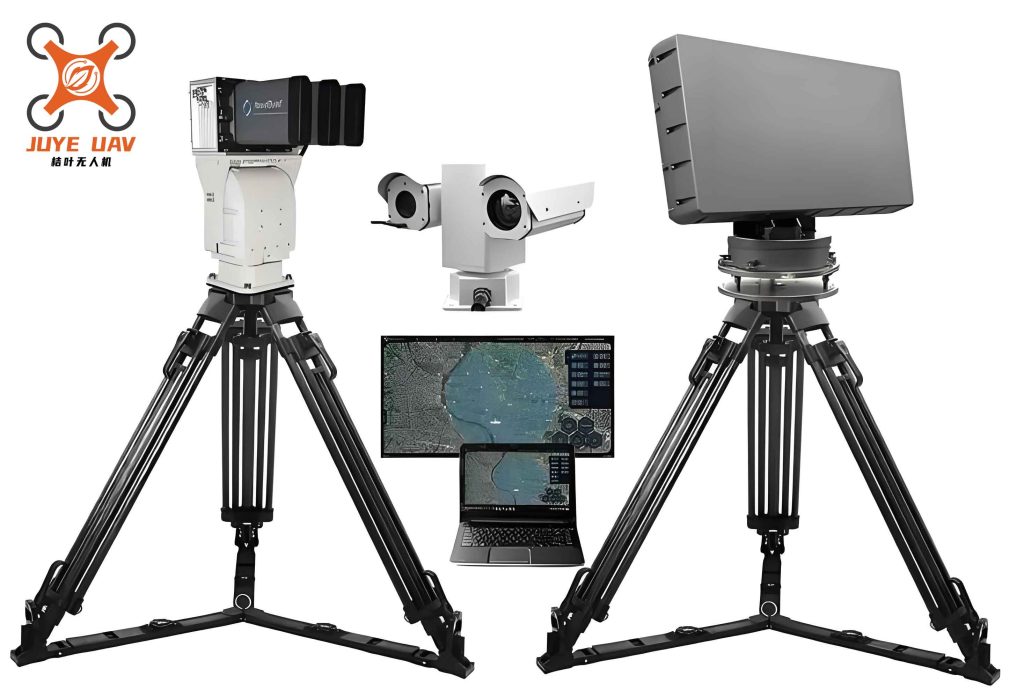
The following table categorizes current and emerging anti-drone technologies by their maturity and primary mechanism:
| Technology Category | Example Systems | Maturity | Key Advantage | Key Limitation |
|---|---|---|---|---|
| Electronic Jamming | DroneDefender, Battelle DUAS | Operational | Non-kinetic, reversible | Range, evolving drone comms |
| GPS Spoofing | Various EW suites | Operational | Covert, can take control | Effectiveness vs. hardened GPS |
| Kinetic (Net/Projectile) | SkyWall, Anti-Drone shotguns | Operational | Positive termination, close-range | Very limited range, collateral risk |
| High-Energy Laser (HEL) | HEL-MD, Athena, Raytheon systems | Late Prototype / Early Fielding | Speed-of-light, low cost-per-shot | Atmospheric effects, power demands |
| High-Power Microwave (HPM) | THOR, Epirus Leonidas | Prototype | Area effect, good vs. swarms | Collateral electronic damage, size/power |
| Counter-UAS Swarms | Anduril Interceptor, Coyote Block 2 | Research / Prototype | Scalable, adaptable, can pursue | C2 complexity, airspace deconfliction |
| AI-Powered C2 & Sensor Fusion | Citadel Titan, SmartShooter | Developing | Automates kill chain, reduces operator load | Data-hungry, vulnerability to adversarial AI |
System Integration and the Kill Chain
Technology alone is not a solution. Effective anti-drone capability requires the seamless integration of sensors, command and control nodes, and effectors into a coherent system. This is often conceptualized as a “kill chain” specific to C-UAS: Detect, Identify, Track, Decide, and Engage. The goal is to automate and compress this timeline as much as possible, especially when facing drone swarms. A critical metric is the system’s decision and engagement latency (\(\Delta T\)):
$$
\Delta T = t_{proc} + t_{comm} + t_{weapon\_align}
$$
Where \(t_{proc}\) is sensor fusion and AI processing time, \(t_{comm}\) is communication latency between nodes, and \(t_{weapon\_align}\) is the time for the effector to acquire and engage the target. For defeating fast-moving or swarming threats, \(\Delta T\) must be minimized. This drives the need for edge processing and autonomous operation protocols within a defined human-on-the-loop framework.
Operational Challenges and Future Trajectories
Despite advances, significant challenges persist in the anti-drone domain. The operational environment is often congested and contested, with friendlies, neutrals, and threats sharing airspace. Reliable identification friend-or-foe (IFF) for small drones does not exist. Furthermore, adversaries continuously adapt, using stealthier drones, autonomous pre-programmed flight (negating jamming), swarm tactics to saturate defenses, and even “kamikaze” drones designed for a single strike. Legally, the use of jammers or kinetic effectors in civilian airspace is highly restricted, creating a vulnerability gap for critical infrastructure protection.
Future development trajectories point towards several key areas. Systems will become more modular and open-architecture, allowing for plug-and-play integration of best-in-class sensors and effectors. Artificial Intelligence and Machine Learning will be embedded at every level, from pattern-of-life analysis for anomaly detection to predictive tracking and fully autonomous counter-swarm coordination. There is also a push for miniaturization and mobility, deploying anti-drone capabilities on tactical vehicles, naval vessels, and even as man-portable systems for dismounted troops. Finally, the concept of “left-of-launch” operations will gain prominence, focusing on detecting and disrupting drone supply chains, manufacturing, and operators before a threat is ever airborne.
Synthesis and Concluding Perspective
The challenge posed by proliferating unmanned aerial systems is enduring and evolving. An effective anti-drone posture cannot rely on a single silver bullet. It requires a holistic strategy encompassing deterrence, defense, and disruption. Technologically, it demands a layered, integrated system-of-systems approach that combines radar, electro-optics, and RF sensing with a mix of electronic, kinetic, and directed energy effectors, all orchestrated by intelligent, automated command and control. The relentless pace of innovation in both drone and counter-drone technologies creates a continuous cycle of measure and countermeasure. Therefore, agility in development, acquisition, and operational concepts is as important as the technologies themselves. Investing in robust anti-drone capabilities is not merely about countering a specific weapon; it is about preserving freedom of maneuver, ensuring the security of critical assets, and maintaining operational advantage in an increasingly complex and contested battlespace that now extends from the frontline to the homeland. The race for dominance in the low-altitude domain is underway, and a comprehensive, adaptive anti-drone ecosystem is the essential key to prevailing.