
In modern warfare, the emergence of drone swarms poses significant challenges to traditional defense systems. As a researcher in military operations and systems engineering, I have been exploring innovative approaches to model and simulate anti-drone swarm operations. This article presents a comprehensive conceptual modeling framework based on the System Six-Element Theory, specifically tailored for electromagnetic weapon systems in anti-drone swarm scenarios. The goal is to bridge the gap between military personnel and technical engineers by providing a structured, visual, and quantitative description of such systems. Through this framework, I aim to enhance the understanding, design, and simulation of anti-drone swarm defenses, ensuring they meet operational requirements effectively.
Military conceptual modeling is a critical step in translating real-world military activities into abstract representations that can guide simulation and system development. Traditionally, methods like natural language descriptions, tree structures, or dynamic models like Petri nets have been used, but they often fall short in capturing the full scope of military needs, such as mission requirements and operational dynamics. In the context of anti-drone swarm operations, this gap becomes more pronounced due to the complexity and scale of drone threats. Drone swarms, characterized by their coordinated, autonomous behavior, require rapid and adaptive responses, making electromagnetic weapons—such as high-power microwave systems, laser weapons, and electromagnetic pulse devices—ideal candidates for countermeasures. These weapons offer advantages like speed, range, and cost-effectiveness, but integrating them into a cohesive anti-drone system demands a robust conceptual model. Here, I leverage the System Six-Element Theory, which emphasizes six aspects: scope, elements, structure, state, operation, and function, to build a detailed model for anti-drone swarm systems. This approach ensures that the model aligns with real-world operational needs, facilitating better communication and design. Throughout this article, I will use tables and formulas to summarize key concepts, and I will repeatedly emphasize the importance of anti-drone capabilities in modern defense strategies.
The System Six-Element Theory posits that any system can be described through six dimensions: environment, function, components, structure, state, and operation. These dimensions map directly to conceptual model elements, such as task space, simulation entities, entity relationships, entity states, entity behaviors, and entity interactions. For anti-drone swarm systems, this mapping provides a holistic view, from high-level mission goals to low-level entity dynamics. In this study, I focus on electromagnetic weapon systems designed to counter drone swarms, which involve multiple entities like surveillance systems, command centers, and weapon platforms. By applying this theory, I develop a model that not only describes static attributes but also captures dynamic behaviors and interactions. This is crucial for anti-drone operations, where timely decision-making and coordinated actions are essential to neutralize swarm threats. To illustrate, consider the task space: it defines the operational boundaries, such as the protected area, time frame, and environmental conditions. For example, an anti-drone system might be deployed to safeguard a military base from drone swarm attacks, with operations occurring over a 24-hour period in varied weather conditions. Using the Department of Defense Architecture Framework (DoDAF) as inspiration, I represent these aspects through views and tables, ensuring clarity and consistency. In the following sections, I will delve into each of the six elements, providing detailed analyses, tables, and formulas to encapsulate the anti-drone swarm conceptual model.
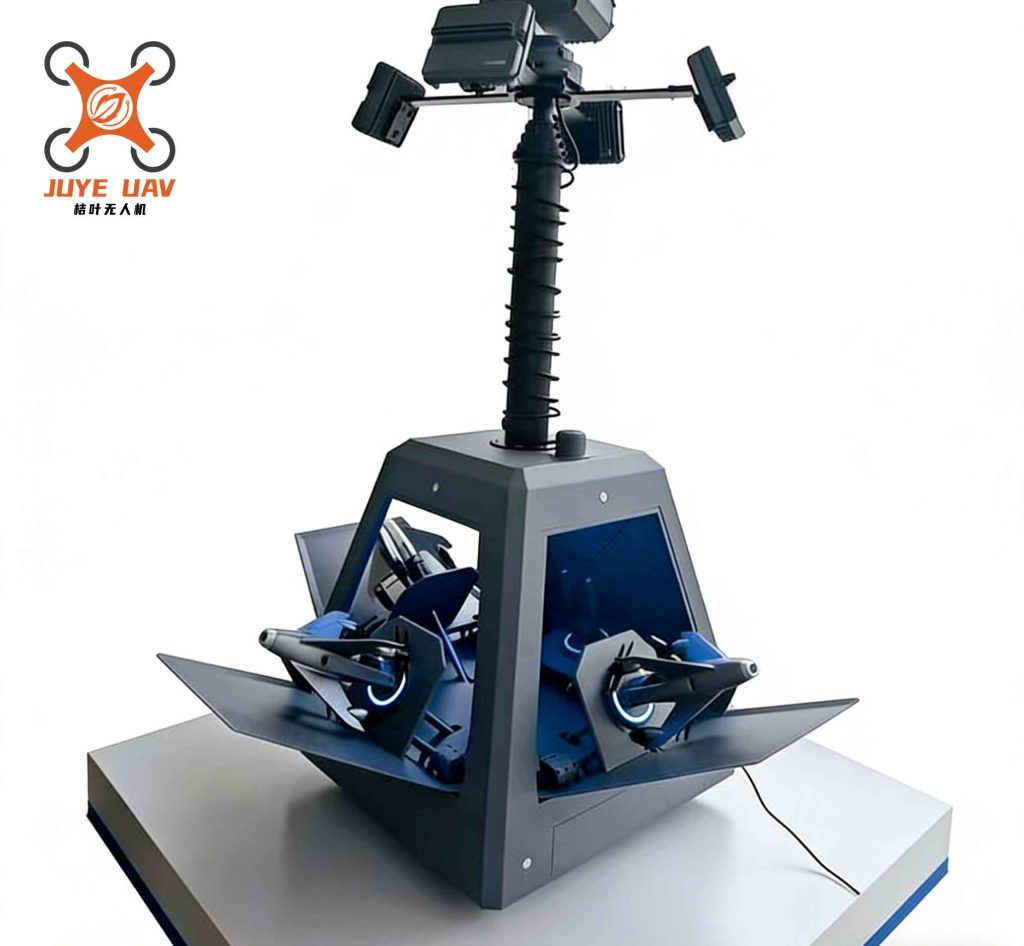
First, let’s explore the task space for anti-drone swarm systems. The task space represents the operational context and boundaries of the anti-drone system. It includes factors like mission objectives, threat types, geographical areas, and environmental conditions. In anti-drone operations, the primary goal is to detect, track, and neutralize drone swarms before they reach sensitive targets. This involves a layered defense approach, where electromagnetic weapons play a key role in both soft-kill (e.g., jamming) and hard-kill (e.g., destruction) functions. To quantify this, I define the task space using parameters such as engagement range, response time, and success criteria. For instance, the engagement range for an anti-drone laser system might be up to 5 kilometers, with a response time of less than 10 seconds. These parameters can be summarized in a task space table, as shown below:
| Task Space Component | Description |
|---|---|
| Operational Level | Tactical/Strategic |
| System Type | Electromagnetic Anti-Drone Swarm System |
| Participating Forces | Space-based surveillance, airborne radar, ground sensors, command centers, electromagnetic weapons, communication links |
| Operational Area | Within a radius of XX km from protected assets |
| Mission Tasks | Detect, track, jam, or destroy incoming drone swarms; coordinate with other defense units |
| Operational Time | From start time T0 to end time T1, based on threat intelligence |
| Environmental Factors | Weather (e.g., rain, fog), terrain (e.g., urban, rural), electromagnetic interference |
| Operational Process | Surveillance → Information fusion → Target engagement → Damage assessment |
This table outlines the high-level scope of anti-drone swarm operations. To further refine it, I introduce formulas to model mission success. For example, the probability of neutralizing a drone swarm can be expressed as a function of detection probability, engagement accuracy, and weapon effectiveness. Let $$ P_{success} = P_d \times P_e \times P_w $$, where $$ P_d $$ is the probability of detection, $$ P_e $$ is the probability of accurate engagement, and $$ P_w $$ is the probability of weapon effectiveness. In anti-drone contexts, these probabilities depend on factors like sensor coverage and weapon range, which I will elaborate on later. The task space also involves dynamic elements, such as adapting to swarm tactics; thus, continuous updates are necessary. By defining the task space clearly, military planners can set realistic expectations for anti-drone system performance.
Next, I analyze the simulation entities in the anti-drone swarm system. Entities are the fundamental components, including both active agents (e.g., operators, command systems) and passive objects (e.g., sensors, weapons). In anti-drone operations, key entities include surveillance platforms (e.g., satellites, radars), command and control (C2) centers, electromagnetic weapon systems (e.g., microwave emitters, lasers), and communication networks. Each entity has attributes like type, quantity, and capability, which influence system performance. For instance, a high-energy laser weapon entity might have attributes such as power output, beam accuracy, and cooling requirements. To capture this, I present an entity table below:
| Entity Name | Entity Type | Key Attributes | Associated Events |
|---|---|---|---|
| Space-based Surveillance | Surveillance System | Orbit type (e.g., GEO, LEO), detection range: XX km, resolution: YY meters | Early warning, target identification, data relay |
| Airborne Radar | Surveillance System | Aircraft type, detection range: XX km, mobility: high | Real-time tracking, threat assessment, support for engagement |
| Ground-based Sensors | Surveillance System | Radar, electro-optical/infrared (EO/IR) sensors, detection range: XX km | Target acquisition, fire control, local area monitoring |
| Tactical C2 Center | Command System | Personnel count, processing speed, decision-making algorithms | Mission planning, resource allocation, coordination with higher commands |
| Electromagnetic Weapon Chain | Weapon System | Weapon types (e.g., laser, microwave), engagement range: XX km, reload time: TT seconds | Target engagement, damage infliction, status reporting |
| Communication Data Link | Communication System | Bandwidth, latency, security level | Data transmission, command dissemination, network management |
This table highlights the diversity of entities in anti-drone swarm systems. To model their behavior mathematically, I use state variables. For example, let $$ E_i $$ represent an entity with state vector $$ S_i(t) = [s_1, s_2, …, s_n] $$, where $$ s_j $$ denotes attributes like position, health, or ammunition level. In anti-drone operations, state changes occur due to actions like moving, sensing, or firing. A formula for state transition could be $$ S_i(t+1) = f(S_i(t), A_i(t), I_i(t)) $$, where $$ A_i(t) $$ is the action taken by entity $$ i $$ at time $$ t $$, and $$ I_i(t) $$ represents interactions with other entities. This dynamic aspect is crucial for simulating real-time anti-drone responses, as swarm threats evolve rapidly. By defining entities and their states, engineers can develop simulations that test various anti-drone scenarios, optimizing system design for reliability and effectiveness.
Moving to entity relationships, which describe how entities are connected and interact within the anti-drone system. Relationships can be static (e.g., organizational hierarchy) or dynamic (e.g., information exchange during engagement). In anti-drone swarm defense, coordination among entities is vital; for instance, surveillance systems must relay target data to C2 centers, which then direct weapons to engage. This creates a network of dependencies that affect overall system performance. To visualize this, I use a relationship matrix, as shown below, which maps interactions between key entities:
| Entity Name | Surveillance Systems | Command and Control | Weapon Systems | |
|---|---|---|---|---|
| Surveillance Systems | Internal data sharing | Provide target information | Support aiming and tracking | |
| Command and Control | Receive and process data | Internal decision-making | Issue engagement orders | |
| Weapon Systems | Use data for targeting | Receive commands and feedback | Coordinate fire (e.g., simultaneous engagement) |
This matrix illustrates the flow of information and control in anti-drone operations. For example, when a drone swarm is detected, surveillance systems send alerts to the C2 center, which evaluates the threat and orders weapon systems to respond. This dynamic interaction can be modeled using network theory. Let $$ G = (V, E) $$ represent the entity graph, where vertices $$ V $$ are entities and edges $$ E $$ are relationships. Each edge has a weight $$ w $$ indicating interaction strength, such as data rate or command priority. In anti-drone contexts, $$ w $$ might depend on factors like distance or urgency. To quantify this, I define an interaction efficiency metric $$ \eta = \frac{\sum_{i,j} w_{ij} \cdot \delta_{ij}}{N} $$, where $$ \delta_{ij} $$ is a success factor for interaction between entities $$ i $$ and $$ j $$, and $$ N $$ is the total number of interactions. Higher $$ \eta $$ implies better coordination, which is essential for timely anti-drone responses. Additionally, hierarchical relationships exist; for instance, a tactical C2 center may report to a strategic command, forming a tree structure. This structure ensures clear lines of authority in anti-drone missions, reducing confusion during high-stakes engagements. By analyzing relationships, we can identify bottlenecks, such as slow communication links that delay weapon deployment, and propose improvements to enhance anti-drone system robustness.
Now, let’s delve into entity states, which capture the condition of entities at any given time. States are observable and measurable properties that change due to internal behaviors or external interactions. In anti-drone systems, states include operational status (e.g., active, damaged), resource levels (e.g., energy, ammunition), and environmental adaptations (e.g., weather effects). For electromagnetic weapons, key states might involve power output, cooling temperature, and targeting accuracy. To detail this, I present a state description table for a representative electromagnetic weapon entity:
| Entity Identifier | Entity Type | Operational Strength | Assigned Task | Spatial Attributes | Motion Attributes |
|---|---|---|---|---|---|
| High-Power Microwave Emitter | Soft/Hard-kill Weapon | Number: XX units; availability: AA%; reliability: RR% | Disrupt drone electronics within range | Deployed at fixed sites around protected area | Stationary; activation time: TT seconds |
| High-Energy Laser System | Hard-kill Weapon | Number: XX units; beam power: PP kW; cooling capacity: CC units | Physically destroy drones via thermal damage | Mobile platforms or fixed installations | Precision aiming; slew rate: SS degrees/sec |
| Electromagnetic Pulse Device | Area-denial Weapon | Number: XX units; pulse energy: EE joules; coverage radius: RR meters | Generate wide-area EMP to disable swarms | Deployed on vehicles or airborne platforms | Rapid deployment; single-use or rechargeable |
| Electronic Warfare Suite | Soft-kill System | Number: XX units; jamming bandwidth: BB MHz; deception capability | Jam drone communications and navigation | Integrated into C2 centers or standalone units | Adaptive to threat frequency; continuous operation |
This table shows how states vary across anti-drone entities. Mathematically, states can be represented as vectors in a multi-dimensional space. For instance, for a laser weapon, let $$ S_{laser} = [P, T, A, R] $$, where $$ P $$ is power level, $$ T $$ is temperature, $$ A $$ is aiming accuracy, and $$ R $$ is remaining shots. Over time, states evolve due to actions like firing or cooling. A differential equation can model this: $$ \frac{dS}{dt} = F(S, U) $$, where $$ U $$ is control input (e.g., fire command). In anti-drone operations, state management is critical; for example, overheating may reduce laser effectiveness, necessitating cooldown periods. By monitoring states, operators can optimize weapon usage, ensuring sustained anti-drone capability. Furthermore, environmental states, such as weather conditions, affect sensor and weapon performance. For instance, fog might reduce laser range, modeled as $$ P_{effective} = P_{nominal} \cdot e^{-\alpha d} $$, where $$ \alpha $$ is attenuation coefficient and $$ d $$ is distance. Incorporating such formulas into the conceptual model allows for realistic simulation of anti-drone scenarios under various conditions, aiding in training and planning.
Entity behaviors refer to the actions and processes that entities undertake, leading to state changes. Behaviors are dynamic and often sequenced into activities or tasks. In anti-drone swarm systems, behaviors include surveillance scanning, target tracking, decision-making, and weapon engagement. These behaviors form the operational workflow, which can be depicted using activity diagrams. For example, the behavior of a C2 center in an anti-drone mission might involve steps like data fusion, threat assessment, and resource allocation. To formalize this, I define behaviors as functions that map inputs (e.g., sensor data) to outputs (e.g., engagement orders). A behavioral table for a tactical C2 center is provided below:
| Executing Entity | Behavior Name | Trigger Conditions | Sub-actions | Related Entities | Incentives |
|---|---|---|---|---|---|
| Anti-drone C2 Operator | Command and Control | Receipt of threat alert from surveillance | Data aggregation, situation analysis, mission planning, resource assignment | Surveillance systems, weapon platforms | Urgency of swarm threat; mission objectives |
| Issue engagement orders, monitor outcomes |
This table outlines a high-level behavior sequence. To model behaviors quantitatively, I use state machines or Markov chains. For instance, let $$ B $$ be a behavior with states $$ \{b_1, b_2, …, b_m\} $$, where transitions occur based on events. In anti-drone operations, a weapon system might have behaviors like “idle,” “targeting,” “firing,” and “reloading.” The transition probability from “targeting” to “firing” could be $$ p = f(accuracy, threat\_level) $$. A formula for behavior execution time is $$ T_{behavior} = \sum_{k} t_k $$, where $$ t_k $$ is time for sub-action $$ k $$. For rapid anti-drone responses, minimizing $$ T_{behavior} $$ is crucial; thus, parallel processing or automation can be employed. Additionally, behaviors are often interdependent; for example, successful jamming by electronic warfare units may reduce the need for hard-kill engagements. By analyzing behaviors, we can identify inefficiencies, such as slow decision loops, and propose faster algorithms for anti-drone systems. Simulation of these behaviors helps in testing various tactics, like layered defense where multiple weapons engage swarms simultaneously, increasing the overall probability of neutralization.
Finally, entity interactions encompass the exchanges between entities, including information flow and physical effects. Interactions drive system dynamics and are essential for coordinated anti-drone operations. They can be classified into informational (e.g., command signals, status reports) and physical (e.g., energy beams, electromagnetic pulses). In anti-drone swarm defense, interactions must be timely and accurate to counter fast-moving threats. For example, when a radar detects a drone, it sends coordinates to a laser weapon, which then aligns and fires—this involves both information and physical interactions. To capture this, I present interaction tables below. First, an informational interaction table for surveillance systems:
| Information Name | Content Description |
|---|---|
| Threat Alert | Drone swarm detected at coordinates (X,Y,Z); estimated size: N drones; velocity: V m/s |
| Target Tracking Data | Real-time updates on drone positions; confidence level: C% |
| Environmental Report | Weather conditions affecting sensors or weapons; e.g., visibility: VV km |
| Engagement Feedback | Results of weapon firing; e.g., hit/miss, damage assessment |
Next, a physical interaction table for weapon systems:
| Interaction Name | Initiating Entity | Receiving Entity | Interaction Parameters |
|---|---|---|---|
| Laser Beam Engagement | High-Energy Laser | Drone Swarm | Beam intensity: II W/cm²; exposure time: Δt seconds; effective range: RR km |
| Microwave Disruption | Microwave Emitter | Drone Electronics | Frequency: FF GHz; power density: PD W/m²; area coverage: AA m² |
| EMP Pulse Emission | EMP Device | Swarm Area | Pulse rise time: TR ns; field strength: EE V/m; radius of effect: R meters |
| Jamming Signal Transmission | EW Suite | Drone Communication Links | Jamming-to-signal ratio: J/S dB; bandwidth: BW MHz |
These tables highlight the variety of interactions in anti-drone systems. To model interactions mathematically, I use equations that describe effects. For instance, the damage inflicted by a laser on a drone can be approximated as $$ D = \int_0^{\Delta t} I(t) \cdot A_{target} \cdot \alpha \, dt $$, where $$ I(t) $$ is beam intensity, $$ A_{target} $$ is target absorption area, and $$ \alpha $$ is material susceptibility. Similarly, jamming effectiveness might be modeled as $$ P_{jam} = 1 – e^{-\beta \cdot J/S} $$, where $$ \beta $$ is a constant. Interactions also involve network delays; for example, command transmission time $$ \tau $$ affects response speed. In anti-drone operations, minimizing $$ \tau $$ is critical, as swarms can maneuver quickly. By simulating interactions, we can assess system performance under different scenarios, such as simultaneous engagements or electronic countermeasures from adversaries. This aids in designing resilient anti-drone networks that can adapt to evolving threats.
In conclusion, the System Six-Element Theory provides a robust foundation for conceptual modeling of anti-drone swarm systems using electromagnetic weapons. By addressing task space, simulation entities, entity relationships, entity states, entity behaviors, and entity interactions, I have developed a comprehensive framework that bridges military and technical domains. This model facilitates clear communication, supports simulation development, and enhances the design of effective anti-drone defenses. Through tables and formulas, I have encapsulated key aspects, ensuring that the model is both descriptive and quantitative. Future work could extend this framework to include machine learning algorithms for autonomous anti-drone decision-making or integrate it with real-time simulation platforms. Ultimately, this approach contributes to advancing anti-drone capabilities, safeguarding critical assets from emerging swarm threats in modern warfare.