
The proliferation of unmanned aerial systems (UAS), ranging from small commercial quadcopters to larger attack drones and loitering munitions, has fundamentally altered the modern battlespace. The conflict in Ukraine and actions in the Red Sea have starkly illustrated the potent threat posed by these accessible and adaptable platforms. In response, the development and fielding of sophisticated Counter-Unmanned Aerial Systems (C-UAS or anti-drone systems) have become a paramount priority for military forces worldwide. This article examines the multifaceted technological and doctrinal evolution of anti-drone capabilities, focusing on integrated systems, diverse effectors, and the critical challenges of cost and scalability.
The core challenge of anti-drone defense lies in the unfavorable cost-exchange ratio and the difficulty of detection. Inexpensive drones operate in cluttered low-altitude environments, often below the optimal engagement envelope of traditional air defense systems. A successful anti-drone architecture must therefore be layered, networked, and employ a mix of kinetic and non-kinetic effects to be both effective and economically sustainable. The fundamental equation driving anti-drone development is one of cost parity: the cost of the defensive interceptor must not vastly exceed the cost of the threat it is defeating. This can be expressed as a constraint for a viable anti-drone engagement:
$$ C_{\text{intercept}} \leq k \cdot C_{\text{threat}} $$
where \( C_{\text{intercept}} \) is the cost of the defensive effect (missile, laser shot, etc.), \( C_{\text{threat}} \) is the cost of the hostile drone, and \( k \) is a tolerable multiplier (ideally close to or less than 1) that accounts for the value of the protected asset. When \( C_{\text{intercept}} \gg C_{\text{threat}} \), the defender risks economic exhaustion.
Architecture and Command & Control
Effective anti-drone warfare is not merely about individual weapon systems but about an integrated architecture. This architecture links sensors, command and control (C2) nodes, and shooters across all domains and services. The goal is to create a common operational picture that enables rapid detection, identification, tracking, and engagement of UAS threats. Key to this is a battle management system that can fuse data from disparate sensors—radar, electro-optical/infrared (EO/IR), radio frequency (RF) detectors, and acoustic arrays—and assign the most appropriate effector. Interoperability standards, such as the SAPIENT protocol, are crucial for enabling a “plug-and-play” integration of systems from different manufacturers and nations into a cohesive anti-drone network.
| UAS Group | Max Weight | Typical Altitude | Example Threats | Primary Anti-Drone Challenges |
|---|---|---|---|---|
| Group 1 | 0-9 kg | < 365 m AGL | Commercial quadcopters | Small radar cross-section, low cost, high numbers |
| Group 2 | 9-25 kg | < 1065 m AGL | Larger commercial drones | Increased endurance/payload, still low signature |
| Group 3 | 25-600 kg | < 5490 m AGL | Attack UAVs, Loitering Munitions | Higher speed, potential for lethal payloads |
Detection, Identification, and Tracking
The first pillar of any anti-drone system is a robust sensor suite. No single sensor is perfect for all scenarios, necessitating a multi-spectral approach.
- Radar: Modern anti-drone radars often utilize Active Electronically Scanned Array (AESA) technology and advanced pulse-Doppler processing to filter out ground clutter and detect slow-moving, low-flying targets. Ku-band radars are commonly employed for their precision in tracking small objects.
- Electro-Optical/Infrared (EO/IR): These systems provide positive visual identification and tracking, essential for verifying a target before engagement, especially in congested airspace. They are passive, making them difficult to detect, but their performance can be degraded by weather.
- Radio Frequency (RF) Sensors: These systems scan the electromagnetic spectrum to detect the communication links between a drone and its operator. They are excellent for early warning and direction finding, particularly against drones that are not using pre-programmed, autonomous flight paths.
- Acoustic Sensors: Networks of acoustic arrays can detect and classify drones by the unique sound signature of their motors and propellers. They are passive and useful for perimeter defense in urban or complex terrain.
The probability of successfully detecting a drone (\(P_d\)) with a sensor network can be modeled as a function of the individual sensor probabilities and their fusion logic. For a network of \(n\) heterogeneous sensors:
$$ P_{d_{\text{network}}} = 1 – \prod_{i=1}^{n} (1 – P_{d_i}) $$
where \( P_{d_i} \) is the detection probability of the i-th sensor. This highlights the benefit of sensor fusion in overcoming the limitations of any single anti-drone sensor type.
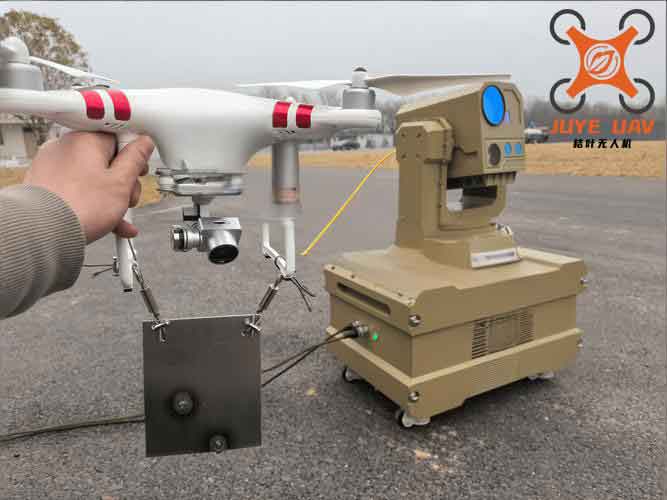
Kinetic Effecters: The Hard-Kill Solution
Kinetic effectors physically destroy the incoming drone. The spectrum ranges from traditional gun systems to advanced interceptor missiles.
- Gun Systems: Rapid-fire cannons (e.g., 30mm chain guns) remain a vital, cost-effective anti-drone tool, especially when paired with airburst munitions. The key is achieving a high volume of fire and proximity-triggered fuzing to compensate for the small size and agility of the target. The lethality of a fragmenting warhead against a drone can be approximated by the density of fragments in the target volume.
- Missile-Based Interceptors: These include adaptations of existing missiles like the FIM-92 Stinger and dedicated systems.
- Loitering Interceptors: Systems like the Coyote Block 2 represent a paradigm shift. They are tube-launched, jet-powered drones themselves that can cruise, identify, and kinetically engage hostile UAS. They offer longer range and greater persistence than a straight-line missile.
- Laser-Guided Rockets: Platforms like the APKWS (Advanced Precision Kill Weapon System) offer a lower-cost guided option compared to traditional missiles. When fitted with a radio frequency proximity fuze, a 70mm laser-guided rocket becomes a potent anti-drone weapon.
Non-Kinetic and Directed Energy Effecters
These systems defeat drones without a physical projectile, offering deep “magazines” and lower cost-per-shot, which is critical for sustainable anti-drone defense.
- Electronic Warfare (EW): RF jammers and spoofers are widespread anti-drone tools. Jammers disrupt the command & control or GPS navigation links, forcing a drone to land, return home, or crash. Spoofers send false GPS signals to hijack the drone’s navigation. However, their effectiveness is highly dependent on the drone’s communication protocols and level of autonomy. As drones incorporate more AI and alternative navigation (e.g., visual odometry), they become harder to counter with EW alone.
- High-Energy Lasers (HEL): Laser weapons deliver lethal energy at the speed of light. Their primary advantage is an extremely low cost-per-shot (essentially the cost of electricity) and an unlimited magazine limited only by power supply. The key parameter is the power density delivered on target over time (fluence). The time \(t\) required to disable a target is related to the laser power \(P\), beam quality, atmospheric attenuation \(\alpha\), and range \(R\):
$$ t \propto \frac{1}{P} \cdot e^{\alpha R} $$
Current deployed systems range from 5 kW for small drones to 50-100 kW for larger Group 2 and 3 UAS. The challenge lies in managing thermal loads, power requirements, and beam degradation through the atmosphere (e.g., fog, rain). - High-Power Microwaves (HPM): HPM systems emit a powerful burst of microwave energy designed to fry the electronic components of a drone. Their great advantage is a wide-area effect; a single pulse can potentially defeat an entire drone swarm within a cone of effect. They are less susceptible to atmospheric conditions than lasers but require careful control to avoid damaging friendly electronics.
| Effector Type | Principle | Key Advantages | Key Challenges | Example Systems/Concepts |
|---|---|---|---|---|
| Kinetic (Guns) | Physical destruction by projectile impact/fragments. | Proven, high rate of fire, low cost per round. | Ammunition logistics, limited range, potential for collateral damage. | 30mm XM914 with airburst rounds; 35mm “Skyranger”. |
| Kinetic (Missiles/Interceptors) | Guided projectile with warhead. | High precision, longer range, high probability of kill. | High cost per engagement, limited magazine depth. | “Coyote” Block 2 loitering interceptor; APKWS rocket. |
| Electronic Warfare | Disrupts C2/GPS links via jamming/spoofing. | Low collateral damage, reusable, rapid effect. | Effectiveness varies with threat, can be countered, potential for spectrum fratricide. | Portable/vehicle-mounted jammers; Drone Restricted Access Using Known EW (DRAKE). |
| High-Energy Laser (HEL) | Concentrated light energy burns through target. | Very low cost-per-shot, speed-of-light engagement, deep magazine. | Line-of-sight only, atmospheric attenuation, high power/thermal management. | 50kW “Guardian” on Stryker; 60kW+ HELIOS for ships. |
| High-Power Microwave (HPM) | EM pulse disables electronics. | Area effect vs. swarms, all-weather potential, rapid engagement. | Short effective range, risk to friendly electronics, significant power needs. | Epirus “Leonidas”; THOR (Tactical HPM Operational Responder). |
The Imperative of Cost and Scale
The most sophisticated anti-drone technology is irrelevant if it cannot be produced and deployed in sufficient quantities. A central theme in current development is the drive to reduce costs and accelerate production lines. The economic asymmetry is clear: launching a million-dollar interceptor against a ten-thousand-dollar drone is a losing strategy. Solutions include:
- Designing lower-cost interceptors from the outset (e.g., using commercial components in military-grade designs).
- Investing in scalable directed energy systems where the cost per engagement is negligible.
- Developing modular, “palletized” systems like “VAMPIRE” that can be rapidly installed on non-specialized vehicles.
The required inventory of anti-drone effectors (\(N_{\text{effector}}\)) for a given theater can be modeled as a function of the threat arrival rate (\(\lambda_{\text{threat}}\)), the expected engagement success probability (\(P_{kill}\)), and the required duration of operations (\(T\)):
$$ N_{\text{effector}} \approx \frac{\lambda_{\text{threat}} \cdot T}{P_{kill}} $$
This simple model underscores why high-cost, low-inventory solutions are unsustainable against persistent, numerous drone threats.
Integrated Mobile Systems: The Way Forward
The trend is towards mobile, self-contained anti-drone platforms that combine sensors, C2, and multiple effectors on a single vehicle. These systems provide protection for maneuvering units. Examples include:
- M-LIDS (Mobile-Low, Slow, Small Unmanned Aircraft System Integrated Defeat System): A vehicle-based system with separate kinetic and EW variants, integrating radar, EO/IR, Coyote interceptors, and a 30mm gun.
- M-SHORAD (Maneuver Short-Range Air Defense): A Stryker-based platform initially fielded with missiles and guns, now being augmented with high-energy lasers (DE M-SHORAD) to create a mixed kinetic/directed energy anti-drone capability.
- MADIS (Marine Air Defense Integrated System): A Joint Light Tactical Vehicle (JLTV)-based family of systems for the US Marine Corps, pairing sensor and shooter vehicles to counter drone threats.
These platforms embody the “integrated” anti-drone concept, providing a responsive and adaptable shield for forces on the move.
Future Challenges and Conclusion
The future of anti-drone warfare will be defined by the race between countermeasure and counter-countermeasure. Adversaries will continue to develop drones with greater autonomy, improved stealth characteristics, and swarm tactics to overwhelm defenses. Future anti-drone systems must therefore be:
- Adaptive and AI-Enabled: Utilizing artificial intelligence and machine learning for faster threat classification, sensor fusion, and optimal effector selection against evolving drone tactics.
- Networked and Joint: Fully integrated into joint all-domain command and control (JADC2) architectures to enable seamless cross-service and coalition anti-drone operations.
- Layered and Mixed: Employing a complementary mix of kinetic, electronic, and directed energy weapons to address different threat types and saturation attacks.
- Affordable and Producible: Designed for mass production to achieve the necessary scale for defense in depth.
The effectiveness of an anti-drone architecture is not just the sum of its technological parts but a product of training, doctrine, and integration. Passive defenses (camouflage, hardening, dispersion) and offensive operations to destroy drone launch sites and control nodes remain critical components of a comprehensive approach. As drone technology democratizes, the demand for effective, scalable, and cost-conscious anti-drone solutions will only intensify, driving continued innovation in this dynamic and essential field of modern warfare.