
In recent years, the rapid advancement of small unmanned aerial vehicle (UAV) technology, including improvements in autonomous navigation, obstacle avoidance, hovering capabilities, and video display systems, has led to widespread adoption of both consumer-grade and industrial-grade drones. However, this proliferation has also increased the risks associated with uncontrolled drone operations and potential malicious attacks, posing significant challenges to public security, law enforcement, and critical infrastructure protection. To address these threats, various countries have been actively developing anti-drone defense systems (AUDS). These systems typically integrate radar for detection, electro-optical sensors for identification, and radio frequency jammers for neutralization. As a key component, anti-drone radar must provide all-weather, long-range, and wide-area surveillance capabilities, independent of the target’s electromagnetic characteristics. In this context, I propose a new anti-drone radar detection system based on a digital circular phased array, which offers enhanced performance for countering low, slow, and small (LSS) drone targets. This paper details the system’s principles, digital simulations, engineering implementation, and field test results, demonstrating its effectiveness in anti-drone applications.
The detection of drone targets using radar presents several technical challenges due to their LSS characteristics. Drones, such as fixed-wing and multi-rotor types, exhibit properties that make them difficult to distinguish from clutter. Below is a table summarizing typical drone characteristics and associated challenges for anti-drone radar systems.
| Characteristic | Fixed-Wing Drone | Multi-Rotor Drone |
|---|---|---|
| Typical Size | Wingspan 1–2 m | Diagonal size ≤0.6 m |
| Radar Cross-Section (RCS) | ≤0.1 m² | ≤0.01 m² |
| Flight Altitude | 50–1000 m | ≤500 m |
| Flight Speed | 15–20 m/s (typical), up to 50 m/s | 5–20 m/s (typical), up to 25 m/s |
The primary difficulties in anti-drone radar detection include:
- Low Altitude and Clutter Proximity: Drones often fly at altitudes below 100 m, leading to radar blind zones due to Earth curvature and multipath effects. Their signals overlap with ground clutter from terrain, buildings, and other structures in both spatial and temporal domains, complicating detection in anti-drone scenarios.
- Slow Speed and Doppler Frequency Proximity: With speeds as low as 5–10 m/s, the Doppler frequency of drone echoes is close to the clutter spectrum. Conventional radar systems typically have a minimum detectable velocity (MDV) above 10 m/s, causing some LSS targets to be missed, which is a critical issue for anti-drone operations.
- High Clutter Amplitude in Urban Environments: In cities, clutter-to-noise ratios can exceed 80 dB, with strong reflections from structures reaching 100–120 dB. The weak RCS of drones (≤0.01 m²) results in signals buried in clutter residues, making detection challenging for anti-drone radar.
- Non-Inertial Motion and Tracking Instability: Drones exhibit erratic flight patterns, and in complex low-altitude backgrounds, track association errors can occur with low data rates. Increasing the search rate reduces beam dwell time, degrading velocity resolution and MDV, thus hindering anti-drone tracking performance.
Traditional anti-drone radars often use one-dimensional phased arrays with mechanical azimuth scanning, which limits beam agility and forces a track-while-scan (TWS) mode. This can lead to track loss for drones. To overcome these limitations, I propose a digital circular phased array system that enables full 360° electronic scanning, supporting both search and track-and-scan (TAS) modes for robust anti-drone capabilities.
The core of the new anti-drone radar system is a circular array antenna with digital beamforming (DBF). Consider a circular array of M elements uniformly distributed on a circle of radius R. The angular position of the m-th element is given by:
$$ \theta_m = \frac{2\pi m}{M}, \quad m = 0, 1, 2, \dots, M-1 $$
For a target at azimuth angle φ, a subset of N elements (typically N ≈ M/3 to M/4) is selected to form a beam. The element pattern is approximated by a cosine function:
$$ f(\theta_k, \phi) =
\begin{cases}
\cos(\theta_k – \phi), & |\theta_k – \phi| \leq \frac{\pi}{2} \\
0, & |\theta_k – \phi| > \frac{\pi}{2}
\end{cases} $$
To achieve low sidelobes, the elements are projected onto a diameter perpendicular to φ, with the projection distance for the k-th element being:
$$ x_k = R \cos(\theta_k – \phi) $$
The beamformed output signal, incorporating a window function w_k for sidelobe suppression, is then:
$$ S_{\text{out}} = \sum_{k=i}^{i+N-1} f(\theta_k, \phi) w_k S_k \exp\left(-j\frac{2\pi x_k}{\lambda}\right) $$
where λ is the wavelength, and S_k is the received signal at the k-th element. This formulation allows for flexible beam steering and high-performance anti-drone detection. The system supports single-beam or multi-beam scanning; for anti-drone applications, single-beam scanning is often used due to its balance of performance and complexity.
To validate the anti-drone radar’s performance, digital simulations were conducted. The parameters include a radar frequency of 6 GHz (S-band), array radius R = 0.25 m, and N = 12 elements per beam. A Taylor window with -27 dB sidelobe level was applied for weighting. The simulated beam patterns are summarized below.
| Beam Type | Beamwidth | Peak Sidelobe Level |
|---|---|---|
| Transmit Beam | 7.6° | -14.5 dB |
| Receive Beam | 8.8° | -25 dB |
The results confirm that the digital circular array can achieve narrow beams with controlled sidelobes, essential for discriminating drone targets from clutter in anti-drone operations. The beamwidth and sidelobe levels meet the requirements for high-resolution detection in complex environments.
For engineering implementation, the anti-drone radar system employs direct digital synthesis (DDS) for phase shifting and digital beamforming. A block diagram illustrates the architecture: the radar control module computes the phase values for each channel based on the desired beam direction, and these are fed to multi-channel signal generators. The DDS units produce RF signals with appropriate phases, which are amplified by transmit/receive (T/R) modules and radiated via column-fed antenna elements. On reception, echoes are processed through low-noise amplifiers, filters, mixers, and analog-to-digital converters (ADCs). Digital beamforming then synthesizes sum and difference beams for the specified azimuth, which are forwarded to signal processing for pulse compression, coherent integration, and detection. The output tracks are displayed and used for anti-drone countermeasures.
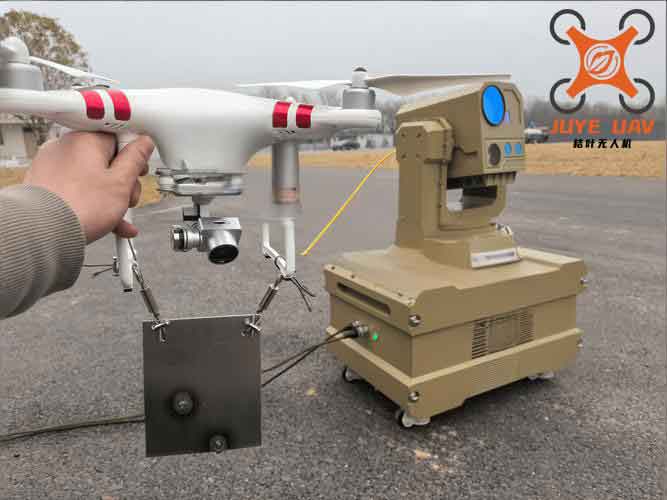
The anti-drone radar prototype was tested in field conditions to evaluate its performance against real drone targets. The system operates in S-band with a 48-element circular array, using 12 elements per beam for 360° electronic scanning. It incorporates pulse-Doppler processing optimized for LSS targets, with a high pulse repetition frequency (PRF) to enhance clutter suppression and detection of slow-moving drones. The radar employs a medium data rate search (5 s update) combined with a high data rate TAS mode (0.5–1 s update), ensuring continuous tracking for anti-drone applications. During tests, the radar successfully detected and tracked a DJI Phantom 4 drone, which has an RCS of approximately 0.01 m², flies at altitudes below 400 m, and speeds under 10 m/s. The radar maintained stable tracks and guided electro-optical sensors and jammers for effective neutralization, demonstrating its practicality as an anti-drone solution.
The table below summarizes key metrics from the field tests, highlighting the anti-drone radar’s capabilities.
| Test Parameter | Value | Implication for Anti-Drone Performance |
|---|---|---|
| Detection Range | ≥ 4.5 km | Provides early warning for anti-drone defense |
| Tracking Update Rate | 0.5–1 s | Enables high-precision tracking of erratic drones |
| Minimum Detectable Velocity | < 5 m/s | Effective against slow-flying drones in anti-drone scenarios |
| Beam Agility | 360° electronic scan | Allows rapid response to multiple drone threats |
These results underscore the system’s effectiveness in addressing the challenges of anti-drone radar detection. The digital circular phased array offers superior beam steering flexibility compared to traditional mechanical systems, enabling robust performance in urban and cluttered environments. Future work will focus on networking multiple such radars to enhance coverage and coordination for comprehensive anti-drone defense networks.
In conclusion, the proposed digital circular phased array radar system represents a significant advancement in anti-drone technology. By leveraging digital beamforming and full electronic scanning, it overcomes the limitations of conventional radars in detecting LSS targets. The system’s ability to perform high-data-rate tracking while maintaining low minimum detectable velocities makes it well-suited for anti-drone applications. Simulations and field tests have validated its performance, confirming its feasibility for real-world deployment. As drone threats continue to evolve, such innovative anti-drone radar systems will play a crucial role in safeguarding airspace and critical assets. Further research will explore integration with other sensors and adaptive algorithms to enhance anti-drone capabilities in dynamic environments.