
In recent years, the escalating competitive landscape has driven the formulation of strategies like the Third Offset Strategy, which aims to alter the rules of future warfare through innovative technologies and operational concepts. Among these, UAV swarm warfare has emerged as a core tactic, representing a significant leap in military innovation. UAV swarms refer to groups of small unmanned aerial vehicles that operate under human supervision or command, autonomously networking to execute unified missions. These swarms can consist of homogeneous or heterogeneous drones, organized in master-slave or decentralized architectures. According to the “Small Unmanned Aircraft Systems Flight Plan 2016-2036,” UAV swarms are capable of performing intelligence, surveillance, and reconnaissance tasks in low-threat environments, while also supporting kinetic strikes, providing target designation for aerial platforms, and executing electronic attacks or suppressing enemy air defenses in high-threat scenarios. Numerous projects, such as the Micro-UAV Swarm, Low-Cost UAV Swarm, and Gremlins programs, have been initiated to develop swarms with diverse applications, tailored to various operational environments and integrated with manned and unmanned platforms. This article delves into the research on UAV swarms, analyzing the characteristics of low-altitude, slow-speed, small (LSS) drones and swarm systems. It reviews the market scale and applications of drones, categorizes key anti-drone technologies for LSS targets, and proposes strategies for countering UAV swarms. By examining past anti-drone swarm methods, it evaluates various engagement手段 and their features, offering insights into future technological directions for anti-drone swarm systems, which may serve as a reference for related developments.
The proliferation of drone technology has introduced new dimensions to modern warfare, with UAV swarms posing a multifaceted threat due to their adaptability and scalability. As an analyst in this field, I observe that the evolution of swarm tactics necessitates a robust anti-drone framework to mitigate risks. The core of anti-drone efforts lies in understanding the swarm’s behavior and vulnerabilities, which can be mathematically modeled to optimize countermeasures. For instance, the effectiveness of a swarm can be represented by its collective decision-making efficiency, often described using swarm intelligence algorithms. A simple formula for swarm coordination might be:
$$ C = \sum_{i=1}^{n} w_i \cdot f(x_i, y_i) $$
where \( C \) is the overall coordination score, \( n \) is the number of drones in the swarm, \( w_i \) represents weight factors for individual drones, and \( f(x_i, y_i) \) denotes the function of positional and operational parameters. This highlights the distributed nature of swarms, making traditional point-defense systems less effective and underscoring the need for scalable anti-drone solutions.
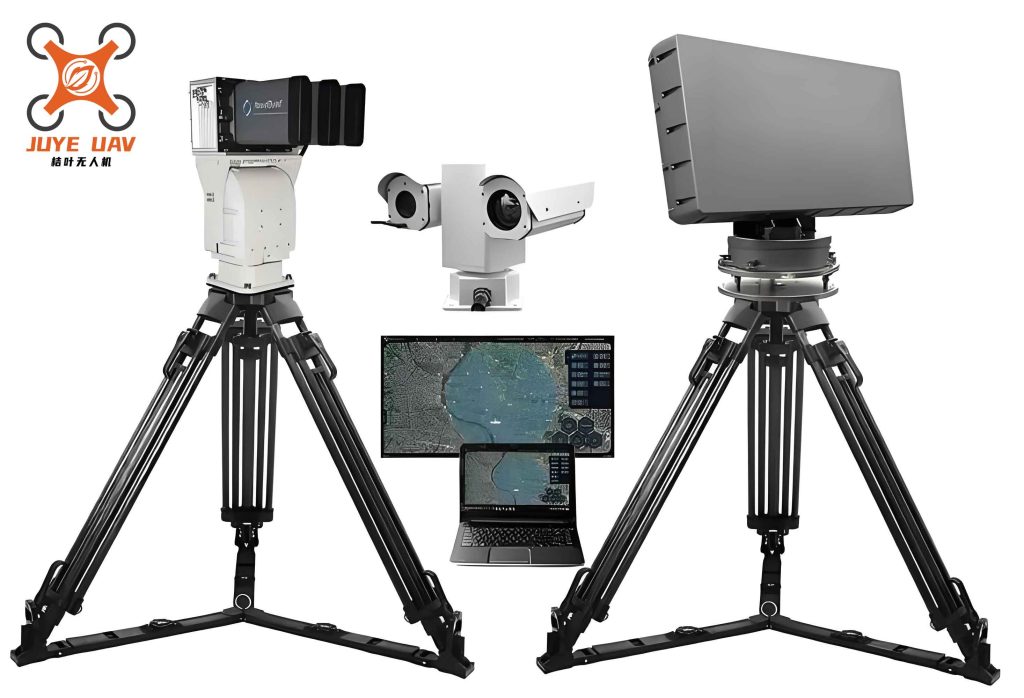
The image above illustrates a typical anti-drone scenario, where multiple systems are deployed to detect and neutralize swarm threats. This visual emphasizes the complexity of modern anti-drone operations, requiring integrated approaches. In my analysis, I categorize drones based on their tactical roles and physical attributes, as summarized in the table below. This classification aids in tailoring anti-drone strategies to specific threat profiles, ensuring that resources are allocated efficiently. The table outlines five categories of UAV systems, with LSS drones (Categories 1, 2, and 3) being the primary constituents of swarms, along with loitering munitions that blend missile and drone technologies.
| Category | Name | Weight (kg) | Altitude (km) | Speed (km/h) | Remarks |
|---|---|---|---|---|---|
| 1 | Micro UAV System | <9 | <0.4 | <185 | Capable of carrying small payloads |
| 2 | Small Tactical UAV System | 10-25 | <1 | <463 | Compact airframe with low radar cross-section, medium endurance |
| 3 | Tactical UAV System | 25-599 | <3 | <463 | Higher logistical requirements |
| 4 | Endurance UAV System | >599 | <6 | Varies | Extended range and loiter time, requires runways |
| 5 | Penetrating UAV System | >599 | >6 | Varies | Similar logistics to manned aircraft |
UAV swarms exhibit distinct operational characteristics that amplify their threat potential. They leverage mass numbers to achieve cost-effectiveness and synergistic effects, enabling tasks beyond the capability of single platforms. The swarm’s emergent intelligence allows for adaptive behaviors, such as self-healing networks and coordinated attacks, which can overwhelm traditional defenses. From an anti-drone perspective, this necessitates a shift from single-target engagement to multi-target management. The swarm’s efficacy can be quantified using metrics like swarm density and communication reliability. For example, the probability of successful swarm penetration against a defense system might be modeled as:
$$ P_{penetration} = 1 – \prod_{i=1}^{m} (1 – p_i)^{n_i} $$
where \( m \) is the number of defense layers, \( p_i \) is the kill probability per layer, and \( n_i \) is the number of drones engaging that layer. This formula underscores the challenge of countering swarms, as even low individual kill probabilities can be negated by large swarm sizes, driving the development of high-volume anti-drone systems.
Anti-drone technologies for LSS targets are broadly classified into four categories, each with unique mechanisms and applications. As I explore these, the term “anti-drone” is central to framing the discussion, emphasizing the proactive measures required to neutralize threats. The first category is interference and disruption, which involves jamming command-and-control (C2) links, GPS signals, or data transmission to force drones to land or return. The effectiveness of jamming can be expressed as:
$$ J_{eff} = \frac{P_{tx} \cdot G_{tx}}{L \cdot N} $$
where \( J_{eff} \) is the jamming effectiveness, \( P_{tx} \) is the transmitted power, \( G_{tx} \) is the antenna gain, \( L \) is the path loss, and \( N \) is the noise floor. This highlights the technical parameters critical for designing anti-drone jammers. The second category is direct destruction, using kinetic or energy-based means to physically damage drones. This includes missiles, guns, lasers, and high-power microwaves (HPM). The kill probability for a direct hit can be modeled with:
$$ P_{kill} = e^{-\frac{A}{E}} $$
where \( A \) is the drone’s vulnerable area and \( E \) is the energy delivered by the anti-drone weapon. The third category is monitoring and control, which entails hacking into drone systems to take over or redirect them. This requires advanced cyber capabilities and is less common for swarms due to encryption challenges. The fourth category is proximity inspection, capture, and destruction, where interceptor drones or nets are used to physically engage threats. This is suitable for slower LSS drones and can be enhanced with autonomous targeting algorithms.
The global drone market underscores the urgency of robust anti-drone solutions. Military drones constitute approximately 65% of the market, with projections indicating significant growth. Based on industry data, I compiled the following table to illustrate market trends and swarm-related estimates. This data informs anti-drone procurement and development priorities, as the scale of potential threats directly impacts defense planning.
| Year | Global Military UAV Market (USD Billion) | Estimated UAV Units (Millions) | LSS UAV Units (Millions, ~75.5% Share) | Asia-Pacific UAV Units (Millions, ~37.8% Share) |
|---|---|---|---|---|
| 2018 | 14.1 | Not specified | Not specified | Not specified |
| 2019 | 16.9 | 0.68 (total drones) | 0.51 (estimated) | 0.26 (estimated) |
| 2025 | 26.8-49.9 | 1.91-3.56 | 1.44-2.69 | 0.55-1.02 |
| 2029 | Projected growth | Further increase | Proportional rise | Dominant regional share |
This table reveals a substantial increase in drone numbers, with LSS drones forming the bulk of potential swarm threats. Consequently, anti-drone systems must evolve to handle large-scale engagements, emphasizing cost-effectiveness and rapid response. The market expansion also suggests a proliferation of drones among non-state actors, complicating anti-drone efforts and necessitating versatile technologies.
To counter LSS drone swarms, various engagement手段 have been developed, each with distinct advantages and limitations. As an advocate for integrated defense, I analyze these手段 to highlight their roles in a layered anti-drone architecture. The first手段 is air defense missiles, which offer long-range, high-maneuverability interception but at high cost per engagement. For swarms, specialized low-cost missiles like the U.S. “Vampire” system are being explored to improve sustainability. The cost-effectiveness of missile-based anti-drone systems can be assessed using:
$$ CE_{missile} = \frac{P_{kill} \cdot N_{targets}}{C_{missile}} $$
where \( CE_{missile} \) is the cost-effectiveness, \( P_{kill} \) is the kill probability, \( N_{targets} \) is the number of drones engaged, and \( C_{missile} \) is the missile cost. This formula underscores the need for affordable solutions in swarm scenarios. The second手段 is drone-on-drone combat, employing counter-UAVs for interception. These can be suicidal, collision-based, or non-suicidal with payloads like jammers. For instance, the U.S. “Coyote” Block 2 and Block 3 drones exemplify this approach, offering flexible anti-drone capabilities. The engagement success rate for drone-on-drone combat can be modeled as:
$$ S_{drone} = \frac{v_{interceptor}}{v_{target}} \cdot \alpha $$
where \( S_{drone} \) is the success score, \( v \) represents velocities, and \( \alpha \) is a factor accounting for maneuverability and control systems. This highlights the importance of speed and agility in anti-drone interceptors.
The third手段 is high-energy laser (HEL) weapons, which provide low-cost, sustained engagement against multiple drones. HEL systems damage drones through thermal and structural effects, with effectiveness depending on beam quality and atmospheric conditions. The energy required for drone negation can be calculated as:
$$ E_{required} = \frac{\rho \cdot V \cdot c \cdot \Delta T}{A_{spot}} $$
where \( \rho \) is the drone material density, \( V \) is the volume to be heated, \( c \) is the specific heat capacity, \( \Delta T \) is the temperature increase needed, and \( A_{spot} \) is the laser spot area. This guides the development of powerful yet compact anti-drone lasers. The fourth手段 is high-power microwave (HPM) weapons, which disrupt drone electronics over wide areas, making them ideal for swarm suppression. The field strength for effective HPM engagement is given by:
$$ E_{field} = \frac{P_{avg} \cdot G}{4\pi r^2} $$
where \( E_{field} \) is the electric field strength, \( P_{avg} \) is the average power, \( G \) is the antenna gain, and \( r \) is the distance. This emphasizes the need for high power outputs in anti-drone HPM systems. The fifth手段 is anti-aircraft artillery (AAA) with specialized ammunition, such as smart rounds or proximity fuzes, which offer high fire rates and low cost. Modern AAA systems are being upgraded with precision guidance to enhance anti-drone performance. The hit probability for AAA against drones can be expressed as:
$$ P_{hit} = 1 – e^{-\lambda \cdot t} $$
where \( \lambda \) is the rate of fire and \( t \) is the engagement time, illustrating the benefits of volume fire in anti-drone roles. The sixth手段 is electronic surveillance and jamming, which targets drone communication and navigation links. This non-kinetic approach is often used in conjunction with other means to degrade swarm coordination. The jamming coverage area can be estimated as:
$$ A_{jamming} = \pi \cdot \left( \frac{c}{4\pi f} \cdot \sqrt{\frac{P_{j} G_{j}}{P_{d} G_{d}}} \right)^2 $$
where \( c \) is the speed of light, \( f \) is the frequency, \( P_{j} \) and \( G_{j} \) are jammer power and gain, and \( P_{d} \) and \( G_{d} \) are drone receiver power and gain. This informs the deployment of anti-drone jamming networks.
To compare these anti-drone手段, I have developed a comprehensive table summarizing their key attributes, including range, cost, effectiveness against swarms, and technological maturity. This table aids in selecting appropriate systems for specific threat scenarios, ensuring a balanced anti-drone portfolio.
| Engagement Means | Typical Range (km) | Cost per Engagement (Relative) | Effectiveness vs. Swarms (Scale 1-10) | Maturity Level | Key Advantages | Key Limitations |
|---|---|---|---|---|---|---|
| Air Defense Missiles | 5-20 | High | 6 | High | High precision, long range | Expensive, limited magazine depth |
| Drone-on-Drone Combat | 1-5 | Medium | 8 | Medium | Flexible, reusable platforms | Short range, requires control links |
| High-Energy Lasers | 1-10 | Low (after initial investment) | 9 | Medium-High | Low cost per shot, rapid engagement | Atmospheric attenuation, line-of-sight required |
| High-Power Microwaves | 0.5-5 | Low | 9 | Medium | Area effect, good for dense swarms | Short range, potential collateral damage |
| Anti-Aircraft Artillery | 1-4 | Low | 7 | High | High rate of fire, proven technology | Accuracy issues, ammunition logistics |
| Electronic Jamming | 2-10 | Medium | 7 | High | Non-kinetic, reversible effects | Limited against autonomous drones |
This table illustrates that no single anti-drone solution is universally superior; instead, a layered approach combining multiple手段 is essential to address swarm threats. For example, lasers and HPM weapons excel in cost-effective swarm suppression, while missiles and drones provide precision strikes against high-value targets. The integration of these systems can be optimized using network-centric models, where sensors and shooters share data in real-time. A formula for integrated anti-drone system effectiveness might be:
$$ E_{system} = \sum_{j=1}^{k} \beta_j \cdot \log(1 + R_j) $$
where \( E_{system} \) is the overall effectiveness, \( k \) is the number of system components, \( \beta_j \) are weighting coefficients, and \( R_j \) are resource allocations. This highlights the synergy achievable through combined anti-drone operations.
Looking ahead, the future of anti-drone swarm technology will likely focus on autonomy, artificial intelligence, and multi-domain integration. As I reflect on current trends, several directions emerge. First, the development of AI-driven threat assessment algorithms can enhance early warning and identification of swarm patterns, reducing response times. These algorithms can process data from radar, electro-optical, and acoustic sensors to classify drones and predict their intent. A predictive model for swarm behavior could use machine learning techniques, represented as:
$$ \hat{Y} = \sigma(W \cdot X + b) $$
where \( \hat{Y} \) is the predicted threat level, \( \sigma \) is an activation function, \( W \) are weights, \( X \) is input sensor data, and \( b \) is bias. This enables proactive anti-drone measures. Second, the miniaturization of directed-energy weapons will make them more deployable on mobile platforms, extending anti-drone coverage to forward areas. Third, the use of swarms to counter swarms—referred to as “anti-drone swarms”—is gaining traction, leveraging similar distributed tactics to overwhelm adversaries. This approach can be modeled using game theory, where the payoff for an anti-drone swarm is maximized when it outnumbers or outmaneuvers the threat swarm. A simple game matrix might be:
| Strategy | Threat Swarm Attacks | Threat Swarm Evades |
|---|---|---|
| Anti-Drone Swarm Engages | High payoff (neutralization) | Medium payoff (pursuit cost) |
| Anti-Drone Swarm Holds | Low payoff (vulnerability) | Zero payoff (no action) |
This underscores the strategic value of adaptive anti-drone systems. Fourth, advancements in cyber-electronic warfare will improve the ability to hack or spoof swarm communications, offering non-kinetic neutralization options. Fifth, international cooperation on anti-drone standards and regulations will be crucial to address cross-border threats and prevent escalation.
In conclusion, the rise of UAV swarms presents a formidable challenge to modern security and defense architectures. Through this analysis, I have outlined the characteristics of drone swarms, categorized anti-drone technologies, and evaluated various engagement手段. The increasing scale of the drone market amplifies the urgency for effective countermeasures, necessitating continuous innovation in anti-drone capabilities. By embracing a multi-layered, integrated approach that combines kinetic and non-kinetic solutions, and by investing in emerging technologies like AI and directed energy, we can develop resilient anti-drone systems capable of mitigating swarm threats. The evolution of anti-drone strategies will play a pivotal role in shaping future battlefields, ensuring that defenses keep pace with the rapid advancements in drone warfare. As research progresses, the focus should remain on affordability, scalability, and interoperability to create a comprehensive anti-drone ecosystem that can adapt to evolving threats.