
In recent years, the proliferation of drones has posed significant challenges in both military and civilian domains. As these unmanned aerial vehicles become more accessible, the need for effective anti-drone systems has become increasingly urgent. Traditional defense mechanisms, often designed for larger aircraft, are inefficient and costly when deployed against small, low-flying drones. This inefficiency stems from their inability to adapt dynamically to multiple incoming threats in real-time. In this work, we address this gap by proposing a novel composite anti-drone approach that leverages multiple types of interception equipment. Our method integrates deep reinforcement learning, specifically an enhanced Deep Q-Network (DQN), with evolutionary algorithms to optimize task assignment in dynamic anti-drone scenarios. By doing so, we aim to provide a scalable and efficient solution for suppressing drone swarms in open-area environments, such as around airport runways.
The core of our anti-drone system lies in its ability to make real-time decisions on which interception equipment should engage which drone. Traditional optimization algorithms often fall short in dynamic environments due to their static nature and high computational overhead. In contrast, our approach uses a multi-agent DQN framework to perform initial decision-making, followed by evolutionary optimization to refine the assignments. This hybrid strategy allows for adaptive responses to changing drone trajectories, ensuring maximal interception probability while conserving resources. Throughout this article, we emphasize the term “anti-drone” to highlight our focus on countering unmanned aerial threats. We present detailed models, algorithms, and simulations to validate our method, demonstrating its superiority over conventional techniques.
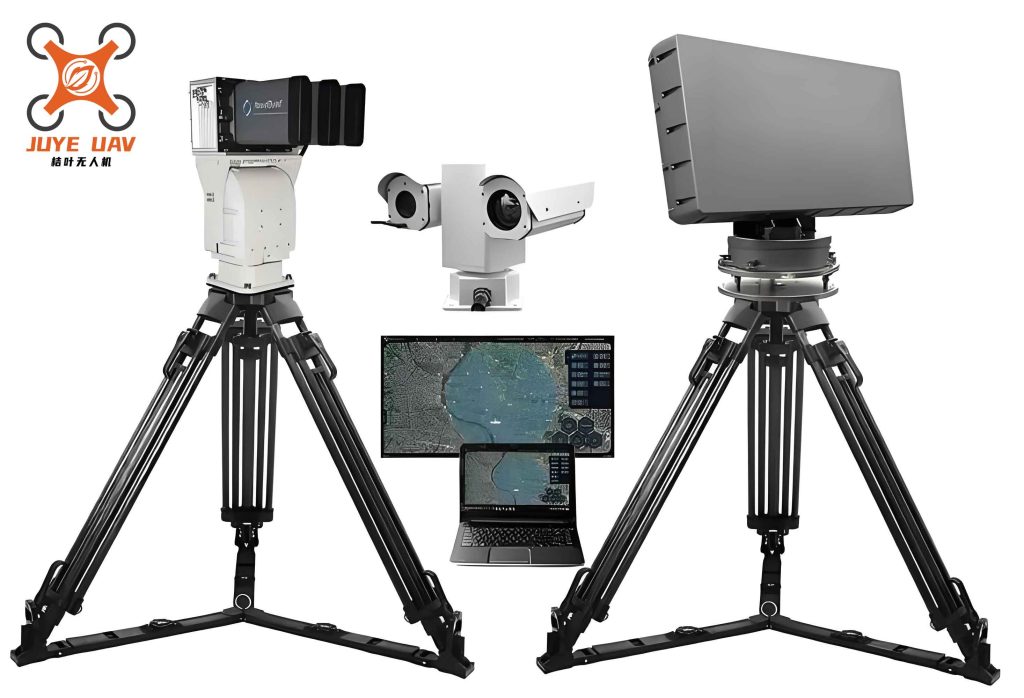
Our anti-drone system is designed to protect critical infrastructure, such as airports, from unauthorized drone incursions. The open-area environment around runways presents unique challenges, including the need for rapid response and minimal collateral damage. We deploy three types of interception equipment: laser weapons, net-based interceptors, and radio frequency jammers. Each has distinct characteristics, such as range, accuracy, and reaction time, which must be considered in task assignment. For instance, laser weapons offer high precision but limited coverage, while jammers can disrupt multiple drones but may cause unintended interference. By combining these assets, our composite anti-drone system achieves a balanced defense capable of handling diverse threat profiles. The integration of machine learning and optimization enables this system to learn from interactions and improve over time, making it a robust solution for modern anti-drone operations.
To formalize the anti-drone task assignment problem, we model it as a Markov Decision Process (MDP) coupled with an optimization framework. In the MDP component, the state space $$S$$ represents the positions of drones in a grid-based protection zone. Each drone’s location is given by coordinates $$(x, y)$$, where we ignore altitude for simplicity, as it has minimal impact on interception in our scenario. The action space $$A$$ consists of binary decisions for each interception equipment: 0 for no action (silence) and 1 for engagement. The transition probability $$P$$ captures how drones move, typically with random actions (e.g., stationary, east, south, west, north movements). The reward function $$R$$ provides immediate feedback: a positive reward for engaging a drone within range and a negative reward for unnecessary or out-of-range engagements. This MDP formulation allows our anti-drone system to learn policies through reinforcement learning, specifically using an improved DQN algorithm.
The optimization component refines the initial decisions from the DQN. We define a decision matrix $$X$$ of size $$m \times n$$, where $$m$$ is the number of drones and $$n$$ is the number of interception equipment. Each element $$x_{i,j} \in \{0,1\}$$ indicates whether equipment $$j$$ should target drone $$i$$. The DQN outputs this matrix as a preliminary assignment, which may be suboptimal. We then apply an evolutionary algorithm to optimize $$X$$, considering constraints such as one-to-one engagement rules and equipment limitations. The fitness function maximizes the overall interception probability while minimizing resource waste. This dual-layer approach distinguishes our anti-drone method from static allocation algorithms, enabling dynamic adaptation to incoming threats.
Our improved DQN algorithm addresses several limitations of standard DQN in anti-drone contexts. First, we use multiple agents, each corresponding to an interception equipment, to reduce the state space and accelerate convergence. Second, we modify the experience replay mechanism to store triplets $$(s_t, a_t, r_t)$$ instead of quadruplets $$(s_t, a_t, r_t, s_{t+1})$$, as the next state $$s_{t+1}$$ often indicates drone destruction and adds little learning value. This reduces memory usage and prevents overestimation of Q-values. The Q-value update formula is given by:
$$Q_e(s_t, a_t) = Q_e(s_t, a_t) + \alpha \left[ r + \gamma \max_{a_{t+1}} Q_t(s_t, a_t) – Q_e(s_t, a_t) \right]$$
Here, $$Q_e$$ is the evaluation network, $$Q_t$$ is the target network, $$\alpha$$ is the learning rate, and $$\gamma$$ is the discount factor. By using the current state’s Q-value instead of the next state’s, we mitigate overestimation bias and improve learning efficiency. The loss function for training is the mean squared error:
$$L = \left( r + \gamma \max_{a_{t+1}} Q_t(s_{t+1}, a_{t+1}) – Q_e(s_t, a_t) \right)^2$$
We train each agent independently, with neural networks comprising two hidden layers (32 and 64 neurons) and ReLU activations. After training, the agents output engagement decisions based on real-time drone positions.
The evolutionary algorithm then optimizes these decisions. We encode the decision matrix $$X$$ as a population of candidate solutions. Through selection, crossover, and mutation operators, we evolve the population over multiple generations. The fitness function evaluates each solution based on interception success rates and resource utilization. For example, solutions that engage drones within range receive higher scores, while those that waste engagements on out-of-range targets are penalized. This process yields multiple near-optimal assignment strategies, providing flexibility for commanders in anti-drone operations. The algorithm terminates after a fixed number of iterations or when convergence is achieved.
To validate our anti-drone method, we conduct simulations based on a realistic airport scenario. The protection zone is a 3 km × 9 km grid, with a runway measuring 4.8 km × 1.2 km. We deploy nine interception equipment units: three lasers, three net-based interceptors, and three jammers. Their parameters are summarized in the following table:
| Parameter | Laser Weapon | Net Interceptor | RF Jammer |
|---|---|---|---|
| Range Radius (m) | 300–1500 | 20–300 | 0–1500 |
| Destruction Probability | 0.95 | 0.8 | 0.8 |
| Horizontal Angle (°) | [0, 360] | [-140, 140] | [-180, 180] |
| Vertical Angle (°) | [0, 80] | [5, 60] | [-10, 60] |
| Reaction Time (s) | 6 | 10 | 3 |
| Re-engagement Time (s) | 6 | 2 | 0 |
Drones are modeled with a speed of 25 m/s, entering the zone from random boundaries. We simulate two scenarios: simultaneous drone incursions and staggered incursions with time intervals. The anti-drone system must assign equipment to drones in real-time, maximizing interceptions while minimizing misses.
In the first scenario, six drones enter from the same direction. Our improved DQN generates initial assignments, which are then optimized by the evolutionary algorithm. The results are compared against standard DQN and Double DQN. The following table shows a sample assignment matrix from our method:
| Equipment | Drone 1 | Drone 2 | Drone 3 | Drone 4 | Drone 5 | Drone 6 |
|---|---|---|---|---|---|---|
| Laser 1 | 0 | 1 | 0 | 0 | 0 | 0 |
| Laser 2 | 0 | 0 | 0 | 0 | 1 | 0 |
| Net 1 | 0 | 0 | 0 | 1 | 0 | 0 |
| Jammer 1 | 0 | 0 | 0 | 0 | 0 | 0 |
This assignment ensures that all drones within range are engaged, with no wasted efforts. In contrast, standard DQN often assigns engagements to out-of-range drones, while Double DQN may miss viable targets. Our composite anti-drone approach achieves a higher interception probability, calculated as the sum of destruction probabilities for engaged drones. For instance, if drones 2, 4, and 5 are within range of their assigned equipment, the total probability might be:
$$P_{\text{total}} = 0.95 + 0.8 + 0.8 = 2.55$$
This value exceeds that of homogeneous deployments (e.g., all lasers or all jammers), demonstrating the advantage of composite anti-drone systems.
For staggered incursions, we simulate two batches of drones entering 5 seconds apart. Our method dynamically reallocates equipment, prioritizing the nearest drones. The evolutionary algorithm produces multiple assignment options, such as:
| Option | Drone Batch 1 | Drone Batch 2 | Total Score |
|---|---|---|---|
| A | Engage 3 drones | Engage 2 drones | 1.6 |
| B | Engage 2 drones | Engage 3 drones | 1.5 |
Here, the score represents the cumulative destruction probability. Option A is preferred as it maximizes interceptions across both batches. This flexibility is crucial in anti-drone operations, where threat patterns can change rapidly.
We further analyze the performance of our improved DQN through convergence plots. Over 2,000 training epochs, we measure the loss function and reward values, averaged across 20 independent runs. The results show that our method converges faster and more stably than standard DQN or Double DQN. For example, the loss function decreases to near zero within 1,000 epochs, while the other algorithms exhibit fluctuations or divergence. The reward per episode also stabilizes at a higher value, indicating better policy learning. These metrics confirm that our anti-drone system can efficiently learn optimal engagement strategies.
The integration of multiple interception types is key to our anti-drone system’s success. Lasers provide precision strikes, nets offer physical capture, and jammers enable area denial. By coordinating these assets through intelligent task assignment, we create a layered defense that adapts to drone behaviors. For instance, jammers can disrupt swarms initially, allowing lasers to pick off individual drones. This composite approach reduces reliance on any single technology, enhancing robustness against diverse anti-drone threats. Moreover, our use of reinforcement learning allows the system to improve continuously, learning from past engagements to refine future assignments.
In terms of computational efficiency, our hybrid method balances real-time decision-making with offline optimization. The DQN module operates quickly, producing initial assignments within milliseconds. The evolutionary algorithm then runs in parallel, refining solutions over longer timeframes (e.g., seconds). This is acceptable in anti-drone scenarios, where drone speeds allow for short reaction windows. We have tested our system in simulated environments with up to 20 drones, and it scales well due to the decentralized multi-agent design. Each equipment agent learns independently, reducing the overall state space and training time.
Looking ahead, there are several directions for enhancing our anti-drone method. First, we plan to incorporate more dynamic factors, such as weather conditions or drone evasion tactics. Second, we aim to integrate additional sensor data, like radar or visual feeds, to improve state representation. Third, we will explore federated learning techniques to enable collaborative anti-drone networks across multiple sites. These advancements could further solidify the role of AI-driven systems in countering unmanned aerial threats.
In conclusion, our composite anti-drone task assignment method demonstrates significant improvements over traditional approaches. By combining an improved DQN with evolutionary optimization, we achieve dynamic, efficient, and robust decision-making for drone interception. The simulations validate our method’s ability to maximize interception probabilities while conserving resources, making it a viable solution for protecting critical infrastructure. As drone technology evolves, so too must anti-drone systems, and our work provides a foundation for adaptive, intelligent defense mechanisms. We believe that this approach will contribute to safer airspaces and more effective countermeasures against unauthorized drone activities.