
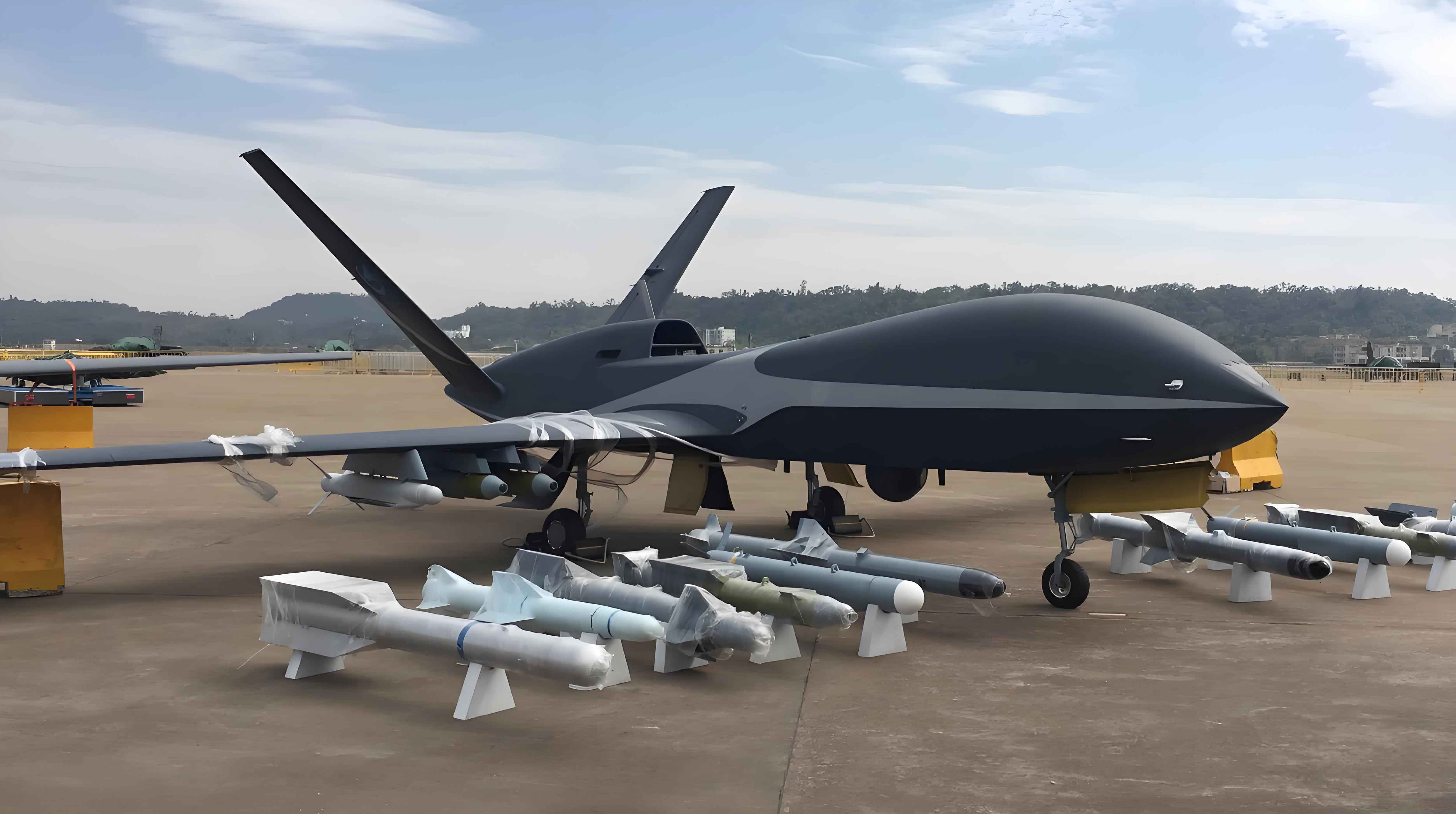
Military drones, or Unmanned Aerial Vehicles (UAVs), have become pivotal assets in modern warfare, reshaping operational doctrines and force structures. Their performance, endurance, survivability, and mission success are fundamentally governed by the capabilities of their propulsion systems. Unlike manned aircraft, the design of a military drone is liberated from the physiological and safety constraints of an onboard pilot, enabling optimized platforms centered purely on mission objectives. This leads to unique demands on the powerplant. This analysis systematically examines the propulsion characteristics of military drones, focusing on turbofan engines, their key requirements, and the intricate relationships between aircraft demands and engine design parameters.
1. Characteristics of Turbofan Engines for Military Drones
1.1. Traits of Typical Military Drone Engines
Military drones can be broadly categorized by their primary mission: Unmanned Combat Aerial Vehicles (UCAVs), reconnaissance drones, and tanker drones. Each category imposes distinct demands on its engine.
Analysis of prominent global platforms reveals a strong emphasis on stealth for UCAVs and, increasingly, for high-end reconnaissance platforms. This directly translates into specific engine installation and modification features:
- Inlet Design: Dorsal-mounted, S-shaped serpentine inlets are prevalent (e.g., X-45, X-47, “Okhotnik”, “Grom”) to shield the engine face from direct radar waves, reducing the Radar Cross-Section (RCS).
- Exhaust System: Specially treated nozzles, including S-shaped ducts and flat “beavertail” nozzles (e.g., X-45C, X-47B, “Grom”), are used to manage infrared (IR) signature and rear-aspect RCS.
- IR Signature Suppression: A common modification for UCAVs is the removal of the afterburner (e.g., X-45A, X-47B, “Okhotnik”) from fighter-derived engines, significantly reducing the high-temperature exhaust plume, a primary IR source.
- Advanced Materials: Use of Radar Absorbent Materials (RAM) and IR-suppressant coatings is critical for platforms like “Neuron” and “Taranis”.
For reconnaissance and tanker drones, while stealth is a growing concern, other parameters like Specific Fuel Consumption (SFC), altitude capability, and reliability are paramount. Engines for these platforms often prioritize low noise, lightweight construction, and high fuel efficiency.
1.2. Key Parameters of Typical Engines
A review of engine selection for operational and demonstrator military drones shows a predominant strategy: the adaptation of mature, existing engines. This approach mitigates development risk, cost, and time.
| Drone Type | Drone | Engine | Thrust (kN) | Bypass Ratio (BPR) | Engine Origin | Development Approach |
|---|---|---|---|---|---|---|
| UCAV | X-45A | F124-GA-100 | 28.0 | 0.47 | Light Fighter | Mature Derivative |
| X-45C | F404-GE-102 | 78.7 | 0.34 | Trainer/Fighter | Mature Derivative | |
| Neuron | MK 951 | 40.0 | 0.75 | Trainer | Mature Derivative | |
| X-47B | F100-PW-220U | 74.0 | 0.60 | Fighter | Mature Derivative | |
| Okhotnik | AL-31F Derivative | ~123.0 | ~0.57 | Fighter | Mature Derivative | |
| Taranis | MK 951 | 40.0 | 0.75 | Trainer | Mature Derivative | |
| Grom | AI-222-25 | 24.5 | 1.18 | Light Fighter/Trainer | Mature Derivative | |
| Reconnaissance | RQ-4 Global Hawk | AE 3007H | 42.0 | 4.90 | Regional Jet | Mature Derivative |
| RQ-170 Sentinel | TF34 | 40.3 | 6.20 | Attack Aircraft | Mature Derivative | |
| MQ-20 Avenger | PW545B | 20.0 | 4.12 | Business Jet | Mature Derivative | |
| Tanker | MQ-25 Stingray | AE 3007N | 40.0 | 5.00 | Regional Jet | Mature Derivative |
The data reveals clear trends: UCAVs predominantly utilize modified military low-bypass turbofans, while reconnaissance and tanker drones favor modified high-bypass commercial engines. This dichotomy stems from core mission requirements. UCAVs demand high specific thrust (thrust per unit airflow) for potential dash speed, good throttle response, and a smaller frontal area conducive to stealth, all hallmarks of low-BPR engines. Reconnaissance and tanker drones prioritize endurance and fuel efficiency, which are best served by high-BPR engines offering lower SFC.
The adaptation process is non-trivial. For instance, the F100-PW-220U for the X-47B involved removing the afterburner, integrating an S-shaped exhaust nozzle, upgrading to higher-strength bearings for carrier landings, and optimizing the turbine cooling system to increase thrust. This exemplifies how a mature fighter engine is tailored to meet the unique demands of a stealthy, carrier-based military drone.
2. Key Requirements for Military Drone Propulsion
2.1. Aircraft-Level Key Requirements
The requirements levied on the propulsion system by the military drone platform vary significantly based on its role. These can be grouped into five major categories, with their relative importance (High-H, Medium-M, Low-L) differing per drone type.
| Key Requirement Category | Specific Requirement | UCAV | Recon Drone | Tanker Drone |
|---|---|---|---|---|
| Performance | Low SFC (Cruise) | M | H | H |
| High Thrust-to-Weight Ratio | H | L | L | |
| High Inlet Temp (T1) Capability* | H | L | M | |
| High Power Extraction | M | H | M | |
| High Altitude Operation | M | H | M | |
| High Maneuver Tolerance | H | L | L | |
| Environment | Low Noise | L | L | L |
| Low Emissions (e.g., NOx) | L | M | L | |
| Stealth | Low Radar Cross-Section (RCS) | H | M | L |
| Low Infrared (IR) Signature | H | M | M | |
| Reliability/Maintainability | Long Life | L | H | M |
| High Cycle Usage Tolerance | M | L | M | |
| High Maintainability | M | H | H | |
| Cost | Low Acquisition Cost | M | M | M |
| Low Development Cost | H | H | H | |
| Low Maintenance Cost | L | M | M |
* Capability to operate at high inlet temperatures due to supersonic flight or high subsonic speed at low altitude.
Several overarching themes emerge. First, low development cost and high maintainability are critical across all military drone types, driven by the need for affordable, rapidly deployable assets with high operational availability. Second, UCAVs place the highest premium on stealth (low RCS/IR) and performance parameters linked to survivability and mission flexibility (high T1, maneuver tolerance). Third, reconnaissance drones prioritize endurance-related factors: low SFC, high-altitude operation, and high power extraction for sensors, coupled with exceptional reliability and maintainability for long-duration missions. Tanker drones share the emphasis on low SFC and maintainability, crucial for their role in extending the reach of other aircraft.
2.2. Relationship Between Key Requirements and Propulsion Characteristics
The aircraft-level requirements must be translated into specific propulsion system characteristics. These characteristics—encompassing thermodynamic cycle, mechanical design, systems, and installation—interact in complex, sometimes contradictory, ways to satisfy the top-level needs.
Key propulsion parameters can be defined mathematically. For instance:
- Bypass Ratio (BPR): $$ BPR = \frac{\dot{m}_{fan}}{\dot{m}_{core}} $$ where $\dot{m}_{fan}$ is bypass airflow and $\dot{m}_{core}$ is core airflow.
- Specific Thrust (Fs): $$ F_s = \frac{F}{\dot{m}_{total}} $$ where $F$ is net thrust and $\dot{m}_{total}$ is total engine airflow. It is inversely related to propulsive efficiency at subsonic speeds.
- Thrust-to-Weight Ratio: $$ \frac{F}{W} = \frac{\text{Engine Thrust}}{\text{Engine Weight}} $$
| Propulsion Characteristic | Correlation with Key Requirements | ||||||||||||
|---|---|---|---|---|---|---|---|---|---|---|---|---|---|
| Low SFC | High F/W | High T1 | High Pext | High Altitude | High G-tol. | Low Noise | Low RCS | Low IR | Long Life | High Maint. | Low Cost | ||
| Thermo Cycle: Low Fs / Low Fan PR | ++ | — | o | o | o | — | + | — | * | o | o | * | |
| Thermo Cycle: High OPR, High SOT | + | + | + | o | o | o | o | – | o | – | – | o/- | |
| Design: Mixed Exhaust | * | o | o | o | o | o | * | o | * | ++ | o | o | |
| Design: High Surge Margin | – | o | o | * | * | * | o | o | * | o | * | o | |
| Design: Modular Construction | o | – | o | o | o | o | o | o | o | o | ++ | – | |
| Systems: FADEC & Health Monitoring | * | o | o | * | * | * | o | * | o | * | ++ | * | |
| Install: Cooled/Shielded Exhaust | — | – | o | o | o | o | o | o | ++ | – | – | — | |
| Install: RAM/IR Coatings | o | – | o | o | o | o | o | ++ | * | – | – | — | |
Legend: ++ Crucial, + Important, o Minor/Negligible, – Detrimental, — Strongly Contrary.
The matrix reveals fundamental trade-offs inherent in designing propulsion for a military drone. For example, a low specific thrust (typically from a high BPR) is crucial for low SFC and low jet noise but is strongly detrimental to achieving a high thrust-to-weight ratio and complicates low RCS design due to a larger frontal area. This explains why UCAVs opt for low-BPR engines despite the SFC penalty.
Similarly, advanced stealth features like cooled/shielded exhausts and Radar Absorbent Materials (RAM) are crucial for low IR and RCS but are inherently detrimental to cost, weight, and sometimes maintainability. The choice of a mixed exhaust system can enhance IR suppression by cooling the core stream but may involve trade-offs with installation complexity.
Technologies like Full Authority Digital Engine Control (FADEC) and Engine Health Monitoring (EHM) are enablers across multiple requirements, particularly for maintainability, performance optimization, and tolerating high maneuver loads or inlet distortion, making them virtually essential for modern military drone propulsion.
3. Propulsion Characteristic Selection for Drone Types
Given the trade-offs, different categories of military drones prioritize distinct sets of propulsion characteristics during the design and selection process.
| Propulsion Characteristic | UCAV | Reconnaissance Drone | Tanker Drone |
|---|---|---|---|
| Low Specific Thrust / High BPR | — (Avoid) | ++ (Seek) | + (Seek) |
| High OPR & SOT | + (Seek) | o/– (Balance) | o (Neutral) |
| Mixed Exhaust | ++ (Seek) | o (Neutral) | + (Seek) |
| High Surge Margin | + (Seek) | o (Neutral) | + (Seek) |
| Modular Design | + (Seek) | ++ (Seek) | ++ (Seek) |
| FADEC & EHM | ++ (Essential) | ++ (Essential) | ++ (Essential) |
| Cooled/Shielded Exhaust | ++ (Seek) | o (Neutral) | — (Avoid if possible) |
| RAM/IR Coatings | ++ (Seek) | o/+ (Conditional) | – (Minimize) |
The selection倾向 are clear:
- UCAVs: The paramount characteristics are those enabling stealth (cooled/shielded exhaust, RAM/IR coatings) and high-performance combat capability (rejection of high BPR, pursuit of high OPR/SOT for compactness, high surge margin for maneuverability). Mixed exhaust is highly desirable for IR suppression. Modular design and advanced controls (FADEC/EHM) are essential for operational flexibility and reliability.
- Reconnaissance Drones: The dominant characteristic is low specific thrust (high BPR) for endurance. Modular design, FADEC, and EHM are critical for achieving the exceptional reliability, maintainability, and in-flight optimization required for long-duration, often remote missions. Stealth characteristics are of medium or conditional priority, depending on the threat environment.
- Tanker Drones: Similar to reconnaissance platforms, they prioritize low specific thrust (high BPR) for fuel efficiency (directly translating to more fuel available for offload) and modular design with FADEC/EHM for high availability and low operating cost. Stealth features are typically a lower priority compared to UCAVs, as their role may not demand deep penetration into contested airspace.
4. Conclusion
The propulsion system is a defining technology for military drones, dictating their operational envelope, survivability, and cost-effectiveness. Analysis reveals that the selection and design of turbofan engines for these platforms are not generic but are meticulously tailored to mission profiles. The prevailing strategy leverages mature engine cores, modified to address specific demands—most notably stealth for UCAVs and ultra-high efficiency for reconnaissance and tanker roles. Fundamental trade-offs exist between key parameters like specific thrust, SFC, stealth, and cost. Successful propulsion integration for a military drone hinges on a clear prioritization of requirements: UCAVs sacrifice some SFC for stealth and combat performance; endurance-focused platforms sacrifice ultimate thrust density for fuel economy and reliability. Technologies such as FADEC, EHM, and modular construction have become universal enablers across all categories. As the operational concepts for military drones evolve—toward collaborative combat, longer endurance, and greater autonomy—the propulsion systems will continue to be a critical area of advancement, demanding careful balancing of these interconnected characteristics and requirements.