
The rapid ascent of the low-altitude economy, powered by unmanned aerial vehicles (UAVs), is reshaping industries from logistics and agriculture to entertainment and emergency services. This proliferation, however, introduces significant airspace security challenges. “Anti-drone” radio frequency (RF) interference technology has emerged as a critical countermeasure against unauthorized or malicious drone activities. Yet, the very application of this “anti-drone” capability poses a substantial paradox: it can itself become a source of harmful radio interference, threatening the safety and stability it seeks to protect. This article examines the multifaceted risks posed by indiscriminate or malicious “anti-drone” radio interference, analyzes its root causes, and proposes a holistic governance framework to mitigate these threats and ensure the sustainable development of the low-altitude economy.
The operational principle of common RF-based “anti-drone” systems involves jamming the command & control (C2) and/or Global Navigation Satellite System (GNSS) links of a target drone. The jamming power required to disrupt a link can be conceptualized through a simplified link budget inequality. Effective jamming occurs when the power of the jamming signal at the drone’s receiver surpasses that of the legitimate signal. This can be expressed as:
$$ P_j \cdot G_{j}(\theta) \cdot L_{j}(d_j) > P_t \cdot G_{t} \cdot L_{c}(d_c) \cdot M $$
where:
- $P_j$ is the transmit power of the “anti-drone” jammer.
- $G_{j}(\theta)$ is the antenna gain of the jammer in the direction of the drone.
- $L_{j}(d_j)$ is the path loss between the jammer and the drone, a function of distance $d_j$.
- $P_t$ is the transmit power of the legitimate signal source (controller or satellite).
- $G_{t}$ is the antenna gain of the legitimate transmitter.
- $L_{c}(d_c)$ is the path loss between the legitimate source and the drone.
- $M$ is a link margin factor.
This equation highlights a core issue: an overly powerful or poorly directed “anti-drone” jammer can easily satisfy this inequality for a wide area, affecting not only the intended target but also countless other radio systems within its radiation pattern. The risks stemming from such collateral interference are severe and multidimensional.
| Risk Domain | Primary Impact | Potential Consequences |
|---|---|---|
| Aviation & Transportation Safety | Disruption of C2/GNSS for manned aircraft and UAVs; interference with critical ground systems (e.g., Air Traffic Control, railway communications). | Mid-air collision risk, loss of aircraft navigation, railway signaling failure leading to delays or accidents. |
| Public Safety & Social Order | Disruption of public event operations (light shows, concerts), interference with law enforcement/comms, potential for deliberate misuse. | Financial losses, public panic, compromised emergency response, facilitation of criminal/terrorist acts. |
| Economic Loss | Halting of commercial UAV operations in logistics, precision agriculture, infrastructure inspection. | Operational downtime, crop damage, delayed deliveries, contract penalties, reputational harm. |
| Electromagnetic Environment | Pollution of the radio spectrum, raising noise floors and causing desensitization of receivers. | Degraded performance of all RF-dependent services (cellular, GPS, IoT), increased difficulty in spectrum management and interference hunting. |
The root causes facilitating these “anti-drone” interference incidents are systemic, spanning technological, regulatory, and market dimensions.
| Cause Category | Specific Manifestations | Contributing Factors |
|---|---|---|
| Malicious Human Activity | Deliberate jamming for industrial sabotage, espionage, or creating public disturbances. | Ease of access to jamming devices; perceived low risk of detection/prosecution. |
| Technical Imperfections | Poor spectral selectivity, excessive output power, lack of smart spatial nulling, inability to distinguish friend from foe. | Rapid commercialization outpacing refinement; cost-cutting in device manufacturing. |
| Regulatory & Enforcement Gaps | Weak penalties for illegal possession/use; fragmented oversight between agencies; slow adaptation of laws to new threats. | Legal frameworks prioritizing traditional spectrum users; lack of coordinated inter-agency protocols. |
| Market Anarchy | Proliferation of uncertified, non-compliant “anti-drone” devices through online and offline channels. | Absence of stringent type-approval or quality standards for civilian counter-UAV equipment. |
| Awareness & Training Deficit | Unauthorized use by entities (e.g., private security, event organizers) unaware of legal and technical ramifications. | Insufficient public and professional outreach on spectrum regulations and “anti-drone” device legality. |
Addressing the complex challenge of “anti-drone” radio interference necessitates an integrated, multi-pronged strategy. A singular focus on any one aspect—be it law, technology, or market—will be insufficient. The solution lies in a synergistic framework where each element reinforces the others.
Optimizing Technical Means and Enhancing Resilience
A critical front is the advancement of both “anti-drone” system precision and the inherent robustness of legitimate UAVs and surrounding infrastructure. The goal is to minimize the “collateral damage zone” of countermeasures. This involves moving from brute-force, wide-area jamming to targeted, intelligent mitigation. Key technological pathways include:
- Precision “Anti-Drone” Systems: Employing phased array antennas and beamforming techniques to focus jamming energy exclusively on the identified threat drone, dramatically reducing spillover. The effective isotropic radiated power (EIRP) in the desired direction is maximized while minimizing it elsewhere.
- Cognitive & Adaptive Jamming: Developing systems that can identify the specific protocol and frequency used by a rogue drone and apply the minimal necessary jamming waveform and power, rather than blanketing an entire band.
- Enhanced UAV Resilience: Legitimate UAVs must integrate advanced anti-jamming capabilities. This includes frequency hopping spread spectrum (FHSS) for C2 links, and for navigation, employing multi-constellation (GPS, Galileo, BeiDou), multi-frequency GNSS receivers combined with alternative navigation sources like inertial measurement units (IMUs) and vision-based navigation. The combined positioning error under jamming can be modeled as a weighted fusion:
$$ \sigma_{total} = \sqrt{ w_{gnss}^2 \cdot \sigma_{gnss}^2(J) + w_{ins}^2 \cdot \sigma_{ins}^2(t) + w_{vis}^2 \cdot \sigma_{vis}^2 } $$
where $\sigma_{gnss}(J)$ increases with jamming power $J$, $\sigma_{ins}$ drifts with time $t$, and $\sigma_{vis}$ depends on environmental features.
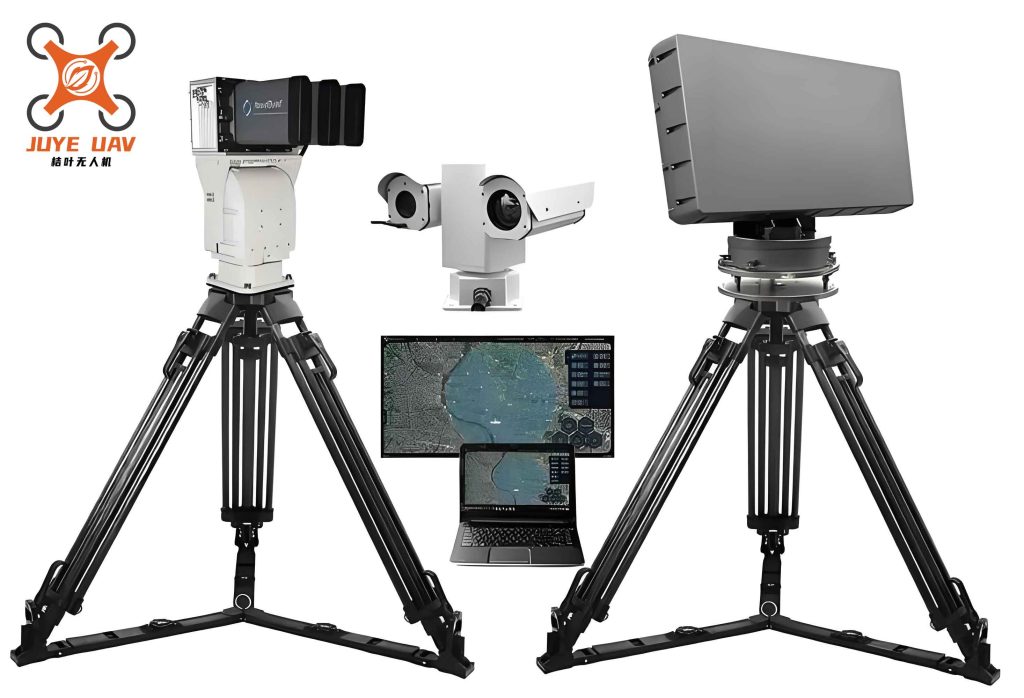
A modern “anti-drone” system is not a single device but a layered, integrated architecture. As illustrated, it typically combines detection sensors (radar, RF scanners, electro-optical/infrared cameras) with mitigation effectors (directed RF jammers, GPS spoofers, net cannons). The fusion center is crucial, using artificial intelligence to correlate sensor data, classify threats, and select the most appropriate, proportionate response—ideally one that minimizes spectrum disruption.
Strengthening Regulatory Architecture and Collaborative Governance
Technology must operate within a clear and enforceable legal and regulatory framework. Governance must evolve from siloed agency actions to a unified, proactive model.
- Unified Regulatory Platform & Increased Penalties: Establishing a national or regional low-altitude activity management platform that integrates data from aviation, law enforcement, and radio monitoring agencies is paramount. This platform should log authorized “anti-drone” system deployments and actively scan for unauthorized emissions. Simultaneously, penalties for illegal manufacture, sale, and use of “anti-drone” devices must be significantly heightened, incorporating substantial fines, criminal liability for severe outcomes, and inclusion of violations in corporate and individual credit records.
- Dynamic Spectrum Management: Regulators should explore dynamic spectrum access schemes for UAV C2 links, allowing them to operate in temporarily vacant bands (e.g., TV white spaces) to avoid congestion and present a less predictable target for jammers. The spectrum efficiency $\eta$ in a managed zone could be improved:
$$ \eta = \frac{\sum_{i=1}^{N} B_i \cdot \log_2(1 + SINR_i)}{B_{total}} $$
where a higher $\eta$ indicates better utilization of total bandwidth $B_{total}$ by $N$ users, contingent on maintaining a sufficient signal-to-interference-plus-noise ratio ($SINR$).
Fostering Industry Self-Discipline and Public Awareness
Top-down regulation is most effective when complemented by bottom-up responsibility and a vigilant public.
- Industry Alliances and Standards: Forming industry consortia to establish technical and ethical standards for “anti-drone” device development and deployment is crucial. Members should commit to strict compliance, undergo regular audits, and face industry sanctions for violations. Such alliances can also pool resources for joint R&D in precision mitigation technologies.
- Comprehensive Training and Certification: Mandatory certification programs for “anti-drone” system operators should be instituted, covering legal knowledge, spectrum awareness, and precise operational procedures to prevent accidental interference.
- Public普法宣传 Campaigns: Widespread educational campaigns are needed to inform the public and potential end-users (e.g., private companies, event venues) about the severe legal and safety consequences of illicit “anti-drone” device use. Awareness initiatives should promote reporting of suspicious interference.
| Governance Pillar | Core Actions | Expected Outcome |
|---|---|---|
| Legal & Regulatory | Establish unified oversight platforms; enact and enforce stringent penalties; define clear licensing for “anti-drone” use. | High deterrence against misuse; clear accountability; streamlined incident response. |
| Technological | Advance precision “anti-drone” systems; mandate and subsidize anti-jamming tech in UAVs; deploy intelligent spectrum monitoring networks. | Minimized collateral interference; resilient low-altitude operations; rapid interference source identification. |
| Market & Industry | Enforce strict type-approval for devices; foster industry self-regulation alliances; create certification for operators. | Purged market of non-compliant gear; promoted ethical practices; professionally trained personnel. |
| Societal | Launch public awareness campaigns; establish protected zone advisories; encourage public reporting mechanisms. | Informed and compliant user base; enhanced community vigilance; stronger societal oversight. |
Conclusion
The sustainable growth of the low-altitude economy is inextricably linked to solving the paradox of “anti-drone” radio interference. Unchecked, such interference acts as a significant brake on development, eroding safety, causing economic harm, and polluting the shared electromagnetic commons. The path forward requires abandoning isolated solutions in favor of an integrated governance model. This model must synchronously advance precision “anti-drone” technology, craft and enforce a robust legal-regulatory framework with meaningful deterrence, cultivate responsible industry self-discipline, and elevate public awareness. Only through this concerted, multi-stakeholder approach—where technological innovation is guided by clear rules and ethical standards—can we secure the electromagnetic spectrum as a safe and reliable foundation. This will allow the immense economic and societal potential of drones to be fully realized, ensuring that the sky remains a domain of opportunity, not conflict. The future of the low-altitude economy depends not just on our ability to fly, but on our collective wisdom to manage and protect the invisible pathways that make flight possible.