
In recent years, the proliferation of civilian drones has introduced unprecedented security challenges for correctional facilities worldwide. As an expert in prison safety and technological countermeasures, I have observed a rising trend of illicit activities facilitated by drones, including contraband delivery, information theft, escape assistance, and potential terrorist attacks. These incidents underscore a critical vulnerability in traditional ground-based security systems, necessitating an urgent shift toward integrated low-altitude anti-drone defenses. The development of such anti-drone capabilities is not merely an option but a imperative driven by警务 reform, smart prison initiatives, and advancements in industry technology. In this article, I will explore the multifaceted threats posed by drones, the pressing need for anti-drone solutions, and the strategic pathways for implementing robust low-altitude security measures. By leveraging tables and formulas, I aim to provide a comprehensive analysis that highlights the importance of proactive anti-drone strategies in safeguarding correctional environments.
The threat landscape for correctional facilities has expanded vertically with the advent of drones. Traditionally, security focused on perimeter walls, ground patrols, and entry-point controls, but drones now enable unauthorized aerial incursions that bypass these defenses. Based on my research and case studies, I categorize the primary threats into several types, each with distinct implications for prison safety. To illustrate, I present a table summarizing these threats along with hypothetical examples, as real incidents from the source material cannot be directly cited due to confidentiality. This table encapsulates the core risks that anti-drone systems must address.
| Threat Type | Description | Potential Impact |
|---|---|---|
| Contraband Delivery | Drones used to smuggle items like drugs, weapons, or phones into prisons. | Increases inmate violence, compromises security, and facilitates criminal activities. |
| Information Theft | Drones equipped with cameras to capture sensitive operational details or inmate data. | Leads to privacy breaches, operational exposure, and potential planning of escapes. |
| Escape Assistance | Drones providing tools, maps, or communication devices to aid inmate escapes. | Poses direct risks to public safety and undermines the integrity of the correctional system. |
| Terrorist Attacks | Drones modified to carry explosives or hazardous materials for targeted assaults. | Could result in mass casualties, structural damage, and psychological terror. |
| Accidental Incursions | Non-malicious drone flights that violate airspace due to hobbyist activities. | Causes disruptions, false alarms, and potential accidents within facility grounds. |
From my perspective, the frequency and sophistication of these threats are escalating, driven by the affordability and accessibility of drone technology. For instance, the global consumer drone market has seen exponential growth, with millions of units sold annually, increasing the probability of misuse. This trend demands a proactive anti-drone approach that integrates detection, identification, and neutralization capabilities. The effectiveness of an anti-drone system can be modeled using probabilistic formulas. For example, the probability of detecting a drone within a given time frame can be expressed as: $$ P_d(t) = 1 – e^{-\lambda t} $$ where \( P_d(t) \) is the detection probability, \( \lambda \) is the average detection rate per unit time, and \( t \) is the time interval. This formula underscores the importance of continuous monitoring in anti-drone operations, as longer surveillance periods enhance the likelihood of intercepting threats.
The demand for low-altitude anti-drone security in correctional facilities arises from multiple dimensions, including regulatory reforms, practical necessities, and innovation drives. In my analysis, I identify three core needs that justify the investment in anti-drone infrastructure. First, there is a reformative need aligned with smart警务 initiatives. Current prison security standards often lack explicit guidelines for aerial defense, leaving gaps that anti-drone technologies can fill. For example, while some regulations mention anti-aircraft measures for high-security prisons, detailed protocols are absent. Anti-drone systems offer a way to standardize and modernize these aspects, enabling a shift from planar to three-dimensional security paradigms. Second, the practical need is evident from the increasing number of drone incursions reported globally. Prisons are transitioning from ground-centric to air-ground integrated mindsets, with many facilities already deploying anti-drone equipment such as radar detectors and signal jammers. This reflects a growing consensus that anti-drone measures are essential for comprehensive safety. Third, an innovative need stems from collaboration between correctional authorities and technology firms. Customized anti-drone solutions are being co-developed to meet specific prison requirements, fostering advancements in both security and industry. I summarize these needs in the following table to emphasize their interdependency.
| Need Category | Key Drivers | Anti-Drone Implications |
|---|---|---|
| Reformative Need | Evolution of警务 strategies and智慧 prison frameworks. | Anti-drone systems become integral to next-generation security standards. |
| Practical Need | Rising incidents of drone invasions and contraband smuggling. | Urgent deployment of anti-drone technologies for real-time threat mitigation. |
| Innovative Need | Partnerships with tech companies for tailored solutions. | Enhanced anti-drone capabilities through research and development. |
To address these needs, I propose a multifaceted construction path for implementing anti-drone security in correctional facilities. This path encompasses expanding multidimensional perspectives, refining technical customizations, and building协同 platforms. From my viewpoint, each element is critical for achieving effective anti-drone defenses. Starting with multidimensional perspectives, prisons must establish clear no-fly zones enforced through legal and technological means. Collaboration with external agencies like law enforcement and aviation authorities is vital to regulate drone usage and penalize violations. Internally, anti-drone protocols should integrate with existing security operations, ensuring swift responses to incursions. For instance, when an anti-drone system detects a threat, it should trigger automated alerts to command centers, followed by coordinated ground-air interventions. This requires standardizing procedures across departments to eliminate response gaps.
In terms of technical customization, selecting appropriate anti-drone technologies is paramount. Based on prison environments—characterized by fixed perimeters, dense populations, and concentrated security forces—certain methods prove more suitable. For detection, radio frequency (RF) scanning is often optimal due to its ability to identify drone communications without line-of-sight constraints. The detection range can be approximated by: $$ R = \sqrt{\frac{P_t G_t G_r \lambda^2}{(4\pi)^2 P_{min}}} $$ where \( R \) is the detection range, \( P_t \) is the transmitter power, \( G_t \) and \( G_r \) are antenna gains, \( \lambda \) is the wavelength, and \( P_{min} \) is the minimum detectable power. This formula highlights how anti-drone systems can be tuned for maximum coverage. For neutralization, interference-based anti-drone devices are preferred, as they disrupt drone controls without causing physical damage—a consideration for legal and safety reasons. These include signal jammers that force drones to land or return, and net-capture drones for emergency takedowns. Additionally, training specialized personnel in anti-drone operations is crucial. Prisons should form dedicated teams proficient in operating anti-drone equipment, conducting drills, and staying updated on evolving threats. I emphasize that continuous education is key to maintaining anti-drone readiness, as technology advances rapidly.
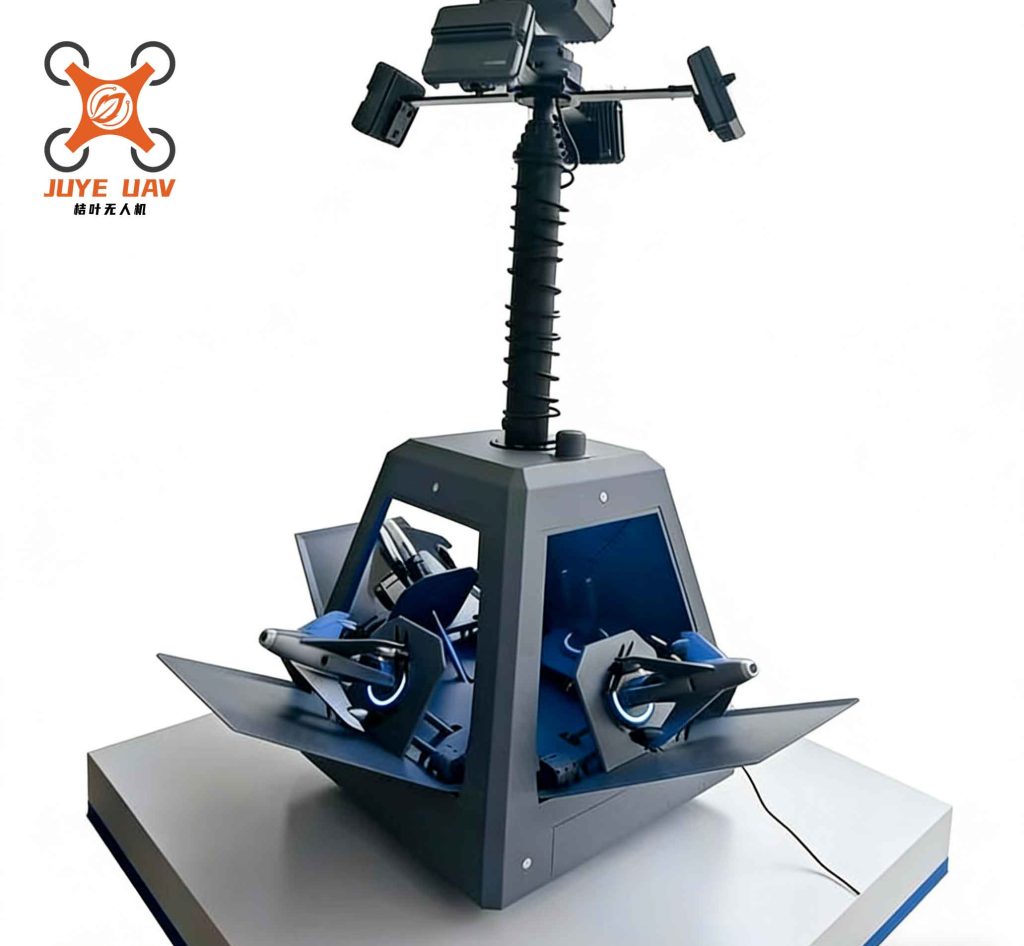
The image above illustrates a typical anti-drone system in action, showcasing how integrated technologies can monitor and respond to aerial threats. Such visual aids reinforce the practicality of anti-drone deployments in correctional settings. Moving to协同 platforms, anti-drone systems must seamlessly interface with existing security infrastructures. This involves data integration with video surveillance,地理 information systems, and alarm networks to enable holistic monitoring. For example, anti-drone alerts can be fed into prison management platforms, allowing real-time decision-making. Furthermore, partnerships between prisons and public security agencies enhance anti-drone efficacy through shared intelligence and joint exercises. Prisons can leverage police expertise in drone forensics and regulatory enforcement, while contributing to broader public safety initiatives. Similarly, ongoing collaboration with anti-drone technology providers ensures system updates and tailored support. These synergies are encapsulated in the formula for overall security effectiveness: $$ E_s = \alpha D + \beta N + \gamma C $$ where \( E_s \) is the security effectiveness score, \( D \) represents detection capabilities, \( N \) denotes neutralization success, \( C \) stands for协同 factors, and \( \alpha, \beta, \gamma \) are weighting coefficients based on prison-specific priorities. This model underscores that anti-drone efforts are not standalone but part of a larger ecosystem.
To further elaborate on technical aspects, I present a comparison of common anti-drone technologies in the table below. This analysis draws from my experience in evaluating systems for prison applications, focusing on their suitability for low-altitude defense.
| Technology Type | Mechanism | Advantages for Anti-Drone Use | Limitations |
|---|---|---|---|
| RF Detection | Monitors radio signals between drone and controller. | Non-line-of-sight, effective in cluttered environments. | May struggle with encrypted or autonomous drones. |
| Radar Systems | Uses electromagnetic waves to detect moving objects. | Long-range, good for perimeter coverage. | High cost, potential false alarms from birds. |
| Optical Sensors | Employs cameras or infrared for visual identification. | Provides visual confirmation, useful for取证. | Weather-dependent, limited at night or in fog. |
| Signal Jammers | Disrupts GPS and control signals to disable drones. | Immediate neutralization, non-lethal. | Legal restrictions, may affect nearby communications. |
| Net-Capture Drones | Deploys nets to physically intercept rogue drones. | Precise takedown, minimizes collateral damage. | Requires skilled operators, shorter range. |
In implementing these anti-drone solutions, prisons must consider cost-benefit analyses. The investment in anti-drone infrastructure can be justified by risk reduction metrics. For instance, the expected loss from drone incidents can be calculated as: $$ L = \sum (p_i \cdot c_i) $$ where \( L \) is the total expected loss, \( p_i \) is the probability of threat type \( i \), and \( c_i \) is the associated cost. By deploying anti-drone systems, prisons aim to minimize \( p_i \), thereby lowering \( L \). This economic perspective reinforces the value of proactive anti-drone measures. Additionally, regular audits and simulations should be conducted to assess anti-drone performance. Using statistical models, prisons can optimize sensor placement and response times. For example, the optimal number of anti-drone sensors \( n \) for a given area \( A \) can be derived from: $$ n = \frac{A \cdot \rho}{\pi r^2} $$ where \( \rho \) is the desired coverage density and \( r \) is the sensor radius. Such formulas aid in strategic planning for anti-drone networks.
Looking ahead, the evolution of anti-drone technology will likely incorporate artificial intelligence and machine learning to predict and preempt threats. From my viewpoint, prisons should stay abreast of these trends to future-proof their defenses. For example, AI-powered anti-drone systems can analyze flight patterns to distinguish between benign and malicious drones, reducing false positives. The learning process can be modeled as: $$ \text{Accuracy} = f(\text{training data}, \text{algorithm complexity}) $$ where higher-quality data and advanced algorithms improve anti-drone discrimination. Moreover, international cooperation on anti-drone standards will facilitate interoperability between prisons and global security networks. This aligns with the broader goal of creating resilient correctional environments where anti-drone capabilities are as routine as ground patrols.
In conclusion, the integration of low-altitude anti-drone security into correctional facilities is a critical step toward addressing modern aerial threats. Through my analysis, I have highlighted the diverse risks posed by drones, the compelling needs for anti-drone solutions, and actionable paths for implementation. By adopting multidimensional strategies, customizing technologies, and fostering协同 platforms, prisons can build robust anti-drone defenses that complement existing security frameworks. The repeated emphasis on anti-drone throughout this article underscores its centrality in contemporary prison safety. As drones continue to proliferate, proactive anti-drone measures will be indispensable for maintaining the integrity and security of correctional institutions worldwide. I advocate for ongoing research and investment in anti-drone initiatives to ensure that prisons remain impervious to evolving challenges from the skies.