
In recent conflicts, unmanned aerial vehicles (UAVs) have played a pivotal role, leading to a surge in their numbers on the battlefield. This proliferation has driven a robust demand for anti-drone technologies and equipment. As an observer of modern warfare trends, I find it crucial to analyze the evolution of anti-drone systems, focusing on their capabilities, limitations, and emerging innovations. This article delves into the current state of anti-drone装备, highlighting key developments and offering insights into future directions. The term “anti-drone” will be frequently emphasized to underscore the centrality of counter-UAV measures in contemporary defense strategies.
The operational workflow of anti-drone systems typically involves three sequential steps: detection, identification, and suppression. This process can be represented as a chain where each step is critical for effective neutralization. Mathematically, the overall effectiveness \( E \) of an anti-drone system can be modeled as a product of the probabilities of success at each stage:
$$E = P_d \times P_i \times P_s$$
where \( P_d \) is the probability of detection, \( P_i \) is the probability of correct identification, and \( P_s \) is the probability of successful suppression. Factors such as signal-to-noise ratio (SNR) for sensors and environmental conditions influence these probabilities. For instance, detection probability often follows a relationship like:
$$P_d = 1 – e^{-\frac{SNR}{\theta}}$$
where \( \theta \) is a threshold parameter dependent on sensor technology.
Anti-drone装备 employ a variety of suppression手段, each with distinct advantages and disadvantages. To systematically compare these, I have compiled a table categorizing representative systems based on their kill mechanism. This table expands on known classifications to include recent innovations.
| Suppression Type | Sub-category | Example Systems (Generic) | Key Advantages | Key Disadvantages | Typical Range |
|---|---|---|---|---|---|
| Kinetic Hard-Kill | Fixed/Semi-fixed | Intercept missiles, ballistic cannons | High single-target kill probability, long range | High cost per engagement, risk of collateral damage, ineffective against swarms | > 5 km |
| Mobile/Installable | Collision drones, net-based capture | Reusable, precise engagement | Limited magazine capacity, shorter range | 100 m – 2 km | |
| Handheld | Drone-catching guns, net launchers | Portability, rapid deployment | Very short range, requires operator skill | < 100 m | |
| Non-Kinetic Hard-Kill | Laser | High-energy laser weapons | Speed-of-light engagement, low cost per shot, precision | High initial cost, atmospheric attenuation, power requirements | 1 – 5 km |
| High-Power Microwave (HPM) | Area effect, effective against swarms, flexible platform integration | Potential for fratricide, limited range on ground platforms | 500 m – 2 km | ||
| Soft-Kill | Radio Frequency (RF) Jamming/Deception | GPS/GLONASS jammers, signal spoofers, command link disruptors | Low cost per use, can capture drones intact, mature technology | Requires knowledge of drone communication protocols, can be bypassed by autonomous drones | 1 – 10 km |
The choice of anti-drone technology often involves trade-offs. For example, kinetic systems excel against single threats but struggle with saturation attacks. The effectiveness of jamming, a core soft-kill anti-drone method, can be analyzed using communication theory. The jamming-to-signal ratio (JSR) is a critical metric:
$$JSR = \frac{P_j G_j R_d^2}{P_s G_s R_j^2}$$
where \( P_j \) and \( P_s \) are the jammer and signal transmitter powers, \( G_j \) and \( G_s \) are their antenna gains, and \( R_j \) and \( R_d \) are distances from the jammer to the receiver and from the transmitter to the receiver, respectively. Successful anti-drone jamming typically requires JSR > 1.
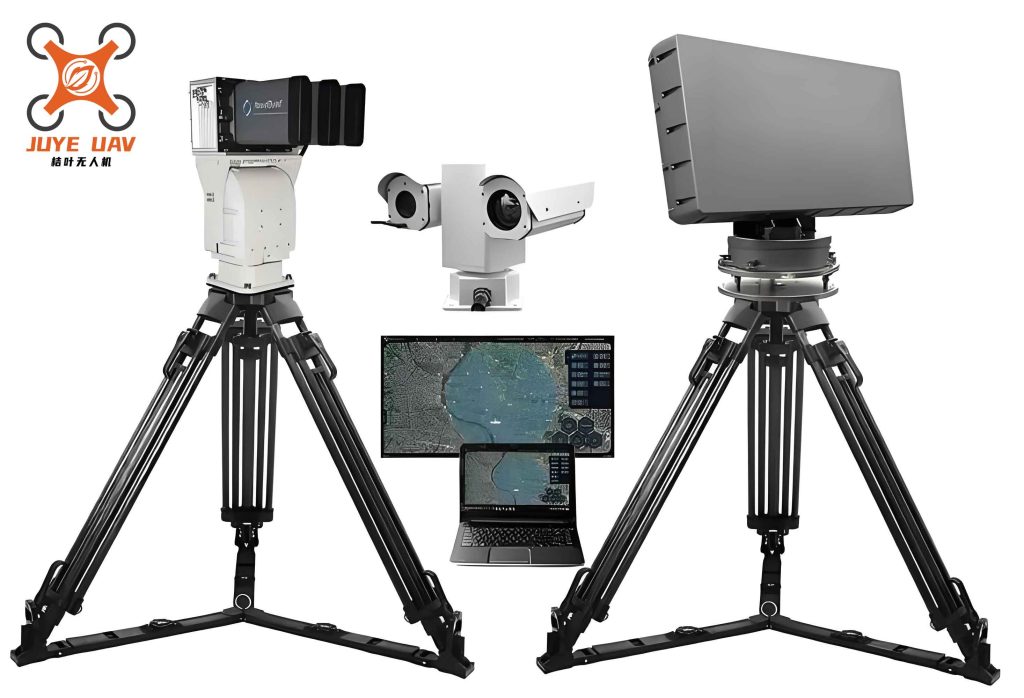
The visual representation above underscores the complexity of modern anti-drone scenarios, where multiple systems may need to interoperate. Recent conflicts have served as testing grounds, accelerating the development of anti-drone solutions. I observe four particularly notable new technologies or approaches shaping the anti-drone landscape.
First, artificial intelligence (AI) is revolutionizing anti-drone capabilities. AI-enhanced systems improve the detection and identification phases by filtering out false alarms (e.g., birds) and classifying drone types in real-time. Machine learning algorithms can predict drone flight paths and recommend optimal suppression measures. For instance, an AI-driven anti-drone system might analyze radar and electro-optical data to compute a threat score \( T \) for each track:
$$T = w_1 \cdot V + w_2 \cdot A + w_3 \cdot P$$
where \( V \) is velocity deviation from normal patterns, \( A \) is altitude risk factor, \( P \) is proximity to critical assets, and \( w_i \) are AI-learned weights. This allows for autonomous or semi-autonomous engagement decisions, significantly reducing operator workload and reaction time. The integration of AI into anti-drone networks is a key trend, making systems more adaptive against evolving drone tactics.
Second, friend-or-foe identification (IFF) for drones is emerging as a critical anti-drone enabler. By equipping friendly drones with miniature IFF transponders, they can be electronically tagged, preventing fratricide by anti-drone systems. This effectively turns the identification problem into a simpler binary check: any unmarked aircraft in protected airspace is deemed hostile. The reliability of such a system depends on the IFF interrogation-success probability \( P_{iff} \), which must be very high to avoid both false negatives (missing hostile drones) and false positives (attacking friendly ones). This approach directly supports anti-drone operations by clearing the engagement space.
Third, aerostat-based anti-drone systems offer a novel, low-cost physical interception method. These systems use tethered balloons or dirigibles equipped with nets or other payloads to create a barrier. When a drone is detected, the aerostat is deployed to entangle or capture the intruder. The effectiveness can be modeled considering the aerostat’s coverage area \( A_c \) and the drone’s penetration speed \( v \):
$$P_{intercept} = 1 – e^{-\lambda A_c t}$$
where \( \lambda \) is the drone arrival rate and \( t \) is the response time. While limited in range and mobility, aerostats provide a persistent, reusable layer of defense for point protection, adding to the diversity of anti-drone tools.
Fourth, the concept of “drone vs. drone” has matured into dedicated anti-drone unmanned platforms. These interceptor drones can engage hostile UAVs kinetically (via collision or nets) or electronically (by emitting jamming signals from close proximity). A key advantage is their ability to pursue threats in complex terrain. The engagement dynamics can be described as a pursuit-evasion problem. For a collision kill, the interceptor drone’s guidance law might minimize the time to intercept, governed by equations of motion:
$$\frac{d\mathbf{r}}{dt} = \mathbf{v}_t – \mathbf{v}_i$$
where \( \mathbf{r} \) is the relative position vector, and \( \mathbf{v}_t \) and \( \mathbf{v}_i \) are the target and interceptor velocity vectors, respectively. Optimal control theory is applied to compute the interceptor’s trajectory. This anti-drone method is highly flexible and can be deployed rapidly.
Given the diversity of threats, a layered, integrated approach is paramount for effective anti-drone defense. No single system can address all scenarios, from slow consumer drones to high-speed military UAVs and coordinated swarms. A holistic anti-drone architecture should combine sensors and effectors across domains. The following table outlines a notional multi-layer defense concept:
| Layer | Range Band | Primary Sensors | Primary Effectors | Anti-Drone Function |
|---|---|---|---|---|
| Long-Range | > 10 km | Long-range radar, SIGINT | Surface-to-air missiles, electronic warfare (EW) jammers | Early warning, engagement of high-altitude/large UAVs |
| Medium-Range | 1 – 10 km | Medium-range radar, EO/IR, RF detectors | HPM systems, laser weapons, net-based interceptor drones | Neutralization of drone groups and swarms |
| Short-Range/Point Defense | < 1 km | Acoustic sensors, short-range radar, cameras | Handheld jammers, micro-interceptor drones, aerostat nets, kinetic energy weapons | Last-ditch protection of critical assets |
The synergy between layers can be expressed as an overall system reliability \( R_{sys} \) for defeating a raid of \( N \) drones:
$$R_{sys} = 1 – \prod_{k=1}^{N} (1 – P_{kill}(k))$$
where \( P_{kill}(k) \) is the probability that the layered defense kills the \( k \)-th drone, dependent on the combined performance of all layers. Maximizing \( R_{sys} \) requires careful integration and data fusion.
Within this layered approach, electronic warfare (EW)手段 deserve special emphasis for anti-drone missions. EW, encompassing jamming, spoofing, and cyber takeovers, offers a cost-effective and scalable solution. The appeal of anti-drone EW lies in its ability to neutralize threats without physical destruction, potentially allowing for capture and analysis. As drones increasingly use commercial communication links and satellite navigation, EW provides a broad attack surface. The effectiveness of a jamming anti-drone system against a frequency-hopping drone control link can be analyzed using probability of bit error \( P_b \) under jamming:
$$P_b = Q\left(\sqrt{\frac{2E_b}{N_0 + J_0}}\right)$$
where \( E_b \) is energy per bit, \( N_0 \) is noise power spectral density, and \( J_0 \) is the jamming power spectral density. Sufficient jamming power (\( J_0 \)) can drive \( P_b \) high enough to break the link. Future anti-drone EW systems must evolve to counter autonomous drones and encrypted links, possibly using AI to generate adaptive jamming waveforms.
In conclusion, the dynamic between drone advancement and anti-drone countermeasures is a classic arms race, accelerated by real-world conflict. The future of anti-drone defense lies in intelligent, networked, and multi-domain systems that leverage AI, novel platforms like interceptor drones and aerostats, and robust IFF to deconflict engagements. Continuous innovation in both kinetic and non-kinetic realms, particularly in directed energy and EW, will be essential to maintain an edge. As drone threats become more pervasive and intelligent, so too must the anti-drone systems designed to stop them. The integration of all these elements into a cohesive, responsive shield will define the success of future air defense architectures.