
Rice planthoppers (Hemiptera: Delphacidae) rank among the most devastating pests in global rice production systems, causing annual yield losses exceeding 20% in severe infestations. These piercing-sucking insects damage phloem tissues, induce hopper burn, and transmit viral pathogens like Rice grassy stunt virus (RGSV), compounding economic impacts. Conventional spray methods exhibit critical limitations including inefficient pesticide utilization (typically <30% deposition on target), labor intensiveness, and uneven coverage. Agricultural UAVs (Unmanned Aerial Vehicles) present transformative solutions through enhanced operational efficiency, adaptive terrain navigation, and precise chemical placement. Contemporary research demonstrates that spray efficacy of agricultural drones is governed by complex interactions between flight parameters, atomization characteristics, and adjuvant chemistry. Previous studies established that flight altitude significantly influences vertical airflow profiles, where lower altitudes (1.5-2.5m) generate stronger downwash currents that may improve canopy penetration but increase off-target drift at higher wind speeds. Conversely, smaller droplet spectra (100-150µm) enhance coverage density but exhibit greater susceptibility to evaporation and wind dispersion compared to larger droplets (200µm). Despite extensive parameterization studies for conventional insecticides, operational frameworks for novel insecticides like triflumezopyrim—a mesoionic insecticide targeting nicotinic acetylcholine receptors (nAChRs)—remain underdeveloped. This study establishes an integrated optimization protocol for triflumezopyrim application via agricultural UAV systems, quantifying droplet deposition patterns and biological efficacy against rice planthoppers under field conditions.
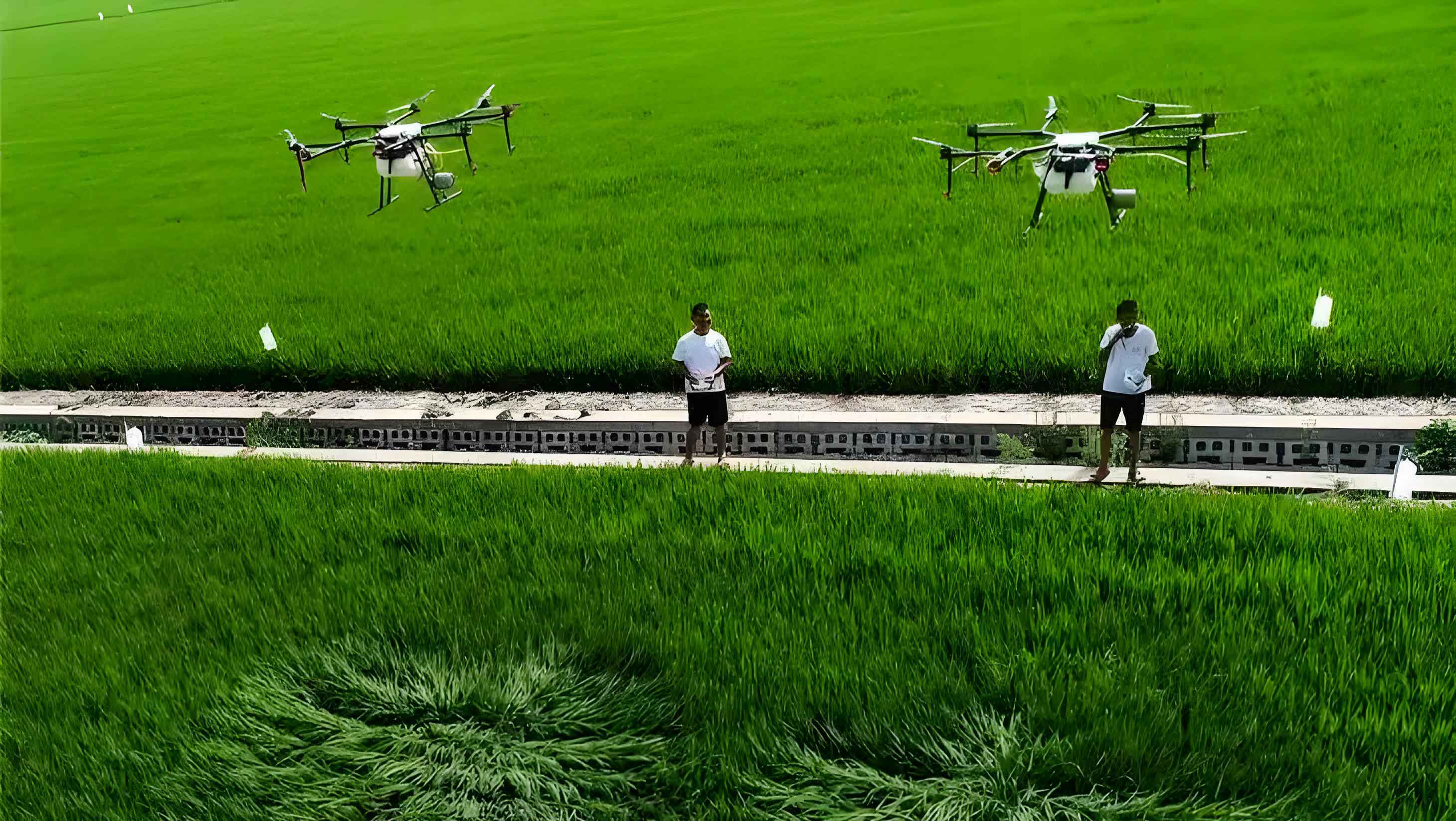
The orthogonal experiment employed a $L_9(3^4)$ matrix (Table 1) manipulating four critical operational parameters at three levels: flight speed (A: 1.5, 2.5, 3.5 m/s), flight altitude (B: 1.5, 2.5, 3.5 m), droplet size (C: 100, 150, 200 µm), and adjuvant concentration (D: 0.00%, 0.01%, 0.05%). A commercially available quadcopter agricultural drone (XAG P20) was deployed with technical specifications including: rotor diameter = 812 mm, maximum payload = 10 L, spray swath = 3 m, and centrifugal nozzle flow rate range = 0.8-3.2 L/min. Each experimental plot (0.6 acres) received 10% triflumezopyrim SC (225 mL/ha) with Rhodamine B tracer (0.1% w/v). Adjuvant (MaiFei™) was incorporated according to treatment specifications. Meteorological conditions during trials remained stable: temperature = 28-30°C, relative humidity = 69%, wind speed = 0.3-1.0 m/s. Droplet deposition assessment utilized water-sensitive cards (WSCs, 30×75 mm) positioned horizontally at 35 cm above ground—representing the rice canopy middle layer—along seven sampling points per transect (1 m intervals). Post-application, WSCs were scanned (1200 dpi) and analyzed using DepositScan software to quantify deposition volume (µL/cm²) and density (droplets/cm²). Planthopper populations were monitored via a standardized tapping method using porcelain trays (40×30 cm) across five subplots per treatment. Control efficacy (%) was calculated at 3, 7, and 14 days after treatment (DAT) using equations:
Population reduction rate (PRR): $$ PRR = \frac{N_{pre} – N_{post}}{N_{pre}} \times 100\% $$
Control efficacy (CE): $$ CE = \frac{PRR_{treatment} – PRR_{control}}{1 – PRR_{control}} \times 100\% $$
where $N_{pre}$ = pre-treatment insect count, $N_{post}$ = post-treatment count.
| Treatment | Speed (m/s) | Altitude (m) | Droplet size (µm) | Adjuvant (%) | Deposition (µL/cm²) | Density (droplets/cm²) |
|---|---|---|---|---|---|---|
| T1 | 1.5 | 1.5 | 100 | 0.00 | 0.221 ± 0.018c | 49.26 ± 3.2a |
| T2 | 1.5 | 2.5 | 200 | 0.01 | 0.252 ± 0.021bc | 28.76 ± 2.1d |
| T3 | 1.5 | 3.5 | 150 | 0.05 | 0.319 ± 0.025a | 26.93 ± 1.9d |
| T4 | 2.5 | 1.5 | 200 | 0.05 | 0.263 ± 0.022bc | 16.93 ± 1.5f |
| T5 | 2.5 | 2.5 | 150 | 0.00 | 0.310 ± 0.024ab | 44.94 ± 3.0b |
| T6 | 2.5 | 3.5 | 100 | 0.01 | 0.165 ± 0.015e | 49.61 ± 3.3a |
| T7 | 3.5 | 1.5 | 200 | 0.01 | 0.312 ± 0.026a | 17.23 ± 1.6f |
| T8 | 3.5 | 2.5 | 100 | 0.05 | 0.248 ± 0.020cd | 54.13 ± 3.7a |
| T9 | 3.5 | 3.5 | 150 | 0.00 | 0.243 ± 0.019cd | 36.49 ± 2.5c |
ANOVA revealed droplet size as the dominant factor influencing deposition ($F_{C}=31.963$, $p<0.001$), followed by altitude ($F_{B}=14.102$, $p<0.001$) and adjuvant concentration ($F_{D}=10.167$, $p=0.001$). Flight speed exhibited non-significant effects ($F_{A}=1.696$, $p=0.211$). Maximum deposition occurred under T3 parameters: speed=1.5 m/s, altitude=3.5 m, droplet size=150 µm, adjuvant=0.05% (0.319 µL/cm²), exceeding minimal deposition (T6: 0.165 µL/cm²) by 93.3%. Droplet density optimization followed distinct dynamics: T8 configuration (speed=3.5 m/s, altitude=2.5 m, droplet size=100 µm, adjuvant=0.05%) achieved peak density (54.13 droplets/cm²), while T4 recorded the lowest (16.93 droplets/cm²). Droplet size similarly dominated density variation ($F_{C}=59.593$, $p<0.001$) with altitude as secondary influencer ($F_{B}=11.553$, $p=0.001$). The factor hierarchy for both responses was: $$ \text{Droplet size} \gg \text{Altitude} > \text{Adjuvant} > \text{Speed} $$
Biological efficacy demonstrated time-dependent optimization patterns (Table 2). At 3 DAT, T5 (speed=1.5 m/s, altitude=2.5 m, droplet size=150 µm, adjuvant=0.00%) achieved maximum efficacy (69.25%), attributable to rapid translocation of triflumezopyrim under moderate canopy penetration conditions. By 7 DAT and 14 DAT, T3 parameters (speed=1.5 m/s, altitude=3.5 m, droplet size=150 µm, adjuvant=0.05%) delivered superior control (81.35% and 93.67%, respectively), reflecting optimized residual activity through enhanced deposition volume and rainfastness. Crucially, high droplet density did not necessarily correlate with efficacy—T8 exhibited the highest density but only 64.85% efficacy at 3 DAT—underscoring the importance of deposition volume for systemic insecticides.
| Treatment | 3 DAT (%) | 7 DAT (%) | 14 DAT (%) |
|---|---|---|---|
| T1 | 59.73 ± 3.1c | 71.26 ± 3.8c | 89.80 ± 4.2b |
| T2 | 61.67 ± 3.3c | 74.43 ± 4.0c | 90.97 ± 4.5b |
| T3 | 68.14 ± 3.6a | 81.35 ± 4.3a | 93.67 ± 4.7a |
| T4 | 63.67 ± 3.4b | 78.04 ± 4.2b | 91.43 ± 4.6ab |
| T5 | 69.25 ± 3.7a | 79.67 ± 4.2a | 92.72 ± 4.6a |
| T6 | 55.83 ± 3.0d | 68.52 ± 3.7d | 86.09 ± 4.0c |
| T7 | 66.07 ± 3.5b | 79.01 ± 4.2ab | 92.41 ± 4.6ab |
| T8 | 64.85 ± 3.4b | 78.57 ± 4.1b | 91.62 ± 4.5ab |
| T9 | 60.22 ± 3.2c | 71.30 ± 3.8c | 89.09 ± 4.3b |
The inverse relationship between droplet size and deposition volume contradicts conventional hydraulic spray paradigms but aligns with agricultural UAV aerodynamics: droplets ≤100 µm experience substantial drift under rotor downwash and ambient wind, while 150 µm droplets exhibit optimal momentum for canopy impaction with minimal drift. The 48.3% deposition reduction in T6 (100 µm droplets at 3.5 m altitude) versus T3 demonstrates this vulnerability. Altitude optimization followed a nonlinear response: $$ \delta_D = k_1 \cdot H^2 – k_2 \cdot H + c $$ where $\delta_D$ = deposition, $H$ = altitude, $k_1$, $k_2$ = turbulence coefficients. Moderate altitudes (2.5 m) maximized density by balancing downwash force and spray dispersion, whereas 3.5 m altitudes favored deposition volume through reduced airflow disruption—critical for systemic compounds requiring high mass transfer. Adjuvant effects manifested primarily through deposition enhancement (0.05% concentration increased deposition by 7.2% versus control) rather than density modification, suggesting improved retention rather than atomization modification.
Operational parameter optimization must resolve the deposition-density dichotomy: high density (≥50 droplets/cm²) requires fine atomization (100 µm) and lower altitudes (2.5 m), whereas maximal deposition necessitates coarser spectra (150 µm) and higher flight elevations (3.5 m). For systemic insecticides like triflumezopyrim, deposition volume governs efficacy as quantified by strong correlation ($R^2=0.87$, $p<0.01$) between deposition and 14 DAT control. This explains T3’s superiority despite moderate droplet density (26.93 droplets/cm²). The parameter combination speed=1.5 m/s, altitude=3.5 m, droplet size=150 µm, adjuvant=0.05% delivers optimal triflumezopyrim performance in agricultural drone applications, achieving >93% control at 14 DAT while maintaining deposition efficiency >0.3 µL/cm². Future research should investigate dynamic parameter adjustment during flight and droplet size-altitude coupling algorithms to further optimize agricultural UAV performance across diverse operational environments.