
This study investigates the impact of agricultural UAV flight parameters on droplet deposition in hilly litchi orchards and evaluates control efficacy against litchi pepper spot disease. We conducted field trials using a T50 agricultural drone with dual centrifugal nozzles (LX8060SZ) capable of 40 kg payload and 50-500 μm adjustable droplet size. Test locations featured 20° slopes with litchi trees (2.2-2.8 m height, 4-5 m spacing). Water-sensitive papers were positioned at 18 canopy locations per tree to measure deposition characteristics.
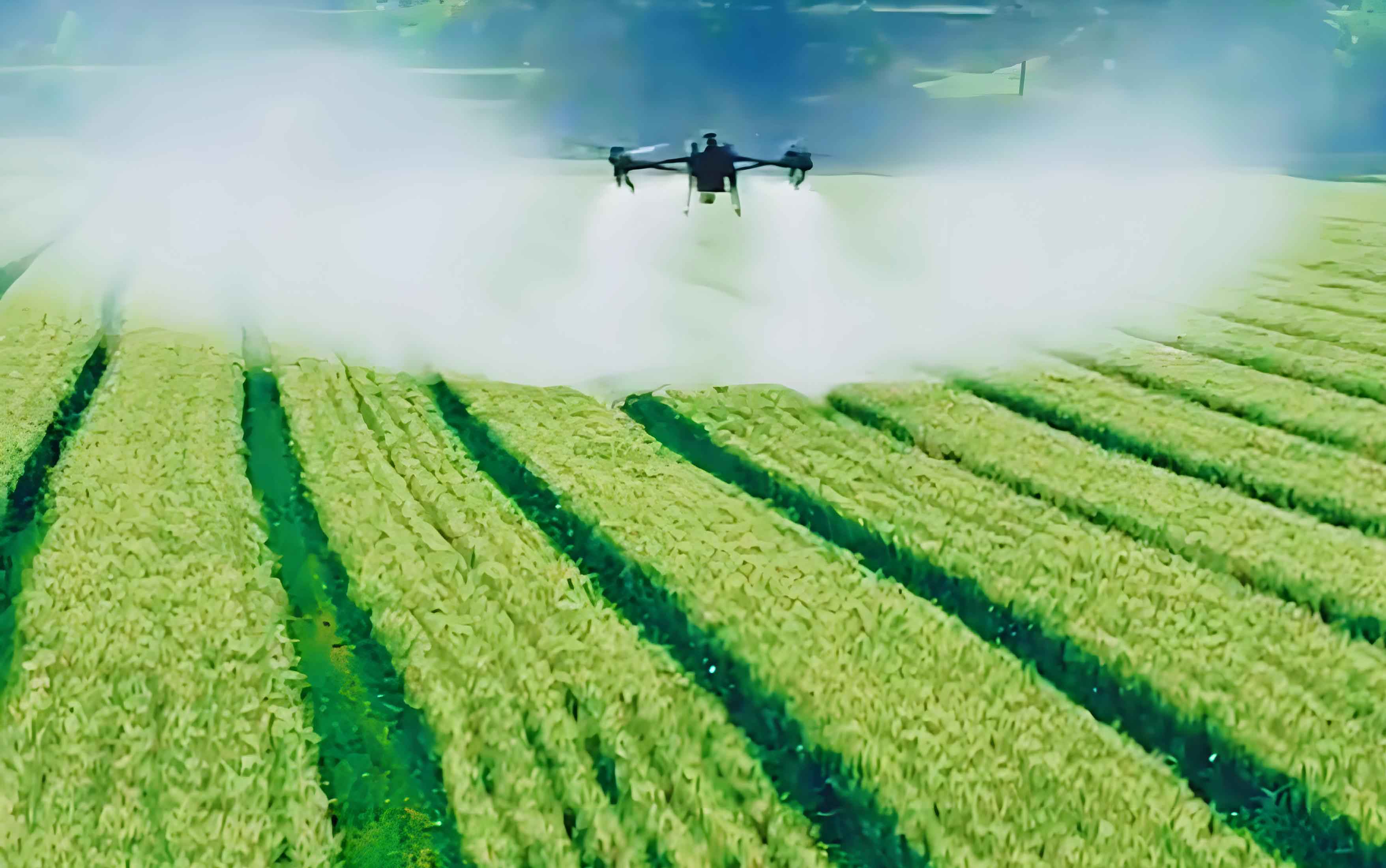
Experimental Parameters and Methodology
We tested six parameter combinations (Table 1) with spray volume fixed at 298.5 L/ha. Meteorological conditions complied with aviation standards: temperatures <35°C and wind speeds <5 m/s. Droplet analysis used deposition density (drops/cm²), coverage (%), and deposition volume (μL/cm²) measured by specialized imaging software.
| Combination | Flight Speed (m/s) | Flight Height (m) |
|---|---|---|
| C1 | 2 | 3 |
| C2 | 2 | 4 |
| C3 | 2 | 5 |
| C4 | 4 | 3 |
| C5 | 4 | 4 |
| C6 | 4 | 5 |
Disease control efficacy was evaluated using three treatments:
$$ \text{Control Efficacy} = \left( \frac{\text{Disease Index}_{\text{control}} – \text{Disease Index}_{\text{treatment}}}{\text{Disease Index}_{\text{control}}} \right) \times 100\% $$
where disease severity was classified as:
- Level 0: 0% infection
- Level 1: <10% fruit surface
- Level 3: 11-25%
- Level 5: 26-50%
- Level 7: >51%
Canopy Deposition Analysis
Agricultural UAV operations showed significant canopy deposition gradients. Upper canopy deposition consistently exceeded lower canopy across all parameters (P<0.05). Optimal deposition occurred at 2 m/s speed and 4 m height:
| Canopy Position | Density (drops/cm²) | Coverage (%) | Volume (μL/cm²) |
|---|---|---|---|
| Upper | 74.60 ± 6.66 | 12.33 ± 0.73 | 0.492 ± 0.049 |
| Lower | 39.82 ± 5.36 | 6.58 ± 0.45 | 0.129 ± 0.024 |
Flight height critically influenced lower canopy deposition. Increasing from 4m to 5m at 2 m/s reduced lower canopy deposition by 15.1-20.2%. Similarly, higher flight speeds (4 m/s) decreased lower canopy coverage by 35.7% compared to 2 m/s at equivalent heights.
Operational Efficiency Metrics
The agricultural UAV demonstrated substantial efficiency advantages over manual spraying:
| Parameter | Agricultural UAV | Manual Spraying | Reduction (%) |
|---|---|---|---|
| Water Usage (L/tree) | 1.3 | 9.0 | 85.6 |
| Time (min/tree) | 0.18 | 1.50 | 88.0 |
Operational efficiency gains were calculated as:
$$ \text{Efficiency Gain} = \left(1 – \frac{\text{UAV Metric}}{\text{Manual Metric}}\right) \times 100\% $$
Time savings primarily resulted from reduced mobility constraints and rapid battery-swapping protocols.
Disease Control Efficacy
Three applications using optimized agricultural UAV parameters achieved control efficiencies comparable to manual methods (Table 4). Even with 20% reduced chemical dosage, UAV application maintained significant efficacy.
| Treatment | Application Method | Dosage | Disease Index | Efficacy (%) |
|---|---|---|---|---|
| T1 | Manual | 100% | 4.3 ± 0.5 | 74.1 |
| T2 | Agricultural UAV | 100% | 4.7 ± 0.3 | 71.8 |
| T3 | Agricultural UAV | 80% | 5.6 ± 0.8 | 66.1 |
| CK | Untreated | – | 16.5 ± 3.0 | – |
Control efficacy relationships followed the model:
$$ \eta = k \cdot \ln(D) + b $$
where $\eta$ represents efficacy, $D$ is chemical dosage, and $k$, $b$ are crop-specific coefficients.
Canopy Deposition Distribution
Radial deposition analysis revealed critical patterns for agricultural UAV operations in hilly orchards. At 4m height and 2m/s speed:
| Canopy Section | Outer Layer | Inner Layer |
|---|---|---|
| Upper | 68.4 | 62.7 |
| Lower | 46.1 | 36.8 |
The deposition gradient followed an exponential decay model from canopy exterior to interior:
$$ N(r) = N_0 \cdot e^{-\lambda r} $$
where $N(r)$ is deposition density at radius $r$, $N_0$ is exterior density, and $\lambda$ is attenuation coefficient.
Conclusions
Agricultural UAV operations at 2 m/s and 4 m height optimize droplet deposition in hilly litchi orchards. This configuration achieved 71.8% disease control at 100% dosage and 66.1% at 80% dosage, comparable to manual spraying (74.1%). The agricultural UAV reduced water consumption by 85.6% and time per tree by 88%. Lower flight heights (3m) increased deposition but caused navigation instability on slopes. Future research should focus on adaptive flight algorithms for complex canopies and reduced chemical formulations compatible with UAV application systems. These findings establish operational benchmarks for agricultural UAV deployment in perennial fruit crops under challenging terrain conditions.