
From my perspective as a defense analyst observing the trajectory of modern warfare, the role of the **military UAV** has transitioned from a peripheral support asset to a central pillar of strategic and tactical planning. The operational lessons from conflicts over the past decades have been unequivocal. I have seen how these systems successfully executed reconnaissance, battlefield surveillance, target designation, and deception missions, proving their worth beyond doubt. This proven utility has catalyzed a global focus on their advancement. It is my firm belief that we are on the cusp of a revolution where the **military UAV** will not merely supplement but could fundamentally reshape the aerial battlespace. The trajectory points toward a future where a significant portion of combat aircraft will be unmanned, driven by relentless advancements in automation, artificial intelligence, and systems integration. The core vectors of this evolution are clear: enhanced stealth, extreme endurance, radical miniaturization, and potent attack capabilities. The convergence of these technologies will produce **military UAVs** that are far more capable, survivable, and influential than their predecessors.
The historical employment of the **military UAV** provided the initial proof of concept. Initially deployed for hazardous reconnaissance missions, these systems demonstrated a unique value proposition: the ability to gather critical intelligence without risking a pilot’s life. This attribute alone guaranteed their continued development. However, early generations were vulnerable. Their lack of stealth made them susceptible to modern air defenses, as evidenced by high loss rates in contested environments. This vulnerability highlighted the first major developmental imperative for the next-generation **military UAV**: survivability through stealth.
In contemporary and future conflict scenarios characterized by “non-contact” warfare, long-range strikes, and precision engagement, stealth is not a luxury but a necessity. My analysis of emerging threats indicates that penetrating sophisticated integrated air defense systems requires a very low observable signature. The technical challenge involves minimizing the Radar Cross-Section (RCS). The RCS ($\sigma$) of a **military UAV** is a complex function of its geometry, materials, and the radar wavelength ($\lambda$). A simplified approximation for a perfectly conducting sphere, though not directly applicable to complex shapes, illustrates the scale dependency:
$$\sigma = \pi r^2$$
where $r$ is the radius. For operational UAVs, engineers employ shaping, radar-absorbent materials (RAM), and structural techniques to reduce RCS by orders of magnitude. The goal is to push the UAV’s signature into the realm of small birds or insects, making detection, tracking, and engagement profoundly difficult for enemy systems. Nations are actively developing high-altitude, long-endurance (HALE) stealth **military UAVs** designed to operate persistently in denied airspace, carrying sensors or even air-to-air missiles for specialized missions like intercepting ballistic missiles in their boost phase. The advancement of composite materials and tailored RAM coatings, initially pioneered for crewed fighters, is now being aggressively adapted for unmanned platforms, ensuring the future **military UAV** fleet will be far more elusive.
| Technique | Description | Impact on Military UAV |
|---|---|---|
| Geometric Shaping | Designing airframes with flat, angled surfaces to deflect radar waves away from the source. | Fundamental reduction of RCS; dictates the platform’s external form. |
| Radar-Absorbent Materials (RAM) | Special coatings and structures that convert radar wave energy into heat. | Absorbs residual energy not deflected by shaping; applied to edges, intakes, and leading edges. |
| Structural & Engine Design | S-shaped engine inlets, shielded exhausts, and internal weapon bays. | Minimizes radar and infrared signatures from high-reflectivity and high-heat areas. |
| Active Cancellation | Emerging technology to emit a counter-phase signal to cancel out reflected radar waves. | Potential for dynamic signature management, adapting to different threat radars. |
Closely linked to survivability is the requirement for persistence. The concept of the “long-endurance” **military UAV** has redefined aerial surveillance and patrol. From my examination of operational needs, the demand for uninterrupted, real-time intelligence over a vast Area of Interest (AoI) has skyrocketed. While satellites provide broad coverage, they lack the persistent stare and tactical flexibility of an airborne platform. A **military UAV** capable of loitering for 24, 48, or even hundreds of hours becomes a transformative strategic asset. The endurance ($E$) of such a platform is primarily a function of its fuel energy capacity ($Q_{fuel}$), its aerodynamic efficiency expressed as the lift-to-drag ratio ($L/D$), and its propulsive efficiency ($\eta_p$). A basic relationship can be framed using the Breguet endurance equation for a propeller-driven aircraft cruising at constant speed and altitude:
$$E = \frac{\eta_p}{g} \cdot \frac{L}{D} \cdot \frac{1}{SFC} \cdot \ln\left(\frac{W_{initial}}{W_{final}}\right)$$
where $g$ is gravity, $SFC$ is the specific fuel consumption of the engine, and $W_{initial}/W_{final}$ is the ratio of initial to final weight (mostly fuel burn). This equation highlights the pathways to extreme endurance: maximizing aerodynamic efficiency ($L/D$), using highly efficient, low-SFC engines (or solar-electric systems), and carrying a large fuel mass fraction. High-Altitude Long-Endurance (HALE) **military UAVs** like the conceptual solar-powered designs aim for stratospheric flight and endurance measured in months, acting as quasi-satellites. At the theater level, Medium-Altitude Long-Endurance (MALE) **military UAVs** provide the crucial link, conducting pre-strike reconnaissance, persistent target tracking, and battle damage assessment, forming the backbone of the intelligence, surveillance, and reconnaissance (ISR) network.
| Category | Typical Altitude | Endurance | Primary Role | Example (Conceptual) |
|---|---|---|---|---|
| High-Altitude Long-Endurance (HALE) | > 15,000 m | > 24 hours (up to months) | Strategic wide-area ISR, Communications relay | Solar-powered stratospheric UAV |
| Medium-Altitude Long-Endurance (MALE) | 5,000 – 15,000 m | 24 – 48 hours | Theater-level ISR, Targeted surveillance | Predator-type UAV |
| Tactical Long-Endurance | 1,000 – 5,000 m | 12 – 24 hours | Direct support to brigade/regiment, localized overwatch | Enhanced tactical UAV systems |
The trend toward miniaturization represents a parallel and equally revolutionary path for the **military UAV**. My focus on future urban and special operations scenarios reveals a critical need for discreet, organic sensing at the small-unit level. The Micro Air Vehicle (MAV), with a wingspan or length under 15-20 cm, fulfills this need. These platforms are not merely scaled-down models; they represent a confluence of nanotechnology, micro-electromechanical systems (MEMS), and advanced low-Reynolds number aerodynamics. The flight dynamics at this scale are dominated by viscous forces. The Reynolds number ($Re$), which compares inertial to viscous forces, is very low:
$$Re = \frac{\rho v L}{\mu}$$
where $\rho$ is air density, $v$ is velocity, $L$ is a characteristic length (e.g., chord length), and $\mu$ is dynamic viscosity. A low $Re$ (often $< 100,000$ for MAVs) leads to challenges like laminar flow separation and low aerodynamic efficiency, requiring innovative wing designs (often inspired by insects or hummingbirds). The power and payload constraints are severe. The energy density of micro-batteries ($E_{bat}$) limits mission duration. The available electrical power ($P_{avail}$) must balance the needs of propulsion ($P_{prop}$), avionics ($P_{av}$), and payload ($P_{pay}$):
$$P_{avail} = \eta_{bat} \cdot E_{bat} \cdot t^{-1} \geq P_{prop} + P_{av} + P_{pay}$$
where $\eta_{bat}$ is battery discharge efficiency and $t$ is time. Advances in materials, micro-sensors (tiny cameras, chemical detectors), and communication links are making these palm-sized **military UAVs** a reality for indoor reconnaissance, surveillance of structural “dead zones,” and even targeted payload delivery in complex terrain.
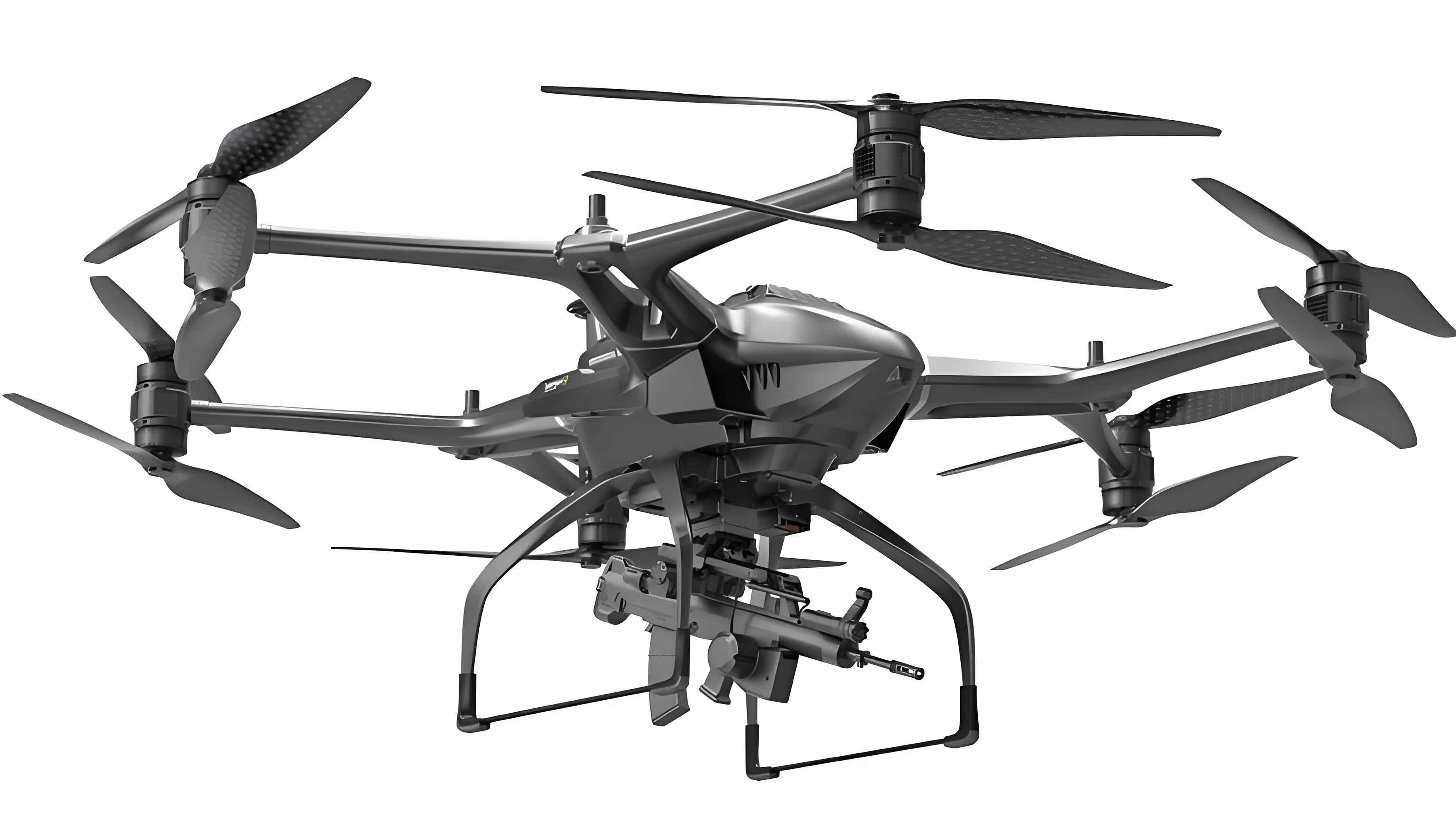
Perhaps the most significant evolution is the transformation of the **military UAV** from a sensor platform to a shooter. The armed **military UAV**, or Unmanned Combat Aerial Vehicle (UCAV), embodies this shift. I distinguish between two primary types: the loitering munition (or “suicide drone”) and the reusable combat drone. The loitering munition, such as anti-radiation systems, is essentially a smart missile with long dwell time. It can be modeled as a trade-off between loiter time ($T_{loiter}$) and engagement radius ($R_{eng}$), given a total energy budget. The reusable UCAV, however, is a more complex system. It involves the integration of weapons bays, targeting systems, and secure datalinks for human-in-the-loop control or increasingly autonomous engagement. The key advantage is risk transfer: high-threat missions can be prosecuted without pilot loss. The development of associated technologies like automatic target recognition (ATR), cooperative engagement algorithms, and secure beyond-line-of-sight communications is critical. From my assessment, the progression is toward greater autonomy, but within a framework of human supervision for lethal decisions. The performance parameters for a next-generation UCAV would rival those of crewed fighters: high subsonic or supersonic dash speeds, significant weapon payload ($W_{pay}$), and combat radius ($R_{combat}$). The design challenge is integrating these capabilities without the life-support systems needed for a pilot, allowing for more optimal airframe designs focused purely on the mission.
| Type | Representative Mission | Control Mode | Key Performance Metrics | Operational Advantage |
|---|---|---|---|---|
| Loitering Munition | SEAD/DEAD, Anti-Radiation, Point Attack | Pre-programmed with terminal homing | Loiter Time, Seeker Acuity, Warhead Lethality | Low cost, high risk-acceptance, persistent threat presence |
| Reconnaissance-Strike UAV | Time-Sensitive Target (TST) Strike | Human-in-the-loop via satellite link | Endurance, Sensor Quality, Weapons Payload (2-4 missiles) | Persistent armed overwatch, rapid reaction to emerging targets |
| Unmanned Combat Aerial Vehicle (UCAV) | Penetrating Strike, Air Interdiction, Escort | Mixed-initiative (Human supervises, machine executes) | Low Observability, High Payload, High Agility, Combat Radius | Performs high-risk missions, designs optimized for performance not human physiology |
| Loyal Wingman Drone | Manned-Unmanned Teaming (MUM-T) | Networked with and controlled by a lead crewed fighter | Data-link robustness, Autonomous formation flying, Weapon capacity | Force multiplier for crewed aircraft, extends sensor and weapon reach, absorbs threat |
The synergistic advancement across these four domains—stealth, endurance, miniaturization, and armament—will have a profound and complex impact on future air warfare. In my view, the future fleet will be a heterogeneous mix. It will feature stealthy, penetrating UCAVs operating ahead of manned formations; “loyal wingman” drones networked with sixth-generation fighters; swarms of small, attritable **military UAVs** for saturation attacks or distributed sensing; and stratospheric HALE platforms providing continuous broad-area awareness. This ecosystem will demand new doctrines, training paradigms, and command-and-control architectures. The decision-making loop, often described by the OODA (Observe, Orient, Decide, Act) cycle, will be compressed and distributed. AI-enabled **military UAVs** will handle more of the “Observe” and “Orient” functions at machine speed, presenting human commanders with refined options for the “Decide” and “Act” phases. Furthermore, the cost-exchange ratio in conflict may shift. Defending against a large, coordinated mix of low-observable, long-endurance, and micro **military UAVs** could become economically and tactically prohibitive for an adversary.
In conclusion, the trajectory for the **military UAV** is one of exponential growth in capability and strategic importance. The foundational technologies in materials science, artificial intelligence, propulsion, and miniaturization are converging to create a new generation of unmanned systems. These systems will be characterized by their ability to persist unseen for extraordinary durations, to operate at scales from the palm-sized to the global, and to deliver precise lethal effects. This evolution is not merely about replacing the pilot in the cockpit; it is about redefining the very geometry, tempo, and logic of aerial combat. The integration of these advanced **military UAVs** will create a more networked, resilient, and potent force structure. As these platforms become more autonomous and capable, they will inevitably raise important ethical and policy questions regarding the use of force. However, from a purely technical and operational standpoint, I am confident that the **military UAV** will be the dominant and most transformative aerial asset of the coming decades, reshaping defense postures and military strategies worldwide.