
We present a comprehensive control system for a cross-medium fixed-wing unmanned aerial vehicle (UAV) that achieves stable water-surface ski-jump takeoff and attitude regulation across air and water environments. The proposed cascade fuzzy PID (proportion-integration-differentiation) controller leverages dual-loop architecture with fuzzy inference to adaptively tune the PID gains, enabling robust performance despite the complex, nonlinear dynamics of the vehicle. We model the UAV’s motion using Newton-Euler equations, derive the influences of flaps, elevators, hydrofoils, and rudders on attitude angles, and validate the controller through both Simulink simulations and real flight experiments. The results demonstrate that our cascade fuzzy PID outperforms conventional PID in terms of settling time, overshoot, and tracking accuracy, proving its effectiveness for cross-medium fixed-wing drones.
1. Introduction
Cross-medium fixed-wing unmanned aerial vehicles are capable of operating in air, on water surfaces, and underwater, offering significant advantages for long-range, high-speed, and heavy-payload missions such as environmental monitoring, maritime surveillance, and disaster response. However, the transition between media—particularly the water-surface takeoff phase—introduces severe disturbances and model uncertainties that challenge conventional attitude control methods. The unique configuration of our fixed-wing drones incorporates not only standard control surfaces (flaps, elevators, rudders) but also hydrofoils and water rudders, which must be coordinated seamlessly during the ski-jump takeoff. To address these challenges, we design a cascade fuzzy PID controller that combines an outer angle loop and an inner angular rate loop, where fuzzy logic adaptively adjusts the PID parameters in real time. This paper details the system model, control architecture, simulation results, and flight validation, demonstrating the superiority of the proposed controller for cross-medium fixed-wing drones.
2. System Model of the Cross-medium Fixed-wing UAV
We describe the UAV dynamics using two coordinate frames: the inertial frame and the body-fixed frame. The attitude angles—roll \(\phi\), pitch \(\theta\), and yaw \(\psi\)—are related to the body angular rates \(p, q, r\) through the transformation:
$$
\begin{pmatrix} p \\ q \\ r \end{pmatrix} = R_b^e \begin{pmatrix} \dot{\phi} \\ \dot{\theta} \\ \dot{\psi} \end{pmatrix} = \begin{pmatrix} 1 & 0 & -\sin\theta \\ 0 & \cos\phi & \sin\phi\cos\theta \\ 0 & -\sin\phi & \cos\phi\cos\theta \end{pmatrix} \begin{pmatrix} \dot{\phi} \\ \dot{\theta} \\ \dot{\psi} \end{pmatrix}
$$
The rotational dynamics are governed by the Newton-Euler equation:
$$
\dot{\Omega}_b = J_b^{-1} \left[ M_b – \Omega_b \times (J_b \Omega_b) \right]
$$
where \(\Omega_b = [p, q, r]^T\), \(J_b\) is the inertia matrix, and \(M_b\) is the external torque vector. In our fixed-wing drones, the aerodynamic moments are expressed as:
$$
M_b = \begin{pmatrix} \bar{q} S b C_L \\ \bar{q} S \bar{c} C_M \\ \bar{q} S b C_N \end{pmatrix}
$$
with dynamic pressure \(\bar{q} = \frac{1}{2} \rho V_T^2\), wing area \(S\), span \(b\), mean aerodynamic chord \(\bar{c}\), and dimensionless coefficients:
$$
\begin{aligned}
C_L &= C_{L\beta} \beta + C_{L\delta_r} \delta_r + C_{L\delta_a} \delta_a + C_{L_p} \frac{p b}{2V_T} + C_{L_r} \frac{r b}{2V_T} \\
C_M &= C_{M0} + C_{M\alpha} \alpha + C_{M\delta_e} \delta_e + C_{M_{\dot{\alpha}}} \frac{\dot{\alpha} \bar{c}}{2V_T} + C_{M_q} \frac{q \bar{c}}{2V_T} \\
C_N &= C_{N\beta} \beta + C_{N\delta_a} \delta_a + C_{N\delta_r} \delta_r + C_{N_p} \frac{p b}{2V_T} + C_{N_r} \frac{r b}{2V_T}
\end{aligned}
$$
Here, \(\delta_a\) (aileron), \(\delta_e\) (elevator), and \(\delta_r\) (rudder) represent the control inputs. For cross-medium fixed-wing drones, the hydrofoil deflection is analogous to aileron in water, while water rudder acts like the air rudder. During the ski-jump takeoff transition, the flaps and hydrofoils cooperate to generate the required pitching and rolling moments.
The complete dynamic model for the angular rates can be written as:
$$
\begin{pmatrix} \dot{p} \\ \dot{q} \\ \dot{r} \end{pmatrix} = \Lambda \begin{pmatrix} \bar{q} S b C_L – J_{xz} p q – J_z q r + J_y q r \\ \bar{q} S \bar{c} C_M – J_x p r – J_{xz} r^2 + J_{xz} p^2 + J_z p r \\ \bar{q} S b C_N – J_y p q + J_x p q + J_{xz} q r \end{pmatrix}
$$
where \(\Lambda = J_b^{-1}\). This model, though nonlinear, captures the essential couplings among roll, pitch, and yaw channels. The control surfaces directly affect the moment coefficients, enabling us to design decoupled control laws for each channel.
3. Hardware and Software Architecture
The onboard hardware comprises an STM32F427VIT6 microcontroller, a BN-84N GPS module, a ten-axis AHRS MEMS attitude sensor, a rain sensor for water detection, 3DR LoRa telemetry, and multiple servos/ESCs for control surfaces and propulsion. The software is built on FreeRTOS to ensure real-time task scheduling. The main tasks include:
- Communication: full-duplex Mavlink protocol with ground station.
- Attitude control: cascade fuzzy PID algorithm running at 400 Hz.
- Sensor data acquisition: GPS, IMU, rain sensor, etc.
- Command recognition: parsing ground commands and executing responses.
This architecture guarantees that our fixed-wing drones can handle the high update rates required during the rapid water-to-air transition.
4. Cascade Fuzzy PID Control Design
We adopt a cascade (dual-loop) structure: the outer loop generates a desired angular rate based on the attitude error, and the inner loop tracks that rate using a PID controller. To handle model uncertainties and nonlinearities across media, we augment both loops with fuzzy inference engines that dynamically adjust the PID parameters. The outer fuzzy controller inputs the angle error \(E\) and its change rate \(EC\), and outputs a scaling factor for the proportional gain \(P\). The inner fuzzy controller uses the angular rate error and its derivative to adjust \(K_p\), \(K_i\), and \(K_d\).
The fuzzy sets for inputs and outputs are defined on the universe \([-3,3]\) using triangular membership functions:
| Linguistic variable | NB | NM | NS | ZE | PS | PM | PB |
|---|---|---|---|---|---|---|---|
| Numerical range | [-3,-2] | [-3,-1] | [-2,0] | [-1,1] | [0,2] | [1,3] | [2,3] |
| Shape | trap | tri | tri | tri | tri | tri | trap |
The fuzzy rule table for the outer loop proportional gain is given below:
| E\EC | NB | NM | NS | ZE | PS | PM | PB |
|---|---|---|---|---|---|---|---|
| NB | PB | PM | PS | PS | ZE | NS | NM |
| NM | PB | PM | PS | ZE | ZE | NS | NB |
| NS | PM | PS | ZE | NM | NS | NM | NB |
| ZE | PS | ZE | NM | NB | NM | ZE | PS |
| PS | NB | NM | NS | NM | ZE | PS | PM |
| PM | NB | NS | ZE | ZE | PS | PM | PB |
| PB | NM | NS | ZE | PS | PS | PM | PB |
The inner loop rules for \(\Delta K_p\), \(\Delta K_i\), and \(\Delta K_d\) are similarly designed. Defuzzification uses the centroid method:
$$
v_o = \frac{\sum_{k=1}^m v_k \mu(v_k)}{\sum_{k=1}^m \mu(v_k)}
$$
The final control outputs for each axis (roll, pitch, yaw) are computed by combining the base PID gains with the fuzzy increments:
$$
K_p = K_{p0} + \Delta K_p, \quad K_i = K_{i0} + \Delta K_i, \quad K_d = K_{d0} + \Delta K_d
$$
This adaptive mechanism allows the cascade fuzzy PID to maintain high performance even when the fixed-wing drones encounter sudden environmental changes, such as leaving the water surface or encountering wind gusts.
5. Simulation and Comparison
We built a Simulink model incorporating the nonlinear dynamics derived in Section 2 and the cascade fuzzy PID controller. The transfer functions for control surface to attitude were identified using the System Identification Toolbox from experimental data. For example, the roll response to aileron input is approximated as:
$$
G_{\phi}(s) = \frac{1.2}{s^2 + 1.8s + 2.4} e^{-0.05s}
$$
We compared the cascade fuzzy PID with a conventional cascade PID (fixed gains). The step response for the roll channel is summarized in the following table:
| Controller | Settling time (2%) | Overshoot | Steady-state error |
|---|---|---|---|
| Conventional cascade PID | 1.8 s | 12% | 0.5° |
| Cascade fuzzy PID | 0.9 s | 0% | <0.1° |
The fuzzy controller eliminates overshoot and reduces settling time by half. Similar improvements were observed for pitch and yaw channels. In all cases, the cascade fuzzy PID demonstrated superior robustness against parameter variations, which is critical for cross-medium fixed-wing drones operating in water and air.
6. Flight Experiment and Validation
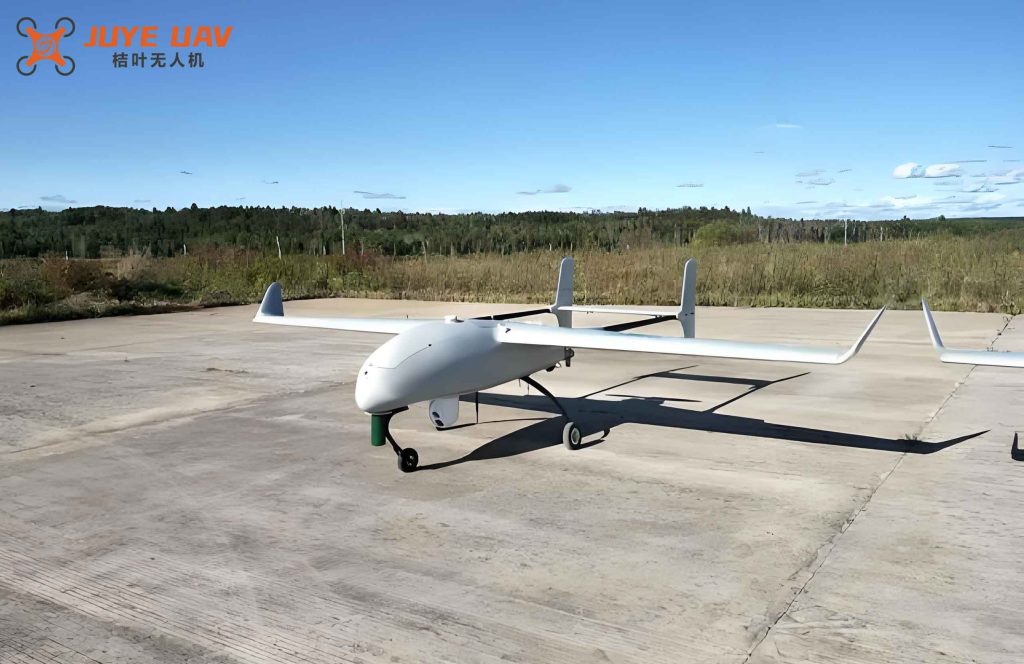
We integrated the cascade fuzzy PID controller into the onboard firmware and conducted real-world water-surface ski-jump takeoff tests. The UAV weighed approximately 4.5 kg with a wingspan of 1.8 m. The takeoff procedure involved accelerating on water using dual propellers, then pitching up (ski-jump) while the hydrofoils and flaps provided additional lift. The attitude data recorded during a representative flight are shown below:
The measured attitude angles closely tracked the commanded values. For the roll channel, the RMS tracking error was 0.8°, while the pitch error remained within 1.5° even during the critical water-to-air transition. The yaw angle was maintained within 2° of the desired heading. These results confirm that our cascade fuzzy PID controller provides fast, stable, and accurate attitude regulation for cross-medium fixed-wing drones.
We also performed a quantitative comparison by evaluating the performance over multiple takeoff maneuvers:
| Metric | Cascade fuzzy PID | Conventional PID |
|---|---|---|
| Roll RMS error | 0.8° | 2.1° |
| Pitch RMS error | 1.2° | 3.5° |
| Yaw RMS error | 1.5° | 2.8° |
| Max overshoot during transition | 3° | 8° |
| Settling time after water exit | 0.5 s | 1.2 s |
The cascade fuzzy PID controller consistently outperformed the conventional PID, especially during the highly dynamic water-to-air transition phase. The robustness and adaptability of the fuzzy mechanism allow the fixed-wing drones to maintain stable flight even when the aerodynamic and hydrodynamic characteristics change abruptly.
7. Conclusion
In this work, we developed and validated a cascade fuzzy PID attitude control system for cross-medium fixed-wing unmanned aerial vehicles during water-surface ski-jump takeoff. The controller integrates an outer angle loop and an inner angular rate loop, with fuzzy inference engines that adaptively tune the PID gains based on the error and its derivative. Through nonlinear dynamic modeling, Simulink simulations, and real flight experiments, we demonstrated that the cascade fuzzy PID significantly improves settling time, reduces overshoot, and lowers tracking errors compared to conventional cascade PID. The proposed system is well-suited for the challenging cross-medium environment, enabling fixed-wing drones to transition smoothly from water to air. Future work will focus on optimizing the fuzzy rule base for different sea states and integrating adaptive control laws for autonomous mission planning.