
As I delve into the advancements of military UAV systems in 2024, it is evident that these platforms have become pivotal in reshaping modern warfare. From my perspective, the rapid evolution in technology, coupled with increasing adoption across global militaries, underscores the transformative impact of military UAVs. This review aims to systematically analyze the key developments, focusing on in-development systems, operational deployments, critical technologies, and emerging trends. The integration of artificial intelligence, enhanced autonomy, and collaborative capabilities has propelled military UAVs into new realms of effectiveness, making them indispensable assets in both tactical and strategic operations. Throughout this analysis, I will emphasize the multifaceted roles of military UAVs, highlighting how innovations in 2024 have set the stage for future conflicts and defense strategies.
The proliferation of military UAVs in 2024 can be attributed to several factors, including reduced costs, improved reliability, and the urgent demands of contemporary battlefields. In my observation, conflicts such as those in Ukraine have served as testing grounds, accelerating the deployment and refinement of military UAV technologies. This year has seen a surge in both state and non-state actors leveraging military UAVs for surveillance, strike missions, and electronic warfare, thereby altering the dynamics of power projection. As I explore these aspects, I will provide detailed insights into the specific systems and technologies that have defined the year, using tables and formulas to summarize complex data and relationships. The focus remains on how military UAVs are evolving to meet diverse operational needs, from high-altitude endurance to close-combat support.
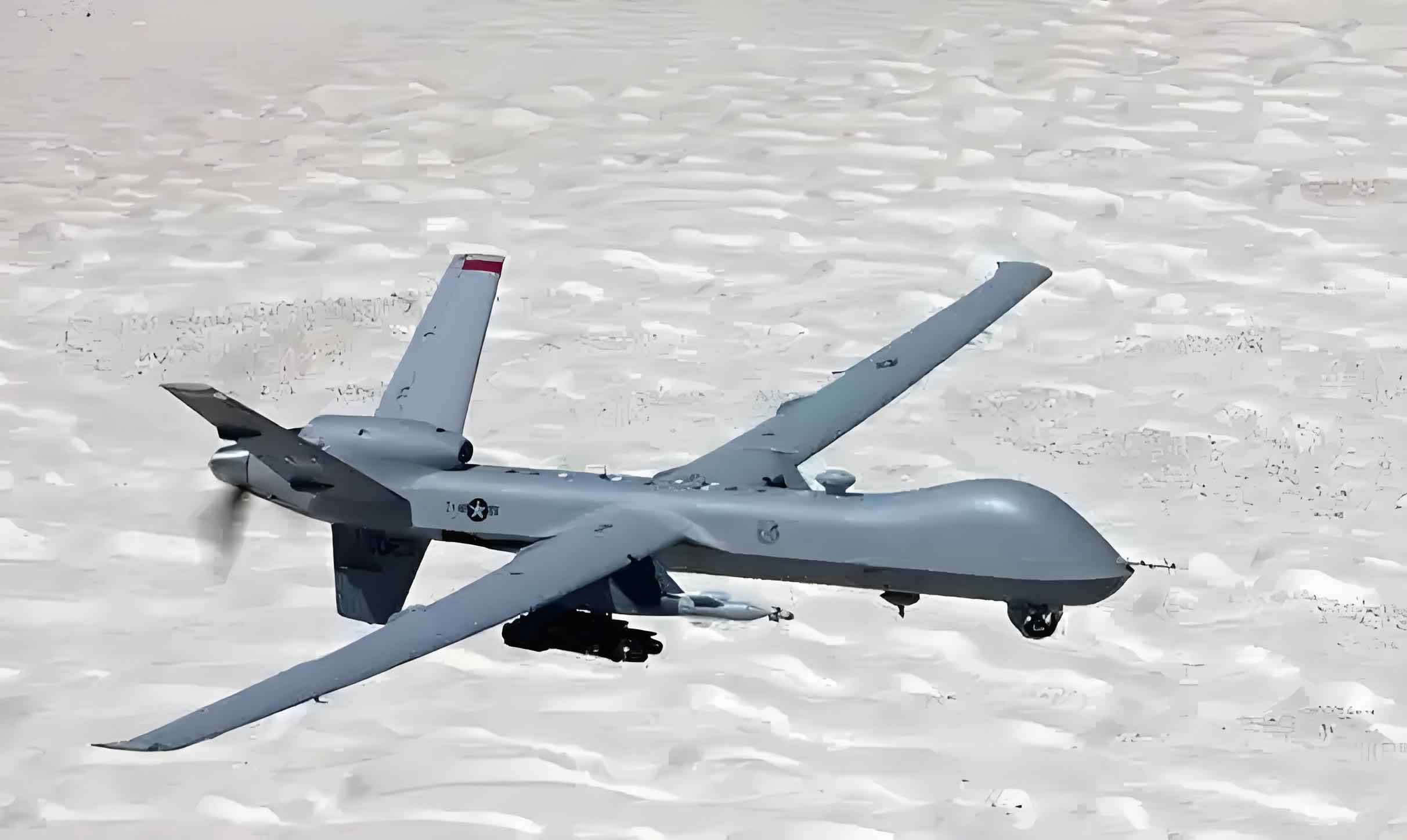
In assessing the development of military UAVs, I note that 2024 has been marked by significant investments in research and development. Nations are prioritizing the creation of next-generation military UAVs that offer greater stealth, longer endurance, and higher payload capacities. For instance, the push toward autonomous collaborative platforms reflects a strategic shift toward manned-unmanned teaming, where military UAVs operate alongside crewed aircraft to enhance mission success rates. This trend is not merely technological but doctrinal, as militaries worldwide revise their tactics to incorporate military UAVs into every facet of operations. My analysis will break down these developments into digestible segments, ensuring a comprehensive understanding of the current state and future trajectory of military UAV ecosystems.
To begin, let me outline the in-development military UAV systems that have emerged or progressed in 2024. These platforms span various categories, each designed to address specific mission requirements. I have categorized them into collaborative air combat UAVs, long-endurance ISR/strike UAVs, tactical operation UAVs, and special mission UAVs. The following table summarizes some key examples, illustrating the diversity and innovation in this sector.
| Category | Example UAV | Country | Key Features | Status in 2024 |
|---|---|---|---|---|
| Collaborative Air Combat | XQ-58A Valkyrie | USA | Autonomous operations, low cost, Link-16 integration | Testing with F-35 fighters |
| Collaborative Air Combat | XQ-67A OBSS | USA | Second-gen autonomous platform, modular design | First flight completed |
| Collaborative Air Combat | Wingman Concept | Europe | Stealth design, AI-driven coordination | Model showcased |
| Long-Endurance ISR/Strike | Hermes 650 Spark | Israel | 24-hour endurance, 260 kg payload | Introduced and operational |
| Long-Endurance ISR/Strike | Bayraktar TB3 | Turkey | Carrier-based, short take-off capability | Successful ski-jump tests |
| Tactical Operation | X10D AI-Enhanced UAV | USA | AI flight assistance, obstacle avoidance | Deployed for reconnaissance |
| Tactical Operation | T-650 Heavy Lift UAV | UK | Electric, 300 kg payload, open architecture | Unveiled at defense shows |
| Special Mission | Skydweller Solar UAV | USA | Solar-powered, multi-day endurance | First autonomous flight |
| Special Mission | X-65 CRANE | USA | Active flow control, no moving surfaces | Prototype in manufacturing |
From my examination, the collaborative air combat military UAVs represent a paradigm shift. These systems, such as the XQ-58A, are designed to operate as loyal wingmen, providing support to manned aircraft like the F-35. The autonomy levels in these military UAVs allow them to execute complex missions with minimal human input, thereby reducing pilot workload and expanding combat reach. In 2024, testing has focused on integrating these military UAVs into existing networks, using data links like Link-16 to ensure seamless communication. The mathematical representation of such协同 can be expressed as: $$ E_{\text{team}} = \sum_{i=1}^{n} (A_i \cdot C_i) $$ where \( E_{\text{team}} \) is the overall team effectiveness, \( A_i \) is the autonomy score of the i-th military UAV, and \( C_i \) is its communication reliability. This formula highlights how enhancing individual military UAV capabilities contributes to collective mission success.
Long-endurance military UAVs have also seen notable progress. Platforms like the Hermes 650 Spark offer extended surveillance capabilities, crucial for persistent ISR missions. The endurance of such military UAVs can be modeled using the formula: $$ T_{\text{endurance}} = \frac{E_{\text{battery}} + E_{\text{fuel}}}{P_{\text{avg}}} $$ where \( T_{\text{endurance}} \) is the flight time, \( E_{\text{battery}} \) and \( E_{\text{fuel}} \) are energy sources, and \( P_{\text{avg}} \) is the average power consumption. In 2024, advancements in hybrid propulsion have pushed \( T_{\text{endurance}} \) beyond 24 hours for many military UAVs, enabling continuous coverage over large areas. The operational impact is significant, as these military UAVs provide real-time intelligence that informs decision-making in dynamic environments.
Tactical military UAVs, including small quadcopters and vertical take-off systems, have proliferated due to their versatility and low cost. I observe that these military UAVs are increasingly used for tasks such as cargo transport, medical supply delivery, and close-range reconnaissance. The cost-effectiveness of tactical military UAVs can be summarized by the equation: $$ C_{\text{effectiveness}} = \frac{M_{\text{payload}} \cdot R_{\text{range}}}{C_{\text{acquisition}} + C_{\text{operation}}} $$ where \( C_{\text{effectiveness}} \) is a measure of value, \( M_{\text{payload}} \) is payload mass, \( R_{\text{range}} \) is operational range, and \( C_{\text{acquisition}} \) and \( C_{\text{operation}} \) are costs. This reflects the drive toward affordable, high-utility military UAVs that can be deployed en masse, as seen in initiatives like the Replicator program.
Special mission military UAVs, such as solar-powered or high-speed variants, push the boundaries of technology. The Skydweller solar UAV, for instance, leverages renewable energy to achieve ultra-long endurance, potentially revolutionizing persistent surveillance. The energy balance for such military UAVs is given by: $$ E_{\text{solar}} = \eta \cdot A \cdot I \cdot t $$ where \( E_{\text{solar}} \) is the solar energy harvested, \( \eta \) is efficiency, \( A \) is panel area, \( I \) is solar irradiance, and \( t \) is time. In 2024, improvements in photovoltaic materials have increased \( \eta \), allowing military UAVs to stay aloft for days without refueling. Similarly, hypersonic military UAVs like the Quarterhorse explore speed frontiers, with performance modeled as: $$ V_{\text{max}} = \sqrt{\frac{2 \cdot T}{\rho \cdot C_D \cdot A}} $$ where \( V_{\text{max}} \) is maximum velocity, \( T \) is thrust, \( \rho \) is air density, \( C_D \) is drag coefficient, and \( A \) is reference area. These innovations underscore the relentless pursuit of enhanced capabilities in military UAV design.
Moving to in-service military UAV systems, 2024 has been a year of extensive production, deployment, and upgrades. From my analysis, operational military UAVs are being integrated into diverse theaters, from the Middle East to the Indo-Pacific, demonstrating their strategic value. The following table captures key activities related to in-service military UAVs in 2024.
| Activity Type | UAV System | Country | Details | Impact |
|---|---|---|---|---|
| Production Delivery | Drishti 10 | India | First indigenous MALE UAV delivered to navy | Boosts domestic UAV capability |
| Production Delivery | K1000ULE Solar UAV | USA | Procured for marine recon units | Enhances long-endurance ISR |
| Deployment Use | MQ-4C Triton | USA | Deployed in Europe and Pacific for maritime patrol | Extends surveillance reach |
| Deployment Use | Replicator Program UAVs | USA | Mass deployment of attritable systems | Promotes scalable warfare |
| Testing Trials | MQ-9A Reaper | USA | Satellite-controlled landing demonstrations | Improves operational flexibility |
| Testing Trials | ACE Project X-62A | USA | AI-driven dogfights with manned F-16s | Advances autonomous air combat |
| Upgrade Modifications | MQ-1C Gray Eagle 25M | USA | Enhanced engines, data links, open architecture | Increases survivability and payload |
| Upgrade Modifications | RQ-4 Global Hawk | USA | Retrofitted for hypersonic test data collection | Repurposes aging platforms |
In my view, the production and delivery of military UAVs like the Drishti 10 highlight a global trend toward self-reliance in UAV technology. Countries are investing in domestic manufacturing to reduce dependence on imports and tailor military UAVs to specific national needs. The delivery processes often involve rigorous testing to ensure reliability, which can be quantified as: $$ R_{\text{system}} = \prod_{j=1}^{m} R_j $$ where \( R_{\text{system}} \) is the overall system reliability and \( R_j \) is the reliability of each component. For military UAVs, high \( R_{\text{system}} \) is critical for mission success, especially in contested environments.
Deployment of military UAVs has expanded their operational footprints. I note that systems like the MQ-4C Triton are now routinely used for maritime domain awareness, patrolling vast ocean areas to detect threats. The effectiveness of such deployments can be measured using the formula: $$ D_{\text{coverage}} = \frac{A_{\text{sensor}} \cdot N_{\text{UAVs}}}{T_{\text{response}}} $$ where \( D_{\text{coverage}} \) is the area coverage density, \( A_{\text{sensor}} \) is the sensor range per military UAV, \( N_{\text{UAVs}} \) is the number of deployed military UAVs, and \( T_{\text{response}} \) is the response time. In 2024, increased \( N_{\text{UAVs}} \) through programs like Replicator has boosted \( D_{\text{coverage}} \), enabling faster threat identification.
Testing and trials have been pivotal in validating new capabilities for military UAVs. For example, the ACE project’s AI algorithms demonstrated superior performance in simulated air combat, showcasing the potential of autonomous military UAVs. The learning curve for such AI systems can be expressed as: $$ P_{\text{AI}}(t) = P_0 \cdot e^{k t} $$ where \( P_{\text{AI}}(t) \) is the performance at time \( t \), \( P_0 \) is initial performance, and \( k \) is the learning rate. In 2024, rapid iterations in testing have accelerated \( k \), allowing military UAVs to adapt to complex scenarios more quickly. Additionally, satellite control trials for the MQ-9A have enhanced operational resilience, reducing reliance on ground stations.
Upgrades to existing military UAV fleets, such as the Gray Eagle 25M, extend their service life and capabilities. These modifications often focus on integrating advanced sensors, improving communication systems, and enhancing propulsion. The cost-benefit analysis for upgrades can be modeled as: $$ B_{\text{upgrade}} = \frac{\Delta C_{\text{effectiveness}}}{C_{\text{upgrade}}} $$ where \( B_{\text{upgrade}} \) is the benefit ratio, \( \Delta C_{\text{effectiveness}} \) is the increase in effectiveness, and \( C_{\text{upgrade}} \) is the upgrade cost. In 2024, militaries have prioritized upgrades that yield high \( B_{\text{upgrade}} \), ensuring that legacy military UAVs remain relevant against evolving threats.
Turning to key technologies, 2024 has seen breakthroughs in several areas that underpin the advancement of military UAVs. I categorize these into intelligent coordination, energy and propulsion, mission payloads, and other supporting technologies. Each domain contributes uniquely to the performance and versatility of military UAVs.
Intelligent coordination technology is at the forefront, enabling military UAVs to operate collaboratively with minimal human oversight. From my analysis, AI algorithms have matured to allow real-time decision-making in dynamic environments. The coordination efficiency can be represented by: $$ \eta_{\text{coord}} = \frac{N_{\text{successful missions}}}{N_{\text{total missions}}} \cdot \frac{1}{T_{\text{decision}}} $$ where \( \eta_{\text{coord}} \) is the coordination efficiency, \( N_{\text{successful missions}} \) is the count of successful协同 missions, \( N_{\text{total missions}} \) is total missions attempted, and \( T_{\text{decision}} \) is the average decision time. In 2024, improvements in machine learning have increased \( \eta_{\text{coord}} \) for military UAVs, as seen in projects like the XQ-58A tests with F-35s. This technology allows military UAVs to swarm, share sensor data, and execute complex maneuvers autonomously, enhancing overall battlefield awareness and strike precision.
Energy and propulsion technologies have evolved to support longer endurance and greater payloads for military UAVs. Hybrid electric systems, solar power, and advanced engines are key trends. The energy management for a hybrid military UAV can be described by: $$ E_{\text{total}} = \int_{0}^{T} (P_{\text{engine}}(t) + P_{\text{battery}}(t)) \, dt $$ where \( E_{\text{total}} \) is the total energy available, \( P_{\text{engine}}(t) \) is power from combustion engines, and \( P_{\text{battery}}(t) \) is power from batteries over time \( T \). In 2024, innovations like the K1000ULE solar UAV have optimized this balance, allowing military UAVs to operate for extended periods with reduced logistical footprints. Additionally, propulsion advancements have increased thrust-to-weight ratios, modeled as: $$ \text{TWR} = \frac{T}{W} $$ where TWR is thrust-to-weight ratio, \( T \) is thrust, and \( W \) is weight. Higher TWR values in new military UAV designs enable quicker take-offs and better maneuverability, crucial for tactical operations.
Mission payload technologies have diversified, equipping military UAVs with sophisticated sensors, weapons, and electronic warfare systems. The payload capacity of a military UAV is a critical parameter, given by: $$ M_{\text{payload}} = M_{\text{max}} – M_{\text{empty}} $$ where \( M_{\text{payload}} \) is the usable payload mass, \( M_{\text{max}} \) is maximum take-off weight, and \( M_{\text{empty}} \) is empty weight. In 2024, advancements in miniaturization have increased \( M_{\text{payload}} \) relative to size, allowing small military UAVs to carry significant payloads like high-resolution cameras or anti-tank missiles. Sensor fusion, which integrates data from multiple sources, enhances situational awareness and can be expressed as: $$ S_{\text{fusion}} = \sum_{i} w_i \cdot S_i $$ where \( S_{\text{fusion}} \) is the fused sensor output, \( w_i \) are weighting factors, and \( S_i \) are individual sensor inputs. This technology has become standard in modern military UAVs, improving target acquisition and classification accuracy.
Other supporting technologies, such as additive manufacturing and secure communications, have also progressed. 3D printing reduces production time and costs for military UAV components, with the relationship: $$ C_{\text{manufacturing}} = k \cdot V^{\alpha} $$ where \( C_{\text{manufacturing}} \) is manufacturing cost, \( V \) is production volume, and \( k \) and \( \alpha \) are constants specific to the technology. In 2024, wider adoption of additive manufacturing has lowered \( C_{\text{manufacturing}} \) for military UAVs, facilitating mass production. Secure data links, essential for controlling military UAVs in contested environments, rely on encryption algorithms that can be modeled as: $$ S_{\text{security}} = – \log(P_{\text{breach}}) $$ where \( S_{\text{security}} \) is security strength and \( P_{\text{breach}} \) is the probability of a breach. Enhancements in quantum-resistant encryption have increased \( S_{\text{security}} \) for military UAV communications, ensuring mission integrity.
Based on my assessment, several clear trends have emerged in the development and deployment of military UAVs in 2024. These trends not only reflect current priorities but also indicate future directions for the industry.
First, platform diversification and performance enhancement are evident. Military UAVs now come in a wide array of sizes and configurations, from nano-drones to large high-altitude systems. This diversity allows militaries to select tailored solutions for specific missions. The performance metrics, such as endurance and speed, continue to improve through technological innovations. For instance, the trend toward higher endurance can be summarized by the equation: $$ T_{\text{endurance trend}} = T_0 \cdot (1 + r)^n $$ where \( T_0 \) is baseline endurance, \( r \) is the annual improvement rate, and \( n \) is the number of years. In 2024, \( r \) has increased due to better energy systems, pushing \( T_{\text{endurance trend}} \) upward for many military UAVs.
Second, autonomy and collaborative warfare have become central to military UAV development. The shift from remotely piloted to fully autonomous systems is accelerating, with AI enabling independent decision-making. Collaborative capabilities allow military UAVs to operate in teams, both with other UAVs and manned platforms. This trend is quantified by the increasing complexity of协同 algorithms, which can be measured as: $$ C_{\text{algorithm}} = O(n \log n) $$ for coordination among \( n \) military UAVs, indicating scalable协同 networks. In 2024, testing has validated such algorithms in real-world scenarios, paving the way for widespread adoption.
Third, mission diversification and broader applications are expanding the roles of military UAVs. Beyond traditional ISR and strike missions, military UAVs are now used for logistics, electronic attack, and even psychological operations. The expansion can be modeled as: $$ A_{\text{missions}} = M_0 + \Delta M \cdot t $$ where \( A_{\text{missions}} \) is the number of mission types, \( M_0 \) is the initial count, \( \Delta M \) is the rate of expansion, and \( t \) is time. In 2024, \( \Delta M \) has grown, with military UAVs taking on roles like medical supply delivery or communication relay, demonstrating their versatility.
Fourth, technological innovation and integration are driving rapid advancements. Cross-disciplinary technologies, such as AI, materials science, and propulsion, are being fused to create next-generation military UAVs. The integration efficiency can be expressed as: $$ I_{\text{efficiency}} = \frac{\sum \text{Performance Gains}}{\sum \text{Development Costs}} $$ In 2024, high \( I_{\text{efficiency}} \) has been achieved through modular designs and open architectures, allowing military UAVs to quickly incorporate new technologies and adapt to changing threats.
In conclusion, my analysis of 2024 reveals that military UAVs have solidified their position as transformative assets in modern defense. The year has been marked by significant strides in system development, operational integration, and technological breakthroughs. From collaborative air combat platforms to solar-powered endurance UAVs, the innovation landscape is rich and dynamic. As I look ahead, I anticipate that military UAVs will continue to evolve, with increased autonomy, enhanced协同, and broader mission sets shaping future conflicts. The ongoing investments in research and testing suggest that military UAVs will remain at the forefront of military strategy, offering both opportunities and challenges for global security. Ultimately, the lessons from 2024 underscore the need for adaptive doctrines and robust policies to harness the full potential of military UAVs while addressing ethical and operational concerns.
To summarize the key points, I have presented a detailed review covering in-development and in-service military UAV systems, critical technologies, and emerging trends. Through tables and formulas, I have quantified aspects of military UAV performance and development, providing a structured understanding of the field. The repeated emphasis on military UAVs throughout this analysis highlights their growing importance, and the inserted image serves as a visual reminder of their pervasive presence. As the technology advances, continuous monitoring and analysis will be essential to navigate the complexities of military UAV integration into global defense ecosystems.