
As an educational institution deeply involved in vocational training, we have embarked on a transformative journey to implement the 1+X drone pilot certification program. This initiative aligns with national reforms in vocational education, aiming to cultivate复合型技术技能人才. In this article, I will share our first-hand experiences, strategies, and outcomes, emphasizing the critical role of drone training in modern education. Our focus is on integrating this certification into our curriculum, enhancing teacher capabilities, and fostering industry collaborations to ensure students are well-equipped for emerging technological landscapes.
The 1+X certificate system, where “1” represents the academic diploma and “X” denotes vocational skill等级证书, is a cornerstone of China’s职业教育改革实施方案. It emphasizes the fusion of theoretical knowledge and practical skills, preparing students for diverse career paths. Our implementation of the 1+X drone驾驶职业技能等级证书 is driven by the rapid growth of drone applications across sectors like surveying, cinematography, and smart city development. Through this program, we aim to not only提升人才培养质量 but also contribute to societal advancements through innovative drone training methodologies.
To provide a clear overview, Table 1 summarizes the key components of our implementation strategy, highlighting how each element contributes to effective drone training.
| Component | Description | Impact on Drone Training |
|---|---|---|
| Background Analysis | Examines the rise of drone technology and policy support. | Ensures alignment with industry needs and educational reforms. |
| Curriculum Optimization | Integrates certification requirements into专业教学方案. | Enhances skill acquisition through structured learning paths. |
| Teacher Development | Focuses on training instructors via workshops and competitions. | Builds a competent team for delivering high-quality drone training. |
| Industry Partnerships | Collaborates with companies for resources and expertise. | Provides real-world exposure and updated training materials. |
| Outcome Assessment | Evaluates student performance and certification rates. | Measures the effectiveness of drone training initiatives. |
Implementation Background: The Driving Forces Behind Drone Training
Our decision to adopt the 1+X drone pilot certification stems from multiple factors. Firstly, the proliferation of drone technology has revolutionized industries such as测绘, emergency response, and infrastructure inspection. Drones offer efficiency and precision, making drone training essential for future professionals. Secondly, national policies like the “Vocational Education 20 Articles” mandate the integration of 1+X certificates to foster复合型人才. This aligns with our goal to升级专业设置, ensuring our programs remain relevant in a数字化 era.
Moreover, the concept of smart cities relies heavily on data collection via drones for 3D modeling and monitoring. By incorporating drone training into our curriculum, we contribute to this vision. The certification also addresses student diversity, allowing those with varied interests to explore无人机应用技术 beyond their core majors. This flexibility is crucial in vocational education, where personalized learning paths can enhance engagement and outcomes.
To quantify the importance, consider the growth rate of drone applications.假设 the demand for skilled drone operators increases annually by a factor of $$ D(t) = D_0 \cdot e^{kt} $$ where $D(t)$ is the demand at time $t$, $D_0$ is the initial demand, and $k$ is the growth constant. Our drone training programs aim to meet this exponential rise, preparing students for lucrative careers.
Implementation Process: A Step-by-Step Approach to Drone Training
Our implementation process is structured into three pillars: curriculum design, teacher development, and industry collaboration. Each pillar is meticulously planned to ensure comprehensive drone training.
1. Optimizing Professional Teaching Scheme Design
We revamped our工程测量技术专业 curriculum to incorporate the 1+X drone pilot certification. This involved aligning courses with the certification standards, creating a seamless blend of academic and vocational content. The updated curriculum includes core subjects like无人机航测技术 and拓展课程 such as三维激光扫描仪应用. Table 2 illustrates the course structure, emphasizing how drone training is integrated.
| Course Type | Example Courses | Alignment with Drone Training |
|---|---|---|
| Public Foundation Courses | Information Technology, Mathematics | Provides basic skills for operating drone software. |
| Professional Core Courses | Engineering Surveying, GPS Measurement | Builds foundational knowledge for aerial surveying. |
| Professional Extension Courses | Drone航测技术, GIS Applications | Directly focuses on drone training and advanced applications. |
| Certification Courses | 1+X Drone Pilot Skills Training | Targeted modules for certification preparation. |
The integration follows a课证融通 approach, where certification requirements are embedded into course objectives. For instance, the无人机航测技术 course covers flight操控训练 and data processing using software like Double Grid. We quantify learning outcomes through skill assessments: $$ S_{\text{total}} = \alpha \cdot S_{\text{theory}} + \beta \cdot S_{\text{practical}} $$ where $S_{\text{total}}$ is the overall skill score, $\alpha$ and $\beta$ are weights for theoretical and practical components, respectively, and $S_{\text{theory}}$ and $S_{\text{practical}}$ are scores derived from exams and hands-on drone training sessions.
2.健全 1+X Certificate Teacher Team System
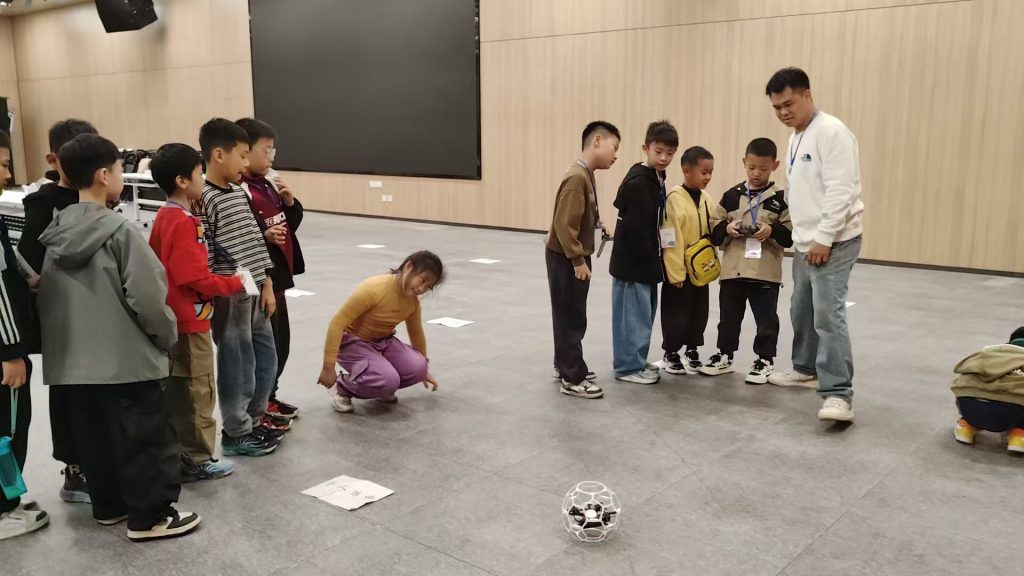
A skilled师资队伍 is vital for effective drone training. We invested in teacher development through multiple channels. Firstly, we sent instructors to specialized workshops, such as those offered by certification评价组织, to enhance their无人机专业知识. Secondly, participation in national drone competitions, like the “达北杯” events, allowed teachers to refine their practical指导水平. Thirdly, we engaged in research projects with industry partners, exploring topics like “无人机倾斜摄影精度分析,” which bolstered our工程实践水平.
To measure teacher competency growth, we use a formula: $$ C_t = C_0 + \sum_{i=1}^{n} \Delta C_i $$ where $C_t$ is the competency at time $t$, $C_0$ is the initial competency, and $\Delta C_i$ represents improvements from training sessions $i$. This ensures our team remains adept at delivering cutting-edge drone training.
Table 3 summarizes our teacher development activities and their impact on drone training quality.
| Activity Type | Description | Outcome for Drone Training |
|---|---|---|
| Professional Workshops | 7-day sessions on drone piloting and maintenance. | Updated knowledge on latest drone technologies and regulations. |
| Competition Guidance | Coaching students in national drone测绘技能竞赛. | Improved practical skills and innovative teaching methods. |
| Research Collaboration | Joint projects with companies on drone applications. | Enhanced ability to integrate real-world scenarios into training. |
| Certification Training | 1+X-specific instructor courses. | Direct alignment with certification standards and assessment criteria. |
3.校企合作完善 1+X Certificate Cultivation Framework
Collaboration with industry is key to relevant drone training. We partnered with companies like中国铁路设计集团有限公司 and天津远洋泓基电子工程有限公司 to bridge the gap between education and employment. These partnerships facilitated resource sharing, such as drone equipment donations and实训基地建设. Additionally, we worked with北京优云智翔航空科技有限公司 to co-develop课证融合教材 and update考核项目.
The collaboration framework is modeled as: $$ F_{\text{collab}} = R_{\text{resources}} + E_{\text{expertise}} + I_{\text{innovation}} $$ where $F_{\text{collab}}$ represents the overall collaboration effectiveness, $R_{\text{resources}}$ denotes material and financial support, $E_{\text{expertise}}$ includes technical guidance, and $I_{\text{innovation}}$ covers joint research and development. This ensures our drone training remains industry-relevant.
Through these partnerships, we established a智能测绘研究院, focusing on areas like全站仪自动化监测系统 and北斗卫星形变监测. This not only enriches our drone training but also prepares students for advanced roles in智慧城市建设.
Main Implementation Outcomes: Achievements in Drone Training
Our efforts have yielded significant outcomes, which we categorize into three areas: foundational design, curriculum integration, and pedagogical reforms. Each area demonstrates the efficacy of our drone training approach.
1.立体设计打基础: A Multi-Level Foundation
We adopted a holistic design encompassing institutional,专业, and student levels. At the institutional level, we secured实训场地 and师资培训规划. At the专业 level, we revised培养目标 to include数字化 skills. For students, we organized seminars by industry experts to boost interest in drone training. This multi-level approach ensured a solid groundwork for certification implementation.
Table 4 outlines the key actions at each level and their contributions to drone training.
| Level | Actions Taken | Impact on Drone Training |
|---|---|---|
| Institutional | Built drone training facilities and申请飞行领空. | Provided safe and equipped environments for practical sessions. |
| Programmatic | Updated专业教学方案 to include drone-related courses. | Ensured systematic skill development aligned with certification. |
| Student-Centric | Conducted awareness workshops and career guidance. | Increased enrollment and motivation for drone training programs. |
2.实施内容入教材: Integrating Content into Teaching Materials
We revised our无人机航测技术 course教材 to reflect certification requirements. Changes included adding more flight操控训练 hours, reducing theoretical图像处理原理 content, and incorporating software like Double Grid for巡航 and data processing. This integration ensures that drone training is practical and up-to-date with industry standards.
To assess content relevance, we use a metric: $$ R_{\text{content}} = \frac{N_{\text{cert}}}{N_{\text{total}}} \times 100\% $$ where $R_{\text{content}}$ is the relevance percentage, $N_{\text{cert}}$ is the number of certification-aligned topics, and $N_{\text{total}}$ is the total topics covered. Our aim is to achieve $R_{\text{content}} > 80\%$, which we have surpassed through continuous updates.
3.教法改革见奇效: Pedagogical Reforms and Results
We reformed teaching methods to emphasize “learning by doing,” encouraging students to practice, reflect, and master skills. This approach, centered on兴趣培养, has led to remarkable outcomes. For instance, in the 2020-2021 academic year, all second-year工程测量技术专业 students participated in the 1+X drone pilot certification exams, with a通过率 of 69.6%. This success is attributed to our innovative drone training methodologies.
The certification rate can be expressed as: $$ P_{\text{cert}} = \frac{N_{\text{passed}}}{N_{\text{total}}} \times 100\% $$ where $P_{\text{cert}}$ is the certification pass rate, $N_{\text{passed}}$ is the number of students who passed, and $N_{\text{total}}$ is the total participants. Our $P_{\text{cert}}$ of 69.6% reflects the effectiveness of our reforms. Additionally, we were recognized as a优秀试点院校 in 2020, validating our efforts in drone training.
Reflections and Future Directions for Drone Training
Implementing the 1+X drone pilot certification has provided valuable insights. Firstly, it breaks专业限制, allowing students from diverse backgrounds to acquire无人机 skills. This is particularly beneficial given that many students may not have initially chosen their majors based on兴趣. By offering drone training as an “X” certificate, we empower them with第二次选择的机会, enhancing their employability.
Secondly, we see potential in linking the certification with学分制 and学分银行 systems. Currently,学费收取 is based on programs, but a学分-based approach could incentivize skill acquisition. For example, 1+X certificate学分 could be stored in a学分银行 and used to置换拓展课程学分. This aligns with national reforms and promotes lifelong learning. We propose a model: $$ C_{\text{total}} = C_{\text{core}} + C_{\text{X}} $$ where $C_{\text{total}}$ represents total credits required for graduation, $C_{\text{core}}$ are core course credits, and $C_{\text{X}}$ are credits from 1+X certificates like drone training. This flexibility can foster a more dynamic educational ecosystem.
Looking ahead, we plan to expand our drone training to include更多证书试点, such as 1+X测绘地理信息获取与处理, further enriching our curriculum. We will continue to leverage industry partnerships for real-time updates and invest in teacher development to maintain high standards. Our goal is to make drone training a beacon of innovation in vocational education, contributing to the培养 of四级 “强国工匠” – from技能工匠 to知识工匠.
In conclusion, the 1+X drone pilot certification has transformed our educational approach, integrating practical skills with academic rigor. Through strategic curriculum design, teacher empowerment, and industry collaboration, we have created a robust framework for drone training that prepares students for the demands of a数字化 world. As we refine our methods, we remain committed to advancing职业教育 and empowering the next generation of drone professionals.