
The evolution of warfare is inextricably linked to technological advancement, and in the modern battlespace, the military UAV has emerged as a transformative asset. From reconnaissance and surveillance to strike and electronic warfare, the roles of these unmanned systems have expanded dramatically. This expansion imposes increasingly stringent demands on performance: greater endurance, higher payload capacity, enhanced survivability, and superior maneuverability. A critical enabler in meeting these demands has been the systematic adoption of Advanced Composite Materials (ACMs). As a practitioner deeply involved in the intersection of materials science and aerospace engineering, I have witnessed firsthand how ACMs have transitioned from being supplementary materials to becoming the primary structural substance for modern military UAV platforms. This article delves into the fundamental properties of ACMs that make them indispensable, surveys their current application landscape, and analyzes the pivotal technological challenges that must be overcome to unlock their full potential in next-generation military UAV systems.
At their core, ACMs are engineered materials consisting of high-performance reinforcements—such as carbon, aramid, or glass fibers—embedded within a matrix material, typically a polymer resin (epoxy, bismaleimide), metal, or ceramic. This synergistic combination yields properties far exceeding those of conventional monolithic materials like aluminum or steel. The primary driver for their use in military UAV design is their exceptional specific strength and specific stiffness. Specific strength is defined as the ratio of a material’s tensile strength ($\sigma_b$) to its density ($\rho$), while specific stiffness is the ratio of its elastic modulus ($E$) to density.
$$
\text{Specific Strength} = \frac{\sigma_b}{\rho}, \quad \text{Specific Stiffness} = \frac{E}{\rho}
$$
To illustrate the advantage, consider the comparison in the table below:
| Material | Density, $\rho$ (g/cm³) | Tensile Strength, $\sigma_b$ (MPa) | Specific Strength (MPa/g·cm⁻³) | Elastic Modulus, $E$ (GPa) | Specific Stiffness (GPa/g·cm⁻³) |
|---|---|---|---|---|---|
| Aluminum Alloy (7075-T6) | 2.81 | 572 | 203 | 71.7 | 25.5 |
| Steel Alloy (4340) | 7.85 | 1720 | 219 | 210 | 26.8 |
| Carbon Fiber/Epoxy (Unidirectional) | 1.55 | 1500 | 968 | 140 | 90.3 |
This order-of-magnitude improvement in specific properties translates directly into significant airframe weight reduction. For a military UAV, weight savings are not merely about efficiency; they are a force multiplier. Reduced structural weight allows for increased fuel capacity for longer endurance (loiter time), greater payload capacity for sensors or weapons, or improved power-to-weight ratio for enhanced agility and climb performance. It is common for ACM airframes to achieve 25-30% weight savings compared to equivalent metal designs, a decisive advantage for any military UAV mission profile.
Beyond lightweighting, ACMs offer a suite of complementary benefits. Their fatigue resistance is superior to metals; while metals tend to fail catastrophically after crack initiation, composites exhibit gradual, more predictable damage progression, allowing for potential detection during maintenance. The inherent damping characteristics of polymer-based composites reduce vibration, leading to a more stable platform for sensitive electro-optical/infrared (EO/IR) sensors. Perhaps most crucially for modern military UAV applications, ACMs provide unparalleled design freedom for stealth (low observability). The material itself can be tailored to absorb radar waves (by incorporating ferrite particles or conductive nano-fillers), and the ability to fabricate large, complex, seamless structures—like smoothly blended wing-body junctions—dramatically reduces radar cross-section (RCS). This integration of structural and functional performance is a hallmark of ACMs in military UAV design.
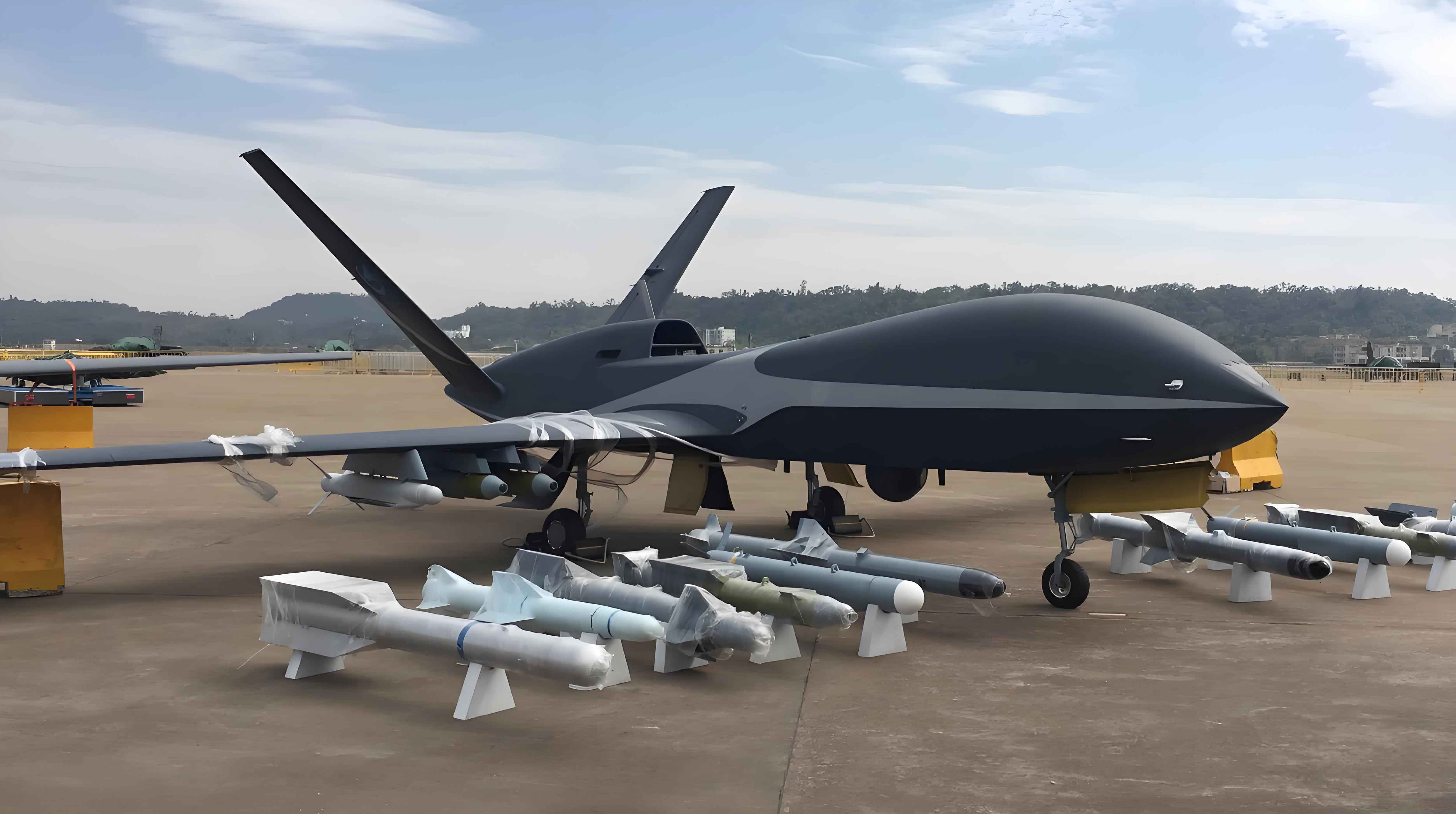
The application of ACMs in military UAV platforms has progressed from secondary components to fully integrated primary structures. Early high-altitude long-endurance (HALE) UAVs demonstrated the feasibility. The Global Hawk, for instance, utilizes carbon-fiber composites for its high-aspect-ratio wings, tail surfaces, and fuselage fairings, accounting for approximately 65% of its structural weight. The drive for stealth accelerated this adoption. The Lockheed Martin RQ-3 DarkStar and the Northrop Grumman X-47A Pegasus were pioneering all-composite, flying-wing designs that prioritized low observability through shape and material selection. This trend has culminated in current-generation stealth combat UAVs. Platforms like the European nEUROn and the British Taranis demonstrator are almost entirely composite, employing carbon-fiber skins over titanium or aluminum substructures to achieve the precise shapes and sharp edges required for very low RCS while managing heat from engine bays.
The following table summarizes the composite material utilization in several iconic military UAV programs:
| Military UAV Platform | Primary Role | Key Composite Components | Material & Notable Features | Structural Weight % (Est.) |
|---|---|---|---|---|
| Northrop Grumman RQ-4 Global Hawk | HALE ISR | Wings, Tail, Radome, Fairings | Carbon/Epoxy prepreg, Nomex honeycomb core. Designed for high stiffness. | ~65% |
| Northrop Grumman X-47B | Carrier-based UCAV | Wing, Fuselage Skin | Carbon/Epoxy. Highly integrated, seamless design for low RCS. | |
| Boeing X-45C | Combat Demonstrator | Full Airframe | Carbon/Bismaleimide (BMI). Designed for high-speed, high-temp performance. | ~90% |
| Dassault nEUROn | Combat Demonstrator | Full Airframe Skins | Carbon/Epoxy & Thermoplastic. Complex, multi-national integrated structure. | |
| General Atomics MQ-9 Reaper | MQ-9 Reaper | Wings, Fuselage Sections | Carbon/Epoxy & Glass/Epoxy. Focus on durability and cost-effectiveness. | ~50% |
Despite these successes, the widespread and optimal use of ACMs in military UAV fleets faces three interconnected technological frontiers: Cost, Integration, and Durability.
1. Low-Cost Manufacturing Technology: A principal advantage of military UAV systems is supposed to be lower acquisition and operating cost compared to manned aircraft. High-performance thermoset prepregs, which require autoclave curing, are expensive and rate-limiting. The industry is therefore shifting towards Out-of-Autoclave (OoA) prepregs, Liquid Resin Infusion (LRI), and Resin Transfer Molding (RTM). These processes use lower-cost tooling and reduce energy consumption. Automation is key; Automated Fiber Placement (AFP) and Automated Tape Laying (ATL) machines reduce labor, minimize material waste, and improve reproducibility. The challenge is to achieve the high structural performance and consistency required for primary military UAV structures with these faster, cheaper methods. The trade-off can be modeled in terms of a cost-function $C_{total}$:
$$
C_{total} = C_{material} + C_{labor}(t_{fab}) + C_{capital} + C_{scrap}
$$
Where $t_{fab}$ is fabrication time. The goal is to minimize $C_{total}$ while constraining mechanical performance $P$ to be greater than a requirement $P_{req}$: $P(fabrication\ method) \geq P_{req}$.
2. Structural/Functional/Design Integration Technology: Modern military UAV design is a multidisciplinary optimization (MDO) problem. The airframe is not just a load-bearing structure; it is an aerodynamic surface, a platform for antennas and sensors, a heat sink, and a contributor to the vehicle’s signature. ACMs enable this integration. “Structural Health Monitoring” (SHM) involves embedding fiber optic sensors within the laminate during layup to create a “nervous system” that can track strain, temperature, and detect impact damage in real-time. The optimization itself is complex. We must often solve a problem where an objective function $f(x)$ (e.g., minimize weight, minimize RCS) is subject to constraints $g_i(x) \leq 0$ (e.g., strength, stiffness, flutter speed, internal volume).
$$
\begin{aligned}
\text{minimize} \quad & f(x) \\
\text{subject to} \quad & g_i(x) \leq 0, \quad i = 1, \ldots, m \\
& x \in \mathbb{R}^n
\end{aligned}
$$
Here, $x$ could represent a vector of design variables including ply angles, thicknesses, and material choices at different locations on the military UAV.
3. Damage Tolerance and Failure Assessment Technology: Metals yield, composites fracture. The failure mechanisms in laminated ACMs are complex, involving matrix cracking, delamination, fiber breakage, and their interactions. A military UAV must be certified to withstand operational loads, including the threat of in-service damage (e.g., tool drop, hail strike, ballistic impact). The “Damage Tolerance” philosophy requires demonstrating that residual strength remains above limit load in the presence of undetected damage. This necessitates robust predictive models. Failure criteria like Tsai-Hill or Tsai-Wu are used for initial ply failure prediction:
$$
\text{Tsai-Wu Criterion: } F_1 \sigma_1 + F_2 \sigma_2 + F_{11} \sigma_1^2 + F_{22} \sigma_2^2 + F_{66} \tau_{12}^2 + 2F_{12} \sigma_1 \sigma_2 \geq 1
$$
where $F_i$ and $F_{ij}$ are strength tensors derived from material tests. For life prediction, fatigue damage accumulation models must account for the multi-axial stress state and varying R-ratios experienced by a military UAV in flight. Establishing statistically significant allowables and developing rapid, reliable Non-Destructive Inspection (NDI) techniques for field maintenance are critical supporting pillars for this technology.
In conclusion, the journey of ACMs from novel materials to the structural backbone of the modern military UAV is a testament to their transformative potential. Their unique combination of light weight, strength, and tailorability directly enables the extended range, enhanced payload, and stealth characteristics that define next-generation unmanned systems. However, their full integration into the military UAV ecosystem is not merely a materials challenge; it is a systems engineering challenge. The triad of cost-effective manufacturing, multidisciplinary design integration, and certifiable damage tolerance represents the critical path forward. Success in these areas will not only solidify the role of ACMs in current platforms but will also pave the way for more radical military UAV concepts—from agile, disposable swarm drones to hypersonic reconnaissance vehicles. The future of unmanned air power will be, quite literally, molded from these advanced composites.