
In the modern era of warfare, the role of unmanned aerial vehicles (UAVs) has evolved dramatically. As a researcher focused on aerospace systems, I have observed that military UAVs, often referred to as military UAVs, have transitioned from simple target drones to sophisticated autonomous systems integral to combat operations. A typical military UAV system comprises the aircraft itself, ground control stations, payloads, data links, launch and recovery subsystems, and support equipment. This complexity underscores the need to understand their usage characteristics, which I will explore in depth from a first-person perspective, emphasizing classification, operational principles, and missions. Throughout this analysis, the term military UAV will be frequently highlighted to reinforce its centrality in contemporary defense strategies.
The development of military UAVs has been shaped by conflicts such as the Vietnam War, Gulf War, and more recent engagements in Afghanistan and Iraq. These experiences have driven advancements from pre-programmed reconnaissance to multi-role and combat-capable systems. To systematically study their usage, I begin with classification, which lays the groundwork for understanding application domains. Military UAVs can be categorized by various parameters, but for usage analysis, I adopt a purpose-based classification. This approach directly links to their operational roles, as summarized in Table 1.
| Category | Sub-category | Primary Functions | Typical Examples |
|---|---|---|---|
| Non-lethal | Reconnaissance and Surveillance | Intelligence gathering, target acquisition | High-altitude long-endurance UAVs |
| Electronic Warfare | Signal jamming, electronic intelligence | Specialized UAVs with EW payloads | |
| Communication Relay | C4I enhancement, data transmission | Medium-altitude UAVs | |
| Lethal | Combat and Strike | Precision attacks, suppression of enemy air defenses | Unmanned combat aerial vehicles (UCAVs) |
| Anti-Radiation | Radar targeting and destruction | Loitering munitions | |
| Target Designation | Laser guidance for manned aircraft | Small tactical UAVs |
This classification reveals that military UAVs span both non-lethal and lethal domains, enabling diverse applications. For instance, reconnaissance military UAVs provide real-time battlefield imagery, while strike military UAVs can engage targets autonomously. To visualize the integration of these systems, consider the following representation of a military UAV’s operational envelope, which can be modeled using performance equations. The endurance \(E\) of a military UAV, a key metric, is given by:
$$E = \frac{C \cdot L/D}{g \cdot SFC}$$
where \(C\) is fuel capacity, \(L/D\) is lift-to-drag ratio, \(g\) is gravitational acceleration, and \(SFC\) is specific fuel consumption. This formula highlights how design parameters influence the usage of military UAVs in prolonged missions. Moreover, the operational altitude range, from 10 meters to 10,000 meters, allows military UAVs to cover varied terrains, which I will discuss in the context of principles.
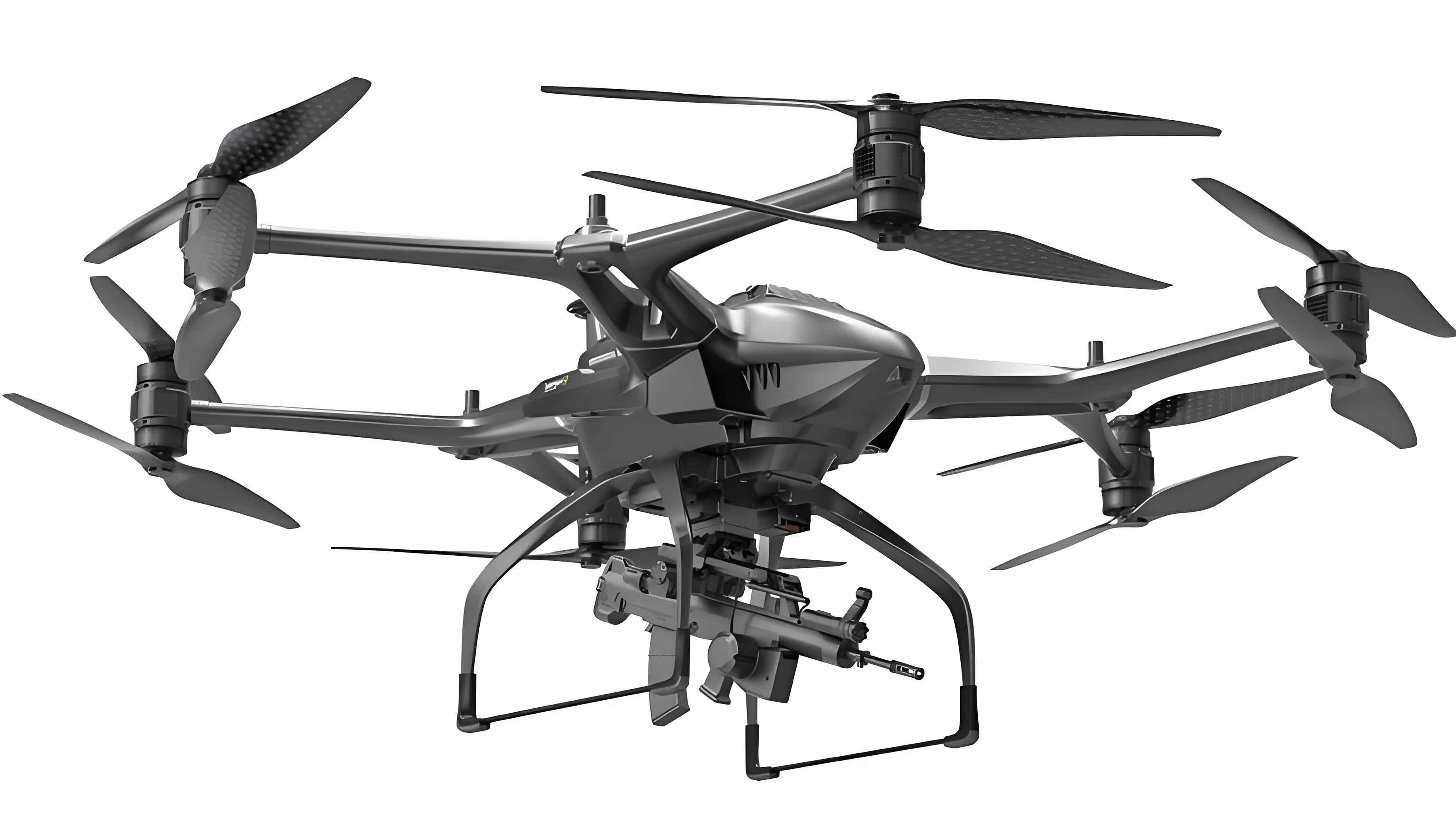
Moving to operational principles, I analyze the guidelines that govern the deployment of military UAVs. Based on lessons from U.S. military practices, which serve as a benchmark, I outline several core principles. First, the principle of massed, concentrated, and prioritized use emphasizes deploying military UAVs in large numbers to cover critical areas. This can be expressed through a coverage model: if \(N\) military UAVs are deployed over an area \(A\), the effective coverage density \(\rho\) is:
$$\rho = \frac{N \cdot s}{A}$$
where \(s\) is the sensor footprint per military UAV. In conflicts like the Kosovo War, hundreds of military UAVs were concentrated for surveillance, demonstrating this principle. Second, task-oriented, functional, and creative use involves adapting military UAVs beyond their primary roles. For example, military UAVs initially designed for reconnaissance might be creatively used for battle damage assessment or psychological operations. Third, planned, adaptive, and coordinated use ensures that military UAVs operate within broader systems, requiring synchronization with air traffic control and other assets. These principles are essential for optimizing the utility of military UAVs, as they balance structure with flexibility.
To further elucidate these principles, I present a table summarizing key aspects and their implications for military UAV usage.
| Principle | Description | Mathematical Representation | Impact on Military UAV Usage |
|---|---|---|---|
| Massed Use | Deploy in large numbers for area saturation | \(\rho = \frac{N}{A}\) (simplified) | Enhances reconnaissance and persistence |
| Task-Oriented Use | Mission-driven deployment | \(U = f(T, P)\) where \(U\) is utility, \(T\) task, \(P\) parameters | Maximizes efficiency for specific objectives |
| Coordinated Use | Integration with other systems | \(C = \sum_{i=1}^{n} w_i \cdot I_i\) for coordination score \(C\) | Reduces fratricide and improves data fusion |
These principles underscore that the effectiveness of military UAVs hinges on strategic planning. As I reflect on global trends, nations tailor these principles based on their defense needs, ensuring that military UAVs contribute to long-term security. For instance, the creative use of military UAVs in asymmetric warfare has expanded their roles, making them indispensable in modern conflicts.
Next, I delve into the core of military UAV usage: their作战 tasks. Military UAV missions can be broadly divided into combat support, combat assistance, and combat strike, with numerous sub-tasks. Drawing from U.S. frameworks and adapting them to a general context, I categorize these tasks in Table 3. This classification aligns with the purpose-based categories earlier, showing how military UAVs fulfill diverse roles.
| Task Category | Specific Tasks | Description | Relevant Military UAV Types |
|---|---|---|---|
| Combat Support | Strategic Communication Relay | Enhancing C4I networks via airborne nodes | Communication relay UAVs |
| Precision Targeting | Real-time tracking for guided munitions | Reconnaissance and target designation UAVs | |
| Battle Damage Assessment (BDA) | High-resolution post-strike evaluation | Surveillance military UAVs | |
| Intelligence Gathering | Collecting data on enemy order of battle | Long-endurance military UAVs | |
| Special Operations Support | Tracking high-value targets in covert ops | Stealthy military UAVs | |
| Combat Assistance | Electronic Warfare | Jamming and electronic attack | Electronic warfare military UAVs |
| Humanitarian Assistance | Monitoring displaced populations | Multi-role military UAVs | |
| Treaty Monitoring | Verifying compliance with international accords | Surveillance military UAVs | |
| Counter-Drug Operations | Surveillance of trafficking routes | Small tactical military UAVs | |
| Combat Strike | Direct Attack | Engaging targets with onboard weapons | Unmanned combat aerial vehicles (UCAVs) |
| Suppression of Enemy Air Defenses (SEAD) | Neutralizing radar and missile sites | Anti-radiation military UAVs |
Each task leverages the unique capabilities of military UAVs. For example, in precision targeting, a military UAV can maintain loitering patterns described by the equation for loiter time \(T_l\):
$$T_l = \frac{E}{\alpha \cdot v}$$
where \(E\) is endurance, \(\alpha\) is a loiter efficiency factor, and \(v\) is velocity. This allows military UAVs to provide persistent coverage, crucial for dynamic targeting. Similarly, for combat strike tasks, the lethality of a military UAV can be modeled using probability of kill \(P_k\) formulas, such as:
$$P_k = 1 – e^{-\lambda \cdot A}$$
where \(\lambda\) is a threat parameter and \(A\) is the effective area covered. These mathematical insights help optimize the deployment of military UAVs for maximum impact.
Furthermore, the integration of military UAVs into networked systems enhances their utility. Consider a scenario where multiple military UAVs collaborate for surveillance. The total information gain \(I\) can be expressed as:
$$I = \sum_{i=1}^{n} \log(1 + \frac{S_i}{N_i})$$
where \(S_i\) is signal strength from the i-th military UAV, and \(N_i\) is noise. This cooperative use underscores the principle of coordinated deployment. In practice, military UAVs have been used for tasks like battlefield isolation, where they deny enemy movement, and sensitive reconnaissance, where they operate in politically volatile areas without risking pilot lives. The versatility of military UAVs is evident in their adaptation to roles such as environmental monitoring or disaster response, though my focus remains on military applications.
To synthesize the relationship between classification and tasks, I propose a mapping framework. Let \(C\) represent the set of military UAV categories, and \(M\) the set of missions. A compatibility function \(f: C \times M \rightarrow [0,1]\) indicates how well a category suits a mission. For instance, reconnaissance military UAVs score high for intelligence gathering, while UCAVs excel in strike missions. This alignment ensures that the development of military UAVs is driven by operational needs, as seen in the evolution toward multi-role platforms.
In conclusion, the usage characteristics of military UAVs are multifaceted, encompassing tailored classification, robust operational principles, and expansive作战 tasks. As I look ahead, the increasing investment in military UAV technology promises further expansion into domains like swarming autonomy and artificial intelligence-driven operations. The mathematical models and tables presented here provide a foundation for ongoing research and development. Ultimately, understanding these characteristics is vital for harnessing the full potential of military UAVs in defense strategies, ensuring they remain a cornerstone of modern warfare. The continuous innovation in military UAV design and usage will undoubtedly shape future battlefields, making this study not only relevant but imperative for security planning worldwide.