
In recent years, the rapid advancement of unmanned aerial vehicle (UAV) technology has transformed military and civilian landscapes, offering cost-effectiveness, flexibility, and stealth. However, this proliferation poses significant security threats, including privacy breaches, public safety disruptions, and national defense challenges. As a researcher focused on defense technologies, I believe that constructing a robust anti-UAV warfare technology system and devising effective strategies are imperative to counter these evolving threats. This article explores the importance of such systems, delves into the integration of technological chains, adherence to operational workflows, and adaptation to complex scenarios, aiming to enhance capabilities in anti-UAV operations. Throughout this discussion, I will emphasize the critical role of anti-UAV measures in safeguarding sovereignty, maintaining social stability, and driving innovation.
The importance of building an anti-UAV warfare technology system cannot be overstated. Firstly, it is essential for defending national security and sovereignty. UAVs have revolutionized modern warfare, enabling adversaries to bypass traditional防空 systems for reconnaissance, strikes, and intelligence gathering. An integrated anti-UAV system, combining radar, electro-optical, and acoustic detection technologies, provides comprehensive, real-time monitoring to identify and neutralize intrusions promptly. This capability fortifies national borders and upholds territorial integrity, forming a strategic cornerstone for defense. Secondly, anti-UAV systems contribute to social stability and public safety. In sensitive areas like military bases or public events, rogue UAVs can conduct espionage or cause accidents, endangering lives. By deploying anti-UAV technologies, we can detect and mitigate these threats in real-time, ensuring operational security and protecting civilians. Thirdly, the development of anti-UAV systems spurs technological innovation, enhancing national competitiveness. This field intersects with cutting-edge disciplines such as sensing, data processing, and artificial intelligence (AI), driving breakthroughs in high-performance radar, predictive algorithms, and more. These advancements not only improve anti-UAV efficacy but also catalyze industry growth, positioning nations at the forefront of global科技.
To illustrate the multi-faceted nature of anti-UAV systems, consider the following table summarizing key components and their functions:
| Component | Function | Example Technologies |
|---|---|---|
| Detection | Identify and track UAVs | Radar, electro-optical sensors, acoustic arrays |
| Identification | Classify UAV type and intent | AI algorithms, database matching |
| Neutralization | Disable or destroy UAVs | Jamming, laser weapons, interceptor drones |
| Command & Control | Coordinate operations | Data fusion platforms, communication networks |
Building an efficient anti-UAV warfare system requires integrating detection and strike technology chains into a cohesive framework. As I analyze this, the first step involves deploying a multi-layered detection network. By fusing radar for long-range coverage, electro-optical sensors for detailed imaging in complex environments, and acoustic detectors for low-altitude慢速 targets, we can minimize blind spots and increase detection probability. Mathematically, the overall detection probability \( P_d \) in such a network can be modeled as:
$$ P_d = 1 – \prod_{i=1}^{n} (1 – p_i) $$
where \( p_i \) represents the detection probability of individual sensor \( i \), and \( n \) is the number of sensors. This formula highlights how redundancy enhances system reliability. Additionally, leveraging AI and big data for real-time analysis enables predictive capabilities, such as forecasting UAV flight paths based on historical data. For instance, using machine learning models, we can estimate threat levels and prioritize responses.
Secondly, establishing协同作战 mechanisms is crucial. Anti-UAV operations demand seamless coordination among military units, government agencies, and private sectors. A well-defined protocol ensures that detection systems, command centers, and strike assets share information dynamically. For example, collaboration with law enforcement can provide intelligence on unauthorized UAV activities, while partnerships with manufacturers offer insights into technical vulnerabilities. This synergy amplifies the overall effectiveness of anti-UAV efforts, reducing response times and optimizing resource allocation.
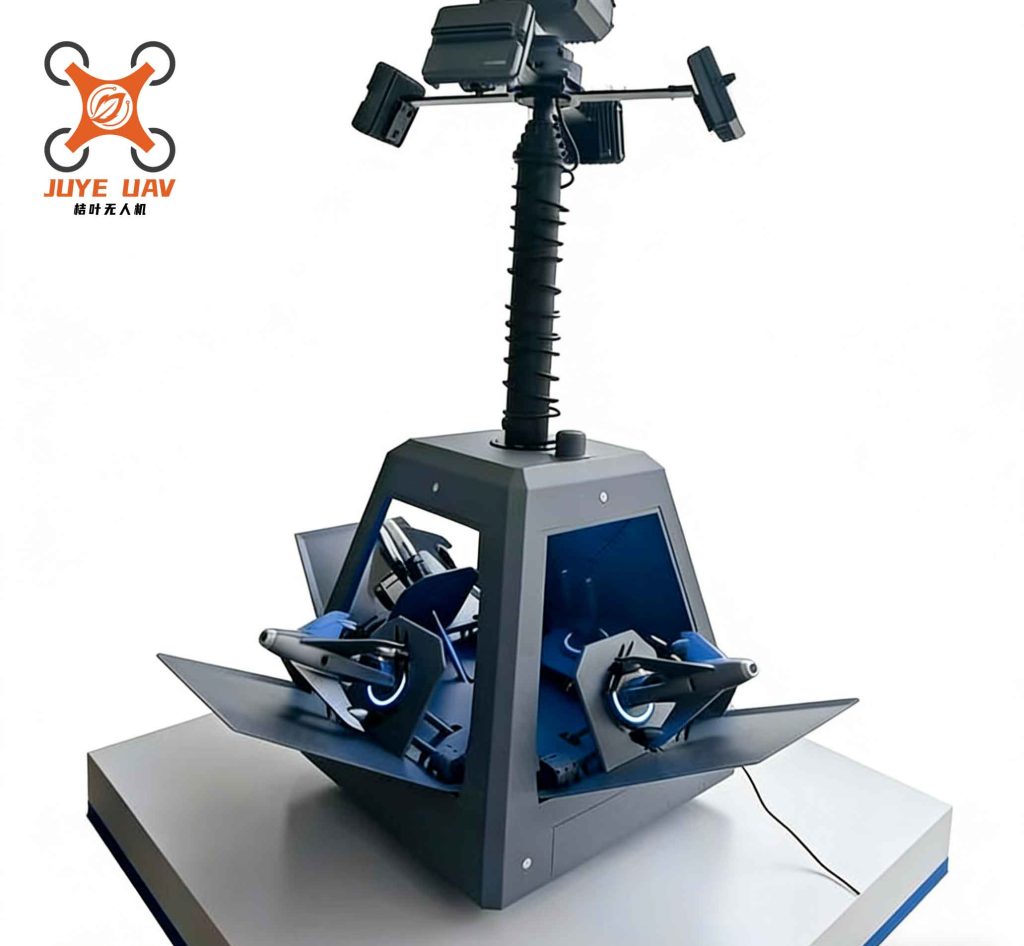
Following a structured预警响应处置流程 is vital for precision in anti-UAV actions. Based on my research, this process begins with intelligent early warning. By integrating multi-source感知 technologies—such as millimeter-wave radar for initial scanning and distributed acoustic sensors for noise recognition—we build a smart预警 network. AI algorithms analyze data against a UAV特征 database to classify threats. For instance, a UAV’s electromagnetic signature can be compared to known patterns using correlation functions:
$$ C(f) = \int_{-\infty}^{\infty} s_1(t) s_2(t + \tau) \, dt $$
where \( s_1(t) \) and \( s_2(t) \) are signal waveforms, aiding in identification. Once a threat is detected, a tiered response mechanism activates. I propose a three-level system: Level 1 for low-risk UAVs, employing non-lethal measures like广播 warnings or electronic jamming; Level 2 for medium-risk threats, using precision tools such as portable防空 weapons or laser systems; and Level 3 for high-risk scenarios, deploying integrated solutions like防空 missiles or drone swarms. This graded approach minimizes collateral damage while ensuring rapid neutralization.
To quantify response effectiveness, we can use metrics like拦截成功率 \( S \), defined as the ratio of successful interceptions to total engagements. For a system with multiple neutralization methods, \( S \) can be expressed as:
$$ S = \sum_{j=1}^{m} w_j \cdot s_j $$
where \( s_j \) is the success rate of method \( j \), and \( w_j \) is its weighting based on threat level. This emphasizes the need for adaptive strategies in anti-UAV operations.
Adapting to urban复杂多样场景 demands flexible anti-UAV tactics. Cities present unique challenges due to skyscrapers, dense populations, and electromagnetic clutter. In my view, the first strategy involves leveraging existing infrastructure to create a立体感知 network. Deploying low-altitude补盲 radar on rooftops and acoustic sensors in streets enhances coverage, while 5G networks enable real-time data fusion. AI-driven analysis can then discern UAV意图 amidst noise, using pattern recognition algorithms. For example, convolutional neural networks (CNNs) can process imagery from electro-optical cameras to identify UAV models with high accuracy.
Secondly, employing varied战术 is key. In商业区 with limited space, “hunter” drones can autonomously track and disable targets using干扰 or physical means. In crowded areas, “electromagnetic trap” tactics create定向干扰 zones to deceive UAV navigation, forcing controlled landings. For distant, high-threat UAVs, perimeter-based防空导弹 systems provide a last line of defense. The effectiveness of these tactics can be assessed through simulation models, such as calculating the probability of UAV neutralization \( P_n \) in an urban environment:
$$ P_n = f(\text{detection accuracy}, \text{response time}, \text{environmental factors}) $$
where environmental factors include building density and signal interference. By tailoring approaches to context, anti-UAV operations become more resilient and efficient.
Beyond technical integration, the anti-UAV warfare system must evolve with emerging technologies. For instance, the rise of drone swarms—groups of coordinated UAVs—poses a new challenge. To counter this, we can develop swarm-based anti-UAV strategies using autonomous interceptor networks. The dynamics of such engagements can be modeled with differential equations, describing the interaction between hostile and defensive swarms. Let \( N_h(t) \) and \( N_d(t) \) represent the numbers of hostile and defensive UAVs at time \( t \), respectively. Their interaction might follow a Lotka-Volterra-type model:
$$ \frac{dN_h}{dt} = r_h N_h – \alpha N_h N_d $$
$$ \frac{dN_d}{dt} = r_d N_d – \beta N_h N_d $$
where \( r_h \) and \( r_d \) are growth rates, and \( \alpha, \beta \) are interaction coefficients. This illustrates the complex, adaptive nature of modern anti-UAV warfare.
Moreover, data fusion plays a pivotal role in anti-UAV systems. By combining inputs from disparate sensors, we achieve a comprehensive battlefield picture. A common approach is Kalman filtering, which estimates UAV states (e.g., position, velocity) from noisy measurements. The filter equations are:
$$ \hat{x}_{k|k-1} = F_k \hat{x}_{k-1|k-1} + B_k u_k $$
$$ P_{k|k-1} = F_k P_{k-1|k-1} F_k^T + Q_k $$
where \( \hat{x} \) is the state estimate, \( F_k \) is the state transition matrix, \( P \) is the error covariance, and \( Q_k \) is process noise. This enables precise tracking, crucial for targeting in anti-UAV operations.
In terms of strategy, continuous innovation is necessary. As UAV technology advances, so must our anti-UAV capabilities. For example, developing directed-energy weapons like high-power microwaves offers a non-kinetic means to disable UAV electronics. The effectiveness of such weapons can be quantified by the power density \( I \) at a distance \( r \):
$$ I = \frac{P_t G}{4\pi r^2} $$
where \( P_t \) is transmitted power and \( G \) is antenna gain. Ensuring \( I \) exceeds a threshold for UAV disruption guides deployment decisions.
To summarize the key aspects of anti-UAV technology systems, I present another table comparing different neutralization methods:
| Method | Advantages | Limitations | Suitable Scenarios |
|---|---|---|---|
| Electronic Jamming | Non-lethal, rapid deployment | Limited range,可能 affect friendly systems | Urban areas, low-risk threats |
| Laser Weapons | High precision, speed of light engagement | Atmospheric attenuation, high energy cost | Medium-risk UAVs, open terrain |
| Interceptor Drones | Autonomous, adaptable to复杂 environments | Cost, risk of collateral damage | Swarm threats, confined spaces |
| Missile Systems | Long range, high kill probability | Expensive, potential for overshoot | High-risk, long-distance targets |
Looking ahead, the future of anti-UAV warfare will likely involve greater integration of AI and machine learning. By training models on vast datasets of UAV behaviors, we can predict attacks and automate responses. For instance, reinforcement learning algorithms can optimize interception strategies in real-time, maximizing success rates while minimizing resources. The reward function \( R \) in such a framework might balance threat neutralization and cost:
$$ R = \sum_{t} \left( \gamma^t \cdot (\text{threat\_reduction} – \lambda \cdot \text{cost}) \right) $$
where \( \gamma \) is a discount factor and \( \lambda \) is a weighting parameter. This aligns with the goal of efficient anti-UAV operations.
In conclusion, as I reflect on the evolving landscape of UAV threats, building a comprehensive anti-UAV warfare technology system is not just a technical endeavor but a strategic imperative. Through integrating detection and strike chains, adhering to structured processes, and adapting to diverse scenarios, we can enhance our ability to safeguard national interests. The repeated emphasis on anti-UAV measures throughout this discussion underscores their centrality in modern defense. By fostering innovation and collaboration, we can stay ahead of adversarial advancements, ensuring security and stability in an increasingly无人机-dominated world.