
As a researcher immersed in the field of aerospace and defense technology, I have witnessed the transformative role of unmanned aerial vehicles, particularly in military contexts. The term ‘military UAV’ has become synonymous with modern warfare, representing a shift towards autonomous, efficient, and low-risk operations. From their humble beginnings as target drones to today’s sophisticated stealth and combat platforms, military UAVs have reshaped strategic paradigms. This article delves into the global evolution, current capabilities, and future trajectories of military UAV technology, emphasizing the critical importance of continuous innovation and adaptation.
The journey of military UAVs began over a century ago. During World War I, initial research into unmanned aircraft was conducted, primarily for reconnaissance and targeting purposes. By 1927, experimental models capable of carrying bombs, serving as aerial targets, and even deploying torpedoes had been successfully tested, marking the dawn of practical UAV applications. World War II saw expanded use, though largely confined to support roles such as reconnaissance and damage assessment, with many still employed as target drones. The post-war era, fueled by the Cold War arms race and rapid advancements in aerospace, catalyzed a diversification in UAV functions and types, ushering in a golden age of development. After the Cold War, while military applications proliferated, civilian uses began to emerge. Since the 1990s, the prominent deployment of military UAVs in conflicts by nations like the United States has spotlighted their value in information warfare, electronic combat, and joint special operations, cementing their place as pivotal assets.
Today, the landscape of military UAV capabilities is dominated by a few key players. The United States leads globally, focusing on long-endurance UAVs, unmanned combat aerial vehicles (UCAVs), micro-UAVs, and specialized platforms. Israel, while technologically reliant on U.S. foundations, stands as a top exporter with significant market share in both military and civilian UAV sectors. European nations, including Russia, the United Kingdom, France, and Germany, have accelerated their development programs, each targeting specific niches, though overall technological maturity and processing capabilities often lag behind top-tier nations. Many countries in Asia, such as Japan, South Korea, India, Singapore, and Iran, have initiated their own military UAV projects or rely on imports, but indigenous innovation remains a challenge.
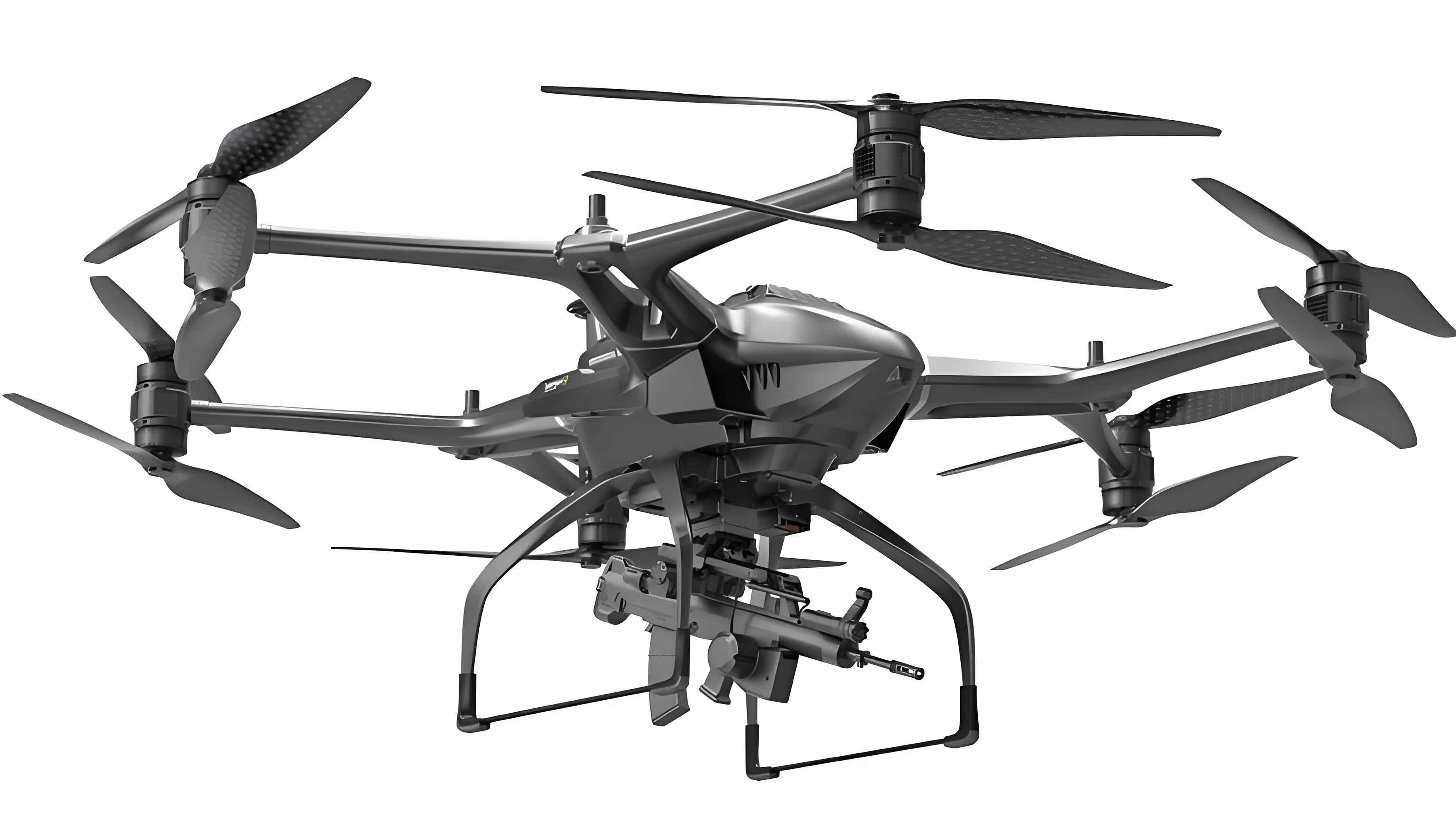
To encapsulate this historical progression and current status, the following table summarizes key milestones in military UAV development:
| Era | Time Period | Key Developments in Military UAVs | Primary Functions |
|---|---|---|---|
| Early Beginnings | 1914-1945 | Initial research; target drones; basic reconnaissance | Training, limited surveillance |
| Cold War Expansion | 1946-1990 | Diversification of types; advance in guidance systems | Reconnaissance, electronic intelligence |
| Modern Proliferation | 1991-Present | Stealth technology; armed strikes; network-centric operations | Combat, persistent ISR, electronic warfare |
The technological underpinnings of military UAV performance can be expressed through several mathematical models. For instance, endurance, a critical metric for surveillance military UAVs, is governed by the energy balance equation:
$$T = \frac{E_{total}}{P_{avg}}$$
where \(T\) is the endurance time, \(E_{total}\) is the total onboard energy (often from fuel or batteries), and \(P_{avg}\) is the average power consumption during flight. For electric military UAVs, this simplifies to \(T = \frac{C}{I}\), with \(C\) as battery capacity in ampere-hours and \(I\) as current draw.
Another vital aspect is communication range for command and control, which for line-of-sight links can be approximated by the Friis transmission equation:
$$P_r = P_t G_t G_r \left( \frac{\lambda}{4 \pi d} \right)^2$$
where \(P_r\) is received power, \(P_t\) is transmitted power, \(G_t\) and \(G_r\) are antenna gains, \(\lambda\) is wavelength, and \(d\) is distance. This formula highlights the challenges in maintaining robust links for military UAVs operating over long ranges or in contested environments.
Turning to domestic developments, my country’s journey in military UAV technology started later but has accelerated remarkably. The formal establishment of the aviation industry in the 1950s laid the groundwork. Initial indigenous efforts in the 1970s led to the development of reconnaissance drones, with systems like the WZ-5 entering service in the 1980s. A pivotal moment came in 1995 with a national strategy emphasizing technological strengthening of the military, which spurred focused R&D in advanced weaponry, including military UAVs. This commitment has yielded tangible results: the successful maiden flights and subsequent deployment of next-generation platforms such as the “Wing Loong” (翼龙) reconnaissance-strike military UAV, the “Soaring Dragon” (翔龙) high-altitude long-endurance military UAV, and the “Sharp Sword” (利剑) stealth unmanned combat aerial vehicle demonstrate that domestic military UAV capabilities now rank among the world’s advanced tier.
The strategic significance of developing and fielding military UAVs cannot be overstated. In modern conflict, these systems are deployed for a wide array of missions: electronic reconnaissance and countermeasures, early warning, long-range precision strikes, battle damage assessment, terrain mapping, and counter-terrorism operations. The core advantages of military UAVs include drastic reduction in personnel casualties, lower operational costs compared to manned aircraft, and enhanced ability to operate in high-risk or complex environments. These attributes collectively boost overall combat efficiency. The vision of military UAVs has moved from science fiction to battlefield reality, and their multifunctional application is becoming increasingly sophisticated, often serving as decisive factors in engagement outcomes. For a nation with vast territory, extensive borders, and a complex geopolitical periphery, possessing advanced military UAV capabilities is not merely an option but a necessity for safeguarding sovereignty and territorial integrity.
Assessing the current technical prowess and gaps is crucial for future progress. While my country’s military UAV sector has achieved significant milestones through a mix of independent innovation and studied adaptation of foreign technologies, certain areas require intensified focus. When compared to global leaders, weaknesses persist in several high-demand domains for contemporary high-tech warfare. The effectiveness of military UAVs in executing large-scale missions involving integrated electronic warfare, advanced early warning, deep penetration reconnaissance, and high-end offensive operations is still being optimized. More specifically, key technological challenges include:
| Technical Domain | Current Challenges for Military UAVs | Desired Performance Metrics |
|---|---|---|
| Stealth Capability | Reducing radar cross-section (RCS) and infrared signature | RCS < 0.001 m²; minimal heat emission profile |
| Maneuverability & Control | High-G autonomous maneuvers in contested airspace | Sustained turn rates > 15°/sec; agile flight control algorithms |
| Data Link & Transmission | Secure, jam-resistant, high-bandwidth beyond-line-of-sight communication | Data rates > 100 Mbps; latency < 50 ms; anti-jam threshold > 30 dB |
| Navigation & Accuracy | Precision guidance in GPS-denied environments | Circular error probable (CEP) < 1 meter without GPS |
| Propulsion & Endurance | High-efficiency power plants for extended range and loiter | Endurance > 40 hours for HALE UAVs; specific fuel consumption optimization |
| Materials & Structures | Lightweight, durable composites for extreme conditions | Strength-to-weight ratio improvement by 20-30% |
These challenges can be framed mathematically. For instance, radar detection range is related to stealth via the radar equation:
$$R_{max} = \left[ \frac{P_t G_t G_r \lambda^2 \sigma}{(4\pi)^3 P_{rmin}} \right]^{1/4}$$
where \(\sigma\) is the target’s RCS. For a stealthy military UAV, minimizing \(\sigma\) directly reduces \(R_{max}\), enhancing survivability. Similarly, endurance for a jet-powered military UAV can be modeled using the Breguet range equation:
$$R = \frac{V}{g \cdot TSFC} \cdot \frac{L}{D} \cdot \ln \left( \frac{W_{initial}}{W_{final}} \right)$$
where \(R\) is range, \(V\) is velocity, \(g\) is gravity, \(TSFC\) is thrust-specific fuel consumption, \(L/D\) is lift-to-drag ratio, and \(W\) are weights. Improving \(L/D\) and reducing \(TSFC\) are constant pursuits for military UAV designers.
The path forward for military UAV development must be strategic and holistic. Building on recent successes, the future trajectory should align with the demands of multi-domain warfare (land, sea, air, space, and cyber) and leverage ongoing technological revolutions. The core principles involve steadfast commitment to scientific advancement, prioritizing innovation, learning from international best practices while mastering core technologies, and fostering indigenous intellectual property. A collaborative ecosystem encompassing military research institutes, civilian academies, universities, and manufacturing entities should be mobilized to develop specialized military UAV platforms tailored for diverse combat scenarios and mission sets. This approach will accelerate the modernization of unmanned military assets and help forge a distinctive, capable military UAV fleet ready for future conflicts.
To quantify future goals, consider a model for autonomous collaboration in a swarm of military UAVs. The effectiveness of a coordinated strike can be related to the number of agents \(N\) and their communication connectivity \(C\):
$$E_{swarm} = k \cdot N^{\alpha} \cdot \log(1 + C)$$
where \(E_{swarm}\) is a measure of mission effectiveness, \(k\) is a constant, and \(\alpha\) is an exponent typically between 0.5 and 1 (subject to diminishing returns). Research aims to maximize \(E_{swarm}\) through advanced AI and robust networks.
In conclusion, the evolution of the military UAV is a testament to technological ambition and strategic necessity. From early experimental crafts to today’s complex systems integrating stealth, sensors, and weapons, military UAVs have irrevocably altered the conduct of warfare. The ongoing journey involves not just catching up in areas like stealth and data links but also pioneering new concepts in autonomy and swarm tactics. As these platforms become more pervasive, their development will continue to be a key indicator of a nation’s defense technological prowess. The future battlefield will undoubtedly see an even greater proliferation and sophistication of military UAVs, making their continued advancement a paramount concern for security and stability worldwide. The focus must remain on innovation, integration, and adaptability to ensure that military UAVs fulfill their potential as versatile, decisive instruments in the defense arsenal.