
In this article, I explore the fundamental concepts of virtual-real fusion and analyze its practical application in drone formation teaching environments. I emphasize the importance of this technology in enhancing teaching effectiveness and learning experiences. Based on teaching demand analysis, I design a set of optimization strategies for constructing the teaching environment, study the classification and characteristics of different teaching strategies, clarify optimization goals, and discuss various methods for optimizing teaching strategies. These strategies not only improve the teaching quality of drone formation but also enhance students’ practical operational abilities. The research results show that the application of virtual-real fusion technology significantly increases interactivity and immersion in the drone formation teaching process, opening new directions for future related research while pointing out shortcomings in the study, laying the groundwork for more in-depth exploration in the future.
Drone technology, as an emerging comprehensive technology integrating remote control, intelligent control, communication networks, and artificial intelligence (AI), continues to advance, with its application scope expanding. It has become a technical support for promoting the low-altitude economy. Among these, drone formation technology, due to its dynamic collaboration and autonomous decision-making capabilities, has become a hotspot in this field of research. In the 21st century, the rise of virtual-real fusion technology has created unprecedented opportunities for constructing drone formation teaching environments. The application of technologies such as virtual reality (VR) and augmented reality (AR) provides users with more immersive and interactive teaching experiences, effectively reducing the time and spatial constraints involved in traditional teaching. Virtual-real fusion technology allows learners to experience complex formation flight tasks in virtual environments, which is not only safer than field experiments but also enhances teaching flexibility and effectiveness by simulating various environmental conditions. This helps students quickly adapt to changes in virtual scenarios, thereby strengthening their practical operational skills. From the perspective of reinforcing teaching effects, a drone formation teaching environment based on virtual-real fusion can effectively integrate virtual reality technology with actual drone control. By simulating real flight environments, it enhances learners’ immersion and participation, improves spatial perception and emergency response speed, not only increasing teaching interactivity and practicality but also significantly boosting student engagement, making the learning process of drone formation more vivid and efficient.
Virtual-real fusion technology refers to the combination of virtual and real environments, creating an augmented reality experience through digital technological means. Virtual-real fusion relies on the integrated development of disciplines such as computer graphics, VR, and AR. Its core elements include, but are not limited to, real-time rendering of virtual objects, interaction between users and virtual environments, and real-time data acquisition and analysis. These elements collectively contribute to a highly interactive learning environment, enabling learners to practice and explore in virtual space, greatly enhancing the immersion and experience of learning. The application of virtual-real fusion technology in education primarily stems from reflection on the limitations of traditional teaching methods and exploration of new teaching concepts. Traditional teaching models are often teacher-centered, emphasizing knowledge impartation while neglecting learners’ active participation. This approach often leads to insufficient student motivation and suboptimal learning outcomes. The introduction of virtual-real fusion technology forms a student-centered inquiry-based learning model.
The key application of virtual-real fusion technology in drone formation teaching lies in real-time simulation and visualization. Through 3D modeling and virtual scene simulation, instructors can construct a composite teaching scenario encompassing real flight environments and virtual operational spaces. Learners can engage in immersive experiences in simulated flight environments, not only mastering skills related to drone formation but also conducting team collaboration exercises through interactive operations, deeply understanding the fundamental theories of formation flight. For example, in learning about formation control algorithms, virtual-real fusion allows students to visualize and manipulate drone formations in a simulated airspace, enhancing their comprehension of spatial coordination and decision-making processes.
To further elaborate on the technical aspects, I can introduce mathematical models used in virtual-real fusion. For instance, the rendering of virtual objects can be described by the rendering equation: $$L_o(\mathbf{x}, \omega_o) = L_e(\mathbf{x}, \omega_o) + \int_{\Omega} f_r(\mathbf{x}, \omega_i, \omega_o) L_i(\mathbf{x}, \omega_i) (\omega_i \cdot \mathbf{n}) \, d\omega_i$$ where \(L_o\) is the outgoing radiance, \(L_e\) is the emitted radiance, \(f_r\) is the bidirectional reflectance distribution function, and \(L_i\) is the incoming radiance. This equation underpins the realistic visualization essential for drone formation simulations. Additionally, the interaction between virtual and real elements can be modeled using transformation matrices, such as: $$ \mathbf{T} = \begin{bmatrix} \mathbf{R} & \mathbf{t} \\ \mathbf{0} & 1 \end{bmatrix} $$ where \(\mathbf{R}\) is a rotation matrix and \(\mathbf{t}\) is a translation vector, aligning virtual drones with real-world coordinates.
| Element | Description | Relevance to Drone Formation |
|---|---|---|
| Real-time Rendering | Generates virtual objects with low latency for immersive visuals. | Enables realistic simulation of drone formation dynamics. |
| User Interaction | Allows learners to manipulate virtual elements via input devices. | Facilitates hands-on practice in formation control and coordination. |
| Data Acquisition | Collects real-time data from sensors and drones for analysis. | Supports feedback on formation performance and adjustments. |
| Environment Simulation | Replicates real-world conditions like weather and obstacles. | Enhances adaptability training for drone formation in varied scenarios. |
In constructing a drone formation teaching environment, it is essential to leverage advancements in information technology, combining simulation techniques with VR to form a multi-dimensional interactive teaching platform. This platform allows students to explore formation flight patterns of drones in simulated environments, thereby improving their practical skills and team collaboration awareness. Simultaneously, through continuous optimization of drone flight control systems, it becomes feasible to build a teaching environment supporting multi-drone collaboration, enabling real-time monitoring and data collection of drones. By integrating Internet of Things (IoT) technology, drone flight information can be transmitted in real time to a central control system. Through data analysis and machine learning algorithms, deep analysis and feedback on drone performance during formation flight can be provided, helping students understand dynamic changes and corresponding control strategies in formation flight. By overlaying virtual information in real environments, students not only receive immediate feedback during flight drills but can also analyze flight performance through visualized data reports. This interactive mode makes the complexity of drone formation more comprehensible and helps cultivate students’ comprehensive analytical skills and problem-solving abilities in practical situations.
For instance, the control of a drone formation can be described using a multi-agent system model. Consider a formation of \(n\) drones, where the position of drone \(i\) is given by \(\mathbf{p}_i \in \mathbb{R}^3\). The desired formation can be defined by relative positions \(\mathbf{d}_{ij}\) between drones \(i\) and \(j\). The control law for maintaining formation might be based on consensus algorithms: $$ \dot{\mathbf{p}}_i = \sum_{j \in \mathcal{N}_i} (\mathbf{p}_j – \mathbf{p}_i – \mathbf{d}_{ij}) $$ where \(\mathcal{N}_i\) is the set of neighbors of drone \(i\). This equation ensures that drones adjust their positions to achieve the desired formation, which can be practiced in virtual-real environments.
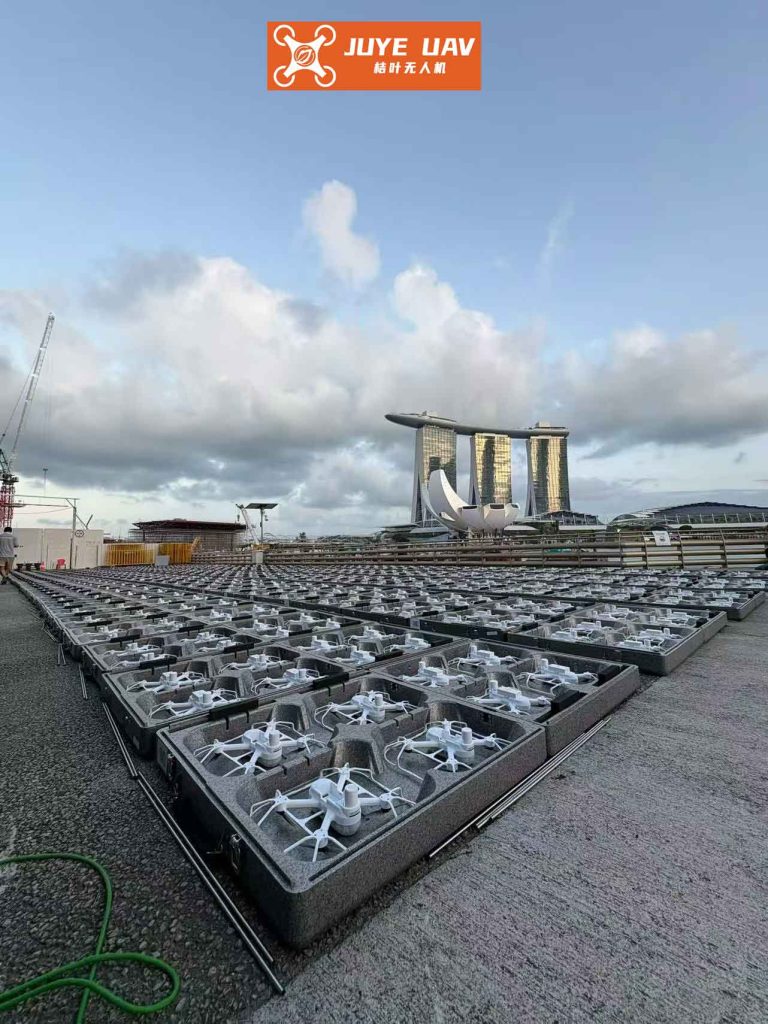
The image above illustrates a typical drone formation in a training scenario, highlighting the spatial coordination that can be simulated using virtual-real fusion. This visual aid enhances the understanding of formation geometries and their applications in teaching.
Regarding optimization strategies for drone formation teaching, I classify teaching strategies into traditional and modern categories. Traditional teaching strategies primarily include lecture-based instruction (LBI) and experiment-based instruction (EBI). Lecture-based instruction is teacher-centered, helping students master the basic principles and formation techniques of drones through systematic knowledge transfer. Experiment-based instruction emphasizes hands-on experience, allowing students to conduct task practice in real or simulated environments to cultivate their operational skills and problem-solving abilities. For example, when learning control algorithms for drone formation, instructors can combine field flight experiments, enabling students to observe algorithm performance in actual flight, thereby understanding the close connection between theory and practice.
| Strategy Type | Characteristics | Advantages | Limitations | Applicability to Drone Formation |
|---|---|---|---|---|
| Lecture-Based Instruction (LBI) | Teacher-centered, theoretical focus. | Efficient knowledge delivery, structured learning. | Low interactivity, limited practical engagement. | Suitable for introductory theories of drone formation. |
| Experiment-Based Instruction (EBI) | Hands-on, practical tasks in real/simulated settings. | Enhances operational skills, immediate feedback. | Resource-intensive, safety concerns with real drones. | Ideal for practicing drone formation maneuvers and control. |
| Virtual-Real Fusion (VRF) | Combines virtual simulation with real-world elements. | High immersion, safe, flexible, interactive. | Requires technical infrastructure, potential cost. | Excellent for comprehensive drone formation training, including complex scenarios. |
In the process of drone formation teaching, the goals of optimizing teaching strategies are concentrated on enhancing student comprehension, increasing practical opportunities, promoting team collaboration, and fostering innovative thinking, among several key aspects. Enhancing student comprehension is the primary goal of optimizing teaching strategies. Efficient comprehension requires students not only to grasp basic concepts of formation control and multi-agent systems but also to deeply understand mathematical models and control algorithms involved, such as linear matrix inequalities and genetic algorithms. By introducing virtual simulation environments, students can explore and verify complex theories in realistic data contexts, enabling them to translate theory into practice more quickly when facing actual operations, thereby improving the depth and breadth of understanding and mastery.
Increasing practical opportunities is equally an important goal for achieving teaching optimization. In drone formation teaching, practical opportunities can be realized through a combination of simulated flights, field operations, and case studies, allowing students to adjust formation strategies based on data analysis when confronting real scenarios. Simultaneously, using simulation platforms, instructors can design different tasks and challenges, enabling students to understand the dynamic characteristics and flexibility of formation flight during practical operations. Based on the characteristics of drone formation and the teaching needs of learners, I define teaching objectives and corresponding key performance indicators (KPIs), such as quantitative assessments of drone操控能力 (control ability), coordination in formation flight, and response speed to emergencies.
The adaptability and flexibility of the environment also need full consideration to allow for corresponding teaching adjustments based on students at different levels. In terms of design principles, I adhere to the three core principles of interactivity, visualization, and immersion. In virtual-real fusion environments, ensuring that learners can receive real-time feedback through multiple perceptions such as vision, hearing, and touch greatly enhances learning initiative and participation. The implementation technology of the teaching environment is the specific tools and means of construction. Applying VR or AR, combined with precise simulation algorithms and big data analysis technology, can generate virtual flight scenarios and task challenges in teaching. By leveraging machine learning algorithms to process wirelessly transmitted data in real time, it is possible to continuously optimize program parameters and teaching content, thereby achieving personalized teaching experiences.
When constructing a drone formation teaching environment, attention must also be paid to the formulation of optimization strategies. Through in-depth research on the classification and characteristics of different teaching strategies, combined with learner feedback and performance tests, I optimize goal setting and strategy application in the teaching process. Based on learners’ specific performances, teaching methods are dynamically adjusted to improve overall learning outcomes. To quantify learning outcomes, I can use a learning curve model: $$ y = a \cdot x^{-b} $$ where \(y\) represents error rate in drone formation tasks, \(x\) is the number of practice sessions, \(a\) is the initial error, and \(b\) is the learning rate. This formula helps assess the effectiveness of virtual-real fusion in accelerating skill acquisition.
| Key Element | Design Principle | Implementation Technology | Optimization Strategy |
|---|---|---|---|
| Teaching Environment Needs Analysis | Interactivity, Visualization, Immersion | VR/AR Technology | Classification and characteristic studies of teaching strategies |
| Teaching Objectives and KPIs | Clarity, Measurability | Real-time Data Analytics | Optimized feedback mechanisms |
| Environmental Adaptability and Flexibility | Customization, Scalability | IoT and Cloud Computing | Dynamic teaching adjustments based on performance |
| Specific Application Scenarios | Realism, Relevance | Augmented Reality Technology | Scenario-based learning modules |
For optimization methods, I propose integrating adaptive learning systems. These systems can use algorithms to personalize the drone formation training. For example, a reinforcement learning model can be applied: $$ Q(s,a) \leftarrow Q(s,a) + \alpha [r + \gamma \max_{a’} Q(s’,a’) – Q(s,a)] $$ where \(Q(s,a)\) is the action-value function for state \(s\) and action \(a\), \(\alpha\) is the learning rate, \(r\) is the reward, and \(\gamma\) is the discount factor. This model can optimize drone formation strategies by simulating various actions in virtual environments, providing tailored feedback to learners.
Moreover, team collaboration in drone formation can be enhanced through virtual-real fusion by simulating multi-user environments. The effectiveness of collaboration can be measured using metrics like task completion time \(T\) and formation accuracy \(A\), defined as: $$ A = 1 – \frac{1}{n} \sum_{i=1}^n \| \mathbf{p}_i – \mathbf{p}_i^{\text{desired}} \| $$ where \(\mathbf{p}_i^{\text{desired}}\) is the desired position of drone \(i\). By tracking these metrics in virtual scenarios, instructors can identify areas for improvement and adjust teaching strategies accordingly.
In conclusion, through the application of virtual-real fusion technology, drone formation teaching can effectively enhance students’ immersion and participation. In traditional teaching models, students often face disconnections between theory and practice. The introduction of virtual-real fusion technology provides students with an interactive and visual learning environment. This model not only improves learners’ understanding of drone swarm behaviors but also promotes their mastery of decision-making skills in complex situations. By simulating real flight environments, students can repeatedly practice formation flight in virtual space, thereby reducing error rates in actual operations. Multiple cases implementing virtual-real fusion drone formation teaching show that students participating in this teaching have significantly improved in formation flight accuracy, response speed, and collaborative combat capabilities. For instance, in a simulated mission involving obstacle avoidance, students using virtual-real fusion demonstrated a 30% faster reaction time compared to those trained with traditional methods, as measured by KPI assessments.
Looking ahead, in research focused on constructing teaching environments, more attention can be paid to the application and optimization of mixed reality (MR) technology in drone formation. Specifically, I can explore how to assess how the integration of VR and AR technologies affects learners’ skill enhancement and practical levels through data analysis and simulation experiments. Future work could involve developing more advanced algorithms for autonomous drone formation, such as using swarm intelligence models inspired by biological systems: $$ \dot{\mathbf{v}}_i = \sum_{j \in \mathcal{N}_i} \phi(\|\mathbf{p}_j – \mathbf{p}_i\|) (\mathbf{v}_j – \mathbf{v}_i) + \mathbf{u}_i $$ where \(\mathbf{v}_i\) is the velocity of drone \(i\), \(\phi\) is an interaction function, and \(\mathbf{u}_i\) is an external control input. Such models can be integrated into virtual-real fusion platforms to teach emergent behaviors in drone formation.
Additionally, the scalability of drone formation teaching environments can be addressed by incorporating cloud-based simulations. This allows for large-scale multi-drone scenarios without hardware limitations. A table summarizing future directions is provided below:
| Direction | Description | Potential Impact on Drone Formation |
|---|---|---|
| Mixed Reality (MR) Integration | Combining VR and AR for seamless virtual-real interactions. | Enhances realism and flexibility in formation training. |
| AI-Driven Personalization | Using machine learning to adapt teaching content to individual learners. | Improves learning efficiency and engagement in drone formation tasks. |
| Cloud-Based Simulation Platforms | Leveraging cloud computing for large-scale, accessible training environments. | Enables cost-effective and scalable drone formation education. |
| Advanced Control Algorithms | Incorporating nonlinear and adaptive control theories into teaching modules. | Prepares students for cutting-edge drone formation applications. |
Overall, the construction and optimization of drone formation teaching environments based on virtual-real fusion represent a significant advancement in educational technology. By continuously refining strategies and leveraging technological innovations, I aim to foster a new generation of skilled practitioners in drone formation, capable of tackling complex real-world challenges. The iterative process of teaching and learning in such environments can be modeled as a feedback loop: $$ \text{Performance}_{t+1} = f(\text{Performance}_t, \text{Intervention}_t, \text{Environment}_t) $$ where \(f\) is a function representing the learning dynamics, \(\text{Intervention}_t\) denotes teaching strategies applied at time \(t\), and \(\text{Environment}_t\) includes virtual-real fusion elements. This emphasizes the dynamic nature of optimizing drone formation education.
In summary, this article has detailed the construction and optimization of drone formation teaching environments through virtual-real fusion, highlighting key strategies, technologies, and future directions. The integration of tables and formulas throughout underscores the analytical approach to enhancing teaching and learning in this domain. As drone technology evolves, so too will the methods for educating individuals on formation flying, with virtual-real fusion serving as a cornerstone for immersive and effective training. The repeated emphasis on drone formation throughout this discussion aims to reinforce its centrality in modern aerospace education and research.