
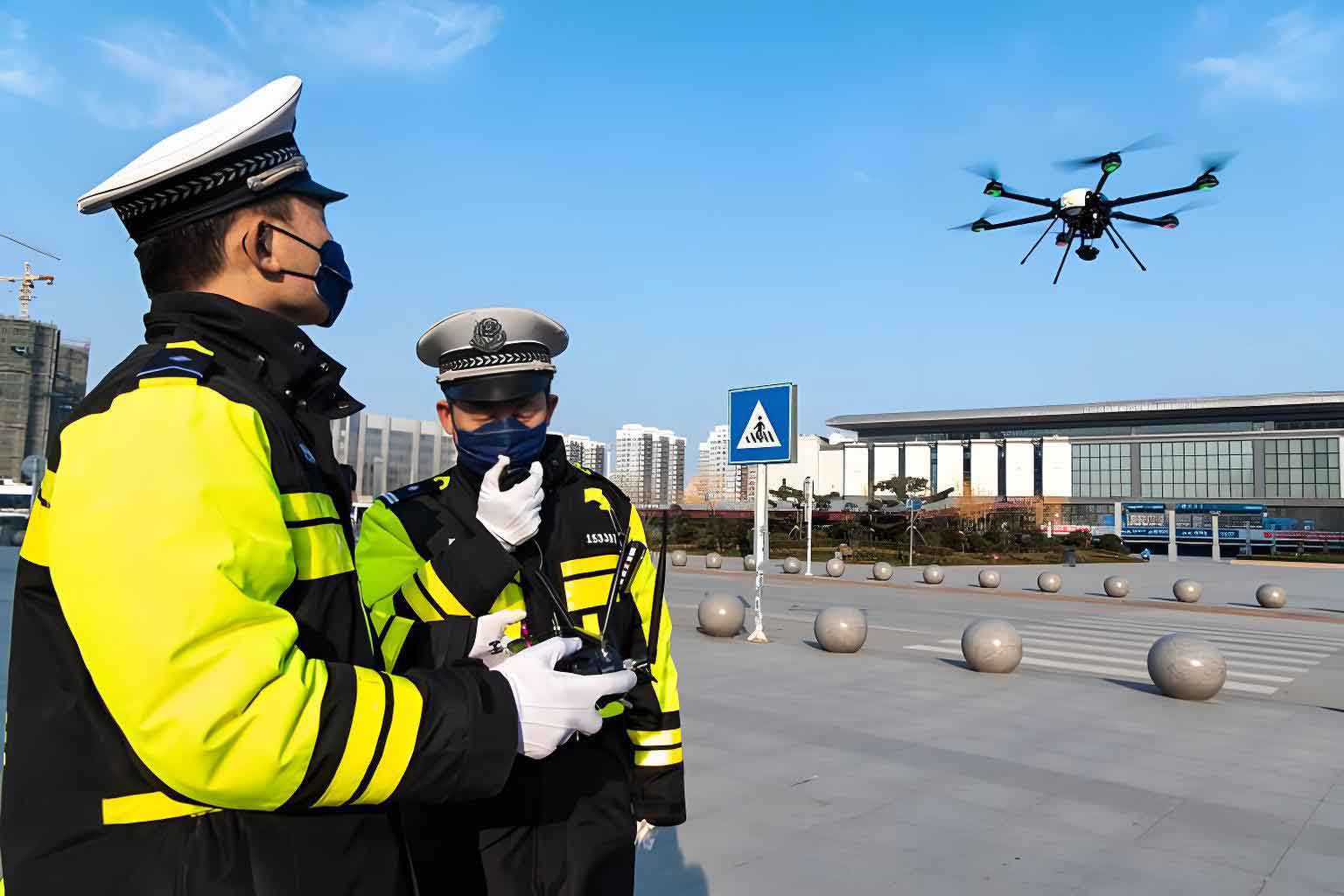
The global landscape of security threats is continuously evolving, with explosive devices representing a persistent and highly dangerous challenge. The increasing technical sophistication and concealment methods of these threats have significantly elevated the risks associated with traditional security screening and explosive ordnance disposal (EOD) operations. In this high-stakes environment, the imperative to maximize standoff distance and operational safety for personnel is paramount. The integration of advanced technological solutions has thus become a critical focal point for modern law enforcement agencies. Among these, the police UAV (Unmanned Aerial Vehicle) has emerged as a transformative tool, offering an unparalleled combination of remote operation, versatility, and situational awareness. This article provides a detailed, first-person analysis of the current application status, inherent advantages, persistent challenges, and future development trends of police UAVs within the specialized domains of security checks and EOD.
1. Operational Paradigm and Current Application Spectrum
The foundational principle guiding EOD procedures is the reduction of direct human exposure to potential threats. Traditional protocols often prioritize relocation of suspected ordnance over manual intervention. In this context, police UAVs serve as a force multiplier, extending the operational reach and sensory capabilities of the EOD team. Unlike ground-based robots, which may be hampered by complex terrain, the aerial mobility of a police UAV allows it to access, observe, and interact with environments that are otherwise inaccessible or prohibitively dangerous.
The application of police UAVs is characterized by its modularity and adaptability. Various payloads can be integrated onto a standardized aerial platform, allowing a single police UAV system to perform multiple distinct functions. The core applications can be systematically categorized as follows:
| Operational Phase | Police UAV Task | Typical Payload/Technology | Key Benefit |
|---|---|---|---|
| Initial Reconnaissance & Assessment | Overflight of suspected hazard area; gathering preliminary visual data. | High-definition zoom camera, thermal imaging sensor. | Rapid situational awareness without personnel entry; identification of potential secondary threats. |
| Detailed Inspection & Diagnosis | Close-range, multi-angle visual examination of an unidentified object. | 4K gimbal-stabilized camera, macro lens attachments. | Provides detailed imagery for bomb technicians to identify device type, initiation mechanisms, and construction. |
| Environmental Mapping & Modeling | Creating 3D maps or digital twins of the incident scene. | Photogrammetry software, LiDAR scanner. | Enables precise measurement, planning of approach routes, and rehearsal of disposal tactics in a virtual model. |
| Direct Intervention & Manipulation | Relocating a suspicious item or deploying a disruptor. | Robotic gripper arm, disruptor mounting system. | Allows for remote rendering safe procedures or moving a device to a containment vessel. |
| Post-Procedure Verification | Confirming the success of a disruption or the absence of remaining hazards. | High-resolution camera, chemical residue detector. | Final safety check conducted from a safe distance. |
The effectiveness of a police UAV in these roles is not merely a function of its flight capabilities but is profoundly enhanced by supporting technologies. Real-Time Kinematic (RTK) positioning systems provide centimeter-level accuracy for geolocation, which is crucial for mapping and precision interventions. The data link stability, often operating on dedicated frequencies like 1.4GHz for control and 2.4/5.8GHz for video, is the lifeline of the operation. A model for the effective operational radius (R_effective) of a police UAV system, considering signal integrity, can be conceptualized as:
$$R_{\text{effective}} = \min(R_{\text{visual line-of-sight}}, R_{\text{data link}}(P_t, G_t, G_r, \lambda, L)),$$
where $R_{\text{visual LOS}}$ is the visual line-of-sight range, and $R_{\text{data link}}$ is a function of transmit power ($P_t$), antenna gains ($G_t, G_r$), wavelength ($\lambda$), and path loss ($L$).
2. Systemic Advantages of Police UAV Platforms
The adoption of police UAV technology offers a multi-faceted advantage over traditional EOD methods, fundamentally changing the risk calculus for operators.
2.1 Unmatched Versatility and Scene Accessibility
The primary advantage of a police UAV is its ability to transcend ground-based obstacles. It can navigate vertically and horizontally across complex urban and natural terrains—rooftops, rubble, muddy fields, riverbanks, and confined interior spaces like ductwork or high atriums. This makes the police UAV indispensable for pre-event security sweeps of large venues and for post-blast forensic assessment in unstable environments.
2.2 Dynamic and Multi-Perspective Observation
Traditional assessment often relies on a single, ground-level viewpoint. A police UAV provides a dynamic, bird’s-eye view and the ability to circle a target, offering orthographic, oblique, and even sub-surface views (when combined with penetrative sensors). This multi-angle data fusion is critical for accurate threat assessment. The information gain (I_gain) from multi-perspective observation can be framed as reducing the entropy (H) in the threat identification problem:
$$I_{\text{gain}} = H(\text{Threat}_{ \text{single-view}}) – H(\text{Threat}_{ \text{UAV multi-view}}).$$
A lower entropy state signifies higher certainty in the technician’s diagnosis.
2.3 Enhanced Precision and Operational Efficiency
Integrating RTK-GPS modules transforms the police UAV from a simple observational platform into a precise measurement and placement tool. This allows for the accurate marking of hazard locations, the creation of high-fidelity 3D models for planning, and the precise positioning of disruptive charges. The efficiency gain is substantial, reducing the time personnel are exposed to danger and accelerating the overall resolution of an incident.
2.4 Favorable Life-Cycle Cost Structure
From a procurement and sustainability perspective, police UAV systems present a compelling economic argument. The acquisition cost of a sophisticated multi-rotor police UAV with multiple payloads is typically an order of magnitude lower than that of a heavy-duty EOD robot. Furthermore, the ecosystem for commercial UAV components is vast and competitive, leading to lower costs for maintenance, repairs, and upgrades. This affordability enables wider departmental deployment and more frequent training. A simplified total cost of ownership (TCO) comparison highlights this advantage:
| Cost Component | Advanced Police UAV System | Traditional EOD Robot |
|---|---|---|
| Initial Acquisition | $XX,XXX – $XXX,XXX | $XXX,XXX – $X,XXX,XXX |
| Annual Maintenance | Low (standardized parts, modular) | High (proprietary parts, specialized service) |
| Training Cost per Operator | Relatively Low | High |
| Platform Upgrade Path | Fast-paced, leveraging commercial tech | Slower, manufacturer-dependent cycles |
3. Persistent Challenges and Technical Limitations
Despite the clear benefits, the operational integration of police UAVs is not without significant hurdles. These challenges span technical, regulatory, and human resource domains.
3.1 Endurance and Power System Constraints
The most pronounced technical limitation is flight endurance. Most electric multi-rotor police UAVs are limited to 20-40 minutes of flight time under optimal conditions, which is reduced significantly when carrying heavy payloads like manipulator arms or disruptors. This constrains mission duration and necessitates complex logistics for battery swapping during prolonged operations. The endurance (E) is a function of battery energy density (ρ_b), UAV mass (m), and power draw (P):
$$E \propto \frac{\rho_b \cdot m_{\text{battery}}}{P(m_{\text{total}}, \text{payload})}.$$
Breakthroughs in battery technology or alternative power systems (e.g., hydrogen fuel cells) are critically needed to advance police UAV capabilities.
3.2 Signal Vulnerability and Electromagnetic Interference
Police UAV operations are entirely dependent on secure, robust data links. In dense urban environments or during large-scale events, the radio frequency spectrum can become congested, leading to potential interference, latency, or even loss of control. Malicious jamming is also a growing concern. Ensuring command integrity in all operational scenarios requires sophisticated frequency hopping, encrypted data links, and possibly fallback autonomous behaviors.
3.3 Regulatory Ambiguity and Operational Governance
The regulatory framework for police UAV operations, especially in complex national airspace, is often fragmented. Issues surrounding flight authorization over populated areas, coordination with aviation authorities, inter-agency communication protocols, and public privacy concerns can create bureaucratic delays. The lack of universally recognized visual identifiers for police UAVs can also lead to public misunderstanding during operations.
3.4 Critical Shortage of Specialized Personnel
The technology is only as effective as its operator. There exists a severe shortage of highly trained police UAV pilots, particularly those certified for complex EOD missions (akin to an “A-level” certification). Training is often ad-hoc, and few formal educational pipelines exist within law enforcement academies to systematically produce pilots who are also versed in EOD tactics, sensor interpretation, and basic platform mechanics. This talent gap is especially acute in less developed regions.
4. Future Trajectories and Integrative Development
The future of police UAVs in security and EOD is inextricably linked to broader technological trends. Their evolution will be marked by greater autonomy, deeper integration, and more sophisticated human-machine teaming.
4.1 The Path to Greater Autonomy and AI Integration
The next generation of police UAVs will transition from remotely piloted vehicles to intelligent partners. Artificial Intelligence (AI) and Machine Learning (ML) will enable:
- Automated Threat Recognition: On-board vision systems trained to visually identify common IED components or suspicious configurations.
- Intelligent Flight Path Planning: Autonomous navigation in GPS-denied environments (e.g., inside buildings) using SLAM (Simultaneous Localization and Mapping).
- Predictive Analytics: Using data from multiple sensors to assess device stability or predict potential blast effects in real-time.
The decision-making process could be modeled as a partially observable Markov decision process (POMDP), where the police UAV must choose actions (e.g., fly closer, change sensor, deploy tool) based on incomplete sensor observations to maximize the reward (successful diagnosis/safe disposal).
4.2 The “Digital Twin” and Immersive Planning
Inspired by Industry 4.0, the concept of a “Digital Twin” will become central. A high-fidelity, real-time digital replica of the incident scene, created by a police UAV’s scanning data, will allow EOD commanders and technicians to:
- Plan and rehearse complex disposal procedures virtually.
- Run simulations of blast effects and collateral damage.
- Monitor the real-world status of the scene through sensor data mapped onto the twin.
This creates a powerful, proactive management tool, enhancing both safety and operational efficacy.
4.3 Swarm Tactics and Heterogeneous Team Coordination
Future operations will likely involve coordinated teams of UAVs and ground robots. A swarm of small, disposable reconnaissance police UAVs could map a large area quickly, while a larger, armed police UAV stands by for intervention, and a ground robot provides a stable platform for detailed manipulation. Effective communication and role allocation within this heterogeneous team present a rich area for research in multi-agent systems.
4.4 Systemic Solutions: Training, Policy, and R&D
Addressing the non-technical challenges requires a concerted, top-down effort:
- National Standardization: Establishing clear, nationwide protocols for police UAV deployment, airspace access, and public communication.
- Investment in Human Capital: Creating dedicated degree and certification programs for police UAV operations within law enforcement and partner academic institutions.
- Focused R&D Initiatives: Government-led research programs should fund development of next-generation platforms specifically for high-risk professions, focusing on endurance, resilience, and specialized AI for threat analysis.
5. Conclusion
The integration of police UAV technology into security screening and explosive ordnance disposal represents a paradigm shift in operational safety and capability. The aerial perspective, remote manipulation, and data-gathering prowess of the modern police UAV directly address the core imperative of protecting human life. While current systems face tangible limitations in endurance, regulation, and operator proficiency, the trajectory of development is unequivocally positive. The convergence of advances in artificial intelligence, materials science, communication networks (like 5G/6G), and robust policy frameworks will propel the police UAV from a valuable tool to an indispensable, intelligent member of the EOD team. The future of counter-explosive operations will be defined by this synergy between human expertise and unmanned, autonomous systems, creating a safer environment for both the public and the personnel sworn to protect them.