
In recent years, the rapid development of unmanned aerial vehicle (UAV) technology has led to remarkable performances in both military and civilian domains. The characteristics of police UAVs, such as modularity, integration, diversity, flexibility, rapid deployment, and safety, enable them to adopt targeted tactics for different types of emergencies. By coordinating with public security agencies, police UAVs enhance the efficiency and success rate of emergency response, effectively avoiding casualties and economic losses. In this article, I will explore the tactical methodologies of police UAVs in handling emergencies, focusing on counter-terrorism, mass incidents, and disaster accidents. I will incorporate tables and formulas to summarize key concepts and provide a comprehensive analysis.
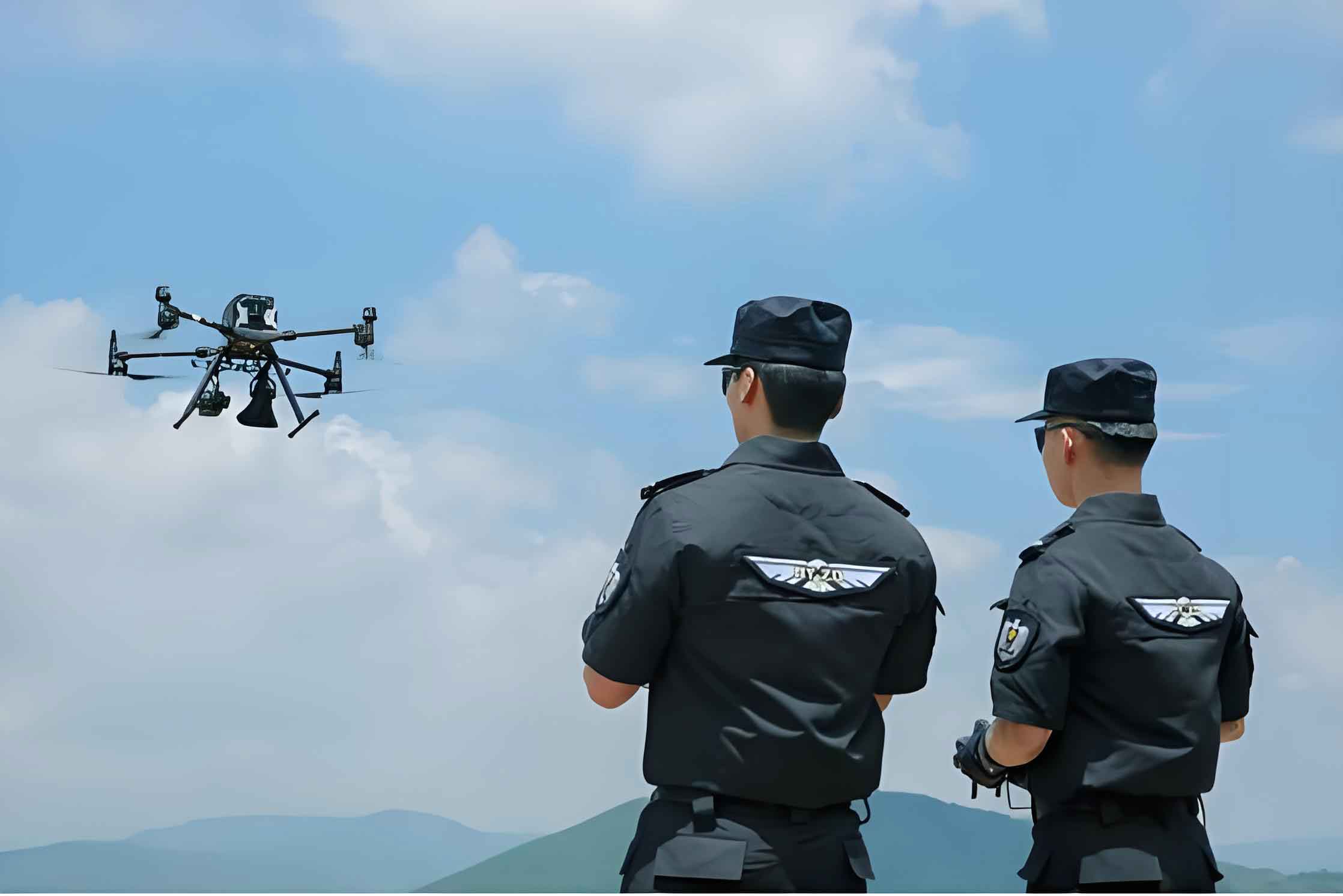
The police UAV, or police unmanned aircraft, refers to aerial vehicles used by law enforcement agencies for policing activities, excluding manned operations. According to standards, police UAVs include autonomous and remotely piloted aircraft, but not unmanned balloons or model aircraft. The modular design of police UAVs allows for customization based on mission requirements, ensuring compatibility and integration across functional modules. This adaptability is crucial for responding to diverse emergencies. For instance, the police UAV can be equipped with various payloads, such as cameras, weapons, or communication relays, depending on the situation. The rapid deployment capability of police UAVs enables quick response times, while their stealth features, like low noise and visibility, enhance operational security. Safety and reliability are paramount, with police UAVs undergoing rigorous testing for extreme conditions and encrypted communications.
To understand the capabilities of police UAVs, I categorize them into three main types, as shown in Table 1. This classification helps in selecting the appropriate police UAV for specific tasks.
| Type | Advantages | Disadvantages | Primary Applications |
|---|---|---|---|
| Unmanned Helicopter | High maneuverability, long endurance, large payload capacity | Strong vibration, high noise, poor stability | Reconnaissance, patrol, supply delivery |
| Multi-axis UAV | Vertical take-off and landing, hovering, flexibility, simple operation, low maintenance cost | Short endurance, small payload capacity | Reconnaissance, patrol, force engagement, supply delivery, communication relay |
| Fixed-wing UAV | Long endurance, high altitude, fast speed, large observation range | Requires take-off and landing space, poor rapid deployment | Reconnaissance, patrol |
The effectiveness of a police UAV in emergencies can be quantified using formulas. For example, the reconnaissance efficiency \( E_r \) of a police UAV can be expressed as:
$$ E_r = \frac{A_c}{A_t} \times t_d \times v_s $$
where \( A_c \) is the area covered by the police UAV’s sensors, \( A_t \) is the total area of interest, \( t_d \) is the deployment time, and \( v_s \) is the sensor resolution factor. This formula highlights how police UAVs enhance situational awareness. Additionally, the response time \( T_r \) for a police UAV is given by:
$$ T_r = t_d + t_f + t_o $$
where \( t_d \) is deployment time, \( t_f \) is flight time to the scene, and \( t_o \) is operational setup time. Minimizing \( T_r \) is critical for emergency response.
In emergency handling, police UAVs serve multiple functions, as summarized in Table 2. These functions leverage the unique attributes of police UAVs to address operational gaps.
| Function | Description | Key Police UAV Features |
|---|---|---|
| Reconnaissance and Evidence Collection | Using cameras or sensors to gather real-time visual data and evidence | High-resolution imaging, modular payloads |
| Patrol and Surveillance | Monitoring areas with night-vision or infrared equipment for continuous oversight | Stealth capabilities, endurance |
| Force Engagement | Deploying lethal or non-lethal weapons for direct or辅助 attacks | Weapon modules, precision targeting |
| Supply Delivery | Transporting essentials like food, medicine, or ammunition to remote locations | Payload capacity, hover capability |
| Communication Relay | Acting as temporary signal relays in areas with damaged infrastructure | Communication modules, altitude advantage |
The tactical methodologies for police UAVs vary based on the type of emergency. I will delve into mass incidents, counter-terrorism operations, and disaster accidents, using tables and formulas to illustrate best practices.
For mass incidents, police UAVs are deployed in phases: pre-action, mid-action, and post-action. In the pre-action phase, the police UAV conducts global reconnaissance to collect information. The information gain \( I_g \) can be modeled as:
$$ I_g = \sum_{i=1}^{n} w_i \cdot d_i $$
where \( w_i \) is the weight of information type \( i \) (e.g., crowd size, terrain), and \( d_i \) is the data collected by the police UAV. Surveillance and警戒 are enhanced by police UAVs patrolling警戒 lines. In the mid-action phase, police UAVs assist in arrests and crowd dispersal. The effectiveness of non-lethal force \( F_n \) from a police UAV can be expressed as:
$$ F_n = k \cdot \frac{P_d}{D^2} $$
where \( k \) is a constant based on weapon type, \( P_d \) is the payload intensity, and \( D \) is the distance to the target. This ensures precise control. In the post-action phase, police UAVs固定 evidence and guide疏散, with the evidence quality \( Q_e \) given by:
$$ Q_e = \frac{R_v \cdot t_r}{N_o} $$
where \( R_v \) is video resolution, \( t_r \) is recording duration, and \( N_o \) is the number of obstructed views. Police UAVs optimize this through aerial perspectives.
In counter-terrorism operations, police UAVs are used in search, containment, and engagement stages. During search, police UAVs employ协同搜索 tactics. The search coverage \( C_s \) by a police UAV team is:
$$ C_s = A_u \cdot n \cdot \eta $$
where \( A_u \) is the area covered per police UAV, \( n \) is the number of police UAVs, and \( \eta \) is the coordination efficiency factor. For stealth, police UAVs use消音熄灯 approaches, with the detection risk \( R_d \) modeled as:
$$ R_d = \frac{N_s \cdot L}{S_m} $$
where \( N_s \) is noise level, \( L \) is light emission, and \( S_m \) is stealth modulation. Lower \( R_d \) reduces terrorist alertness. In containment, police UAVs conduct patrols and psychological operations. The psychological impact \( P_i \) of police UAV喊话 is:
$$ P_i = \frac{V \cdot f}{d^2} $$
where \( V \) is voice volume, \( f \) is frequency of messages, and \( d \) is distance from the police UAV to targets. During engagement, police UAVs provide火力压制 or辅助打击. The打击 accuracy \( A_f \) for a police UAV is:
$$ A_f = \frac{H_t}{T_s} \cdot \sigma $$
where \( H_t \) is hit rate, \( T_s \) is target size, and \( \sigma \) is sensor precision. Police UAVs enhance this with real-time tracking.
For disaster accidents, police UAVs address geological hazards, water incidents, and firefighting. In geological disasters, police UAVs perform侦查搜索 and通信中继. The救援 efficiency \( E_{res} \) is:
$$ E_{res} = \frac{N_s \cdot t_a}{D_r} $$
where \( N_s \) is number of survivors located by police UAVs, \( t_a \) is time to aid delivery, and \( D_r \) is disaster radius. Police UAVs act as临时基站 for communication, with signal strength \( S_c \) given by:
$$ S_c = \frac{P_t \cdot G}{d^2} $$
where \( P_t \) is transmission power of the police UAV relay, \( G \) is antenna gain, and \( d \) is distance. In water incidents, police UAVs enable高空侦测 and应急救援. The search rate \( R_{sw} \) for溺水者 is:
$$ R_{sw} = \frac{A_s}{v_u \cdot t_s} $$
where \( A_s \) is search area, \( v_u \) is police UAV speed, and \( t_s \) is sensor sweep time. Police UAVs drop life-saving equipment, reducing response time. For firefighting, police UAVs conduct近火侦查 and灭火救援. The thermal detection capability \( T_d \) of a police UAV is:
$$ T_d = \frac{\Delta T \cdot r_i}{d_f} $$
where \( \Delta T \) is temperature difference, \( r_i \) is infrared resolution, and \( d_f \) is distance from the fire. Police UAVs deliver灭火 agents or rescue gear, improving safety.
To summarize the tactical advantages, I present Table 3, which compares police UAV applications across emergency types. This highlights the versatility of police UAVs.
| Emergency Type | Key Police UAV Tactics | Performance Metrics | Optimal Police UAV Type |
|---|---|---|---|
| Mass Incidents | Reconnaissance, surveillance, non-lethal engagement, evidence collection | Crowd control efficiency, evidence quality | Multi-axis UAV for flexibility |
| Counter-Terrorism | Stealth search, psychological operations, direct force engagement | Search coverage,打击 accuracy, containment success rate | Unmanned helicopter for payload, multi-axis for agility |
| Disaster Accidents | Rapid assessment, supply delivery, communication relay, rescue support | Response time,救援 efficiency, signal reliability | Fixed-wing UAV for endurance, multi-axis for precision |
The integration of police UAVs into emergency response requires careful planning. I propose a decision framework based on the police UAV selection index \( I_{sel} \):
$$ I_{sel} = \alpha \cdot E + \beta \cdot S + \gamma \cdot C $$
where \( \alpha, \beta, \gamma \) are weights for endurance \( E \), stealth \( S \), and cost \( C \). This index guides agencies in deploying police UAVs effectively. Furthermore, the tactical effectiveness \( TE \) of a police UAV operation can be evaluated as:
$$ TE = \sum_{j=1}^{m} w_j \cdot O_j $$
where \( w_j \) is the weight for objective \( j \) (e.g., casualty reduction, speed), and \( O_j \) is the outcome achieved by police UAVs. Regular training and protocol updates are essential to maximize \( TE \).
In conclusion, police UAVs represent a transformative tool for emergency response, offering modular capabilities that enhance侦查, surveillance, engagement, and救援. Through targeted战术法, police UAVs address the limitations of traditional methods in handling mass incidents, counter-terrorism, and disasters. The formulas and tables provided in this article summarize key concepts, such as efficiency metrics and performance comparisons. As technology evolves, police UAVs will continue to play a pivotal role in public safety. Future research should focus on autonomous swarms and AI integration for police UAVs to further improve response outcomes. By leveraging police UAVs, law enforcement agencies can achieve higher success rates with minimized risks.