
As a professional deeply involved in the field of law enforcement technology, I have observed the rapid integration of police Unmanned Aerial Vehicles (UAVs) into public security operations. A police UAV, defined as an unpiloted aircraft system operated by law enforcement agencies, typically consists of an airframe, mission payloads, data transmission links, ground control stations, and launch/recovery systems. These systems, categorized into fixed-wing, rotary-wing (helicopters), and multi-rotor types, offer unique advantages such as an elevated aerial perspective, high mobility, rapid deployment, operational flexibility, and the ability to integrate into broader policing frameworks. Their application has demonstrably reduced officer risk, alleviated manpower shortages, and significantly enhanced operational efficiency across various domains. Guided by national aviation management offices, police departments are establishing dedicated UAV units within tactical, aviation, criminal investigation, traffic, and public order divisions. However, as deployment scales, critical challenges related to technical performance, regulatory frameworks, legal standing, and team development have emerged, posing significant barriers to their sustainable and effective utilization.
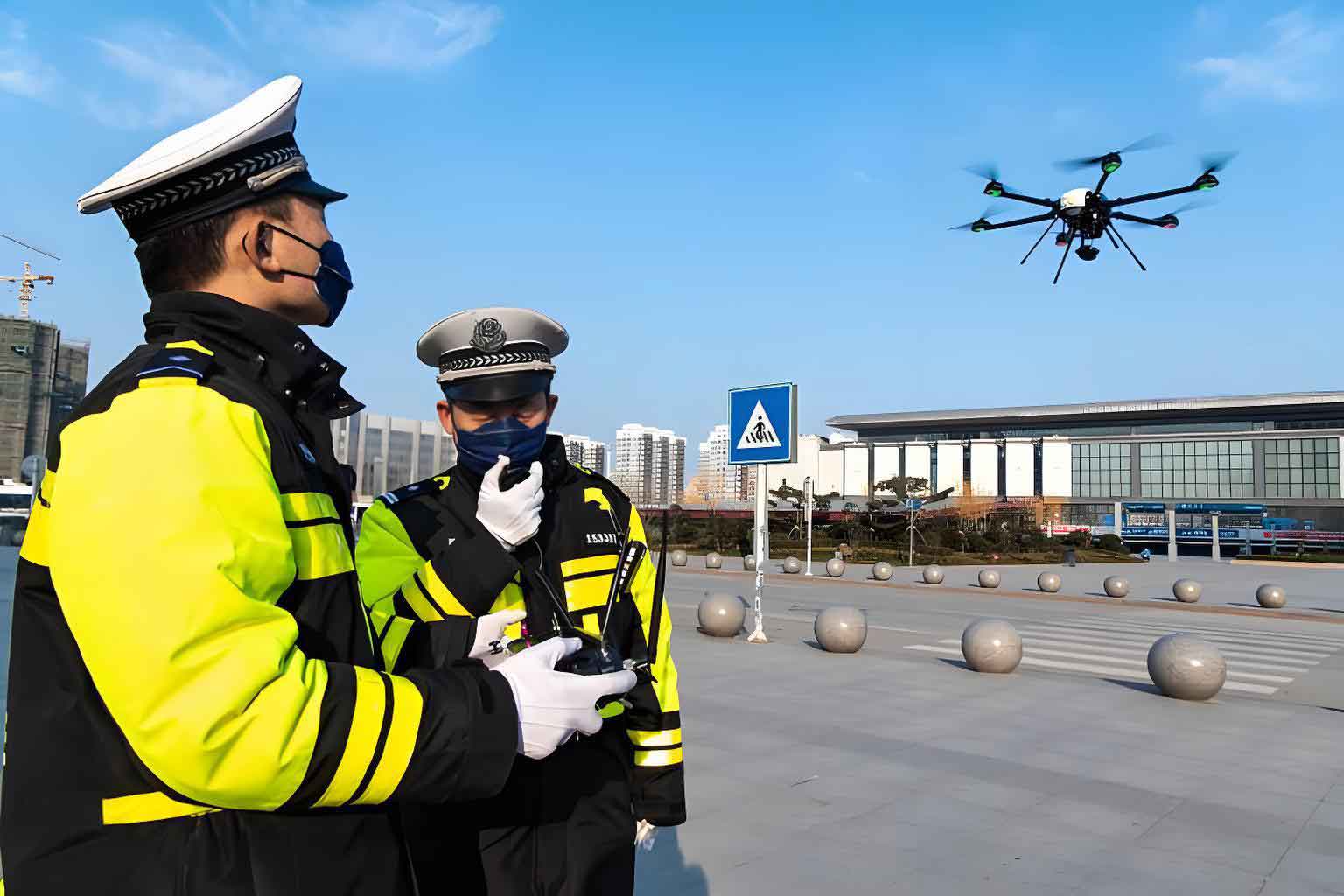
The operational landscape for police UAVs is primarily divided into two core areas: public order management and criminal investigation. Based on extensive field surveys and analyses, the application distribution is highly pronounced in specific tasks. The following table details the current primary and secondary application domains for police UAVs.
| Application Category | Primary Application Domains (High Adoption >75%) | Secondary Application Domains (Moderate Adoption 50-75%) | Emerging/Niche Application Domains (Lower Adoption <50%) |
|---|---|---|---|
| Public Order Management | Security for Large-scale Events; Security for Key Installations & Sites. | Response to Mass Disturbances; Emergency Rescue & Disaster Response; Forest/Fire Patrol. | Hotspot/Tourist Area Management; River Patrol; Traffic Violation Enforcement; Emergency Traffic Control; Rapid Accident Scene Management; Illegal Poppy Cultivation Monitoring. |
| Criminal Investigation | Major Criminal Case Investigations. | Wilderness Gambling Operations; Wilderness Drug-related Operations. | Illegal Logging; Illegal Quarrying; Illegal Sand Dredging; Illegal Hunting Cases. |
This distribution highlights a focus on high-impact, resource-intensive scenarios where the police UAV provides a decisive advantage, such as overseeing large crowds or accessing remote, hazardous locations for investigations.
Technical Performance Requirements and Identified Gaps
The effectiveness of a police UAV is fundamentally tied to its technical capabilities. Requirements can be analyzed through the lens of generic platform performance and mission-specific application needs.
1. Generic Platform Performance
Core technical parameters form the baseline for any police UAV application. Common requirements include:
- Endurance & Range: Maximizing flight time ($t_{flight}$) and operational radius ($R_{op}$) is crucial for extended patrols or searches. Current limitations often constrain missions.
$$ \text{Coverage Area} \propto R_{op} \times t_{flight} \times v $$
where $v$ is patrol velocity. - Payload Capacity & Versatility: The ability to carry ($m_{payload}$) and rapidly swap modular payloads (optical/thermal zoom cameras, loudspeakers, searchlights, tactical modules) is essential.
- Environmental Resilience: Performance must be maintained under various conditions: wind resistance ($WS_{max}$), all-weather operation (rain, snow), and acoustic stealth (low $dB_{noise}$) for covert ops.
- Operational Robustness: This includes reliable command & control links with resistance to interference ($C/N_{min}$), robust Positioning, Navigation, and Timing (PNT) in GNSS-denied environments, and advanced sense-and-avoid ($SAA$) capabilities.
2. Public Order Management: Performance Needs & Deficiencies
In public order management, the police UAV functions as an airborne sensor and initial response platform. Two primary operational models are patrol/prevention and rapid call response.
| Operational Model | Core Task Description | Key Performance Deficiencies |
|---|---|---|
| Patrol & Area Surveillance | Conducting automated or piloted patrols over designated areas (events, key sites). Using imaging and AI payloads to identify persons, vehicles, objects, and anomalies. Real-time data is streamed to command centers for situational awareness and ground team dispatch. |
|
| Rapid Call Response (Automated) | Upon receiving an alert (e.g., disturbance, accident), a nearby docked police UAV is remotely activated from the command center. It autonomously flies to the GPS coordinate, provides live footage, conducts speaker announcements, delivers supplies, or illuminates the scene for first response before ground units arrive. |
|
The future of police UAVs in this domain lies in deeper integration with Smart Policing ecosystems, moving beyond simple surveillance to predictive analytics and automated command and control functions.
3. Criminal Investigation: Performance Needs & Deficiencies
Here, the police UAV serves as a tactical intelligence, surveillance, reconnaissance (ISR), and force multiplication asset.
| Operational Model | Core Task Description | Key Performance Deficiencies |
|---|---|---|
| Case Investigation & Scene Command | Gathering aerial evidence (photos, video, orthomosaics) for crimes like illegal quarrying or gambling. Providing real-time overwatch and situational overview to commanders via live feed or quick aerial maps of the scene. |
|
| Search, Tracking & Apprehension Support | Conducting wide-area searches for suspects or missing persons using EO/IR cameras. Tracking identified targets and guiding ground units precisely to their location. Facilitating coordinated arrests through shared aerial video with ground teams. |
|
| Tactical Engagement & Crime Scene Forensics | Providing overwatch for high-risk operations. Carrying non-lethal (speakers, tear gas, nets) or less-lethal payloads for precision delivery in hostile situations. Documenting crime scenes, especially those difficult to access. |
|
Systemic Challenges: Regulation, Law, and Institutional Capacity
Beyond technical specs, the integration of police UAVs faces significant systemic hurdles that constrain their operational scope and legitimacy.
1. Regulatory and Safety Oversight
A fragmented regulatory environment creates operational uncertainty:
- Airspace Management: The process for obtaining flight clearance from civil and military authorities is often cumbersome and slow, incompatible with the urgent nature of police work. This leads to a tendency for units to fly without proper authorization (“fly first, ask later”), creating safety and legal risks.
- Standardization & Identification: Despite existing guidelines, many police UAVs operate without standard law enforcement livery or markings. This “naked” operation can confuse the public and lead to disputes over authority and privacy infringement.
- Safety Assurance: Insurance coverage for police UAV operations is often incomplete, focusing on hull damage but neglecting third-party liability for ground damage caused by a malfunction or crash. This exposes agencies to significant financial risk.
2. Legal and Policy Framework
The legal status of police UAV actions remains a gray area, causing operational hesitancy:
- Use of Force: There is no clear legal framework defining if and how a police UAV can employ tactical payloads (e.g., nets, gas, electro-shock devices) or, in extreme scenarios, lethal weapons. While analogies can be made to traditional police tools, the absence of explicit statutes creates a liability vacuum for officers.
- Privacy and Counter-UAV Actions: Guidelines for lawful surveillance that balances security needs with individual privacy are underdeveloped. Similarly, the legal authority and methods for police to intercept or disable unauthorized drones (“counter-UAV”) are not well-defined, potentially leading to legal challenges over signal jamming or seizure.
- Accident Liability: Protocols for investigating crashes and assigning liability (pilot error, technical failure, command decision) are lacking, complicating accountability and compensation.
This legal ambiguity can be modeled as a risk factor ($R_{op}$) that reduces the willingness to deploy ($W_{deploy}$) a police UAV in complex scenarios:
$$ W_{deploy} \propto \frac{1}{R_{op}} \quad \text{where} \quad R_{op} = f(\text{Legal Ambiguity}, \text{Liability Risk}) $$
3. Institutional and Human Resource Development
The “soft infrastructure” for sustaining police UAV operations is underdeveloped:
- Organizational Structure: Most police UAV units are adjuncts to existing departments (like SWAT) without dedicated, stable personnel allocations or career progression paths (e.g., a UAV operator specialty within the technical police track). This leads to high turnover and loss of expertise.
- Training and Doctrine: Training is often limited to basic flight certification. Advanced training in tactical employment, data analysis, legal aspects, and maintenance is inconsistent and scarce. There is a lack of standardized tactical playbooks for different scenarios.
- Sustainability: Funding models frequently support initial purchase but fail to provide for lifecycle costs: regular system upgrades, software licenses, payload refreshes, and sustained maintenance. This leads to rapid technological obsolescence of police UAV fleets.
Strategic Countermeasures for Enhanced Application
To overcome these challenges and unlock the full potential of police UAVs, a multi-pronged strategic approach is necessary, focusing on technology, regulation, and capacity building.
1. Foster Applied R&D Partnerships for Mission-Centric Technology
Law enforcement agencies must move from being passive consumers to active co-developers. This requires establishing long-term partnerships with academia and industry.
- Requirement-Driven Development: Police departments should systematically document and communicate their operational needs (e.g., “need to track a suspect through a forest at night” or “need to autonomously patrol a 50 sq. km border area”). These become the specifications for joint R&D projects.
- Integration with Smart Policing: The highest priority is to develop middleware and APIs that seamlessly integrate the police UAV’s data stream into the broader Computer-Aided Dispatch (CAD) and real-time crime center ecosystems. The police UAV should act as a intelligent, mobile sensor node within this network.
- Focus on Key Technologies: Partnerships should target: hybrid VTOL platforms for endurance and flexibility; lightweight, AI-powered multi-sensor payloads; secure and resilient data links (e.g., leveraging 5G mesh networks); and sophisticated human-UAV teaming interfaces for intuitive control.
2. Establish a Clear and Agile Legal- Regulatory Ecosystem
Clarity and efficiency in regulation are paramount for safe and confident use.
- National Operating Directives: Pending comprehensive legislation, national police authorities should issue detailed, legally-vetted directives covering all aspects of police UAV use: airspace request procedures, use-of-force protocols, privacy safeguards, data handling, and accident investigation. This provides immediate, uniform guidance for officers.
- Unified Airspace Management Platforms: Governments should mandate the creation of integrated UTM/U-space platforms where law enforcement, civil aviation, and military authorities share real-time airspace data. A dedicated liaison office can expedite emergency flight approvals for police UAVs, modeled by:
$$ T_{approval} = \frac{k}{\text{Liaison Efficiency} \times \text{System Integration}} $$
where reducing approval time ($T_{approval}$) is the goal. - Internal Compliance Regime: Police agencies must enforce strict internal oversight: mandatory pre-flight checklists, airspace authorization logs, standardized livery, comprehensive insurance, and regular audit of footage for privacy compliance. A police UAV must exemplify regulatory adherence.
3. Build Professional, Sustainable UAV Units
Investing in people and organizations is as critical as investing in hardware.
- Formalize Organizational Structures: Agencies should establish dedicated Police Aviation Units or Divisions with clear budgets, personnel rosters, and command structures. Creating a formal “UAV Operator” career track within the technical service ranks ensures talent retention and career development.
- Implement a Tiered Training Curriculum: Move beyond basic flight training. Develop advanced curricula including: tactical employment in various policing disciplines (narcotics, CSI, traffic), legal update briefings, data analysis for intelligence, maintenance technician certification, and command-level training for UAV-integrated operations.
- Adopt Lifecycle Funding Models: Procurement budgets must transition to account for total cost of ownership: not just the purchase price of the police UAV, but also 5-10 year costs for software updates, spare parts, payload upgrades, training cycles, and insurance. This ensures the fleet remains capable and mission-ready over time.
In conclusion, the police UAV has evolved from a novel gadget to an indispensable tool in the modern law enforcement toolkit. Its value in enhancing officer safety, expanding operational reach, and improving situational awareness is proven. The path forward requires a concerted effort to bridge the gap between technological potential and operational reality. By strategically guiding technology development through partnerships, clarifying the rules of engagement through proactive policy, and professionalizing the human and organizational elements that wield this technology, law enforcement agencies can fully realize the transformative promise of the police UAV. The future of aerial support in policing is not merely about more advanced aircraft, but about smarter, better-integrated, and responsibly governed systems that serve justice and public safety effectively.