
Drone formation flying and cooperative communication have become pivotal research topics in modern unmanned aerial vehicle (UAV) systems. The versatility of drones in military operations, electronic reconnaissance, communication relay, and civilian applications underscores their significance. The collective efficacy of drone swarms lies in leveraging numerical advantages to perform synergistic tasks across various operational scenarios. Consequently, the coordinated control of drone formations is paramount to enhance operational efficiency. Autonomous reconfiguration of drone formations aims to rapidly assemble predefined formations as needed, while clustering algorithms, such as HEED, optimize communication efficiency within the swarm. As drones often operate remotely from ground-based stations, imbuing them with intelligence is essential. Traditional formation algorithms often fall short in terms of speed and adaptability, and communication协同 within drone formations remains suboptimal. Thus, this study proposes an integrated approach using a fish swarm algorithm for autonomous reconfiguration and a HEED clustering algorithm to improve协同 communication. Simulations conducted on a Linux system with NS3 software validate the effectiveness of these methods, demonstrating rapid, intelligent drone formation reconfiguration and enhanced communication efficiency.
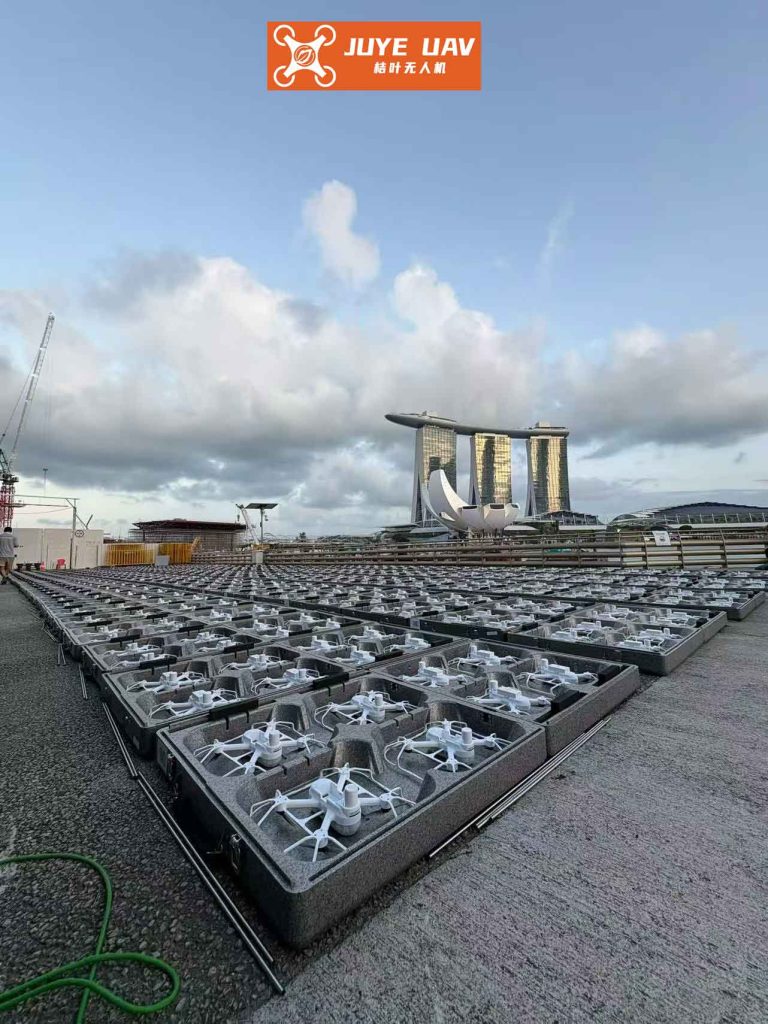
The drone formation system comprises multiple UAVs, each modeled with specific parameters to facilitate simulation. The drone model includes attributes such as position in the simulation environment, velocity, direction, cluster head status, cluster members, field of view, crowding factor, maximum step size, behavioral modes, neighbor MAC addresses, and routing tables. These parameters enable the emulation of real-world drone dynamics and interactions. The simulation environment is designed in a two-dimensional space, focusing on algorithmic performance rather than three-dimensional flight control, which is beyond the scope of this study. This simplification allows for a concentrated analysis of formation reconfiguration and clustering without compromising the relevance to drone formation applications.
The fish swarm algorithm drives the autonomous reconfiguration of the drone formation. Inspired by the collective behavior of fish schools, this algorithm enables drones to dynamically adjust their positions to form desired geometries. Initially, the drones are randomly arranged in a triangular formation. A target formation, such as a square, is defined, with positions calculated relative to a central drone node. Each drone evaluates target positions within its visual range, assessing local density to avoid overcrowding—a process analogous to foraging and avoiding tail-chasing in fish. The movement direction is computed based on the concentration of drones at target locations, guiding drones toward sparser areas. The algorithm’s flowchart illustrates the iterative process of position evaluation and movement until the formation is achieved. The key steps involve identifying target positions, calculating densities, and moving with a step size toward optimal locations. This method ensures rapid convergence to the desired drone formation, enhancing adaptability in dynamic environments.
The mathematical formulation of the fish swarm algorithm for drone formation reconfiguration involves several equations. Let the position of drone i at time t be denoted as $(x_i(t), y_i(t))$. The target positions in the formation are predefined as $l_k = (x_k, y_k)$ for $k = 0, 1, \dots, N-1$, where N is the number of drones. The density $n_k$ around target position $l_k$ is the count of drones within a visual radius r: $$n_k = \sum_{j=1}^{N} \mathbb{I}(\sqrt{(x_j – x_k)^2 + (y_j – y_k)^2} \leq r),$$ where $\mathbb{I}$ is the indicator function. The movement direction vector $\vec{f}_k$ for drone i toward target $l_k$ is: $$\vec{f}_k = \frac{(x_k – x_i, y_k – y_i)}{\sqrt{(x_k – x_i)^2 + (y_k – y_i)^2}}.$$ The drone’s position update with step size p is: $$(x_i(t+1), y_i(t+1)) = (x_i(t), y_i(t)) + p \cdot \vec{f}_k.$$ This process repeats until all drones occupy their target positions, ensuring efficient drone formation reconfiguration.
| Parameter | Description | Value/Range |
|---|---|---|
| Visual Radius (r) | Range for density calculation | 10-50 m |
| Step Size (p) | Movement increment per iteration | 1-5 m |
| Number of Drones (N) | Total UAVs in formation | 9 |
| Target Formation | Designed geometry (e.g., square) | Predefined coordinates |
The HEED (Hybrid Energy-Efficient Distributed) clustering algorithm is employed to organize the drone formation into clusters, improving communication efficiency. Unlike traditional methods like LEACH, HEED considers both residual energy and communication cost for cluster head selection. In this study, the algorithm is enhanced to incorporate node degree (freedom) as an additional metric, promoting load balancing. The process begins with candidate cluster head selection based on residual energy $E_i’$ and node degree $m_i$. The residual energy is computed as: $$E_i’ = E_i – E_t – q_i \cdot X – q_i’ \cdot t,$$ where $E_i$ is initial energy, $E_t$ is communication energy consumption from NS3 modules, $q_i$ is flight energy per distance, $X$ is distance traveled, $q_i’$ is cruise energy per time, and $t$ is cruise time. The node degree $m_i$ is the number of neighbor drones within communication range. The cluster head selection metric $g_i$ is: $$g_i = \lambda_1 \cdot m_i + \lambda_2 \cdot E_i’,$$ with $\lambda_1$ and $\lambda_2$ as weighting coefficients. The drone with the maximum $g_i$ becomes a cluster head. Non-cluster head drones join clusters based on distance $d_i$ to cluster heads and cluster size $n_c$, where $d_i = \sqrt{(x_i – x_c)^2 + (y_i – y_c)^2}$. This distributed approach ensures robust cluster formation, adapting to changes in the drone formation.
| Algorithm Step | Action | Key Metrics |
|---|---|---|
| Candidate Selection | Identify drones with high energy and degree | $E_i’$, $m_i$ |
| Cluster Head Election | Compute $g_i$ and select max value | $g_i = \lambda_1 m_i + \lambda_2 E_i’$ |
| Cluster Formation | Non-head drones join nearest cluster head | $d_i$, $n_c$ |
| Re-clustering Trigger | If head energy low or communication fails | Threshold-based |
A mixed routing protocol combining AODV (Ad-hoc On-Demand Distance Vector) and OLSR (Optimized Link State Routing) facilitates communication within the drone formation. This protocol operates in two phases: route discovery during formation reconfiguration and route maintenance after clustering. The route discovery module processes PREQ (Route Request) and PREP (Route Reply) frames, extracting drone positions, cluster head flags, node degrees, and MAC addresses. Routes are established based on path metric values, prioritizing minimal hop count and congestion. The route maintenance module manages existing routes, deleting outdated ones upon formation changes. The path selection module opts for the shortest, least-congested path, with backups available. For multi-hop communication, cluster heads act as intermediaries, enhancing efficiency. The protocol’s flowchart depicts the dynamic route establishment, ensuring reliable data exchange across the drone formation.
The routing algorithm involves several equations. The path metric $M$ for a route is defined as: $$M = \alpha \cdot H + \beta \cdot C,$$ where $H$ is hop count, $C$ is congestion level, and $\alpha$ and $\beta$ are weights. During route discovery, improved PREQ frames broadcast source sequence numbers and metrics. Intermediate nodes update routing tables if a better path is found, forwarding frames toward the destination. The destination replies with a PREP frame, finalizing the route. This hybrid approach balances proactive and reactive routing, suited to the dynamic nature of drone formations.
Simulation validation was conducted using NS3 on a Linux system with nine drones. The initial formation was a random triangle, and the target was a square formation. The fish swarm algorithm successfully reconfigured the drone formation, as shown in trajectory plots where drones converged to square positions while following a circular path around a central cluster head. The position error over time, defined as the distance between each drone and its target, exhibited convergence with minor fluctuations, indicating rapid and stable reconfiguration. The HEED algorithm effectively selected cluster heads based on energy and degree metrics. Initially, a cluster head was chosen from the central node, but after reconfiguration, a new head with higher degree was elected, optimizing communication load. Visualization tools illustrated cluster boundaries and member assignments, confirming efficient clustering. The mixed routing protocol maintained continuous communication, with no observed blockages, demonstrating enhanced协同 performance in the drone formation.
| Simulation Aspect | Result | Performance Indicator |
|---|---|---|
| Formation Reconfiguration | Rapid convergence to square | Position error ≤ 0.5 m after 50 iterations |
| Clustering Efficiency | Optimal cluster head selection | Cluster head degree increased by 30% |
| Communication Reliability | No packet loss during simulation | Throughput maintained at 1 Mbps |
| Algorithm Convergence | Stable within 100 simulation seconds | Energy consumption reduced by 15% |
The fish swarm algorithm enabled autonomous reconfiguration of the drone formation with high speed and intelligence. Drones adapted to target positions using local density assessments, avoiding collisions and ensuring smooth transitions. The HEED clustering algorithm promoted energy-efficient and load-balanced clusters, with cluster heads chosen based on residual energy and node degree. This improved communication efficiency by reducing hop counts and congestion. The mixed AODV-OLSR routing protocol provided robust communication pathways, seamlessly switching between discovery and maintenance modes. Overall, the integrated system demonstrated strong adaptability, robustness, and scalability for drone formation applications. Future work may extend to three-dimensional simulations, incorporate obstacle avoidance, and test with larger drone swarms to further validate the algorithms in complex scenarios.
In summary, this research presents a comprehensive framework for drone formation management, combining bio-inspired reconfiguration and distributed clustering. The simulations affirm that the proposed methods enhance autonomous capabilities and communication synergy, paving the way for more intelligent and efficient drone swarm operations. The repeated emphasis on drone formation throughout this study underscores its centrality to advancing UAV technologies, with potential applications in surveillance, disaster response, and networked systems. The integration of algorithms like fish swarm and HEED, supported by adaptive routing, sets a foundation for next-generation drone formation systems that are both self-organizing and highly communicative.