
In recent years, the threat of terrorism has become increasingly severe, prompting law enforcement agencies to adopt advanced technologies to enhance their operational capabilities. Among these technologies, police UAVs (unmanned aerial vehicles) have emerged as a critical tool in counter-terrorist attacks. As a researcher in this field, I have observed that police UAVs offer significant advantages, such as low maintenance costs, high mobility, and adaptability to integrated policing systems. However, their deployment in offensive operations raises complex legal issues that must be addressed to ensure compliance with human rights and legal standards. This article explores the current legal framework, identifies the unique challenges posed by police UAVs, and proposes comprehensive regulatory improvements to govern their use in counter-terrorist attacks.
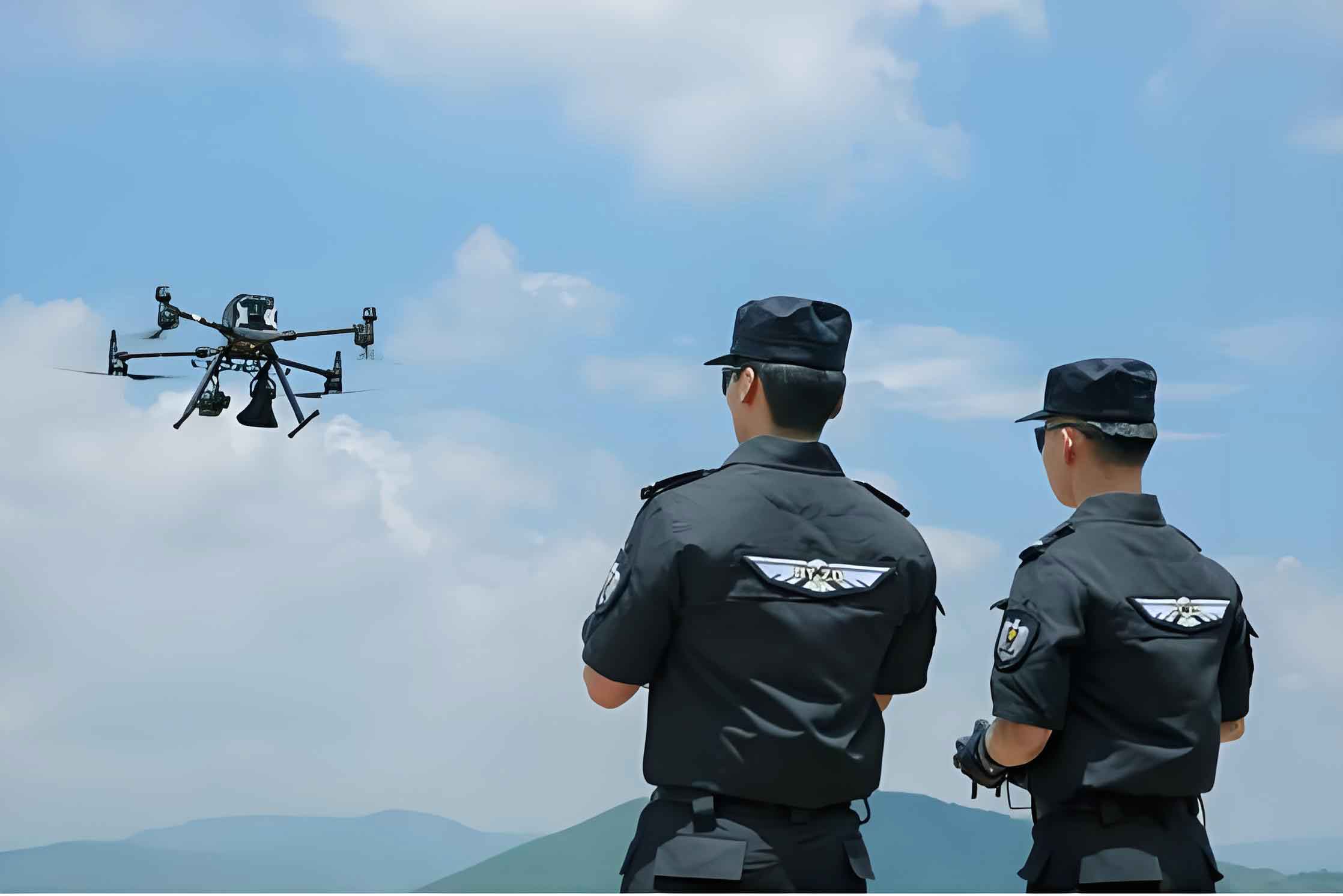
The integration of police UAVs into counter-terrorist operations is not merely a technological advancement but a paradigm shift in law enforcement tactics. From my perspective, police UAVs can be equipped with various payloads, ranging from non-lethal devices like tear gas canisters to lethal weapons such as firearms and missiles. This versatility allows police UAVs to perform diverse roles, including surveillance, reconnaissance, and direct攻击. However, the legal classification of police UAVs remains ambiguous. Under existing regulations, police UAVs can be treated as police implements or weapons based on their mounted equipment and intended actions. For instance, if a police UAV carries催泪弹, it may be classified as a police implement, whereas if it carries a firearm, it falls under the weapon category. This classification is rooted in the distinction between lethal and non-lethal tools, but it fails to account for the unique characteristics of police UAVs. In this article, I will delve into the legal intricacies and advocate for a tailored regulatory approach that balances operational efficacy with legal accountability.
Current Legal Framework for Police UAVs in Counter-Terrorist Attacks
The legal basis for using police UAVs in counter-terrorist attacks derives from a patchwork of laws, administrative regulations, and normative documents. In China, the primary laws include the “Counter-Terrorism Law” and the “People’s Police Law,” which grant authorities the power to use weapons and police implements in terrorist situations. Specifically, the “Counter-Terrorism Law” allows for weapon use when individuals are持凶器 or employing dangerous methods, while the “People’s Police Law” provides broader principles for police器械 deployment. Additionally, the “Regulations on the Use of Police Implements and Weapons by the People’s Police” (hereinafter referred to as the “Regulations”) offers detailed provisions on scenarios, procedures, and liabilities. To summarize the key legal instruments, I have compiled the following table:
| Legal Instrument | Scope | Key Provisions for Police UAVs |
|---|---|---|
| Counter-Terrorism Law | Weapon use in terrorist attacks | Allows weapon use against individuals持凶器 or using dangerous methods; emphasizes immediate threat response. |
| People’s Police Law | General police powers | Authorizes use of police implements and weapons; sets foundational principles for force application. |
| Regulations on Use of Police Implements and Weapons | Detailed rules for force deployment | Classifies police implements and weapons; lists conditions for use and cessation; includes warning requirements. |
| Normative Documents (e.g., “Firearm Use规范”) | Operational guidelines | Specifies procedures for枪支 use and现场制止;补充s the Regulations with practical directives. |
From my analysis, this legal framework is fragmented and lacks specificity for police UAVs. The “Regulations” define weapons as lethal equipment like firearms and ammunition, but police UAVs with non-lethal payloads blur this distinction. For example, a police UAV equipped with a stun gun could be considered a police implement, yet its remote operation introduces novel risks. Moreover, the legal hierarchy is problematic: the use of force, especially lethal force, should be governed by laws due to its impact on fundamental rights, but current reliance on administrative regulations may violate legal reservation principles. In essence, while police UAVs can be analogized to traditional tools, their unique attributes demand a more nuanced legal approach.
Special Characteristics of Police UAVs in Attack Operations
Police UAVs exhibit several distinctive features that complicate their legal regulation. As I have studied, these characteristics stem from their remote operation, technological capabilities, and tactical applications. Understanding these traits is crucial for developing effective laws. Below, I outline the key特殊性 of police UAVs in attack roles:
| Characteristic | Description | Legal Implication |
|---|---|---|
| Non-Contact Nature | Operators engage targets remotely without physical or emotional proximity. | Reduces psychological barriers to force use, potentially leading to overuse or abuse of police UAVs. |
| Limitations in Audiovisual Information | Police UAVs provide鸟瞰 perspectives that may omit contextual details, causing misjudgment. | Increases risk of erroneous attacks, necessitating enhanced verification protocols for police UAVs. |
| Unique Attack Morphology | Police UAVs can strike without prior escalation, unlike traditional force where presence deters. | Undermines警告 effectiveness and limits suspects’ opportunities to comply, raising proportionality concerns. |
| Autonomy and AI Integration | Advanced police UAVs may incorporate artificial intelligence for decision-making. | Challenges legal accountability, as AI lacks legal personality and cannot bear responsibility for police UAV actions. |
In my view, the non-contact nature of police UAVs is particularly concerning. Operators, detached from the scene, may perceive attacks as video game-like, diminishing empathy and increasing the likelihood of excessive force. For instance, studies on military drone use have shown higher civilian casualty rates due to this detachment. Similarly, information limitations mean that police UAVs might misinterpret benign activities, such as children playing, as threats. To quantify the risk, we can model the decision error probability using a formula: $$ P_e = \frac{F_p}{T_p} $$ where \( P_e \) is the probability of error, \( F_p \) represents false positives from police UAV data, and \( T_p \) denotes true positives. This highlights the need for robust oversight in police UAV operations.
Legal Issues in Regulating Police UAVs for Counter-Terrorist Attacks
Despite the existing framework, numerous legal gaps persist in governing police UAVs. From my research, these issues span from vague legal bases to procedural inadequacies. I categorize them into three main areas: unclear legal foundations, imperfections in force use regulations, and mismatches with police UAV特殊性. Below, I detail these problems with emphasis on police UAV applications.
Unclear Legal Foundations
The legal status of police UAVs is ambiguous beyond their classification as implements or weapons. Aviation laws, such as the “Civil Aviation Law,” exclude police UAVs from民用 regulations, leaving them governed only by basic飞行 rules. This results in inconsistent procurement, management, and operation standards across agencies. For police UAVs, the lack of unified guidelines hampers战术 development and raises compliance risks. In mathematical terms, the legal uncertainty can be expressed as a function: $$ L_c = \sum_{i=1}^{n} (A_i – B_i) $$ where \( L_c \) denotes legal clarity, \( A_i \) represents applicable laws for police UAVs, and \( B_i \) denotes regulatory gaps. Currently, \( L_c \) is low, necessitating legislative intervention.
Imperfections in Force Use Regulations
The regulations for using police implements and weapons are scattered and lack specificity for police UAVs. Key issues include:
- Dispersed Legal Sources: Laws and规范性文件 are not integrated, making it difficult for officers to apply them to police UAV scenarios.
- Vague Substantive Conditions: Terms like “凶器” or “dangerous methods” in the “Counter-Terrorism Law” are poorly defined, complicating decisions on when to deploy police UAVs offensively.
- Inadequate Procedural Rules: Warning procedures are not tailored for police UAVs; for example, how should a police UAV issue warnings before attack? The “Regulations” assume human presence, but police UAVs operate remotely.
- Low Legal Hierarchy: Critical force use matters are regulated by administrative rules instead of laws, potentially violating legal reservation principles for police UAV operations.
To illustrate, I have created a table summarizing these flaws:
| Issue Category | Specific Problem | Impact on Police UAVs |
|---|---|---|
| Legal Basis | No direct authorization for police UAV attacks | Restricts operational use of police UAVs due to liability fears. |
| Substantive Conditions | Ambiguous thresholds for weapon use | Leads to inconsistent application of force by police UAVs. |
| Procedural Gaps | Lack of tailored warning and confirmation steps | Increases risk of unjustified attacks by police UAVs. |
| Hierarchy Concerns | Over-reliance on low-level regulations | Undermines legal legitimacy for police UAV deployments. |
Mismatches with Police UAV Special Characteristics
Existing laws do not account for the unique traits of police UAVs. For instance, the warning requirement in the “Regulations” presumes audible or visual cues from officers, but police UAVs may need alternative methods like闪光 or audio broadcasts. Additionally, the use of non-firearm weapons on police UAVs lacks procedural guidance, creating a regulatory void. The非-contact nature also conflicts with the principle of proportionality, as officers may overestimate threats via police UAV feeds. A formula for proportionality in police UAV use could be: $$ \Pi = \frac{E_b}{C_h} $$ where \( \Pi \) represents proportionality, \( E_b \) is the expected benefit of stopping a threat with a police UAV, and \( C_h \) is the potential harm to human rights. If \( \Pi < 1 \), the action may be disproportionate, highlighting the need for strict controls on police UAVs.
Proposals for Improving Legal Regulation of Police UAVs
To address these issues, I propose a multi-faceted approach centered on establishing core principles, enhancing legal foundations, and enacting specialized management法规. My recommendations aim to create a coherent framework that maximizes the utility of police UAVs while safeguarding legal and ethical standards.
Fundamental Principles for Police UAV Attacks
Based on my analysis, police UAV operations should adhere to the following principles:
- Legality and Proportionality Principle: Police UAV use must strictly comply with laws and employ the minimal necessary force. This aligns with the proportionality rule: $$ \text{Force}_{UAV} \leq \alpha \cdot \text{Threat}_{level} $$ where \( \alpha \) is a proportionality constant determined by legal standards.
- Full Warning Principle: Before attack, police UAVs must issue clear warnings through multiple means, such as voice alerts or visual signals, to ensure suspects are aware. This mitigates the非-contact issue.
- Ground Guidance Confirmation Principle: Police UAV attacks should require final approval from ground personnel who assess the situation directly, reducing误判 risks from police UAV data limitations.
- Exclusion of AI-Controlled Attacks: Artificial intelligence must not autonomously decide or execute attacks via police UAVs; human officers must retain control to uphold accountability.
These principles can be summarized in a table for clarity:
| Principle | Description | Application to Police UAVs |
|---|---|---|
| Legality and Proportionality | Actions must be legal and use minimal force proportional to threat. | Guides all police UAV deployments to prevent excessive use. |
| Full Warning | Multiple warning methods required before police UAV attack. | Ensures suspects have opportunity to comply, addressing attack morphology issues. |
| Ground Guidance Confirmation | Ground personnel must confirm police UAV attacks based on现场 assessment. | Reduces errors from police UAV信息 limitations and non-contact nature. |
| AI Exclusion | AI cannot autonomously control police UAV attacks; humans must decide. | Preserves legal accountability and prevents uncontrolled police UAV actions. |
Enhancing Legal Foundations
I advocate for the enactment of a comprehensive law, such as the “People’s Police Use of Implements and Weapons Law,” to centralize regulations. This law should:
- Define police UAVs explicitly: “Police UAVs equipped with implements or weapons shall be treated accordingly based on their payload and intended action.”
- Clarify weapon categories: Introduce distinctions like低致命性 and lethal weapons to accommodate diverse police UAV payloads.
- Simplify substantive conditions: Allow weapon use when lives are at serious risk or significant societal harm is imminent, with a necessity threshold: $$ U_w = \begin{cases} 1 & \text{if } T \geq T_{crit} \\ 0 & \text{otherwise} \end{cases} $$ where \( U_w \) is weapon use authorization, \( T \) is threat level, and \( T_{crit} \) is a critical threshold determined by law.
- Systematize procedures: Create a hierarchical force continuum for police UAVs, integrating warnings and confirmations. For example, require police UAVs to use audible alerts before escalation.
This legal upgrade would resolve hierarchy issues and provide clear directives for police UAV operations.
Developing Specialized Management Regulations
In addition to laws, administrative regulations should be issued, such as the “Police UAV Use and Management Measures,” to address operational details. Key elements include:
- Standardized Management: Establish unified police UAV units with certified operators and maintenance protocols. This ensures consistency across agencies.
- Detailed Attack Procedures: Specify steps for police UAV attacks: approval from县级 authorities, multi-modal warnings, ground confirmation, and post-action reporting. A decision flowchart can be represented as: $$ \text{Attack}_{UAV} = \text{Approval} \cap \text{Warning} \cap \text{Confirmation} \cap \text{Recording} $$
- Liability Frameworks: Define legal responsibilities for police UAV misuse. For instance, officers causing unjust harm via police UAVs may face administrative or criminal penalties, calculated based on negligence: $$ L = k \cdot D $$ where \( L \) is liability, \( k \) is a fault coefficient, and \( D \) is damage caused by police UAVs.
To encapsulate these proposals, I present a comprehensive table:
| Regulatory Level | Proposed Measure | Impact on Police UAVs |
|---|---|---|
| Legislative (Law) | Enact “Use of Implements and Weapons Law” with police UAV provisions | Provides high-level authority and clarity for police UAV deployment. |
| Administrative (Regulations) | Issue “Police UAV Management Measures” for operations | Standardizes police UAV use, ensuring safety and compliance. |
| Procedural (Guidelines) | Develop attack protocols with warning and confirmation steps | Minimizes risks from police UAV特殊性 and enhances accountability. |
| Liability (Enforcement) | Define penalties for police UAV misuse, including compensation | Deters abuse of police UAVs and upholds justice. |
Conclusion
In conclusion, the integration of police UAVs into counter-terrorist attacks represents a significant advancement in law enforcement, but it necessitates a robust legal framework. From my perspective, current regulations are inadequate due to their fragmentation and failure to address the unique characteristics of police UAVs. By establishing core principles like proportionality and ground confirmation, enhancing legal foundations through dedicated laws, and implementing detailed management regulations, we can create a balanced system that harnesses the benefits of police UAVs while mitigating risks. This approach will not only improve operational effectiveness but also uphold the rule of law and human rights in counter-terrorism efforts. As police UAV technology evolves, continuous legal adaptation will be essential to ensure that these tools serve justice without compromise.
Throughout this article, I have emphasized the importance of police UAVs in modern security contexts. The repeated mention of police UAVs underscores their centrality to this discussion. By addressing legal gaps and promoting responsible use, we can foster a safer environment where police UAVs contribute positively to counter-terrorist missions. Future research should explore international comparisons and technological trends to further refine regulations for police UAVs, ensuring they remain a force for good in an increasingly complex world.