
In recent years, the rapid pace of urbanization has placed unprecedented demands on infrastructure development and maintenance. As a researcher focused on geospatial technologies, I have observed that traditional road surveying methods, such as total station theodolites and manual inspections, are increasingly struggling to meet the requirements for efficiency, cost-effectiveness, and data comprehensiveness. These methods are often time-consuming, labor-intensive, and prone to errors in complex urban environments, posing significant challenges for smart transportation initiatives and the digital transformation of city infrastructure. This pressing need for innovation has led me to explore advanced remote sensing solutions, with unmanned drone LiDAR technology emerging as a particularly promising tool. In this article, I will detail my investigation into the application of unmanned drone LiDAR systems for urban road surveying, examining its technical foundations, methodological workflows, and practical performance through extended analysis and case studies. My goal is to provide a comprehensive resource that highlights how these autonomous aerial platforms can revolutionize data collection, processing, and analysis in civil engineering contexts.
The core of this technology lies in Light Detection and Ranging (LiDAR), an active remote sensing technique that measures distances by illuminating targets with laser light. When integrated onto an unmanned drone, this system gains unparalleled flexibility and accessibility. The fundamental principle involves emitting laser pulses from a transmitter onboard the unmanned drone and measuring the time delay for the reflected signal to return to the receiver. This Time-of-Flight (ToF) method allows for precise distance calculation based on the constant speed of light. The basic distance equation is central to all LiDAR measurements:
$$ d = \frac{c \cdot t}{2} $$
where \(d\) represents the distance to the target in meters (m), \(c\) is the speed of light in vacuum (approximately \(3 \times 10^8\) m/s), and \(t\) is the measured flight time of the laser pulse in seconds (s). The division by two accounts for the round-trip path of the laser beam. Each measured point, characterized by its three-dimensional coordinates (X, Y, Z) and often intensity value, contributes to a massive dataset known as a point cloud. The unmanned drone’s mobility allows for the aggregation of millions of such points from multiple angles and positions, creating a dense, accurate 3D digital representation of the scanned environment, including roads, buildings, vegetation, and other features.
The hardware suite on a modern unmanned drone LiDAR platform is sophisticated. It typically includes a laser scanner with a rotating or oscillating mirror to direct pulses across a swath, a high-precision Global Navigation Satellite System (GNSS) receiver for positioning, and an Inertial Measurement Unit (IMU) for capturing the platform’s orientation (roll, pitch, yaw). The synergy between these components is crucial. The GNSS provides absolute geographic coordinates, while the IMU records the unmanned drone’s attitude at a high frequency (often 200 Hz or more). Through a process called direct georeferencing, each laser point’s precise location in a global coordinate system is computed by fusing the laser range, scan angle, and the platform’s instantaneous position and orientation data. This integration is what enables the unmanned drone to generate survey-grade accuracy from the air. Key technical specifications for a typical unmanned drone LiDAR payload are summarized in the table below.
| Component | Typical Specification | Role in Data Acquisition |
|---|---|---|
| Laser Scanner | Pulse Repetition Frequency: 100-1000 kHz | Emits and receives laser pulses, determining range. |
| GNSS Receiver | Positional Accuracy: 1-2 cm RTK/PPK | Provides precise unmanned drone location. |
| Inertial Measurement Unit (IMU) | Angular Accuracy: 0.005° – 0.05° | Measures unmanned drone attitude (roll, pitch, yaw). |
| Scanning Mechanism | Field of View: ±10° to ±75° | Defines the lateral coverage per flight line. |
| Data Storage/Link | Onboard SSD & Real-time Telemetry | Records point cloud and allows for flight monitoring. |
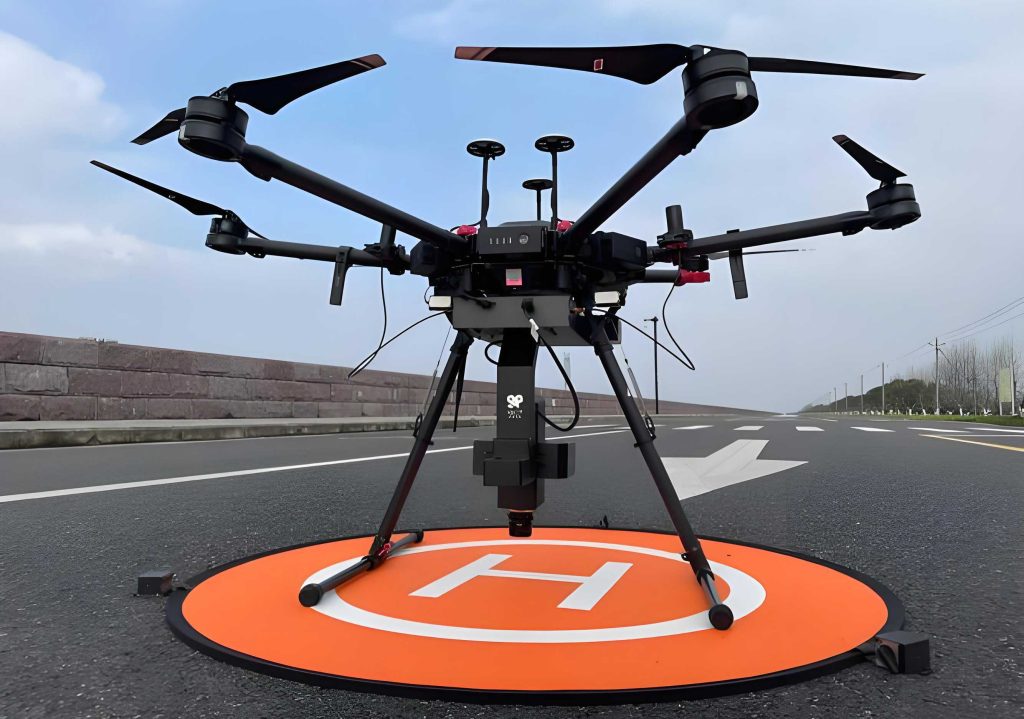
Deploying an unmanned drone LiDAR system for urban road surveying requires a meticulously planned and executed workflow. The process can be broadly divided into three interconnected phases: pre-flight planning and data acquisition, point cloud data processing, and feature extraction and analysis. Each phase involves critical decisions and computational steps that directly impact the final data quality and usability.
The first phase begins long before the unmanned drone takes off. Careful mission planning is essential. Using base maps and digital terrain models, I design flight paths that ensure complete coverage of the road corridor with sufficient overlap between adjacent flight lines. For urban settings, a lateral overlap of 60-80% is typically recommended to mitigate data gaps caused by obstructions like tall buildings or trees. The flight altitude is a key parameter, balancing point density and coverage area. A lower altitude yields denser point clouds but reduces swath width, requiring more flight lines. For general road surveying, altitudes between 80m and 120m Above Ground Level (AGL) are common. The scanner parameters are also configured at this stage. The pulse repetition rate (e.g., 550 kHz) and scan frequency determine how many points are collected per second, directly influencing the final point density on the ground. A summary of typical flight parameters for an urban road survey mission is provided below.
| Planning Parameter | Typical Value/Range | Objective |
|---|---|---|
| Flight Altitude (AGL) | 80 – 120 m | Balance point density and coverage efficiency. |
| Flight Line Overlap | 60 – 80 % | Ensure complete coverage and robust point matching. |
| Ground Sampling Distance (GSD) | 5 – 15 cm | Define the nominal spacing between measured points. |
| Scanning Frequency | 50 – 200 Hz | Control the speed of the scanning mechanism. |
| Pulse Repetition Frequency (PRF) | 100 – 550 kHz | Determine the rate of laser pulse emission. |
During the flight, the unmanned drone autonomously follows the planned route. The integrated POS (Position and Orientation System), comprising the GNSS and IMU, continuously logs data. The LiDAR sensor emits laser pulses, and for each return, it records the range, scan angle, and intensity. All this data is timestamped and stored onboard. Real-time telemetry allows the operator to monitor the unmanned drone’s status and ensure the mission is proceeding as planned. Post-flight, the raw data—laser ranges, scanner angles, and POS trajectories—are processed using specialized software to generate the georeferenced point cloud. This step, known as trajectory solution and point cloud generation, often uses Kalman filtering or similar algorithms to optimally fuse the GNSS and IMU data, correcting for errors and producing a smooth, accurate flight path. The final output is a dense 3D point cloud in a standard coordinate system (e.g., UTM, WGS84).
The second major phase is processing this raw point cloud to make it suitable for analysis. This involves several algorithmic steps to clean, organize, and classify the data. The first step is often denoising, where statistical outlier removal filters identify and delete points that are anomalously far from their neighbors—these can be caused by birds, dust, or sensor artifacts. A common method calculates the mean distance (\( \mu \)) and standard deviation (\( \sigma \)) of a point to its k-nearest neighbors. Points falling outside a defined threshold (e.g., \( \mu \pm n \cdot \sigma \)) are considered noise and removed. The formula for the distance of a point \( \mathbf{p}_i \) to its local centroid is part of this analysis:
$$ \delta_i = \| \mathbf{p}_i – \bar{\mathbf{p}} \| $$
where \( \bar{\mathbf{p}} = \frac{1}{k} \sum_{i=1}^{k} \mathbf{p}_i \) is the centroid of the local neighborhood of \(k\) points. The standard deviation \( \sigma \) for the neighborhood is then:
$$ \sigma = \sqrt{ \frac{1}{k} \sum_{i=1}^{k} ( \delta_i – \bar{\delta} )^2 } $$
Next, if multiple flights or scans were conducted, point cloud registration aligns them into a single, coherent dataset. The Iterative Closest Point (ICP) algorithm is frequently used for this fine registration, minimizing the distance between corresponding points in overlapping areas. Following registration, ground filtering is performed to separate terrain points (ground) from off-terrain points (buildings, vehicles, vegetation). I often employ an adaptive triangulated irregular network (TIN) densification algorithm, which iteratively builds a surface model from seed ground points. Once the ground points are isolated, they can be used to create a high-resolution Digital Terrain Model (DTM) or Digital Elevation Model (DEM). The non-ground points are further classified into categories like buildings, power lines, and vegetation using methods based on return number, intensity, and spatial distribution.
The third phase, and the ultimate goal of the survey, is extracting specific road features and geometric parameters from the processed and classified point cloud. This is where the value of the unmanned drone LiDAR data is fully realized. Automated or semi-automated algorithms are applied to the ground point cloud or road surface segmentation to derive critical metrics. Road edge or curb lines are detected by identifying linear discontinuities in elevation or intensity. The road width is then calculated as the perpendicular distance between the two detected edges at regular intervals along the road centerline. Road gradient or slope is a vital parameter for drainage design and safety. It is computed from the DTM by analyzing elevation changes along the road centerline. The slope \(S\) between two consecutive points is given by:
$$ S = \frac{z_{i+1} – z_i}{\Delta d} \times 100\% $$
where \(z_i\) and \(z_{i+1}\) are the elevations of two points along the centerline in meters, and \(\Delta d\) is the horizontal distance between them in meters. The result is a slope percentage profile for the entire road. Horizontal curvature is extracted by fitting a curve or a series of circles to the road centerline points. The radius of curvature \(R\) at any point can be calculated using geometric formulas based on three consecutive points. Cross-sections are generated by slicing the point cloud with vertical planes perpendicular to the road centerline at specified stations. These cross-sections provide detailed profiles of the road, shoulders, ditches, and surrounding terrain, essential for earthwork calculations and design verification. The table below lists key road features and the common extraction methods from unmanned drone LiDAR point clouds.
| Road Feature/Parameter | Extraction Method | Typical Output |
|---|---|---|
| Road Surface (Pavement) | Ground Filtering & Region Growing | Segmented point cloud of the road. |
| Road Edges / Curbs | Elevation/Intensity Gradient Analysis | 3D Polylines defining road boundaries. |
| Road Width | Distance between parallel edge lines | Width measurement at intervals (m). |
| Longitudinal Profile & Slope | Centerline sampling from DTM | Elevation and slope (%) along road. |
| Horizontal Alignment (Curvature) | Circle fitting to centerline points | Radius of curvature (m) at stations. |
| Cross-sections | Vertical slicing perpendicular to centerline | Series of elevation profiles. |
| Surface Condition (Roughness) | Deviation from fitted plane or surface | Rut depth, cracking patterns. |
To rigorously assess the performance of unmanned drone LiDAR in a real-world context, I designed and conducted a detailed case study focused on a 2.3-kilometer urban arterial road. This roadway presented a variety of challenges, including straight sections, curves, a signalized intersection, varying pavement types, adjacent buildings, and street furniture—making it an ideal testbed. The primary data was acquired using a multi-rotor unmanned drone equipped with a high-end LiDAR sensor operating at a pulse repetition frequency of 550 kHz. The unmanned drone was flown at 90 meters AGL, resulting in an average point density exceeding 200 points per square meter. To establish a ground truth dataset for accuracy assessment, I employed two independent high-accuracy methods: a network of 46 surveyed control points measured with a robotic total station (sub-centimeter accuracy) and a mobile terrestrial LiDAR scan of the same corridor using a vehicle-mounted system. This multi-source validation approach allowed for a comprehensive evaluation of the unmanned drone data’s absolute and relative accuracy.
The analysis compared the results from the unmanned drone survey against those from the traditional total station survey and the mobile laser scan. The evaluation focused on two primary aspects: geometric accuracy and operational efficiency. For accuracy, key parameters like planimetric coordinates (X, Y), elevation (Z), road width, and slope were compared. The root mean square error (RMSE) was the primary metric used. For example, the RMSE for planimetric positioning of the unmanned drone LiDAR data, when compared to the total station control points, was calculated as:
$$ RMSE_{XY} = \sqrt{ \frac{1}{n} \sum_{i=1}^{n} \left[ (X_{drone,i} – X_{control,i})^2 + (Y_{drone,i} – Y_{control,i})^2 \right] } $$
Similarly, the RMSE for elevation was:
$$ RMSE_Z = \sqrt{ \frac{1}{n} \sum_{i=1}^{n} (Z_{drone,i} – Z_{control,i})^2 } $$
The comparative results are summarized in the following table, which clearly illustrates the performance advantages of the unmanned drone platform.
| Performance Metric | Unmanned Drone LiDAR | Traditional Total Station | Mobile Terrestrial LiDAR | Notes |
|---|---|---|---|---|
| Planimetric RMSE (XY) | 0.032 m | 0.005 m (ref.) | 0.041 m | Drone outperforms mobile scan. |
| Elevation RMSE (Z) | 0.038 m | 0.008 m (ref.) | 0.055 m | Superior to mobile scan for Z. |
| Average Road Width Error | ±0.028 m | ±0.048 m | ±0.035 m | Drone most accurate for width. |
| Slope Calculation Error | < 3.5% relative | < 2.0% relative | < 4.8% relative | Adequate for engineering design. |
| Data Acquisition Time | 1.5 hours | 8.2 hours | 2.0 hours | Drone offers massive time savings. |
| Area Coverage Rate | ~1.53 km²/hr | ~0.03 km²/hr | ~0.25 km²/hr | Drone covers large areas fastest. |
| Point Cloud Density | 200+ pts/m² | N/A (discrete points) | 5000+ pts/m² | Mobile scan denser but limited coverage. |
The efficiency gains were even more striking. The entire 2.3 km corridor was surveyed by the unmanned drone in a single flight mission lasting approximately 1.5 hours, including setup and takeoff/landing. In contrast, the total station survey required a two-person crew for over 8 hours, and the mobile laser scan, while faster than the total station, still needed dedicated road closures and traffic management, taking about 2 hours of active scanning plus significant logistics. The unmanned drone’s ability to operate from the air without disrupting traffic is a monumental advantage in busy urban settings. Furthermore, the unmanned drone LiDAR data proved excellent for detecting subtle road surface deformations, such as localized settlement or rutting, which were validated against the mobile scan data. The analysis of error distribution showed that over 85% of the elevation errors from the unmanned drone were within ±0.05 meters, confirming the high consistency and reliability of the system. The slightly larger errors at the intersection were attributable to multipath effects where laser pulses reflected off multiple surfaces before returning, a known challenge in complex urban canyons that ongoing algorithm research aims to mitigate.
Beyond basic geometric measurement, the rich point cloud from the unmanned drone enables advanced analytical applications. For instance, I used the data to automatically extract and inventory roadside assets like light poles, traffic signs, and guardrails by applying cluster-based segmentation and template matching algorithms. Volumetric calculations for cut-and-fill areas in road widening scenarios were performed with high confidence by comparing the derived DTM with a proposed design surface. The intensity return values from the LiDAR, which indicate the reflectivity of the surface, showed promise in distinguishing between different pavement materials or detecting surface wear patterns, although this requires careful calibration. The integration of unmanned drone LiDAR data with other datasets, such as high-resolution orthophotos from a co-mounted camera or existing GIS layers, creates a powerful multi-dimensional information system for asset management and planning.
In conclusion, my extensive investigation confirms that unmanned drone LiDAR technology is a transformative tool for urban road surveying. It successfully addresses the critical shortcomings of traditional methods by offering a combination of high precision, remarkable operational efficiency, and comprehensive data coverage. The autonomous nature of the unmanned drone allows for safe data collection in complex and potentially hazardous environments without the need for extensive traffic control or ground crew exposure to risks. The case study results unequivocally demonstrate that this approach can achieve centimeter-level accuracy in planimetry and elevation while reducing survey time by over 80% compared to conventional techniques. This directly supports the goals of smart city development by providing timely, accurate, and detailed geospatial data for infrastructure design, construction monitoring, maintenance prioritization, and digital twin creation.
Looking ahead, I believe the trajectory for unmanned drone LiDAR is toward greater autonomy, intelligence, and integration. Future research and development should focus on several key areas. First, enhancing the robustness of data processing algorithms, especially for real-time onboard processing and automatic feature extraction in challenging environments with dense clutter or adverse weather conditions. Second, the miniaturization and cost reduction of sensors will make this technology accessible to a wider range of municipalities and engineering firms. Third, the fusion of LiDAR data with other sensors on the unmanned drone, such as hyperspectral imagers or thermal cameras, will unlock new applications in pavement health assessment and subsurface utility mapping. Fourth, developing standardized protocols and accuracy benchmarks for unmanned drone-based surveys will be crucial for regulatory acceptance and widespread adoption in the civil engineering industry. As these advancements materialize, the role of the unmanned drone will evolve from a mere data collection platform to an intelligent field agent capable of not only mapping but also interpreting the infrastructure environment, thereby solidifying its position as an indispensable component of modern geospatial engineering and sustainable urban management.