
Military drones, also termed military UAVs (Unmanned Aerial Vehicles), have emerged as pivotal assets in modern warfare. Their operational effectiveness hinges critically on propulsion system performance. We systematically analyze turbofan engines powering these platforms, examining key requirements across performance, stealth, reliability, maintainability, and cost domains. The intricate relationships between aircraft demands and engine characteristic parameters reveal fundamental trade-offs that shape propulsion design for diverse mission profiles.
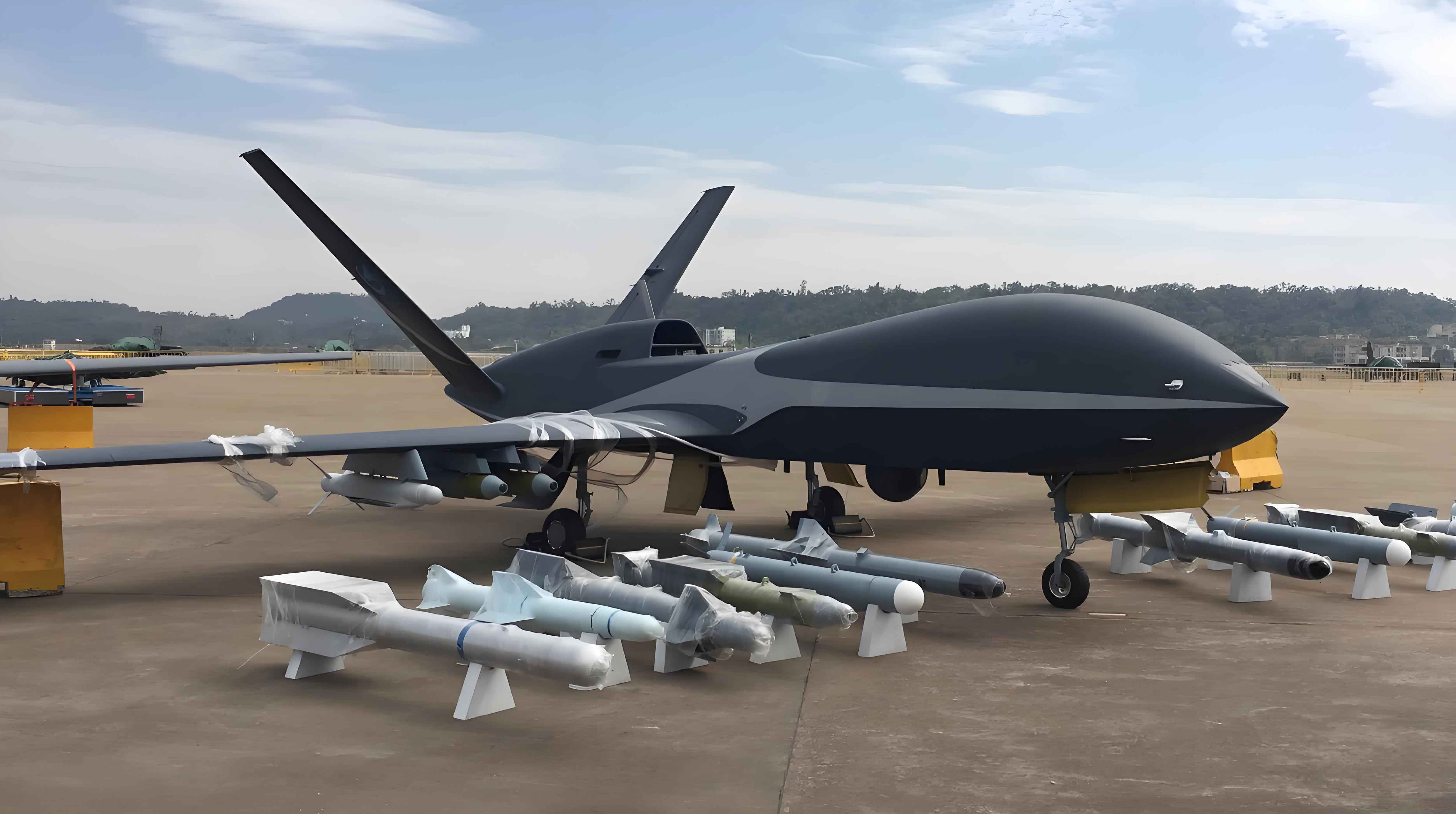
Characteristics of Turbofan Engines in Military UAVs
Military UAVs are categorized by mission: Unmanned Combat Aerial Vehicles (UCAVs) perform strike, suppression, and air dominance; reconnaissance variants conduct ISR (Intelligence, Surveillance, Reconnaissance); and tankers enable aerial refueling. Engine selection reflects these roles:
| UAV Type | Engine | Thrust (kN) | Bypass Ratio | Key Adaptations |
|---|---|---|---|---|
| UCAV | F404-GE-102 (X-45C) | 78.70 | 0.34 | Afterburner removal, S-duct nozzle, enhanced bearings |
| F100-PW-220U (X-47B) | 74.00 | 0.60 | Dorsal intake, S-nozzle, turbine cooling optimization | |
| AL-31F Derivative (“Hunter”) | 123.00 | 0.57 | Dorsal intake, afterburner deletion, increased stall margin | |
| MK951 (“Neuron”) | 40.00 | 0.75 | RAM coatings, advanced fan, FADEC integration | |
| Reconnaissance | AE 3007H (RQ-4) | 42.00 | 4.90 | Lightweight construction, low SFC optimization |
| PW545B (MQ-20) | 19.96 | 4.12 | Dorsal intake, compact S-nozzle, noise reduction | |
| Tanker | AE 3007N (MQ-25) | 40.00 | 5.00 | Rectangular nozzle, high fuel-offload efficiency |
Key trends emerge:
- UCAVs predominantly use low-bypass ratio military-derived turbofans (BPR < 1). Stealth drives adaptations: dorsal/S-duct intakes conceal fans, serpentine nozzles mask turbines, and afterburner removal minimizes IR signature. For example, the F100-PW-220U achieves 10% thrust increase via turbine cooling redesign while eliminating the afterburner.
- Reconnaissance & Tanker UAVs favor high-bypass ratio commercial-derivative engines (BPR > 4). Prioritizing Specific Fuel Consumption (SFC) and endurance, the RQ-4’s AE 3007H exemplifies this with BPR=4.9. Later stealth-aware designs like MQ-20 integrate dorsal intakes.
The bypass ratio ($\text{BPR}$) critically influences thrust ($F_n$) and SFC. Thrust for a turbofan is approximated by:
$$F_n = \dot{m}_c \cdot (V_{j,c} – V_0) + \dot{m}_b \cdot (V_{j,b} – V_0)$$
where $\dot{m}_c$ is core mass flow, $\dot{m}_b$ is bypass mass flow, $V_{j,c}$ and $V_{j,b}$ are core and bypass jet velocities, and $V_0$ is flight velocity. SFC relates inversely to propulsive efficiency ($\eta_p$):
$$\text{SFC} \propto \frac{1}{\eta_p} \quad \text{and} \quad \eta_p = \frac{2 V_0}{V_j + V_0}$$
Higher BPR reduces average $V_j$, boosting $\eta_p$ and lowering SFC – crucial for endurance-focused military UAVs. However, larger fans increase frontal area and radar cross-section (RCS), creating a core trade-off for stealth-sensitive UCAVs.
Critical Requirements for Military UAV Propulsion
Military drone propulsion systems must satisfy multifaceted demands. We categorize these and assess their relative priority:
| Requirement | UCAV | Recon UAV | Tanker UAV |
|---|---|---|---|
| Performance | |||
| Low Specific Fuel Consumption (SFC) | M | H | H |
| High Thrust-to-Weight Ratio | M | L | L |
| High Inlet Temperature ($T_1$) Tolerance | H | L | M |
| High Power Extraction (for sensors/avionics) | M | H | M |
| High-Altitude Operation | M | H | M |
| High Maneuver Tolerance | M | L | L |
| Stealth | |||
| Low Radar Cross-Section (RCS) | H | M | L |
| Low Infrared (IR) Signature | H | M | M |
| Reliability & Maintainability | |||
| Long Life | L | H | M |
| High Cycle Tolerance | M | L | M |
| Maintainability | M | H | H |
| Cost | |||
| Low Acquisition Cost | M | M | M |
| Low Development Cost | H | H | H |
| Low Maintenance Cost | L | M | M |
Distinct priorities arise:
- UCAVs demand exceptional stealth (low RCS/IR) and high $T_1$ tolerance for supersonic/low-altitude penetration. Development cost sensitivity is high due to program scale.
- Reconnaissance Military UAVs prioritize low SFC, high-altitude capability, power extraction, maintainability, and longevity. Stealth requirements are rising but secondary to endurance.
- Tanker Military UAVs emphasize fuel efficiency (SFC), maintainability, and development cost control. Moderate stealth and $T_1$ tolerance are needed.
Environmental factors (low noise/emissions) rank lower across all military drone types compared to civil counterparts.
Requirement-Parameter Interdependencies
Engine characteristics interact complexly with UAV requirements. Some parameters are synergistic; others impose trade-offs:
| Engine Characteristic | Impact on Key Requirements | Relationship Description |
|---|---|---|
| Low Unit Thrust / Low Fan Pressure Ratio (FPR) | ++ Low SFC — High T/W — Low RCS |
Reduces jet velocity ($V_j$), lowering SFC via improved $\eta_p$. Increases fan diameter, penalizing T/W and increasing frontal RCS. Essential for reconnaissance/tanker UAVs, problematic for stealthy UCAVs. |
| High Overall Pressure Ratio (OPR) | + Low SFC – High $T_1$ Tolerance – High-Altitude Op. |
OPR $= P_{03}/P_{02}$ boosts thermal efficiency, reducing SFC. Increases compressor exit temperature, stressing materials at high $T_1$. High-altitude start/relight becomes harder. |
| High Turbine Inlet Temp (SOT) | + Low SFC + High T/W — Cost — Life |
SOT $= T_{04}$ enables smaller core, higher T/W and lower SFC. Requires expensive materials (single-crystal alloys, CMCs) and complex cooling, increasing cost and potentially reducing life. Governed by: $$\eta_{th} = 1 – \frac{1}{(OPR)^{(\gamma-1)/\gamma}} \quad \text{(Brayton Cycle)}$$ |
| Mixed Exhaust | + Low SFC + Low IR + Low Noise |
Mixing cold bypass and hot core flows before ejection lowers average $V_j$ and plume temperature. Improves $\eta_p$ (lower SFC), reduces IR signature, and attenuates noise. Widely used in UCAVs. |
| Cooled/Shielded Exhaust | ++ Low IR ++ Low RCS — Weight — Cost |
Internal cooling flows and geometric masking (e.g., S-nozzles) minimize IR/RCS. Adds weight, complexity, and cost. Critical for UCAV stealth. |
| Modular Design | ++ Maintainability + Life Cycle Cost |
Line-replaceable units (LRUs) enable field maintenance, reducing downtime and cost. Minimal impact on performance parameters like SFC. |
| FADEC & EHM | + Reliability + Power Extraction + Maintainability |
Full Authority Digital Engine Control (FADEC) optimizes performance and handles complex inlet distortion. Engine Health Monitoring (EHM) enables predictive maintenance. Essential across all military UAV classes. |
These interdependencies necessitate holistic optimization. For instance, achieving low SFC via high BPR conflicts directly with UCAV stealth needs, forcing reliance on mature low-BPR military cores. Similarly, high SOT enhances performance but escalates cost – a key constraint for military drone programs.
Parameter Selection for Military UAV Classes
Divergent mission profiles drive distinct parameter prioritization during engine design/selection:
| Engine Characteristic | UCAV | Recon UAV | Tanker UAV |
|---|---|---|---|
| Low Unit Thrust / Low FPR | – | ++ | + |
| High OPR | – | + | – |
| High SOT | + | – | – |
| Mixed Exhaust | ++ | o | + |
| Large Surge Margin | + | o | + |
| Modular Design | + | ++ | ++ |
| FADEC & EHM | + | ++ | ++ |
| Cooled/Shielded Exhaust | ++ | o | – |
| RAM/IR Suppression Materials | ++ | o | – |
Specific imperatives define each class:
- UCAV Engines: Stealth is paramount. Mixed exhaust, cooled/shielded nozzles, and Radar Absorbent Material (RAM)/IR coatings are non-negotiable. Moderate SOT elevation balances performance and risk. Modularity and FADEC/EHM enhance deployability but are secondary to signature control. Low unit thrust designs are avoided.
- Reconnaissance Military UAV Engines: Endurance and supportability dominate. Ultra-low SFC demands high BPR/low FPR designs. Modular construction and sophisticated FADEC/EHM maximize availability and simplify logistics. Stealth features are incorporated only if mission-specific. High SOT/OPR are often sacrificed for reliability and life.
- Tanker Military UAV Engines: Fuel offload efficiency and maintainability are critical. High BPR/low FPR optimizes SFC. Modularity and FADEC/EHM ensure carrier-compatible operations and reduce lifecycle cost. Exhaust stealth features are minimal to save weight/complexity.
The power extraction capability ($P_{ext}$) for avionics/sensors scales with core size and generator capacity:
$$P_{ext} \propto \dot{m}_c \cdot \Delta h_{turbine} \cdot \eta_{gen}$$
Reconnaissance military UAVs, requiring significant power for sensors, benefit from larger core flow ($\dot{m}_c$), further favoring commercial-derivative engines over small military cores.
Conclusion
Propulsion systems fundamentally dictate the capabilities of military drones. Our analysis reveals that:
- Mission Dictates Architecture: UCAVs necessitate stealth-optimized, low-BPR military turbofan derivatives. Reconnaissance and tanker military UAVs leverage high-BPR commercial cores for endurance and cost efficiency.
- Trade-Offs Are Inescapable: Conflicting requirements – notably low SFC vs. low RCS/IR, and high performance vs. low development cost – demand careful parameter balancing. Mathematical optimization of SFC ($\text{SFC} = \frac{\dot{m}_f}{F_n}$), thrust ($F_n$), and RCS/IR models is essential.
- Enabling Technologies Are Universal: FADEC, EHM, and modular design enhance all military UAV classes, improving reliability, maintainability, and lifecycle affordability despite divergent performance goals.
Future military UAV propulsion will intensify these trends. UCAVs will push adaptive cycle engines for multi-mode stealth/performance; reconnaissance platforms will integrate hybrid-electric systems for extreme endurance; tankers will prioritize fuel-centric efficiency. Mastering the requirement-parameter relationships outlined here remains key to developing effective military drone propulsion.