
As a professional deeply involved in the development and deployment of advanced law enforcement tools, I have witnessed the transformative impact of police drones. These are not mere consumer-grade aerial cameras; they are specialized police unmanned aerial vehicles (UAVs) designed to execute critical missions such as reconnaissance, intervention, and strikes with precision. In modern policing, police drones have become indispensable across various departments, including criminal investigation, traffic management, public security, patrol, special police, narcotics control, and firefighting. They play vital roles in counter-terrorism, emergency response, disaster relief, surveillance, riot control, search and rescue, and large-scale event security.
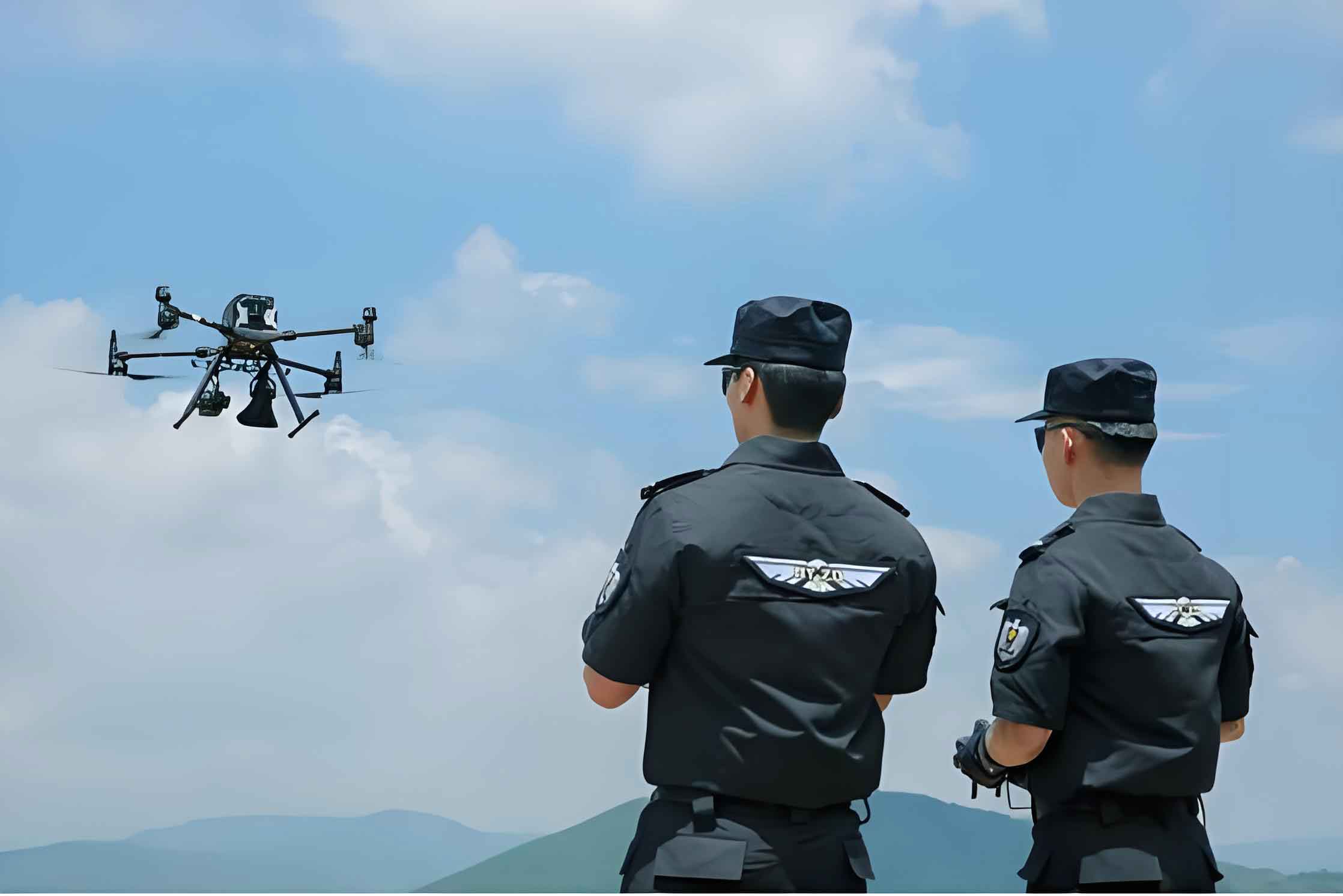
The adoption of police drones stems from their unique ability to enhance operational efficiency and safety. Unlike consumer drones, a police drone is engineered to meet the rigorous demands of law enforcement, integrating advanced technologies for real-time data acquisition and action. In this article, I will delve into the application characteristics and development trends of police drones, leveraging tables and formulas to summarize key insights. My goal is to provide a comprehensive perspective on how these systems are evolving to tackle complex policing challenges.
Application Characteristics of Police Drones
Police drones, as specialized equipment for public security, exhibit distinct features compared to consumer or other industrial drones. They serve as technical support for seven major police branches and twenty-three types of police work, characterized by the following aspects.
First, police drones possess rapid deployment capability. Police operations are often突发性 and unpredictable, requiring swift response and action. A police drone must be ready for flight within minutes to seize fleeting opportunities. This can be quantified by the deployment time $$ T_d $$, which includes setup, calibration, and take-off. For an effective police drone, $$ T_d \leq 5 \text{ minutes} $$ is ideal, ensuring immediate aerial support.
Second, stealth is crucial for police drones. During missions like surveillance or tracking, avoiding detection is paramount. Police drones are designed with noise reduction, low visibility, and specialized propellers and外观 to minimize acoustic and visual signatures. The stealth performance can be modeled using the detectability index $$ D $$, where $$ D = k_a \cdot S_a + k_v \cdot S_v $$, with $$ S_a $$ and $$ S_v $$ representing acoustic and visual signatures, and $$ k_a $$, $$ k_v $$ as weighting factors. A lower $$ D $$ value indicates better隐蔽能力 for a police drone.
Third, police drones are highly versatile and integrated. Policing involves diverse tasks across different branches, necessitating modular and通用 platforms. A police drone system typically includes multiple airframes and payloads, such as cameras, thermal imagers, and loudspeakers, allowing adaptation to various scenarios. The versatility can be summarized in Table 1, comparing平台 types and their适用警务工作.
| Platform Type | Advantages | Typical Police Applications |
|---|---|---|
| Multi-rotor | Vertical take-off, hover capability | Crowd monitoring, search and rescue |
| Fixed-wing | Long endurance, high speed | Large-area patrol, traffic surveillance |
| Helicopter | Flexible maneuverability | Pursuit operations, emergency delivery |
| Hybrid VTOL | Combines endurance and vertical take-off | Multi-role missions, extended reconnaissance |
Fourth, safety and reliability are paramount for police drones. As professional-grade systems, they undergo rigorous testing beyond consumer standards. Key tests include high-low temperature resistance, corrosion resistance, maximum endurance, payload capacity, flight speed, operational stability, and防水. The reliability can be expressed as the mean time between failures (MTBF), where for a police drone, $$ \text{MTBF} \geq 1000 \text{ hours} $$ is often required. Additionally, data security and communication链路保密性 adhere to industrial or military standards, ensuring robust performance in critical situations.
Development Trends of Police Drones
The evolution of police drones is accelerating, moving from nascent stages to refined applications and mature technologies. With advancements in science and警务航空管理, police drones are poised for broader adoption. Here, I outline five key trends shaping the future of police drone systems.
First, innovation in airframe platforms is driving progress. Traditional platforms like fixed-wing, helicopter, and multi-rotor drones have limitations. The emergence of vertical take-off and landing (VTOL) fixed-wing hybrids addresses runway dependency but lacks low-altitude agility. A promising direction is the tilt-rotor aircraft (VTOL), where旋翼 provide lift, hover, and forward propulsion. Its efficiency $$ \eta $$ can be compared using $$ \eta = \frac{L}{P} $$, where $$ L $$ is lift and $$ P $$ is power input. Tilt-rotor designs offer higher $$ \eta $$ than hybrids, combining endurance, speed, and hover capability, making them ideal for next-generation police drone platforms.
Second,装备多样化 is expanding to meet diverse policing needs. As police drone technology advances, operational demands will spur variety in platforms and payloads. The approach involves selecting suitable无人机飞行平台 and integrating modular, high-reliability任务装备. This adaptability can be modeled as a optimization problem: maximize effectiveness $$ E $$ subject to constraints like cost $$ C $$ and weight $$ W $$, where $$ E = f(\text{platform}, \text{payload}, \text{mission}) $$. For instance, a police drone for surveillance might prioritize optical zoom, while one for crowd control may require loudspeakers or non-lethal devices.
Third, establishing professional police drone units is essential. Effective deployment requires skilled operators who understand UAV technology, piloting,警务设备, and公安信息化作战. Training programs should cover political theory, aviation regulations, and hands-on skills, leading to certification like a police drone pilot license. The competency level $$ C_o $$ of an operator can be quantified as $$ C_o = \alpha \cdot K + \beta \cdot S $$, where $$ K $$ is knowledge and $$ S $$ is skill, with coefficients $$ \alpha $$ and $$ \beta $$ reflecting training emphasis. Collaboration between academies and manufacturers will foster talent pipelines, ensuring每一名警用无人机操作人员 is proficient and legal.
Fourth,智能化程度 is rising with AI, cloud computing, and big data. Police drones are becoming more user-friendly and autonomous. Wearable control systems, using gesture recognition and AR, free operators from ground stations, allowing hands-free operation.智能 features include automatic target recognition, face detection, and tracking, enabled by algorithms like convolutional neural networks (CNNs). The autonomy level $$ A $$ can be defined as $$ A = \sum_{i} w_i \cdot F_i $$, where $$ F_i $$ represents functions like auto-follow or obstacle avoidance, and $$ w_i $$ are weights.此外,警力叠加技术 integrates data from police drones, officers, and command centers, enhancing situational awareness. The shared information增益 $$ G $$ is given by $$ G = \frac{I_{shared}}{I_{isolated}} $$, where $$ I $$ denotes information utility, often $$ G > 1 $$ for effective叠加.
Moreover,一站多机协同 allows one ground station to control multiple police drones simultaneously via集群控制技术. This improves efficiency and coverage. The协同 efficiency $$ \eta_c $$ can be expressed as $$ \eta_c = \frac{N \cdot M}{T} $$, where $$ N $$ is number of drones, $$ M $$ is missions per drone, and $$ T $$ is time. For example, a police drone swarm can monitor large events or search areas faster than single units.
Fifth, deepening integration with公安业务信息系统 is critical. Currently, police drones often operate as isolated tools, but future systems must embed into broader信息化 networks. Standardization of data ports and链路 will facilitate this. The integration benefit $$ B $$ can be modeled as $$ B = \int (S_{drone} \cdot S_{system}) \, dt $$, where $$ S $$ represents system synergy. By connecting police drone data to systems like警用地理信息系统 (PGIS), fugitive databases, or traffic management, real-time intelligence and remote control become possible. This enhances指挥决策效率, with response time $$ T_r $$ reduced as $$ T_r \propto \frac{1}{\sqrt{\text{integration level}}} $$.
To summarize these trends, Table 2 contrasts current and future capabilities of police drones.
| Aspect | Current State | Future Trend |
|---|---|---|
| Platform Design | Separate fixed-wing/multi-rotor | Integrated tilt-rotor VTOL |
| Payload Variety | Basic cameras and sensors | Modular, AI-driven tools |
| Operator Training | Ad hoc programs | Standardized certification courses |
| Intelligence | Manual or semi-autonomous | Full autonomy with wearable controls |
| System Integration | Standalone operations | Seamless link to公安信息系统 |
In conclusion, the trajectory of police drone development is marked by innovation and integration. As a key player in this field, I believe that police drones will increasingly become intelligent, reliable partners in law enforcement. By embracing these trends, we can enhance public safety and operational effectiveness. The future police drone will not just be a tool but a core component of smart policing ecosystems, driving progress in the years to come.