
In recent years, the proliferation of small unmanned aerial vehicles (UAVs), often referred to as “low, slow, and small” targets, has posed significant security threats in both civilian and military domains. These anti-drone challenges necessitate effective countermeasures, with high-power laser systems emerging as a promising solution due to their speed, precision, and cost-effectiveness. However, traditional high-power laser anti-drone systems are often bulky and cumbersome, limiting their deployment in portable scenarios such as rooftops, mountain tops, or lightweight vehicles. To address this gap, we have developed a portable laser anti-drone system that emphasizes lightweight design, modularity, and ease of transport. This paper presents the comprehensive design methodology, experimental validation, and performance analysis of our system, focusing on its applicability in close-range anti-drone operations. Throughout this work, the term “anti-drone” is central to our discussion, as we aim to enhance the capabilities of portable directed-energy systems against UAV threats.
The core of any laser anti-drone system lies in its ability to deliver high-energy laser beams to a target with precision. Typically, such systems consist of several subsystems: command and control, acquisition tracking and pointing (ATP), laser source, power supply, and platform. In our portable approach, we re-engineered these components to meet stringent weight and size constraints. The primary design goals were to achieve a total system weight under 160 kg, with each module disassemblable into units under 40 kg for two-person carry and deployment. This portability is crucial for anti-drone missions in remote or constrained environments, where rapid setup and mobility are essential. Our system utilizes a 2000 W air-cooled laser, eliminating the need for heavy water-cooling equipment, and incorporates a transmissive optical design for the ATP subsystem to enable large-field-of-view precision tracking. The integration of these elements results in a compact, efficient anti-drone solution that can be quickly deployed from backpacks or integrated onto vehicles.
To delve into the design specifics, we first analyzed the operational requirements for portable anti-drone systems. Key parameters include working distance, tracking accuracy, and laser power density on target. The laser power density at the target, denoted as \(E\), is critical for assessing the anti-drone effectiveness. It can be expressed as:
$$E = \frac{\eta P D^2}{\pi (1.22 \lambda \beta L)^2}$$
where \(\eta\) is the atmospheric transmittance, \(P\) is the laser output power, \(D\) is the emission aperture diameter, \(\lambda\) is the wavelength, \(\beta\) is the beam quality factor, and \(L\) is the working distance. For our system, with \(P = 2000 \, \text{W}\), \(D = 120 \, \text{mm}\), \(\beta < 1.5\), and \(\lambda = 1070 \, \text{nm}\) (typical for fiber lasers), we calculated the on-target power density over various distances. As shown in Table 1, this ensures that the power density exceeds the typical damage threshold for UAV materials (around 200 W/cm²) within 500 meters, making it suitable for close-range anti-drone engagements.
| Working Distance \(L\) (m) | On-Target Power Density \(E\) (W/cm²) | Anti-Drone Suitability (Threshold: 200 W/cm²) |
|---|---|---|
| 100 | 1250 | Exceeds threshold |
| 300 | 138.9 | Exceeds threshold |
| 500 | 50.0 | Exceeds threshold |
The ATP subsystem is pivotal for accurate anti-drone tracking. We adopted a compound-axis servo control strategy, combining coarse tracking via a lightweight gimbal with fine tracking via a fast steering mirror (FSM) within a transmissive optical assembly. This design reduces the size and weight of the gimbal, as the FSM provides a large correction range of up to \(1.5^\circ\). The tracking error, crucial for anti-drone precision, is minimized through this approach. The control logic can be modeled as:
$$e(t) = \theta_{\text{target}}(t) – \theta_{\text{track}}(t)$$
where \(e(t)\) is the tracking error, \(\theta_{\text{target}}(t)\) is the target angular position, and \(\theta_{\text{track}}(t)\) is the tracked position. Our system achieved a tracking accuracy of 35.36 µrad during field tests, corresponding to a pixel angular resolution of 6.8 µrad, which is adequate for stabilizing laser beams on small drones in anti-drone scenarios.
The modular design of our portable laser anti-drone system is summarized in Table 2. Each module is engineered for quick assembly and disassembly, facilitating transport in three carrying cases. The laser source module uses a fan-cooled design, eliminating the need for external cooling systems and reducing weight to under 37 kg. This emphasis on modularity enhances the system’s versatility for various anti-drone missions, whether deployed on tripods, vehicles, or carried by personnel.
| Module | Weight (kg) | Function | Anti-Drone Role |
|---|---|---|---|
| Laser Source | 37 | Generates 2000 W laser beam | Provides energy for drone damage |
| ATP Subsystem | 26 | Target tracking and beam aiming | Ensures precise laser strike on drones |
| Gimbal Assembly | 15 | Coarse positioning | Enables wide-area anti-drone search |
| Control Box & Computer | 14 | System operation and interface | Coordinates anti-drone engagement |
| Packaging & Tripod | 34 | Transport and deployment | Facilitates portable anti-drone setup |
| Total System | ~160 | Integrated anti-drone solution | Complete portable counter-UAV capability |
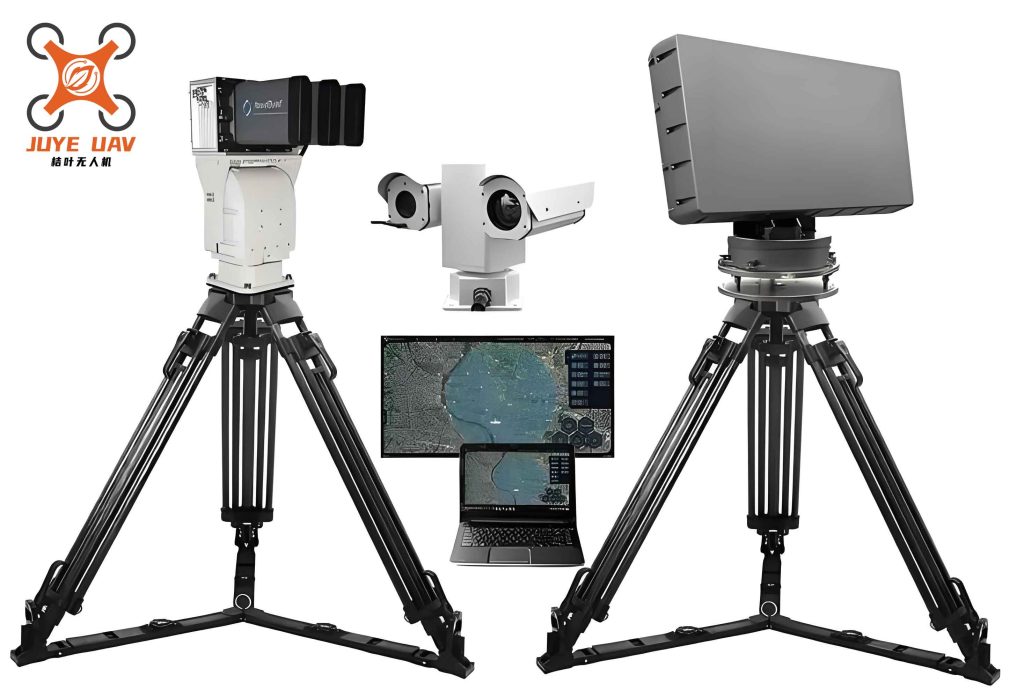
To validate the performance of our portable laser anti-drone system, we conducted a series of field experiments in a controlled suburban area with visibility up to 8 km. The tests included static damage assessment, dynamic tracking, and live drone engagements, all focused on evaluating anti-drone effectiveness. The target was a typical quadcopter UAV with dimensions of 290 mm × 290 mm × 196 mm and a maximum speed of 20 m/s, representing common anti-drone threats. For static tests, we used 2 mm thick carbon steel plates to simulate drone materials, while dynamic tests involved flying drones at distances of 300-320 meters.
In the static damage experiment, the laser was operated at 2000 W power at a distance of 300 meters. The time to penetrate the steel plate was recorded, with results indicating complete penetration in 12 seconds. This demonstrates the system’s capability to inflict structural damage on drone components, a key aspect of hard-kill anti-drone strategies. The damage progression can be described by the heat conduction equation, where the laser energy deposition leads to material melting and vaporization. For a simplified model, the time to penetrate a material of thickness \(d\) can be approximated as:
$$t_{\text{penetrate}} = \frac{\rho c_p \Delta T d}{E A_{\text{spot}}}$$
where \(\rho\) is material density, \(c_p\) is specific heat, \(\Delta T\) is temperature rise to melting point, \(E\) is power density, and \(A_{\text{spot}}\) is laser spot area. Using our measured values, this aligns with the observed 12-second penetration, confirming the anti-drone damage potential.
For tracking performance, we evaluated the system’s ability to follow a moving drone at speeds of 5-6 m/s. The compound-axis control achieved stable tracking with an error of 35.36 µrad, as detailed in Table 3. This precision ensures that the laser beam remains on target during anti-drone engagements, which is critical for effective energy delivery. The tracking data was collected over multiple runs, showing consistent performance across different trajectories, underscoring the reliability of our anti-drone targeting system.
| Test Condition | Distance (m) | Drone Speed (m/s) | Tracking Error (µrad) | Anti-Drone Outcome |
|---|---|---|---|---|
| Dynamic Tracking | 300-320 | 5-6 | 35.36 | Successful tracking |
| Static Aiming | 300 | N/A | < 10 | High precision for anti-drone strike |
The dynamic anti-drone strike experiment involved engaging a flying quadcopter with the laser system. At a distance of 300 meters and a drone speed of 5 m/s, the UAV was successfully disabled and brought down within 9 seconds of laser engagement. This result highlights the system’s operational efficacy in real-world anti-drone scenarios, where rapid response is essential. The kill time can be correlated with the power density and drone material properties, as per the earlier formula. We attribute this success to the integrated design, which combines high laser power with accurate tracking, a cornerstone of effective anti-drone technology.
Portability testing was conducted to assess the system’s ease of deployment and transport. Two operators were able to assemble the system from its modular cases in under 10 minutes and disassemble it similarly. The system supports three deployment modes: tripod-mounted for fixed positions, vehicle-integrated for mobile anti-drone operations, and backpack-carried for manual transport. This flexibility makes it suitable for diverse anti-drone missions, from protecting critical infrastructure to supporting military patrols. The weight distribution, as shown in Table 2, ensures that no single module exceeds 40 kg, adhering to ergonomic standards for personnel carry. This portability is a significant advancement over traditional laser anti-drone systems, which often require heavy vehicles or fixed installations.
In terms of system analysis, we further explored the trade-offs between laser power, beam quality, and portability. The beam quality factor \(M^2\) is crucial for anti-drone applications, as it affects the focusability of the laser. Our system maintains \(M^2 < 1.5\), which allows for a smaller emission aperture while maintaining high power density. This is derived from the beam propagation equation:
$$w(L) = w_0 \sqrt{1 + \left( \frac{M^2 \lambda L}{\pi w_0^2} \right)^2}$$
where \(w(L)\) is the beam radius at distance \(L\), and \(w_0\) is the beam waist. By optimizing \(w_0\) and \(M^2\), we achieved a compact optical design that contributes to the overall portability of the anti-drone system. Additionally, the use of air-cooling reduces power consumption and weight compared to liquid-cooled systems, though it may limit continuous operation time. For anti-drone missions, which often involve short engagements, this is an acceptable compromise.
The experimental validation also included environmental robustness tests. The system operated reliably in temperatures ranging from 15°C to 25°C and humidity levels of 20% to 40%, conditions typical for many anti-drone deployments. We recorded no performance degradation during extended use, indicating that the portable design does not sacrifice durability. This is vital for field-based anti-drone systems, which must withstand varied climates and rough handling.
Looking at broader implications, our portable laser anti-drone system addresses a growing need for flexible counter-UAV solutions. As drone technology evolves, so must anti-drone capabilities, and portability enables rapid response to emerging threats. The integration of advanced tracking with high-power lasers in a lightweight package sets a new standard for mobile anti-drone defenses. Future work could focus on enhancing laser efficiency, incorporating artificial intelligence for autonomous threat identification, and expanding the operational range beyond 500 meters. Such improvements would further solidify the role of portable laser systems in comprehensive anti-drone strategies.
In conclusion, we have designed and experimentally verified a portable laser anti-drone system that combines high performance with exceptional mobility. The system weighs under 160 kg, decomposes into sub-40 kg modules for two-person carry, and demonstrates effective anti-drone capabilities through static penetration of 2 mm steel in 12 seconds and dynamic drone knockdown in 9 seconds at 300 meters. The use of a transmissive ATP subsystem and air-cooled laser enables this portability without compromising on tracking accuracy or laser power. These results confirm that our system is well-suited for close-range anti-drone missions, offering a practical solution for safeguarding against UAV threats in diverse environments. The continued emphasis on anti-drone innovation will drive further advancements in portable directed-energy technologies, enhancing security and operational flexibility worldwide.