
In recent years, the deployment of police drones has revolutionized surveillance and reconnaissance operations, providing aerial perspectives that are crucial for situational awareness. However, due to limitations in flight altitude and camera focal length, individual aerial images captured by police drones often have a narrow field of view, making it challenging to form a comprehensive understanding of a scene. Therefore, stitching multiple aerial images into a panoramic view is essential. Image registration is the core step in image stitching, directly impacting the quality of the final output. Hence, developing fast and accurate image registration methods is a critical research focus. Traditional feature-based algorithms, such as SIFT and SURF, have been widely used, but they often suffer from high computational complexity, especially when dealing with large-sized, high-resolution images from police drones. ORB (Oriented FAST and Rotated BRIEF) offers a balance between speed and performance, yet it tends to produce unevenly distributed feature points with clustering issues, which can compromise registration accuracy in drone imagery. To address this, I propose an enhanced ORB-based image registration method tailored for police drone applications. This approach integrates a mask-based feature detection strategy with non-maximal suppression to ensure uniform feature distribution, followed by robust matching and outlier rejection using PROSAC. Through extensive experiments, I demonstrate that this method significantly improves registration accuracy under various transformations, making it highly suitable for police drone aerial images.
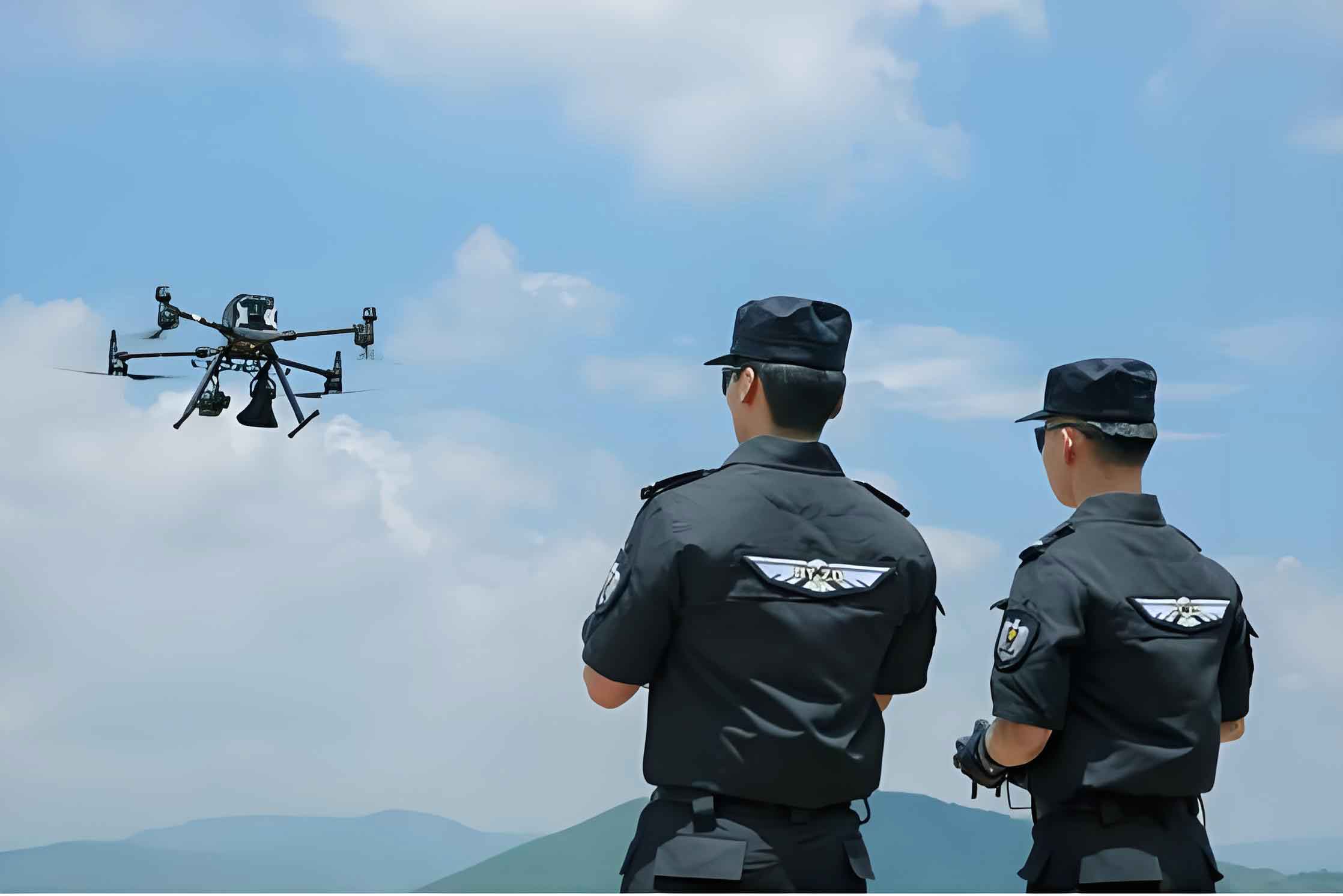
The proliferation of police drones in law enforcement has underscored the need for efficient image processing techniques. Police drones capture vast amounts of visual data, which must be quickly analyzed to support decision-making in scenarios like search and rescue, crowd monitoring, or crime scene investigation. Image registration, the process of aligning two or more images of the same scene taken from different viewpoints or at different times, is fundamental to creating cohesive aerial maps. For police drones, this task is compounded by challenges such as scale variations, rotation, blur due to motion, viewpoint changes, and illumination differences. While feature-based methods have shown promise, their performance on drone imagery can be inconsistent. My work focuses on refining the ORB algorithm to overcome these limitations, ensuring that feature points are evenly spread across the image to capture more contextual information. This is particularly vital for police drone operations, where missing details in certain image regions could lead to oversight in critical situations. By enhancing feature distribution and matching reliability, the proposed method aims to provide a robust solution for real-time image stitching in police drone systems.
To contextualize this research, it is important to review existing image registration techniques. SIFT (Scale-Invariant Feature Transform) is renowned for its robustness to scale and rotation changes, but its computational cost is high, making it less ideal for real-time applications with police drones. SURF (Speeded-Up Robust Features) offers faster performance than SIFT but may still struggle with large image sizes common in drone footage. ORB, as a combination of FAST keypoint detection and BRIEF descriptors, provides a good trade-off, being computationally efficient while maintaining reasonable invariance. However, as noted in prior studies, ORB-derived feature points often cluster in central image regions, leaving peripheries sparse. This can result in insufficient matches for accurate registration, especially in wide-area scenes captured by police drones. Some improvements have been suggested, such as grid-based filtering or Laplacian extremum methods, but these may not fully address clustering or handle areas with no detected points. My approach builds on these ideas by introducing a dynamic masking mechanism that systematically scans the entire image, ensuring comprehensive feature extraction. This is coupled with non-maximal suppression to thin out dense clusters, thereby optimizing the feature set for matching. The goal is to achieve a balance where feature points are both numerous and well-distributed, enhancing the reliability of registration for police drone imagery.
The core of my method lies in the improved ORB algorithm, which modifies the feature detection and description stages. For a given image to be registered, typically captured by a police drone, I construct a mask of dimensions proportional to the image size. Specifically, if the image has dimensions $M \times N$, the mask size is set to $m = M/4$ and $n = N/4$. This ensures at least 16 image blocks are considered, promoting coverage across the entire frame. The mask is then moved gradually across the image with a step size of $3m/4$ horizontally and $3n/4$ vertically, allowing overlap to avoid gaps. Within each mask position, the standard ORB feature detection is applied, which involves building an image pyramid for scale invariance and using FAST to identify keypoints. The FAST algorithm operates by comparing pixel intensities on a circle around a candidate point; for a pixel $p$ with intensity $I_p$, if $n$ contiguous pixels on the circle have intensities all greater than $I_p + t$ or all less than $I_p – t$, where $t$ is a threshold, then $p$ is considered a corner. Mathematically, for a set of pixels $x_i$ on the circle, the condition is:
$$\exists S \subseteq \{x_1, x_2, \dots, x_{16}\} \text{ such that } |S| \geq n \text{ and } \forall x \in S, I_x > I_p + t \text{ or } I_x < I_p – t$$
In ORB, this is extended by computing Harris corner response values to rank keypoints, retaining the top $N$ points per pyramid level. To assign orientation, the intensity centroid method is used, where the moments of a patch around a keypoint are computed as:
$$m_{pq} = \sum_{x, y} x^p y^q I(x, y)$$
for $p, q \in \{0, 1\}$. The centroid $C$ is given by:
$$C = \left( \frac{m_{10}}{m_{00}}, \frac{m_{01}}{m_{00}} \right)$$
and the orientation $\theta$ is:
$$\theta = \operatorname{atan2}(m_{01}, m_{10})$$
This ensures rotation invariance, critical for police drone images that may be captured from varying angles.
However, directly applying ORB within masks can still lead to clustered keypoints. To mitigate this, I employ non-maximal suppression (NMS). After detecting keypoints in each mask, for every keypoint, I examine its neighborhood (defined by a radius based on the image scale) and identify all other keypoints within that region. These are sorted according to their Harris response values, and only the keypoint with the highest response is retained; others are suppressed. This process reduces redundancy while preserving the strongest features, ensuring that the final set of keypoints is sparse and evenly distributed. The NMS operation can be expressed as: for a keypoint $k_i$ with response $r_i$, in a neighborhood $\mathcal{N}(k_i)$, retain $k_i$ only if $r_i = \max\{r_j \mid k_j \in \mathcal{N}(k_i)\}$. This step is computationally lightweight since Harris values are already computed in ORB, maintaining the algorithm’s efficiency for police drone applications.
Once keypoints are selected, they are described using the rotated BRIEF descriptor. ORB improves upon BRIEF by steering the descriptor according to the keypoint orientation $\theta$. The descriptor is a binary string of length 256, constructed by comparing intensities of point pairs in a smoothed image patch. For a set of point pairs $(x_i, y_i)$, the binary test function is:
$$\tau(p; x, y) = \begin{cases} 1 & \text{if } p(x) < p(y) \\ 0 & \text{otherwise} \end{cases}$$
where $p(x)$ denotes the pixel intensity at location $x$. The descriptor $f_n(p)$ is:
$$f_n(p) = \sum_{1 \leq i \leq n} 2^{i-1} \tau(p; x_i, y_i)$$
To incorporate rotation, the point pair matrix $S$ is rotated by $\theta$ using a rotation matrix $R_\theta$, yielding $S_\theta = R_\theta S$. The oriented descriptor becomes:
$$g_n(p, \theta) = f_n(p) \mid (x_i, y_i) \in S_\theta$$
ORB uses a learned set of point pairs that maximize variance and minimize correlation, ensuring discriminative power. This descriptor is compact and fast to compute, suitable for real-time processing on police drone platforms.
With features extracted, the next step is feature matching between two images—often sequential frames from a police drone’s video stream or overlapping aerial shots. I use Hamming distance to measure similarity between binary descriptors. For two descriptors $d_a$ and $d_b$ of length $L$, the Hamming distance $H(d_a, d_b)$ is the number of bits where they differ:
$$H(d_a, d_b) = \sum_{i=1}^L [d_a(i) \oplus d_b(i)]$$
where $\oplus$ denotes XOR operation. For each keypoint in the reference image, I find the two nearest neighbors in the target image based on Hamming distance. A match is accepted if the nearest distance is less than 50 and the ratio of the nearest to second-nearest distance is below 0.7. This ratio test, inspired by Lowe’s work on SIFT, helps filter ambiguous matches. Mathematically, for distances $d_1$ and $d_2$ with $d_1 < d_2$, the match is valid if $d_1 < 50$ and $d_1 / d_2 < 0.7$. This thresholding is effective for police drone images, where repetitive patterns or noise might cause false matches.
However, initial matches often contain outliers due to noise, occlusion, or repetitive textures common in aerial views from police drones. To refine these, I employ the PROSAC (Progressive Sample Consensus) algorithm, an enhancement of RANSAC. PROSAC improves efficiency by prioritizing high-quality matches early in the sampling process. First, all matched pairs are sorted based on the ratio of Hamming distances (lower ratios indicate higher quality). Then, from the top $m$ pairs, random subsets of 4 pairs are iteratively selected to estimate a homography matrix $H$, which models the transformation between images. The homography relates points $(x, y)$ in one image to $(x’, y’)$ in another via:
$$\begin{bmatrix} x’ \\ y’ \\ 1 \end{bmatrix} = H \begin{bmatrix} x \\ y \\ 1 \end{bmatrix} = \begin{bmatrix} a_0 & a_1 & a_2 \\ a_3 & a_4 & a_5 \\ a_6 & a_7 & 1 \end{bmatrix} \begin{bmatrix} x \\ y \\ 1 \end{bmatrix}$$
For each estimated $H$, the reprojection error for all matches is computed, and inliers are counted as those with error below a threshold (e.g., 3 pixels). The model with the highest inlier count after a maximum number of iterations is chosen. This process effectively removes mismatches, yielding a robust transformation matrix for precise image alignment. The use of PROSAC is particularly beneficial for police drone imagery, where match quality can vary due to environmental factors.
To validate the proposed method, I conducted experiments using standard datasets from the Oxford Visual Geometry Group, which include images with various transformations such as scale and rotation, blur, viewpoint change, and illumination variation. These conditions simulate real-world challenges faced by police drones. I compared the improved ORB algorithm against standard SIFT, SURF, and ORB in terms of matching accuracy and registration time. Matching accuracy is defined as the ratio of correct matches to total matches, where correct matches are verified via ground truth homography. Registration time includes feature extraction, matching, and outlier rejection. For police drone applications, both accuracy and speed are critical, as operational decisions often depend on timely and reliable image analysis.
The results for scale and rotation changes are summarized in Table 1. The improved ORB method achieved a higher matching rate compared to others, demonstrating its robustness to geometric transformations common in police drone footage. The formula for matching rate $R$ is:
$$R = \frac{N_{\text{correct}}}{N_{\text{total}}}$$
where $N_{\text{correct}}$ is the number of correct matches and $N_{\text{total}}$ is the total matches. The improvement stems from better feature distribution, which captures more relevant keypoints across the image.
| Algorithm | Total Matches | Correct Matches | Matching Rate |
|---|---|---|---|
| SIFT | 2827 | 2396 | 0.8475 |
| SURF | 1218 | 878 | 0.7209 |
| ORB | 255 | 225 | 0.8824 |
| Improved ORB | 637 | 612 | 0.9608 |
For blur changes, which often occur due to camera motion or atmospheric conditions in police drone operations, the improved ORB maintained high accuracy, as shown in Table 2. The non-maximal suppression helps retain stable keypoints even in degraded images.
| Algorithm | Total Matches | Correct Matches | Matching Rate |
|---|---|---|---|
| SIFT | 1052 | 749 | 0.7120 |
| SURF | 865 | 734 | 0.8486 |
| ORB | 333 | 310 | 0.9309 |
| Improved ORB | 729 | 703 | 0.9643 |
Viewpoint changes, simulating different angles from a police drone’s flight path, also benefited from the improved method, with results in Table 3. The mask-based detection ensures features are extracted from all image regions, reducing bias toward central areas.
| Algorithm | Total Matches | Correct Matches | Matching Rate |
|---|---|---|---|
| SIFT | 1281 | 1044 | 0.8150 |
| SURF | 735 | 492 | 0.6694 |
| ORB | 266 | 235 | 0.8835 |
| Improved ORB | 495 | 452 | 0.9131 |
Illumination variations, common during different times of day or weather conditions for police drones, are handled well, as indicated in Table 4. The ORB descriptor’s robustness to brightness changes, combined with improved feature distribution, leads to superior performance.
| Algorithm | Total Matches | Correct Matches | Matching Rate |
|---|---|---|---|
| SIFT | 1309 | 1152 | 0.8801 |
| SURF | 853 | 708 | 0.8300 |
| ORB | 275 | 232 | 0.8436 |
| Improved ORB | 930 | 886 | 0.9527 |
Regarding computational efficiency, the average registration times across all test cases are presented in Table 5. While improved ORB is slower than standard ORB due to additional processing, it remains faster than SIFT and SURF, making it viable for real-time applications with police drones. The time complexity of the improved method can be approximated as $O(MN + k \log k)$, where $MN$ is the image size and $k$ is the number of keypoints, compared to $O(MN)$ for ORB with fewer keypoints. However, the gain in accuracy justifies this trade-off for police drone missions where precision is paramount.
| Algorithm | Average Time (seconds) |
|---|---|
| SIFT | 15.636 |
| SURF | 5.746 |
| ORB | 1.139 |
| Improved ORB | 3.141 |
To further demonstrate applicability, I tested the method on actual police drone aerial images with dimensions 3840 × 2160, capturing scenes from治安 operations. The improved ORB produced more uniformly distributed feature points and a higher number of correct matches compared to standard ORB, leading to better-aligned stitched images. This is crucial for police drone analysts who rely on seamless panoramas to assess large areas quickly. The mask size in such high-resolution images was set to $m = 960$ and $n = 540$, ensuring detailed coverage without excessive computation. The step sizes of $720$ and $405$ allowed smooth traversal, and non-maximal suppression with a neighborhood radius of 10 pixels effectively reduced clustering. The resulting homography matrices showed lower reprojection errors, indicating accurate registration suitable for forensic or operational use.
The mathematical underpinnings of the method can be extended to optimize parameters for specific police drone scenarios. For instance, the mask dimensions and step sizes can be adaptive based on image content or flight altitude. Let $A$ represent the area covered by the police drone’s camera, and $R$ the resolution; then the optimal mask size $m \times n$ could be derived from:
$$m = \alpha M, \quad n = \beta N$$
where $\alpha$ and $\beta$ are coefficients learned from training data to maximize feature spread. Similarly, the threshold $t$ in FAST detection could be dynamically adjusted based on image contrast, which varies in police drone footage due to lighting conditions. A contrast measure $C$ for an image patch can be computed as the standard deviation of intensities, and $t$ set as:
$$t = \gamma \cdot C$$
where $\gamma$ is a scaling factor. This adaptability enhances robustness across diverse environments encountered by police drones.
In terms of feature matching, the Hamming distance threshold and ratio test can be tuned. For police drone images with high noise levels, such as those taken in low light, the distance threshold might be relaxed. However, to maintain precision, I use a probabilistic model where the likelihood of a correct match given a distance $d$ is:
$$P(\text{correct} \mid d) = \frac{1}{1 + e^{k(d – d_0)}}$$
where $k$ and $d_0$ are parameters estimated from labeled data. This could be integrated into the matching process to weight matches, though in my current implementation, fixed thresholds suffice for general use. The PROSAC algorithm’s performance also depends on the inlier ratio; for police drone images with large viewpoint changes, the initial match set may have a lower inlier ratio, requiring more iterations. The expected number of iterations $E$ for PROSAC to find a good model is:
$$E = \frac{\log(1 – p)}{\log(1 – \epsilon^s)}$$
where $p$ is the desired confidence, $\epsilon$ is the inlier ratio, and $s$ is the sample size (4 for homography). By monitoring $\epsilon$ from the sorted match list, the algorithm can adjust iterations dynamically, saving time in critical police drone operations.
The improved ORB method also has implications for real-time video stitching from police drones. As a drone moves, consecutive frames need to be registered rapidly to update a live panorama. My method’s efficiency allows for frame-by-frame processing at manageable rates. For a video stream at 30 fps, the registration time of around 3 seconds per pair might seem high, but by using keyframe selection and incremental homography updates, the effective rate can be increased. Specifically, keyframes can be chosen when the overlap between frames drops below a threshold, reducing redundant computations. The homography between non-keyframes can be interpolated using motion models, such as:
$$H_t = H_{t-1} \cdot \Delta H$$
where $\Delta H$ is estimated from feature flow. This pipeline ensures smooth stitching for police drone video analytics.
Moreover, the method’s robustness to scale changes is vital for police drones that may alter altitude during flight. The image pyramid in ORB provides some scale invariance, but the mask-based approach further ensures that features are detected at all scales within each level. The pyramid construction involves downsampling the image by a factor $\sigma$ at each level $l$, so the effective mask size at level $l$ becomes $m/\sigma^l \times n/\sigma^l$. This maintains consistent coverage across scales, which is beneficial when a police drone zooms in or out on a target.
In conclusion, the proposed improved ORB-based image registration method offers significant advantages for police drone applications. By incorporating a moving mask and non-maximal suppression, it addresses the uneven feature distribution problem inherent in standard ORB, leading to higher matching accuracy under various transformations including scale and rotation, blur, viewpoint change, and illumination variation. The use of PROSAC for outlier rejection further refines the matching process, ensuring reliable homography estimation. Experimental results show accuracy improvements of 3% to 11% over standard ORB, with competitive registration times. This makes the method well-suited for processing high-resolution aerial images from police drones, where both precision and speed are essential. Future work could involve integrating deep learning for feature enhancement or optimizing the algorithm for embedded hardware on police drones, enabling on-board real-time stitching. As police drones become increasingly integral to law enforcement, advancements in image registration like this will play a crucial role in enhancing situational awareness and operational effectiveness.
The deployment of police drones in urban and rural settings presents unique challenges for computer vision. For instance, in crowded events, police drones capture wide-area footage that must be stitched quickly to monitor crowd movement. The improved ORB method’s ability to handle viewpoint changes and blur ensures that even with rapid drone maneuvering, the resulting panoramas remain coherent. Similarly, in search and rescue missions, police drones often fly over heterogeneous terrain, causing illumination and scale variations; the method’s robustness to these factors aids in creating accurate maps for responders. The mathematical formulations provided, such as the homography model and probability-based matching, offer a framework for further customization. By continuously refining these algorithms, we can better support police drone operators in their mission to enhance public safety through advanced aerial imaging.