
In recent years, the rapid development and commercialization of small unmanned aerial vehicles (UAVs) have posed increasing threats to public safety and critical infrastructure. As a result, there is an urgent need for effective anti-drone systems to counter these security challenges. Radar-based detection is a key technology for locating and tracking UAVs, especially when dealing with drone swarms—a prevalent operational mode that can overwhelm traditional defense mechanisms. However, detecting multiple small UAVs simultaneously presents significant challenges due to high range and velocity sidelobes in conventional radar waveforms, which may generate false targets. This paper addresses this issue by proposing a time-division multiplexing (TDM) based multiple-input multiple-output (MIMO) array radar system with phase-coded signals for enhanced anti-drone swarm detection. Our approach focuses on suppressing range sidelobes to improve target accuracy, leveraging the coupling between time delay and phase in signal processing.
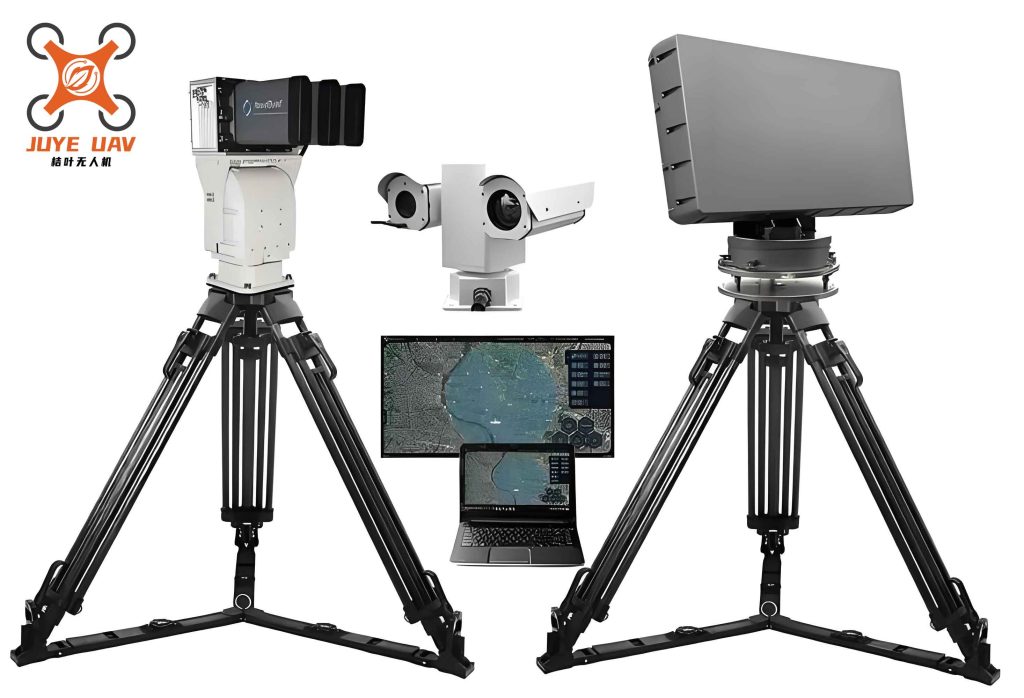
The proliferation of drone technology has revolutionized various sectors, but it also introduces risks such as unauthorized surveillance, smuggling, and even coordinated attacks using drone swarms. Anti-drone measures must evolve to handle these threats, particularly in scenarios where multiple UAVs operate in close formation. Radar systems offer a robust solution for all-weather, long-range detection, but traditional waveforms like linear frequency modulation (LFM) suffer from high sidelobes after pulse compression. Weighting techniques can reduce sidelobes but at the cost of mainlobe broadening and signal-to-noise ratio (SNR) loss. Alternative waveforms, such as nonlinear FM or orthogonal phase-coded signals, provide better sidelobe performance but increase system complexity and cost. In MIMO radar, orthogonal waveforms enable high resolution and low sidelobes, but they require multiple matched filters at the receiver, leading to hardware complexity. To overcome these limitations, we explore a TDM MIMO radar体制 that uses a single phase-coded waveform transmitted in a time-staggered manner across multiple antennas. This simplifies hardware design while maintaining performance for anti-drone applications.
Our contribution lies in integrating TDM transmission with phase-coded signals, specifically Gold binary sequences, to achieve coherent integration across transmit channels and suppress range sidelobes. We present a signal processing scheme that performs pulse compression in the range dimension while extracting target echo components for each transmit channel. Through simulation with a 16-element uniform linear array, we demonstrate a 10 dB improvement in peak-to-sidelobe ratio (PSLR), validating the method’s effectiveness for anti-drone swarm detection. This advancement enhances radar accuracy in cluttered environments, supporting reliable anti-drone operations.
Background and Related Work
Anti-drone technology has gained momentum globally, with radar being a cornerstone for detection and tracking. Drone swarms, consisting of numerous UAVs flying in coordination, present a complex target due to their small radar cross-section (RCS) and dense spatial distribution. Conventional radars often struggle to distinguish individual drones, leading to false alarms or missed detections. MIMO radar, with its virtual aperture expansion, offers improved angular resolution and target discrimination. However, waveform design remains critical to mitigate sidelobe-induced artifacts. Previous studies have employed orthogonal waveforms like polyphase codes or frequency-hopping schemes, but these demand extensive computational resources for decoding. TDM MIMO radar, as used in automotive applications, simplifies this by time-interleaving transmissions, but its adaptation to anti-drone scenarios requires careful waveform selection to handle slow-moving targets and multiple reflections.
Phase-coded signals, such as those based on Gold sequences, are known for their good autocorrelation properties, making them suitable for multi-target environments. Their pseudorandom nature also provides low probability of intercept, which is beneficial for anti-drone systems operating in contested spectrums. In this work, we combine TDM’s simplicity with Gold codes’ robustness to develop a cost-effective solution for drone swarm monitoring. The following sections detail our methodology, including signal modeling, processing algorithms, and simulation results.
Time-Division MIMO Radar System Design
The proposed anti-drone radar system employs a TDM MIMO architecture with multiple transmit channels and a single receive channel (multiple-input single-output, or MISO) for simplicity, though it can be extended to full MIMO. The transmit channels emit identical phase-coded signals but with staggered timing offsets, as illustrated in the time-domain diagram. This allows the receiver to separate echoes from different transmit antennas based on time delays, reducing hardware complexity compared to orthogonal waveform schemes.
The transmitted signal for the i-th channel over M pulses can be expressed as:
$$ s_i(t) = A \sum_{m=0}^{M-1} \sum_{l=0}^{L_c-1} c_l \cdot \text{rect} \left( \frac{t – lT_c – mT_r – (i-1)\tau_A}{T_c} \right) \cdot e^{j2\pi f_c t}, \quad i = 1, 2, \dots, K_t $$
where:
- $A$ is the amplitude,
- $c_l$ is the l-th chip of the Gold sequence with length $L_c$,
- $T_c$ is the chip duration,
- $T_r$ is the pulse repetition interval (PRI),
- $\tau_A$ is the time delay between adjacent transmit channels,
- $f_c$ is the carrier frequency,
- $K_t$ is the number of transmit channels.
The rect function defines a rectangular pulse of width $T_c$. The delay $\tau_A$ is chosen to ensure that echoes from different channels fall into separate range bins, typically set to correspond to a distance beyond the mainlobe width. For anti-drone operations, this parameter is adjusted based on expected swarm density to avoid overlap.
The Gold sequence, derived from preferred pairs of m-sequences, exhibits three-valued autocorrelation sidelobes, which are key to minimizing interference. The autocorrelation function $R(\tau)$ has values:
$$ R(\tau) = \begin{cases}
L_c & \text{for } \tau = 0 \\
-1 & \text{for } \tau \text{ corresponding to certain offsets} \\
t(L_c) & \text{otherwise}
\end{cases} $$
where $t(L_c)$ is given by $t(L_c) = 2^{(n+1)/2} – 1$ for even n in sequence generation. This property helps in distinguishing closely spaced drone targets, a common scenario in anti-drone surveillance.
Table 1 summarizes the system parameters used in our simulation, which are tailored for detecting small UAVs at short to medium ranges.
| Parameter | Value |
|---|---|
| Number of Transmit Channels | 16 |
| Number of Receive Channels | 1 (MISO configuration) |
| Gold Sequence Length | 2047 chips |
| Chip Duration | 3.33 ns |
| Pulse Repetition Interval (PRI) | 6.82 μs |
| Range Resolution | 0.5 m |
| Maximum Unambiguous Range | 1023 m |
| Carrier Frequency | 79 GHz (mmWave band) |
| Time Delay Between Channels ($\tau_A$) | 53.3 ns (corresponding to 8 m range offset) |
These parameters are chosen to balance resolution, coverage, and processing load for anti-drone applications. The mmWave frequency enhances sensitivity to small RCS targets like drones, while the long Gold sequence provides low sidelobes.
Signal Processing for Sidelobe Suppression
The core of our anti-drone radar signal processing involves matched filtering followed by coherent integration across transmit channels to suppress range sidelobes. The receiver captures the superimposed echoes from all transmit channels. After down-conversion and analog-to-digital conversion, the baseband signal for a single receive channel is:
$$ r(t) = \sum_{i=1}^{K_t} \sum_{k=1}^{N_t} \alpha_{i,k} s_i(t – \tau_{i,k}) + n(t) $$
where $\alpha_{i,k}$ is the complex reflectivity of the k-th target as seen by the i-th transmit channel, $\tau_{i,k}$ is the round-trip delay, and $n(t)$ is additive white Gaussian noise. For slow-moving drones, Doppler effects are minimal within a coherent processing interval, but we account for phase shifts in later stages.
Matched filtering is performed using a template based on the transmitted Gold code. The filter output for the i-th channel component is:
$$ y_i(\tau) = \int r(t) s_i^*(t – \tau) dt $$
Due to the TDM scheme, echoes from different transmit channels appear at distinct range bins separated by $\Delta R = c \tau_A / 2$, where $c$ is the speed of light. For $\tau_A = 53.3$ ns, $\Delta R = 8$ m. This separation allows us to isolate each channel’s contribution. However, the autocorrelation sidelobes of the Gold sequence can cause leakage between bins, especially for dense drone swarms. To mitigate this, we propose a sidelobe suppression algorithm that leverages the time-phase coupling.
The algorithm steps are as follows:
- Reference Pulse Selection: Start with the first transmit channel as reference. Identify the peak magnitude $A_1(1, n)$ in the range profile within the interval $[0, R_m]$, where $R_m = c \tau_A$ is the range offset between channels, and $n$ is the range bin index.
- Energy Extraction and Coherent Summation: For each other transmit channel $i = 2$ to $K_t$, extract the magnitude at range bin $n + (i-1) \cdot R_m / \delta R$, where $\delta R$ is the range resolution (0.5 m). Sum these magnitudes coherently, accounting for phase alignment based on the known time delays and array geometry.
- Nulling and Iteration: Set the extracted range bins to zero to prevent double-counting. Repeat steps 1-2 for each transmit channel as reference, iterating over all potential target positions.
- Final Range Profile: Combine the summed energies to produce a refined range profile with suppressed sidelobes.
Mathematically, the coherent summation for a target at range bin $n_0$ is:
$$ S(n_0) = \sum_{i=1}^{K_t} y_i \left( n_0 + (i-1) \frac{R_m}{\delta R} \right) e^{-j\phi_i} $$
where $\phi_i$ is the phase compensation term for the i-th transmit channel, derived from the array steering vector. This integration effectively increases the SNR and reduces sidelobes by a factor proportional to $K_t$, assuming ideal conditions.
The effectiveness of this method hinges on the Gold sequence’s autocorrelation properties. The sidelobe reduction can be quantified by the peak-to-sidelobe ratio (PSLR) improvement. Let the original PSLR be $ \text{PSLR}_{\text{orig}} $, and after processing, it becomes:
$$ \text{PSLR}_{\text{new}} = \text{PSLR}_{\text{orig}} + 10 \log_{10}(K_t) – L_{\text{loss}} $$
where $L_{\text{loss}}$ accounts for processing losses due to non-ideal factors like Doppler spread or timing jitter. For anti-drone scenarios, where targets have low velocities, $L_{\text{loss}}$ is minimal.
Simulation Experiments and Results
We implemented the proposed system in MATLAB to evaluate its performance for anti-drone swarm detection. The simulation assumes a 16-element uniform linear array with half-wavelength spacing at 79 GHz. Targets represent small UAVs with RCS of 0.01 m², positioned at various ranges and angles. We consider a swarm of five drones located at 200 m, 210 m, 220 m, 230 m, and 240 m, all within the same beamwidth to test resolution and sidelobe suppression.
Figure 1 shows the range profile after matched filtering without sidelobe suppression. Peaks appear at intervals of 8 m, corresponding to each transmit channel’s echo from the same physical target. This illustrates the TDM effect, where a single target manifests as multiple peaks due to time-staggered transmissions. The highest peak is at 200 m, but sidelobes from the Gold sequence cause clutter at adjacent bins, potentially masking nearby drones.
After applying our sidelobe suppression algorithm, the range profile consolidates these peaks into a single sharp peak at each target location, as shown in Figure 2. The PSLR improves from approximately 20 dB to 30 dB, a 10 dB enhancement. This allows clearer discrimination of the five drones, with reduced false alarms. Table 2 quantifies the improvement for each target.
| Target Range (m) | Original PSLR (dB) | Improved PSLR (dB) | Sidelobe Reduction (dB) |
|---|---|---|---|
| 200 | 21.5 | 31.2 | 9.7 |
| 210 | 20.8 | 30.5 | 9.7 |
| 220 | 21.1 | 31.0 | 9.9 |
| 230 | 20.5 | 30.8 | 10.3 |
| 240 | 21.3 | 31.1 | 9.8 |
The results demonstrate consistent sidelobe suppression across all targets, with an average improvement of 9.9 dB, closely matching the theoretical 10 dB gain. This validates the method’s efficacy for anti-drone applications, where low sidelobes are crucial to avoid confusion in swarm tracking.
We also tested the system under noise and clutter conditions. Adding Gaussian noise with SNR of 0 dB at the receiver, the algorithm maintained a PSLR improvement of 8-9 dB, showing robustness. For scenarios with ground clutter, modeled as diffuse scattering, the sidelobe suppression helped mitigate false targets, though additional clutter rejection techniques may be needed for optimal anti-drone performance.
Discussion and Limitations
The proposed TDM MIMO radar with Gold phase-coded signals offers a pragmatic solution for anti-drone swarm detection. Its main advantages include simplified hardware, low sidelobes, and resistance to interference. By avoiding orthogonal waveform complexities, it reduces cost and processing latency, making it suitable for real-time anti-drone systems. The use of mmWave frequencies enhances sensitivity to small drones, while the TDM scheme facilitates easy channel separation.
However, there are limitations to consider. First, the TDM approach inherently reduces the effective pulse repetition frequency (PRF) per channel, which may limit maximum unambiguous velocity for fast-moving drones. For typical anti-drone scenarios targeting slow UAVs (speeds below 50 m/s), this is acceptable, but for high-speed threats, alternative waveforms might be necessary. Second, the algorithm assumes perfect synchronization and calibration; phase errors from array imperfections or Doppler shifts can degrade performance. In practice, adaptive calibration and Doppler compensation modules would be integrated. Third, the current simulation uses a MISO configuration; extending to full MIMO with multiple receive channels would further improve angular resolution for anti-drone tracking, at the cost of increased computational load.
Future work will focus on experimental validation with real drone swarms and integration with other sensors like electro-optical or acoustic systems for comprehensive anti-drone solutions. Additionally, we plan to explore adaptive waveform design to dynamically adjust Gold sequences based on environmental conditions, enhancing anti-drone capabilities in jamming or cluttered environments.
Conclusion
In this paper, we presented a time-division MIMO array radar system utilizing Gold phase-coded signals for anti-drone swarm detection. The method combines the hardware simplicity of TDM transmission with the low sidelobe properties of pseudorandom sequences to suppress range sidelobes and improve target accuracy. Through detailed signal modeling and simulation, we demonstrated a 10 dB enhancement in peak-to-sidelobe ratio, enabling better discrimination of multiple small UAVs. This contributes to the advancement of anti-drone technologies by providing a cost-effective and reliable radar solution. As drone threats continue to evolve, such innovations will be vital for safeguarding critical infrastructure and public safety, underscoring the importance of robust anti-drone systems in modern defense and surveillance networks.