
From my perspective as someone deeply involved in the operational deployment of aerial technology, the recent global events have served as a profound catalyst, accelerating the integration and public recognition of police drone units. What was once primarily a tool for specialized missions has rapidly evolved into a versatile, indispensable asset in the law enforcement toolkit. The shift has been remarkable, transitioning from niche applications to becoming frontline responders in community safety and large-scale crisis management. The compact, buzzing aircraft are no longer just eyes in the sky; they have become dynamic platforms for communication, intervention, and support, fundamentally altering traditional policing paradigms and proving that physical size is no measure of operational impact.
The core of this transformation lies in the inherent advantages of the police drone. From my operational experience, these advantages can be distilled into a clear set of capabilities that directly address modern policing challenges.
| Advantage Category | Operational Manifestation | Direct Benefit |
|---|---|---|
| Mobility & Access | Ability to hover, move quickly in 3D space, and access confined or hazardous areas. | Overcomes geographical barriers, reaches inaccessible crime/accident scenes. |
| Perspective | Provides a real-time, elevated, and broad field of view. | Enhances situational awareness for command decisions; sees “the bigger picture.” |
| Resource Efficiency | Single operator can control a drone covering a large area. | Acts as a force multiplier, saving personnel hours and optimizing patrol resources. |
| Safety | Removes officers from initial contact with potentially dangerous situations. | Reduces direct risk to officer life during reconnaissance, surveillance, or crowd monitoring. |
| Versatility | Platform can be equipped with various payloads (cameras, speakers, lights, delivery mechanisms). | One tool for multiple missions: search, communication, evidence gathering, delivery. |
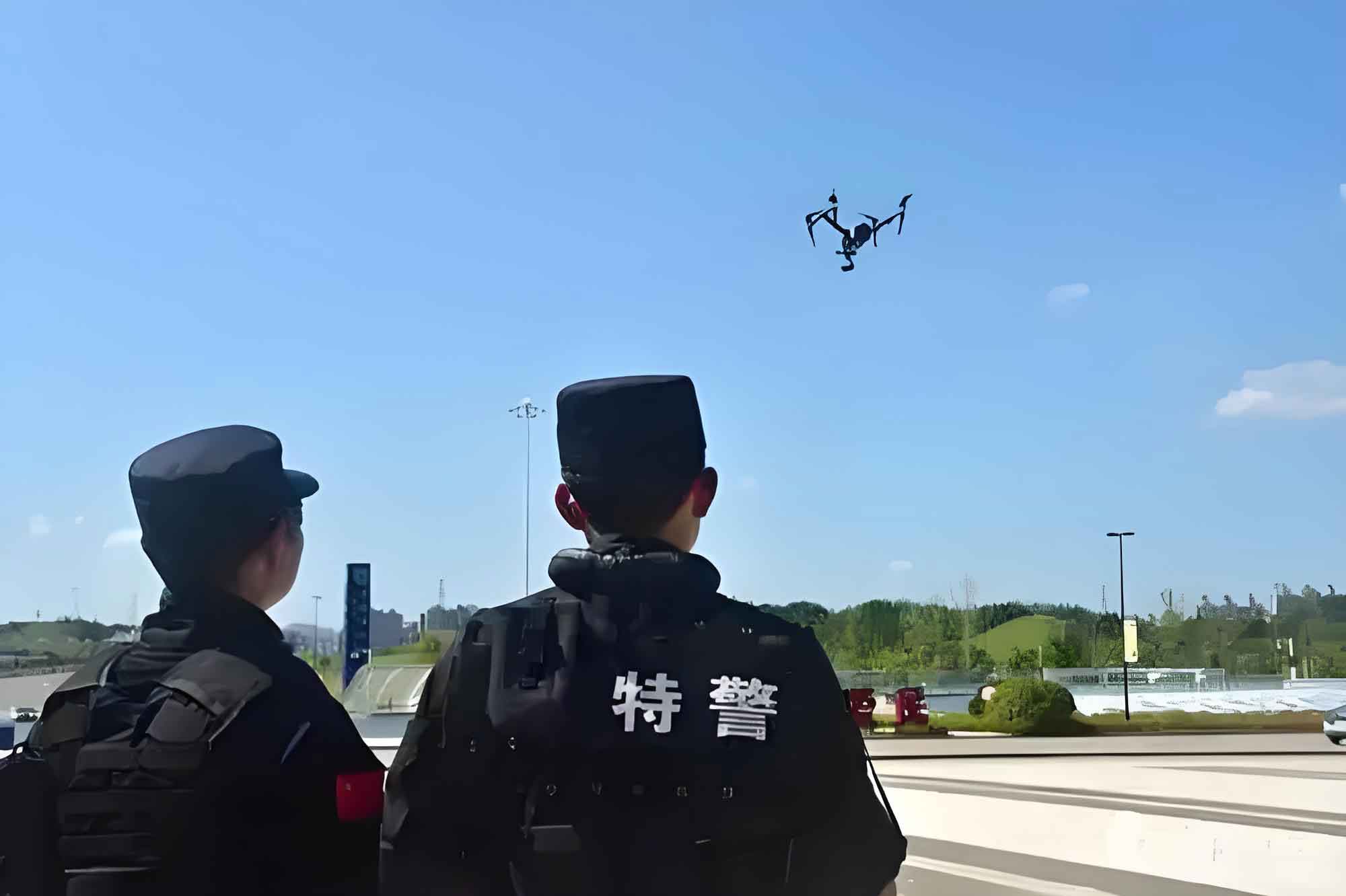
This multifaceted utility was thrown into sharp relief during recent public health crises. The police drone seamlessly transitioned into a public health assistant. Equipped with loudspeakers, they conducted aerial patrols over parks, neighborhoods, and commercial areas, delivering critical messages on social distancing and health guidelines. This “sky-cop” phenomenon was not about replacing officer presence but amplifying it—extending the reach of a single officer’s voice over kilometers in a clear, non-confrontational manner. The psychological impact was significant; a directive from the sky often commanded immediate public compliance, all while maintaining a safe distance. This period was a massive, real-world stress test, demonstrating that a police drone could be a compassionate communicator as effectively as a vigilant observer.
The operational scope expanded further. I have overseen missions where police drone units, fitted with specialized sprayer attachments, were deployed to disinfect public spaces, playgrounds, and large industrial complexes. The efficiency was mathematically undeniable. Consider the area coverage for disinfection:
$$ A_{covered} = v \cdot w \cdot t $$
Where \( A_{covered} \) is the total area disinfected (in m²), \( v \) is the drone’s ground speed (m/s), \( w \) is the effective spray swath width (m), and \( t \) is the total flight time (s). Compared to a two-person ground team covering perhaps 50-100 m² per minute, a single police drone could systematically cover thousands of square meters per hour, uniformly and without exposing personnel to chemicals or contaminated zones.
The applications of the modern police drone now span the entire spectrum of public safety and service. The following table categorizes these diverse mission profiles.
| Mission Domain | Typical Applications | Key Drone Payloads Used |
|---|---|---|
| Crowd & Traffic Management | Monitoring large public events, assessing traffic congestion, investigating accidents from above, directing flow during emergencies. | High-resolution zoom cameras, thermal cameras, loudspeakers, strobe lights. |
| Search & Rescue (SAR) | Locating missing persons in rugged terrain, searching flood or disaster zones, delivering emergency supplies (life vests, radios, medicine). | Thermal/IR cameras, spotlights, loudspeakers, payload release systems. |
| Crime Scene & Accident Investigation | Creating detailed orthomosaic maps of scenes, capturing aerial perspectives for reconstruction, documenting evidence over large areas. | High-res mapping cameras, RTK GPS for centimeter accuracy. |
| Tactical Operations | Surveillance of barricaded suspects, reconnaissance of building layouts prior to entry, deployment of distraction devices. | Silent rotors (where possible), low-light/thermal cameras, secure data links. |
| Hazardous Material Response | Inspecting suspected chemical spills or radiological sources from a safe distance, assessing structural integrity of damaged buildings. | Gas sensors, radiation detectors, high-zoom cameras. |
| Community Service & Innovation | Aerial broadcasting of alerts, monitoring illegal dumping, supporting firefighting with aerial ignition or hotspot identification. | Loudspeakers, standard visual cameras, thermal cameras. |
The effectiveness of a police drone program is not anecdotal; it is quantifiable. We can model the efficiency gain. Let \( T_{traditional} \) represent the time and \( R_{traditional} \) represent the number of personnel required for a traditional ground-based method of a task (e.g., searching a 1km² area). Let \( T_{drone} \) and \( R_{drone} \) represent the time and personnel for the same task using a drone. The operational efficiency multiplier \( M \) can be expressed as a composite function:
$$ M = f\left(\frac{T_{traditional}}{T_{drone}}, \frac{R_{traditional}}{R_{drone}}\right) $$
In practical terms, for a search mission, \( T_{drone} \) might be 1/10th of \( T_{traditional} \) and \( R_{drone} \) might be 1/3 (pilot + visual observer). This results in a resource efficiency multiplier well over 10x. Furthermore, the probability of success \( P(success) \) for tasks like finding a missing person increases with aerial thermal imaging, which can be modeled as enhancing the effective search sweep width \( W_{effective} \) by a factor \( k \) (where \( k > 1 \)) compared to ground searchers:
$$ P(success)_{drone} \propto \frac{v \cdot (k \cdot W_{effective}) \cdot t}{A_{search}} $$
This quantitative edge is why investment in police drone technology has surged globally. A structured development path has been followed, moving from ad-hoc experimentation to institutional integration.
| Development Phase | Key Characteristics | Outcome |
|---|---|---|
| Pioneering & Experimentation | Individual units acquiring small drones, testing in limited scenarios (photography, basic overview). | Proof of concept established; early adopters demonstrated value. |
| Standardization & Training | Development of standard operating procedures (SOPs), dedicated police drone units, formal pilot certification programs. | Enhanced safety, reliability, and admissibility of aerial evidence in court. |
| Strategic Integration & Expansion | Drones integrated into daily patrol and command center operations. Fleet diversification (small, medium, long-endurance). | Police drone becomes a standard dispatchable asset, like a patrol car. |
| Data Fusion & AI Enhancement | Live video feed integrated into real-time crime centers. Use of AI for automatic license plate recognition (ALPR), object detection, and behavioral analysis. | Transition from pure data collection to intelligent, automated analysis and alerting. |
The result of this evolution is a formidable national capacity. The numbers speak for themselves: dozens of dedicated aviation units now exist, managing fleets numbering in the thousands. These fleets are operated by thousands of trained, certified pilots who have logged countless flight hours on missions ranging from routine patrol to critical incident response. The police drone has cemented its role as a pillar of the modern, technology-enabled police force.
Looking ahead, the trajectory for the police drone is aimed firmly toward greater autonomy, resilience, and intelligence. The next-generation police drone will likely feature:
- Advanced Swarm Technology: Coordinated fleets of drones working autonomously to search vast areas, create communication networks, or perform complex 3D mapping. Their behavior could be modeled by distributed control algorithms ensuring coverage \( C(t) \) approaches 100% of a target area \( A \) in minimal time.
- Beyond-Visual-Line-of-Sight (BVLOS) Operations: Secure, long-range flights enabled by robust command-and-control links and detect-and-avoid systems, governed by regulations ensuring airspace safety. This expands the operational radius exponentially.
- Enhanced Sensor Fusion: Integrating LiDAR, hyperspectral imaging, and advanced acoustic sensors with standard visual and thermal feeds to detect concealed items, identify chemical compositions, or pinpoint gunshot locations with even greater accuracy.
- AI-Powered Predictive Analytics: Moving from reactive to proactive policing. A police drone‘s live feed, analyzed in real-time by AI, could automatically detect unusual crowd formations, identify abandoned packages, or recognize patterns indicative of criminal activity, alerting officers before a situation escalates.
The formula for future success is clear: continued investment in both the police drone hardware and, more importantly, in the data infrastructure and analytical software that transforms raw aerial data into actionable intelligence. The small aircraft that once elicited surprise from the public has firmly established itself as a silent guardian, a watchful eye, and a powerful voice—a compact tool enabling a monumental leap in public safety, operational efficiency, and officer protection. Its future is not just in the sky, but integrated into the very fabric of intelligent, responsive, and community-focused policing.