
In recent years, the integration of police drones into law enforcement activities has emerged as a transformative approach under the推广 of technology-driven and efficiency-oriented policing concepts. As a researcher examining modern警务 strategies, I have observed that police drones offer significant potential to enhance执法 levels while reducing警力 and time costs. During the COVID-19 pandemic, this innovation became particularly crucial, with cities like Shenzhen, Weihai, and Guiyang pioneering studies on police drone applications in公安勤务, yielding promising results. In this article, I explore the conceptual foundations, feasibility, innovative uses, and critical reflections on police drones in pandemic response, aiming to provide a comprehensive analysis that underscores their growing importance. Throughout, I will emphasize the term “police drone” to highlight its central role in reshaping law enforcement paradigms.
To effectively incorporate police drones as emerging technology into traditional police operations and systems, it is essential to first define key concepts. Police operations, or公安勤务, refer to the concrete tasks and requirements undertaken by law enforcement agencies within specific timeframes and regions. From my perspective, police operations are the tangible manifestations of公安 tasks during particular stages, characterized by systematic, operable, and高效 structures and执法执勤 styles. They exhibit阶段性 (phase-specific),系统性 (systematic), and操作性 (operational) traits, adapting to societal needs and时代 contexts. On the other hand, police drones represent a technological advancement in law enforcement tools. In a narrow sense, a police drone is an uncrewed aerial vehicle (UAV) with公安机关标识 capable of various operations. Broadly, it encompasses the entire police unmanned aircraft system (PUAS), including the drone, data links, and ground control stations. Based on my analysis, police drones exhibit辅助性 (auxiliary nature),延展性 (extensibility), and技术性 (technical complexity), making them versatile assets in警务实践. For instance, their auxiliary role supports primary law enforcement tasks, while their extensibility allows for pre-activity reconnaissance and multi-equipment integration, such as loudspeakers or cameras. The technical aspect demands skilled operators and maintenance, underscoring the need for specialized training.
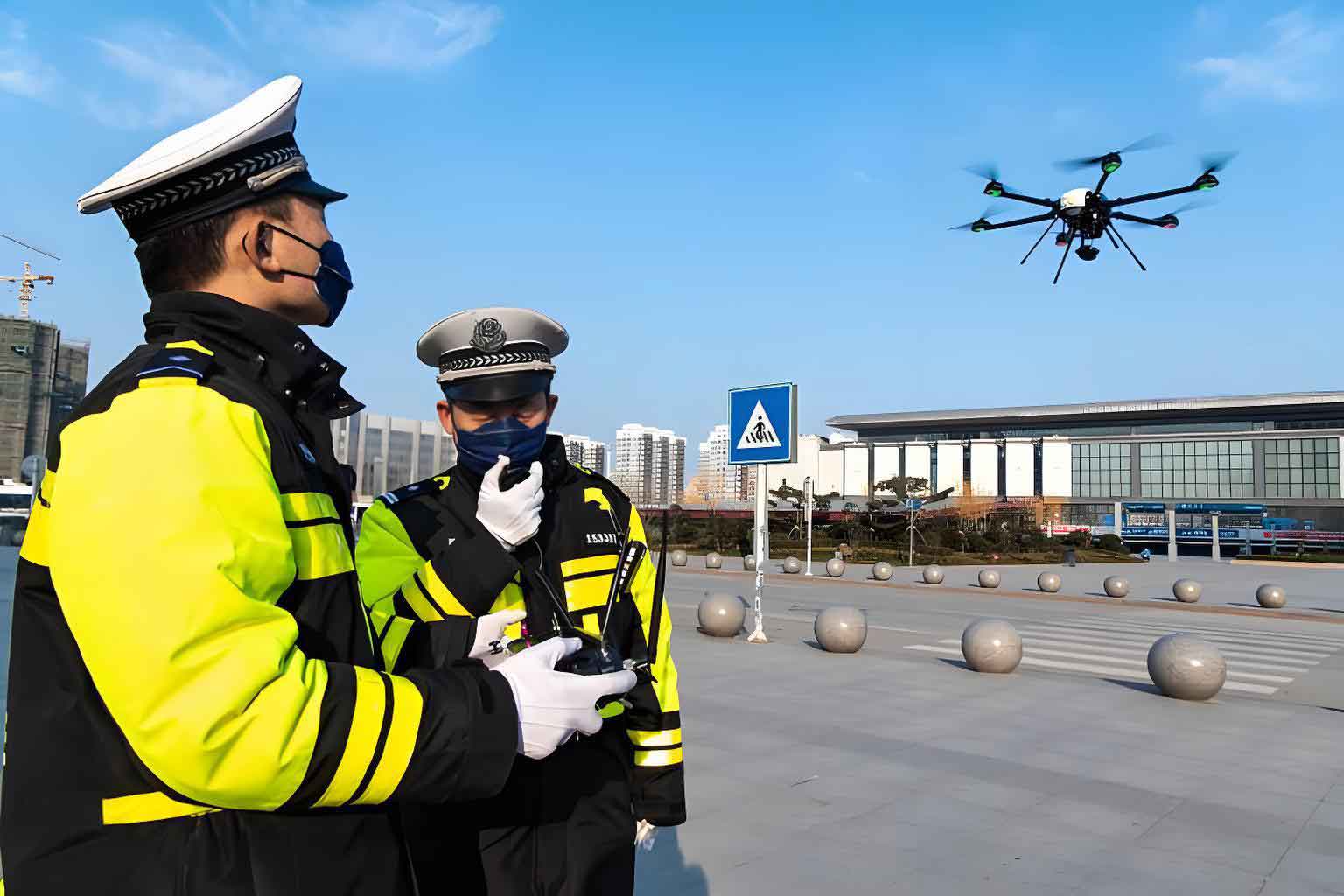
The COVID-19 pandemic imposed new demands on police operations, requiring enhanced efficiency in routine执法执勤 while managing additional duties like checkpoint setups, patrols, and guarding critical areas such as hospitals. Traditional methods often relied on high-intensity work and extended hours, leading to警力倦怠 and health risks. Thus, reforming traditional勤务 systems is imperative, and police drones serve as a catalyst for this change. From my viewpoint, the feasibility of police drones during the pandemic stems from two key needs:变革传统勤务理念 and改革公安工作. Firstly, police drones革新成本理念 by addressing警力资源 shortages. They can supplement patrols and social control, optimizing resource allocation. This can be quantified using a cost-saving formula: $$Cost\ Saving = C_{human} – C_{drone}$$ where \(C_{human}\) represents human resource costs and \(C_{drone}\) denotes drone operational costs. Secondly, they革新效率理念 by enabling coordinated responses and real-time monitoring of hotspots, thus improving警力应用效率. For example, during the pandemic, police drones facilitated “全时作息”勤务 modes, shifting from fixed shifts to continuous coverage. This aligns with an efficiency gain model: $$Efficiency\ Gain = \frac{Time_{traditional} – Time_{drone}}{Time_{traditional}} \times 100\%$$ where \(Time_{traditional}\) and \(Time_{drone}\) are task completion times with and without police drones, respectively.
To illustrate the feasibility further, I have summarized the comparative advantages of police drones in Table 1, which highlights their role in transforming pandemic law enforcement.
| Aspect | Traditional Operations | Police Drone-Assisted Operations |
|---|---|---|
| Cost Efficiency | High human resource expenditure; limited scalability | Reduced警力 costs; scalable deployment |
| Time Efficiency | Longer response times due to manual processes | Faster reconnaissance and response via aerial视角 |
| Risk Exposure | High infection risk from接触性执法 | Lower risk with非接触性模式 |
| Coverage Area | Limited to ground-level “points” and “lines” | Three-dimensional coverage of “volumes” |
| Technological Integration | Minimal; reliant on experience | High; supports data-driven decisions |
Building on this feasibility, police drones have been innovatively applied in pandemic勤务工作, primarily through establishing协同勤务应用机制 and transforming执法执勤形式. From my experience, a robust application mechanism is crucial. This involves明确归口保障体系, akin to how警用直升机 are regulated under national aviation systems. Although police drones are纳入警用航空管理范畴, their保障体系 remains underdeveloped, posing challenges for基层公安机关. Additionally,革新勤务运行方式 is essential. Police drones enable proactive勤务, replacing passive “坐班制” approaches with dynamic patrols. For instance, in Nanjing during the pandemic, a police drone squad monitored port areas, controlling违规行为 via real-time video, thus eliminating blind spots and enhancing officer safety. This demonstrates how police drones can enhance后勤保障 and巡查勤务 efficiency.
In terms of执法执勤形式转变, police drones revolutionize日常巡防方式 and设卡方式. Traditional patrols rely on human and vehicle movements, covering only planar areas. With police drones, three-dimensional巡防 becomes possible, allowing for立体管控 of jurisdictions. During COVID-19, this was vital for dispersing crowds in parks or markets, as seen in Ruichang City, where police drones with loudspeakers劝诫聚集人群, reducing infection risks. Similarly, for设卡, police drones provide pre-checkpoint data on traffic flow, enabling precise resource deployment. They can also carry infrared thermometers for体温监测, streamlining防疫 checks. This transforms粗放 setups into data-driven operations. Moreover, police drones完善行政部门间协调联动 by facilitating communication during emergencies. For example, they can deploy通讯中继器 to restore connectivity, aiding collaboration between公安机关 and other agencies.
To encapsulate these innovative applications, I have developed Table 2, which outlines specific use cases and benefits of police drones in pandemic settings.
| Application Scenario | Description | Benefits |
|---|---|---|
| 协同巡防 (Coordinated Patrols) | Police drones assist ground units in monitoring hotspots and crowds | Enhances coverage; reduces officer exposure; enables real-time alerts |
| 非接触执法 (Non-Contact Enforcement) | Using loudspeakers or cameras for remote communication and surveillance | Minimizes infection risk; maintains执法 quality; improves public compliance |
| 智能设卡 (Smart Checkpoints) | Drones pre-scan traffic and conduct体温监测 before manual checks | Speeds up processing; prevents congestion; enhances safety |
| 应急通讯 (Emergency Communication) | Drones deploy as临时通讯平台 during outages | Ensures coordination; supports crisis management |
| 社区协助 (Community Assistance) | Drones identify hazardous blockades (e.g.,夯土堵路) and alert authorities | Promotes public safety; facilitates特种车辆 access |
Despite these advancements, the application of police drones in pandemic work necessitates critical思辨, particularly regarding法规确定地位 and职责思辨. From my analysis,源头思辨 involves establishing a legal framework for police drones. In China,无人机法规 include the Aviation Law, administrative regulations, and over 30 rules, but police drones fall outside civil aviation governance, creating a regulatory gap. To ensure程序性正义 and实体性正义, laws must define police drone status, usage protocols, and oversight mechanisms. During pandemics, this becomes pressing as police drones might infringe on公民私权利, such as privacy through surveillance of隔离人员. I propose that部门规章 or行政规范性文件 should limit police drone use based on时段,地方,高度, and装备, similar to技侦装备准人原则. This can be modeled with a compliance function: $$Compliance = f(Legal\ Framework, Application\ Protocols)$$ where adherence reduces risks of “毒树之果”.
Regarding职责思辨, operator素养 is paramount. Police drone飞手 require specialized training under a “警用无人机长期发展规划演进计划”. From my perspective, a培养指标体系 should be developed, emphasizing “平战结合” and “轮值轮训”. During the pandemic,两种形式 exist:执勤民警驾驶 drones or专业无人机飞行大队 operations. I argue that the “单兵” approach, where基层民警 are trained, offers greater value amid警力资源缺乏, as it integrates drones into routine tasks without over-relying on specialized units. This aligns with an efficiency equation: $$Operational\ Effectiveness = Skill\ Level \times Drone\ Utilization\ Rate$$ where higher skill and utilization boost outcomes.
In conclusion, police drones represent a pivotal tool in modern law enforcement, especially during crises like the COVID-19 pandemic. Their ability to enhance efficiency, reduce risks, and innovate勤务模式 is undeniable. However, as I have discussed, challenges remain in legal grounding and operator competency. By追根溯源 through robust regulations and注重能力培养 via training programs, police drones can be seamlessly integrated into公安工作, alleviating民警压力 and safeguarding lives. The future of police drones lies in their智能化 and非接触化 capabilities, which, if properly harnessed, will redefine policing in the post-pandemic era. Throughout this exploration, the term “police drone” has been central, reflecting its transformative potential in advancing警务科技 and operational效能.
To further summarize key insights, I present a formula that encapsulates the overall impact of police drones: $$Overall\ Impact = \alpha \cdot Efficiency + \beta \cdot Safety + \gamma \cdot Innovation$$ where \(\alpha\), \(\beta\), and \(\gamma\) are weighting factors based on contextual priorities. This underscores the multifaceted value of police drones in pandemic and beyond, urging continued research and development in this dynamic field.