
In my role overseeing advancements in military drone technologies, I have witnessed firsthand the transformative evolution of flight control systems. Over the past four decades, military UAVs have shifted from basic remote-controlled platforms to sophisticated autonomous systems, driven by the need for enhanced battlefield capabilities. This development is rooted in the OODA (Observe, Orient, Decide, Act) loop, which integrates the physical, information, and cognitive domains. For instance, the physical domain collects sensor data, the information domain processes it for situational awareness, and the cognitive domain makes real-time decisions to execute commands. This framework underscores why military drones excel in intelligence, surveillance, and reconnaissance (ISR) missions. Compared to manned aircraft, they offer superior stealth, endurance, and safety by eliminating pilot risk. Against satellites, military UAVs provide higher resolution, lower costs, and greater flexibility in short-notice operations. As global conflicts grow more complex, these advantages necessitate continuous innovation in flight control systems to meet emerging threats and operational demands.
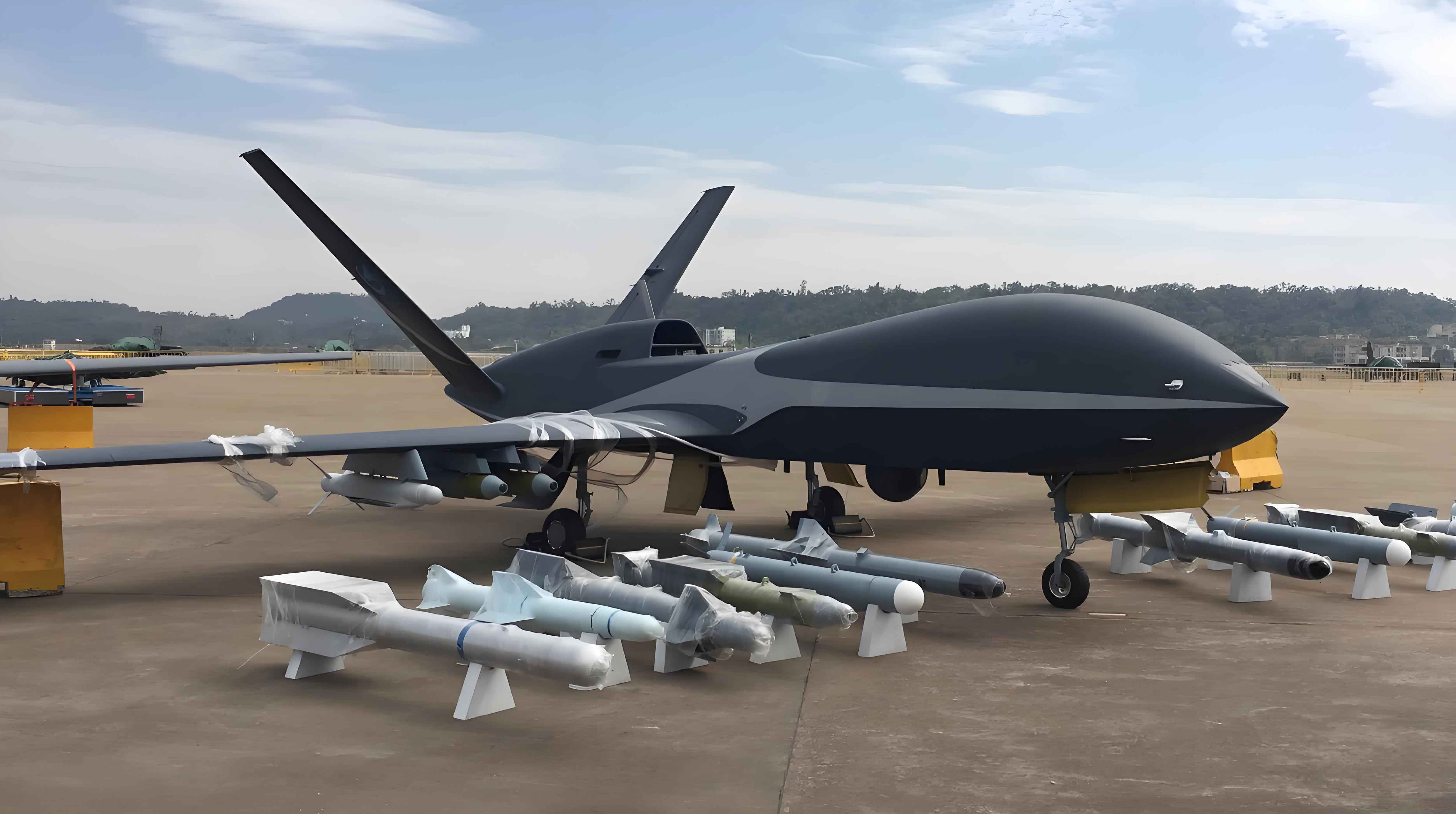
Analyzing current trends, military drone platforms are evolving toward extreme polarization. On one end, high-altitude long-endurance (HALE) UAVs dominate for wide-area surveillance. These large-scale military UAVs, such as those operating above 60,000 feet with 30+ hour endurance, enable persistent monitoring over vast territories, reducing intelligence blind spots. Conversely, micro-miniaturized military drones are proliferating due to their agility in urban or jungle environments. Weighing under 2 kg, these systems support special forces with covert operations in confined spaces. This polarization demands adaptive flight control algorithms that handle diverse dynamics—from stabilizing massive airframes against turbulence to enabling nimble maneuvers in cluttered terrains. The trend is quantified below:
| Platform Type | Key Characteristics | Flight Control Requirements |
|---|---|---|
| Large-Scale HALE Military UAVs | Altitude > 60,000 ft, Endurance > 30 hours, Payload > 500 kg | High-altitude stabilization, fuel-efficient trajectory optimization, long-range navigation |
| Micro-Mini Military Drones | Weight < 2 kg, Size < 0.5 m, Low radar signature | Collision avoidance in dense areas, rapid response to wind gusts, swarm coordination |
Moreover, mission diversification is accelerating across air, land, and sea domains. Military UAVs now engage in anti-submarine warfare, missile defense, and close air support, requiring specialized flight control modules. For example, in air-to-air combat, drones must autonomously track high-value targets using advanced guidance laws. This expansion stems from dual drivers: technological leaps in AI and shifting battlefield complexities. Control systems must thus evolve from basic pre-programmed routines to human-machine collaborative intelligence. Today, most military drone operations rely on remote piloting, but we are transitioning to semi-autonomous modes where AI handles routine tasks, freeing operators for strategic decisions. Full autonomy is the end goal, enabled by breakthroughs in computing power and adaptive algorithms. The OODA loop is central here, with cognitive systems now executing decisions in milliseconds using deep learning models. For instance, a military UAV’s control law for evasive maneuvers can be expressed as:
$$\dot{x} = Ax + Bu + d(t)$$
Here, \(x\) represents the state vector (e.g., position, velocity), \(A\) and \(B\) are system matrices, \(u\) is the control input, and \(d(t)\) denotes disturbances like wind shear. This formula allows real-time adaptation to dynamic threats.
To address these trends, flight control technologies for military drones focus on three core capabilities: high-performance computation and control, high-bandwidth interconnectivity, and high fault tolerance with environmental adaptability. Starting with high-performance computation, this enables complex real-time processing for autonomous functions. Key sub-technologies include autonomous flight path planning, where algorithms minimize human intervention by dynamically rerouting based on threats. For instance, an A* search algorithm optimizes paths under constraints like fuel limits and no-fly zones:
$$J = \min \int_{t_0}^{t_f} \left( w_1 \cdot \text{fuel}(t) + w_2 \cdot \text{risk}(t) \right) dt$$
Here, \(J\) is the cost function, weights \(w_1\) and \(w_2\) balance objectives, and the integral covers the mission duration. Similarly, digital copilot systems assist pilots via knowledge graphs, reducing workload in takeoff or landing phases. In air combat, decision-making integrates OODA loops for autonomous targeting, using reinforcement learning to maximize success probabilities. Another critical area is morphing control, allowing military UAVs to alter wing configurations mid-flight for optimal performance. For example, variable-sweep wings adjust to speed changes, modeled by:
$$\tau \dot{\theta} + \theta = K u$$
Where \(\theta\) is the wing angle, \(\tau\) is a time constant, \(K\) is gain, and \(u\) is the control signal. Hypersonic flight introduces unique challenges like aeroelastic instability due to mass shifts from fuel burn. Suppression techniques involve unsteady aerodynamics calculations:
$$M\ddot{q} + C\dot{q} + Kq = F_{\text{aero}}$$
With \(M\), \(C\), and \(K\) as mass, damping, and stiffness matrices, \(q\) as displacement, and \(F_{\text{aero}}\) as aerodynamic forces. These sub-technologies are summarized below:
| Sub-Technology | Description | Key Algorithms/Formulas |
|---|---|---|
| Autonomous Path Planning | Real-time route optimization for military drones | A*, Dijkstra’s, cost minimization as above |
| Digital Copilot Systems | AI-assisted control for complex maneuvers | Knowledge graph-based decision trees |
| Air Combat Decision-Making | Autonomous targeting in dogfights | Reinforcement learning policies |
| Morphing Control | Adaptive wing configuration changes | Differential equations as above |
| Hypersonic Aeroelastic Suppression | Stability control at Mach 5+ speeds | Dynamic modeling as above |
High-bandwidth interconnectivity is equally vital, ensuring seamless coordination in networked operations. For carrier-based military UAVs, autonomous landing guidance is critical, involving precision approaches amid deck movements. Technologies like automatic landing systems use Kalman filters for state estimation:
$$\hat{x}_{k|k} = \hat{x}_{k|k-1} + K_k (z_k – H \hat{x}_{k|k-1})$$
Where \(\hat{x}\) is the estimated state, \(K_k\) is the Kalman gain, \(z_k\) is measurement, and \(H\) is the observation matrix. Similarly, autonomous aerial refueling demands millimeter-level accuracy between tanker and receiver military drones, enabled by relative positioning algorithms. Manned-unmanned teaming (MUM-T) allows human operators to direct drone swarms in high-risk zones, leveraging offline path planning for initial deployment. Multi-drone task allocation optimizes resource use, with auction-based algorithms assigning roles dynamically. Cluster control, inspired by biological swarms, enables scalable formations for overwhelming defenses. For instance, flocking algorithms maintain cohesion:
$$\dot{p}_i = \sum_{j \in N_i} \phi (\| p_j – p_i \|) (p_j – p_i)$$
Here, \(p_i\) is the position of drone \(i\), \(N_i\) is its neighbors, and \(\phi\) is a potential function ensuring collision avoidance. These interconnectivity sub-technologies are cataloged here:
| Sub-Technology | Description | Interoperability Features |
|---|---|---|
| Carrier Landing Guidance | Autonomous deck operations for naval military UAVs | High-precision GPS and inertial sensors |
| Aerial Refueling Control | Automated fuel transfer in flight | Millimeter-wave radar for proximity detection |
| MUM-T Coordination | Human-directed drone teams | Secure datalinks for command relay |
| Multi-Drone Task Allocation | Dynamic mission reassignment in fleets | Distributed optimization protocols |
| Cluster Swarm Control | Massive autonomous formations | Local interaction rules as per formula above |
High fault tolerance and environmental adaptability ensure military UAV resilience in harsh conditions. Health management systems predict failures using machine learning, such as support vector machines (SVMs) for anomaly detection:
$$\min_{w,b} \frac{1}{2} \| w \|^2 + C \sum_{i=1}^n \xi_i$$
Subject to \(y_i (w \cdot x_i + b) \geq 1 – \xi_i\), where \(w\) is the weight vector, \(C\) is a penalty, and \(\xi_i\) are slack variables. Collision avoidance employs sensor fusion from radar and vision, with probabilistic models estimating threat levels. Fault-tolerant control compensates for system failures, using robust methods like H-infinity control to maintain stability:
$$\min_K \| T_{zw} \|_\infty$$
Where \(K\) is the controller and \(T_{zw}\) is the transfer function from disturbances to outputs. Environmental adaptations handle extreme weather or damage, with control reallocation redistributing actuator efforts. For example, if a control surface fails, the system recalculates inputs:
$$u_{\text{new}} = W u_{\text{nom}}$$
With \(W\) as a redistribution matrix. This capability set is outlined below:
| Sub-Technology | Description | Resilience Mechanisms |
|---|---|---|
| Health Management | Predictive maintenance for military drones | SVM-based fault diagnosis as above |
| Collision Avoidance | Real-time threat detection and evasion | Sensor fusion with Bayesian filters |
| Fault-Tolerant Control | System stability under failures | H-infinity methods as above |
| Environmental Adaptation | Performance in extreme conditions | Control reallocation formulas |
In conclusion, the future of military UAV flight control hinges on advancing these three pillars—computation, connectivity, and resilience. As a key stakeholder, I foresee AI-driven autonomy becoming pervasive, with OODA loops operating at near-instantaneous speeds. Innovations like quantum computing will accelerate path planning, while 5G/6G networks enhance swarm interoperability. For fault tolerance, digital twins will simulate failures pre-mission. Ultimately, military drones will dominate multi-domain operations, from hypersonic strikes to urban reconnaissance, ensuring superiority through adaptive, intelligent control systems. This evolution promises not only tactical advantages but also reduced costs and risks, solidifying military UAVs as indispensable assets in modern warfare.