
From our vantage point in law enforcement, the global surge of COVID-19 presented an unprecedented operational crucible. As nation after nation declared states of emergency, we were tasked with enforcing stringent public health mandates—restricting fundamental freedoms of movement and assembly to curb the viral tide. This sudden expansion of our duties, coupled with the omnipresent threat of infection, exposed critical vulnerabilities in traditional policing models. Our mission became a dual one: protect public health while protecting ourselves. In this high-stakes environment, a new tool rapidly evolved from a tactical novelty to an operational cornerstone: the police drone.
Our initial challenges were multifaceted and acute. We can formalize the core “pains” of traditional执法 (zhí fǎ, law enforcement) during the pandemic as follows. Let R represent the infection risk to an officer, T the response time to an incident, C the operational cost, and A the effective area of surveillance or intervention. Our pre-drone operational reality was defined by undesirable maxima and minima:
$$ \text{Maximize: } R, T, C \quad \text{Minimize: } A $$
| Operational Pain Point | Traditional Method Limitation | Consequence During Pandemic |
|---|---|---|
| Slow Mobility (T↑) | Foot and vehicle patrols. | Inability to intercept fleeting violations (e.g., unmasked gatherings) before dispersal. |
| Narrow Surveillance Range (A↓) | Fixed CCTV with blind spots; costly helicopters. | Incomplete situational awareness, especially for large-scale compliance monitoring. |
| High Environmental Vulnerability | Officers limited by terrain and weather. | Impeded emergency deliveries and patrols in hazardous conditions. |
| High Infection Risk (R↑) | Mandatory close-contact interactions. | Depletion of vital personnel due to illness and quarantine, crippling force strength. |
Enter the police drone or Unmanned Aerial Vehicle (UAV). For us, it ceased to be mere hardware and became a force multiplier, a “new recruit” with unique capabilities. Its value proposition can be modeled by inverting our previous equation. A drone’s performance parameters directly counter our pains. Let v be its velocity, d its endurance, r its operational radius, and k a risk mitigation factor (where 0 ≤ k ≤ 1, with 1 being full exposure and 0 being no exposure).
$$ \text{Drone Contribution: } T \propto \frac{1}{v}, \quad A \propto r^2, \quad R \propto k \approx 0, \quad C_{\text{marginal}} \ll C_{\text{traditional}} $$
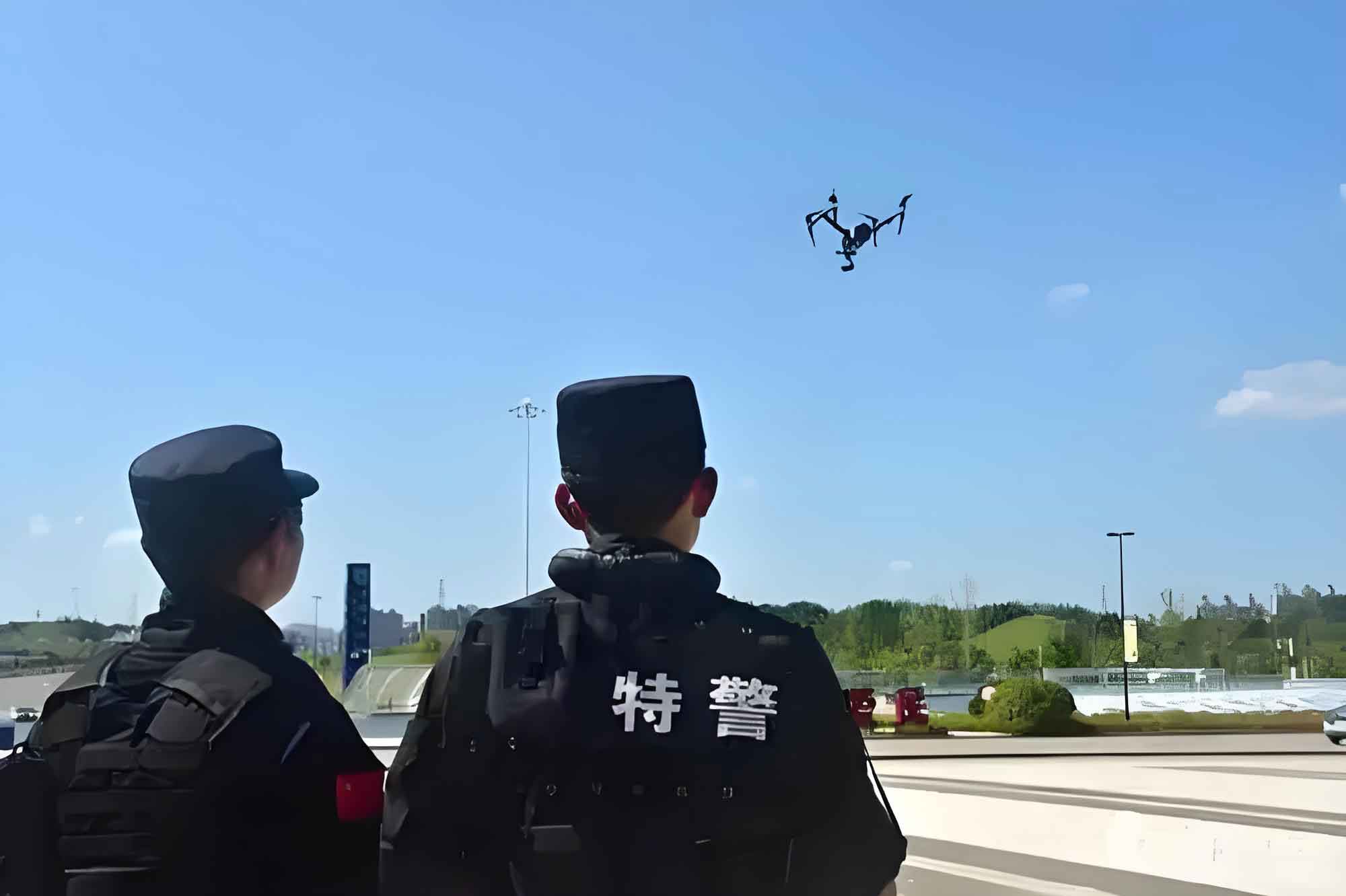
In practical terms, the modern police drone is a modular platform. Controlled via tablet or ground station, it integrates high-definition (HD) and thermal cameras, loudspeakers, and payload release mechanisms. Its capabilities translate into direct solutions:
| Drone Capability | Technical Specification (Typical) | Addresses Which Pain Point |
|---|---|---|
| Rapid Deployment & Agility | Speed: ~60 km/h, Endurance: 25-30 min, Payload: ~5-20 kg. Deployment time: < 2 min. | Dramatically reduces T, enabling immediate response. |
| Omnidimensional Surveillance | 360° gimbal camera, optical zoom, real-time HD transmission to command center. | Expands A exponentially, providing aerial俯瞰 (fǔ kàn, bird’s-eye view) and digital evidence. |
| Environmental Resilience | IP-rated water/dust resistance, wind tolerance > 10 m/s, obstacle avoidance sensors. | Operates in conditions hazardous or inaccessible to officers. |
| Non-Contact执法 (zhí fǎ) | Remote piloting, sustained aerial hover, loudspeaker communication, remote sensing. | Drives R towards zero (k → 0), preserving officer health and force capacity. |
This last point is paramount. The non-contact nature of police drone operations created a paradigm shift. We were no longer forced to choose between effective enforcement and officer safety. The drone became our physical proxy in the contagion zone.
Wartime ‘Anti-Epidemic’ Operations: A Global Campaign
Our experience, mirrored by agencies worldwide, saw the police drone deployed across four critical mission profiles during the emergency state.
1. Patrol, Dissuasion, & Scientific Law Enforcement
Inspired by early applications in East Asia, we quickly adopted drones for mass communication and presence. The pattern was consistent: a police drone, equipped with a loudspeaker, would fly pre-programmed routes over parks, boulevards, and residential areas. Its message was clear: “Stay home. Maintain distance. Wear a mask.” This was not merely a broadcast; it was a scalable, non-contact form of verbal warning and劝诫 (quàn jiè, admonishment). The effectiveness can be partly expressed by comparing coverage. One officer on foot patrol might cover an area A_foot in an hour. A single police drone could cover an area A_drone, where:
$$ A_{\text{drone}} = v \times d \times w \approx 60\text{km/h} \times 0.5\text{h} \times 0.1\text{km} = 3 \text{ km}^2 $$
$$ A_{\text{foot}} \approx 5\text{km/h} \times 1\text{h} \times 0.02\text{km} = 0.1 \text{ km}^2 $$
$$ \text{Coverage Ratio} = \frac{A_{\text{drone}}}{A_{\text{foot}}} \approx 30 $$
This 30x potential coverage multiplier explains its rapid adoption from Europe to Southeast Asia. Police services from Italy to Spain to France to Malaysia reported deploying police drone fleets over iconic locations—from the Seine quays to the Caspian coastline—to disperse crowds and reinforce lockdown orders audibly and visually.
2. Evidence Gathering & Targeted Law Enforcement
When dissuasion failed, the police drone transformed into a flying, mobile evidence unit. This was particularly vital for enforcing specific ordinances against large gatherings in open areas like beaches or scenic overlooks. The operational sequence showcased规范 (guī fàn, standardized)执法 (zhí fǎ):
- Covert Approach & Documentation: Using long-range zoom, the police drone would document violations (e.g., groups sunbathing on a closed beach) from a safe, unnoticed distance, gathering comprehensive video evidence.
- Legal Announcement: The drone would then approach and, via loudspeaker, formally announce police presence, state the violation, and issue a lawful order to disperse. This act fulfills the procedural duty of notification.
- Evidence Lock & Scene Management: The drone continues recording, providing real-time situational awareness to ground units moving in for apprehensions, while creating an immutable record for prosecution.
This method was employed effectively in parts of North America and the British Isles. The police drone provided not just efficiency but also a layer of procedural rigor and officer safety during potentially volatile confrontations.
3. Emergency Delivery & Crisis Response
Beyond enforcement, the police drone demonstrated its utility in vital support roles. The equation for delivery efficiency is stark. For a critical payload (medicines, test kits) over a distance L with terrain difficulty δ:
$$ \text{Ground Transport Time: } T_g = \frac{L}{v_g} \times \delta \quad (\delta \ge 1) $$
$$ \text{Drone Transport Time: } T_d = \frac{L}{v_d} \quad (\text{straight-line path}) $$
$$ \text{Speed Multiplier: } S_m = \frac{T_g}{T_d} = \frac{v_d \times \delta}{v_g} $$
With v_d often exceeding v_g in urban or complex settings and δ being significant, S_m can reach 80x, as observed in early trials in South Asia. Agencies in Europe and Asia pioneered using police drone networks for contactless transport of medical supplies, vaccines, and blood samples between facilities, minimizing delays and exposure risks for human couriers.
4. Disinfection Spraying & Proactive Prevention
Perhaps one of the most visually striking adaptations was the transformation of the police drone into a large-scale sanitization tool. By integrating tanks and spraying systems, these UAVs could disinfect public spaces. The effectiveness metric here is area per unit time. A single disinfection police drone with a tank capacity Q (liters) and spray swath W (meters) flying at speed v_s has an approximate coverage rate:
$$ \text{Coverage Rate} = v_s \times W $$
Compared to a team of n personnel with backpack sprayers covering rate r_p each, the drone’s advantage is clear:
$$ \text{Team Coverage} = n \times r_p $$
Reports from East Asia and the Middle East indicated v_s \times W could equate to the work of 100 personnel (n = 100), achieving millions of square meters of disinfection daily. Police units from the UK to the UAE collaborated with technical providers to deploy these systems for sanitizing markets, transport hubs, and public squares, acting as a powerful deterrent to viral fomite transmission.
Synthesis and Quantified Impact
The global experiment in police drone deployment during the pandemic allows us to synthesize its impact. We can create a composite scoring model for a mission’s suitability for drone intervention. Let each factor (Response, Safety, Coverage, Cost) be scored from 1 (Low Suitability) to 5 (High Suitability).
| Mission Type | Response Need (T↓) | Safety Priority (R↓) | Coverage Need (A↑) | Cost Efficiency (C↓) | Drone Suitability Score (Σ) |
|---|---|---|---|---|---|
| Lockdown Patrol & Announcement | 4 | 5 | 5 | 5 | 19 |
| Crowd Gathering Evidence & Dissolution | 5 | 5 | 4 | 4 | 18 |
| Emergency Medical Supply Delivery | 5 | 5 | 3* | 4 | 17 |
| Large-Area Disinfection | 3 | 5 | 5 | 5 | 18 |
| Traditional Traffic Stop | 2 | 2 | 1 | 2 | 7 |
*Coverage here refers to the need for broad area access, not surveillance.
The table unequivocally shows the high suitability of police drone operations for public health crisis management. Its core value equation combines performance and protection:
$$ \text{Drone Value} = \int_{0}^{t} \left[ \alpha \cdot P(t) + \beta \cdot S(t) \right] dt $$
Where P(t) is the operational performance metric (tasks completed, area covered), S(t) is the safety metric (officers kept from harm), and α and β are weighting coefficients that, during a pandemic, shift dramatically to emphasize β.
Looking Forward: The Integrated ‘Police Drone’ Ecosystem
The pandemic was a brutal but effective proving ground. It forced us to integrate the police drone not as a standalone gadget, but as a node in a broader technology ecosystem. The future lies in integrating real-time police drone data with AI analytics for predictive policing of hotspots, using 5G for flawless high-bandwidth video transmission, and developing more advanced payloads for a wider range of civil services.
However, this future requires navigating airspace regulations, public privacy concerns, and developing robust operational protocols. The police drone is a tool, and its benefit—科技向善 (kē jì xiàng shàn, technology for good)—is determined by the wisdom of its human operators and the legal frameworks that guide its use. The lesson is clear: in the face of sprawling, non-traditional threats, the agility, perspective, and protective buffer offered by the police drone are no longer just advantageous—they are essential components of resilient, modern law enforcement. We have moved from seeing it as a mere “eye in the sky” to recognizing it as a versatile partner, transforming operational vulnerabilities into actionable intelligence and safe, effective public service.