
From my vantage point within the defense technology sector, the global race for 5G dominance is not merely a commercial competition; it is a strategic imperative that fundamentally reshapes national security paradigms. The 2018 report by a prominent U.S. think tank, framing 5G as a technology that will reshape the innovation and security environment, resonates deeply with my own observations. Nations are treating 5G deployment as a top-tier national priority, and its implications for advanced military systems, particularly military drones, are profound and immediate. I’ve witnessed early-stage collaborations, like those between major tech corporations and defense departments to test high-bandwidth 5G networks using millimeter-wave spectrum, which clearly signal the direction of travel. The exploration of stratospheric military drones acting as airborne 5G base stations is not science fiction—it’s a tangible project laying the groundwork for a new era of connectivity. The fusion of 5G and unmanned systems represents a pivotal leap, promising to redefine aerial warfare, intelligence gathering, and network-centric operations in ways we are only beginning to comprehend.
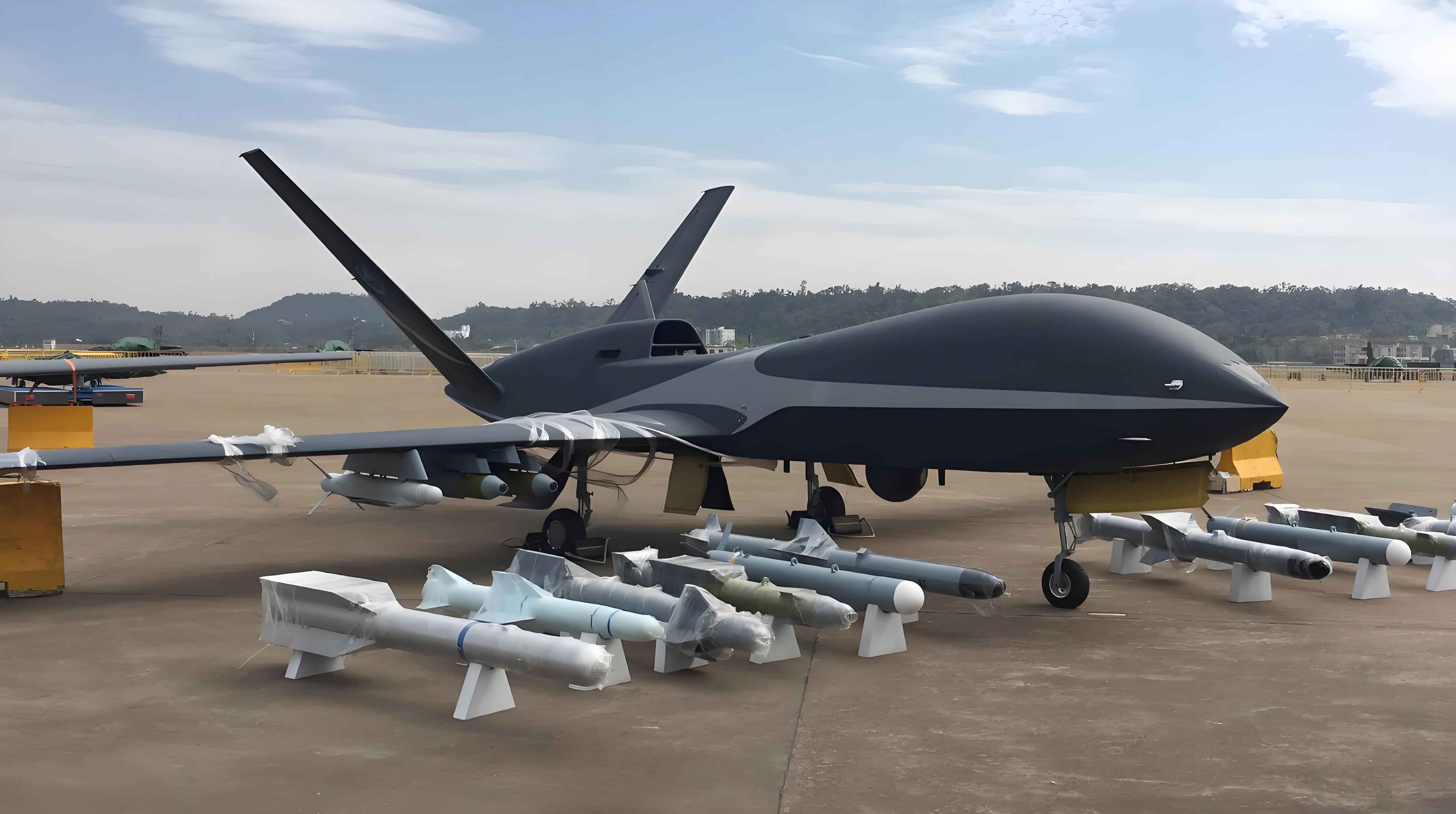
In my analysis, the inherent limitations of current communication infrastructure are becoming a critical bottleneck for next-generation military drones. These platforms have evolved far beyond simple reconnaissance tools. Today’s military drones are expected to perform complex, synchronized missions involving persistent surveillance, real-time targeting, electronic warfare, and collaborative swarm tactics. Each of these roles generates staggering amounts of data, especially high-definition video feeds that must be transmitted, processed, and acted upon instantaneously. While 4G/LTE networks can support some basic functions, they struggle with the triad of requirements essential for advanced drone operations: ultra-high reliability, ultra-low latency, and massive data throughput. Issues like downlink interference and handover instability in three-dimensional airspace are significant hurdles. This is where 5G enters the frame not as an incremental upgrade, but as a transformative enabler. The leap in performance metrics is not linear; it is exponential, creating a new design space for military drone capabilities.
| Performance Metric | 4G-LTE (Practical/Peak) | 5G (Target/Peak) |
|---|---|---|
| Peak Data Rate (Downlink) | 1 Gbps / 1 Gbps | 100 Mbps / 20 Gbps |
| Peak Data Rate (Uplink) | 25 Mbps / 500 Mbps | 50 Mbps / 10 Gbps |
| User-Plane Latency | ~10 ms | < 1 ms |
| Control-Plane Latency | ~50-100 ms | ~10-50 ms |
| Connection Density | ~100,000 devices/sq. km | > 1,000,000 devices/sq. km |
| Mobility Support | Up to 350 km/h | Up to 500 km/h |
| Spectral Efficiency (Downlink) | ~15 bps/Hz | ~30 bps/Hz |
| Operating Frequency Bands | Sub-6 GHz (e.g., 700 MHz – 2.1 GHz) | Sub-6 GHz & mmWave (e.g., 28 GHz, 39 GHz) |
The core of 5G’s advantage for military drones lies in its foundational technologies. Firstly, the use of millimeter-wave (mmWave) spectrum (e.g., 28-40 GHz) provides enormous bandwidth, which is the direct path to multi-gigabit data rates. This allows a military drone to stream multiple 4K or even 8K video feeds simultaneously without compression artifacts that could obscure critical details. Secondly, and perhaps most crucially for aerial nodes, is Massive MIMO (Multiple-Input, Multiple-Output). Traditional base stations beam signals primarily in the horizontal plane. A military drone, however, operates in a dynamic three-dimensional space. Massive MIMO, with its hundreds of antenna elements, enables 3D beamforming. This means the network can create precise, focused “pencil beams” that track and serve a fast-moving military drone in three dimensions, dramatically improving signal strength, reducing interference, and increasing network capacity. The channel capacity gain can be conceptualized by the fundamental limit expressed by the Shannon-Hartley theorem:
$$ C = B \log_2(1 + \text{SNR}) $$
Where \(C\) is the channel capacity, \(B\) is the bandwidth, and SNR is the signal-to-noise ratio. 5G’s mmWave provides a massive increase in \(B\), while Massive MIMO’s beamforming significantly improves the effective SNR by directing energy toward the intended military drone user, thereby multiplicatively boosting \(C\).
Furthermore, 5G introduces the concept of network slicing, which I believe is a game-changer for diverse military drone missions. A single physical 5G network can be partitioned into multiple virtual, independent logical networks. Each slice is tailored with specific characteristics—bandwidth, latency, security, reliability—to match a particular mission profile. Consider the divergent needs: a long-endurance Intelligence, Surveillance, and Reconnaissance (ISR) military drone requires a slice guaranteeing high, steady throughput for video. An autonomous strike military drone requires an Ultra-Reliable Low-Latency Communications (URLLC) slice with sub-1ms latency for real-time control and sensor fusion. A swarm of small military drones requires a massive Machine-Type Communications (mMTC) slice supporting thousands of simultaneous, low-power connections. Network slicing allows all these to coexist on the same infrastructure, optimizing resource allocation. The resource allocation for a slice \(i\) can be modeled as an optimization problem, often aiming to maximize total utility:
$$ \max \sum_{i} U_i(R_i, L_i) $$
$$ \text{subject to: } \sum_{i} R_i \leq R_{\text{total}}, \quad L_i \leq L_i^{\text{max}}, \quad \forall i $$
Where \(U_i\) is the utility function for slice \(i\) (e.g., for a URLLC slice, latency \(L_i\) is supremely important), \(R_i\) is the allocated data rate, and the constraints ensure the sum of all slice resources does not exceed the physical network’s total capacity \(R_{\text{total}}\), and each slice meets its maximum latency requirement \(L_i^{\text{max}}\).
| Military Drone Application | Key Performance Requirement | Recommended 5G Slice Type | Typical Parameter Needs |
|---|---|---|---|
| Persistent HD/4K ISR | Extremely High Throughput | Enhanced Mobile Broadband (eMBB) | Data Rate: >100 Mbps, Latency: 50-100 ms |
| Autonomous Navigation & Obstacle Avoidance | Ultra-Low Latency, High Reliability | Ultra-Reliable Low-Latency Comm. (URLLC) | Latency: < 10 ms, Reliability: 99.999% |
| Coordinated Swarm Attack | Ultra-Low Latency, Massive Connectivity | URLLC / massive MTC (mMTC) Hybrid | Latency: ~1 ms, Density: >100 drones/km² |
| Battlefield Communication Relay | Wide Coverage, Stable Connection | Custom “Coverage” Slice | Data Rate: Variable, Priority: High |
| Electronic Warfare / Jamming | Precise Timing, Rapid Adaptation | Secure URLLC Slice | Latency: < 5 ms, Security: Highest Level |
From a security standpoint, which is paramount for any military drone system, 5G offers both challenges and enhanced solutions. The historical vulnerability of drone communication links to interception and hijacking is a well-known tactical risk. Strong encryption has always been a necessity, but it traditionally added processing overhead and latency. The immense raw speed of 5G changes this calculus. It allows for the implementation of more robust, higher-grade encryption protocols—such as stronger variants of AES (Advanced Encryption Standard) or post-quantum cryptography algorithms—without perceptibly impacting the mission-critical data flow. The higher bandwidth effectively “absorbs” the encryption overhead. This means a military drone can maintain secure, classified communication links while simultaneously streaming sensor data, a significant advancement in maintaining information superiority and operational security.
The most transformative impact I foresee is the acceleration of autonomy and intelligent swarm behavior in military drones. The sub-1ms latency of 5G’s URLLC service is the missing link for large-scale, tightly coordinated drone swarms. Current demonstrations often involve pre-programmed choreography or rely on local, short-range mesh networks with limited scalability. 5G enables a centralized or hybrid control paradigm where a command node can send real-time updates to hundreds of military drones in a swarm almost instantaneously, allowing for dynamic re-tasking, adaptive formation flying, and collective decision-making based on a shared, real-time operational picture. This is further supercharged by the convergence of 5G and edge computing. Instead of sending all sensor data back to a distant cloud for analysis, lightweight AI processors on the military drone or at nearby tactical edge servers can perform real-time object detection, classification, and tracking. The 5G network then serves as the high-speed nervous system to disseminate these insights across the swarm. The decision latency \(L_{\text{decision}}\) for a drone in a swarm can be modeled as:
$$ L_{\text{decision}} = L_{\text{sensing}} + L_{\text{processing}} + L_{\text{communication}} + L_{\text{actuation}} $$
With 5G drastically reducing \(L_{\text{communication}}\) to near-negligible levels and edge computing minimizing \(L_{\text{processing}}\), the overall loop becomes fast enough for complex, emergent swarm behaviors, making a large-scale military drone swarm a formidable, intelligent aerial entity.
Interestingly, the relationship is symbiotic. While 5G empowers military drones, the drones themselves can “give back” by acting as agile, on-demand nodes for the 5G network. The concept of drone-mounted airborne base stations (Airborne Communication Nodes – ACNs) is particularly compelling for military operations. In a denied, degraded, or operationally limited environment—such as a forward operating base, a disaster zone, or a maritime theater—rapidly deploying a constellation of military drones equipped with 5G small cells can create an instant, high-capacity communications bubble. This provides troops with secure, local 5G connectivity for command and control, situational awareness apps, and sensor data sharing, without relying on vulnerable fixed infrastructure or overtaxing satellite links. The coverage area \(A_{\text{cov}}\) of a single drone-BS at an altitude \(h\) can be approximated (for a simplified model ignoring complex terrain) as:
$$ A_{\text{cov}} \approx \pi \cdot (h \cdot \tan(\theta))^2 $$
Where \(\theta\) is the antenna’s half-power beamwidth or the effective coverage angle. A fleet of such military drones can dynamically reposition to optimize coverage, fill gaps, and follow moving units, offering unprecedented flexibility in network deployment.
However, from my practical experience, significant challenges must be overcome for this 5G-military drone vision to mature. The high-frequency mmWave signals, essential for peak speed, have limited range and are susceptible to atmospheric attenuation and blockage by obstacles like foliage or buildings. This necessitates a very dense network of ground cells, which is impractical in remote combat zones. While drone-BSs can help, their limited endurance creates a persistence problem. Furthermore, the network management complexity skyrockets. Planning a 3D cellular network with moving aerial base stations and highly mobile user equipment (military drones and soldiers) is an enormous optimization challenge involving dynamic spectrum allocation, handover management, and interference coordination in three dimensions. The robustness of the entire system against sophisticated electronic attack also requires continuous research and hardening.
Looking ahead, I am convinced the integration path is clear. We are moving beyond connecting military drones in isolation. The ultimate goal is a pervasive, resilient “Internet of Battlefield Things” (IoBT), where 5G forms the connective tissue linking not just military drones, but also ground vehicles, soldiers’ exosuits, sensors, and command centers into a single, aware, and intelligent organism. Artificial intelligence will be the brain of this network, with 5G serving as its central nervous system. In this future, a military drone swarm will not just execute a pre-planned mission; it will continuously sense the battlespace, share intelligence with autonomous ground units, receive dynamic targeting updates from satellite networks, and adapt its strategy in real-time, all facilitated by the near-instantaneous, high-fidelity data exchange that 5G promises. The convergence of 5G, AI, and unmanned systems is not just an upgrade—it is the foundation for a new era of networked, intelligent, and autonomous warfare, redefining the very essence of air power and tactical advantage. The development journey is arduous, but the strategic imperative is undeniable.