
As I reflect on the evolution of modern warfare, I am struck by the profound impact of military drones. From their early use in conflicts like the Gulf War and Kosovo, where military drones excelled in reconnaissance, surveillance, target定位, and deception, to their anticipated dominance in future air combat, the trajectory of military drone development is clear. I predict that by 2040, the majority of combat aircraft will be unmanned, with military drones advancing in stealth, endurance, miniaturization, and attack capabilities. This article, from my perspective as a defense analyst, explores these facets in detail, using formulas and tables to summarize key insights.
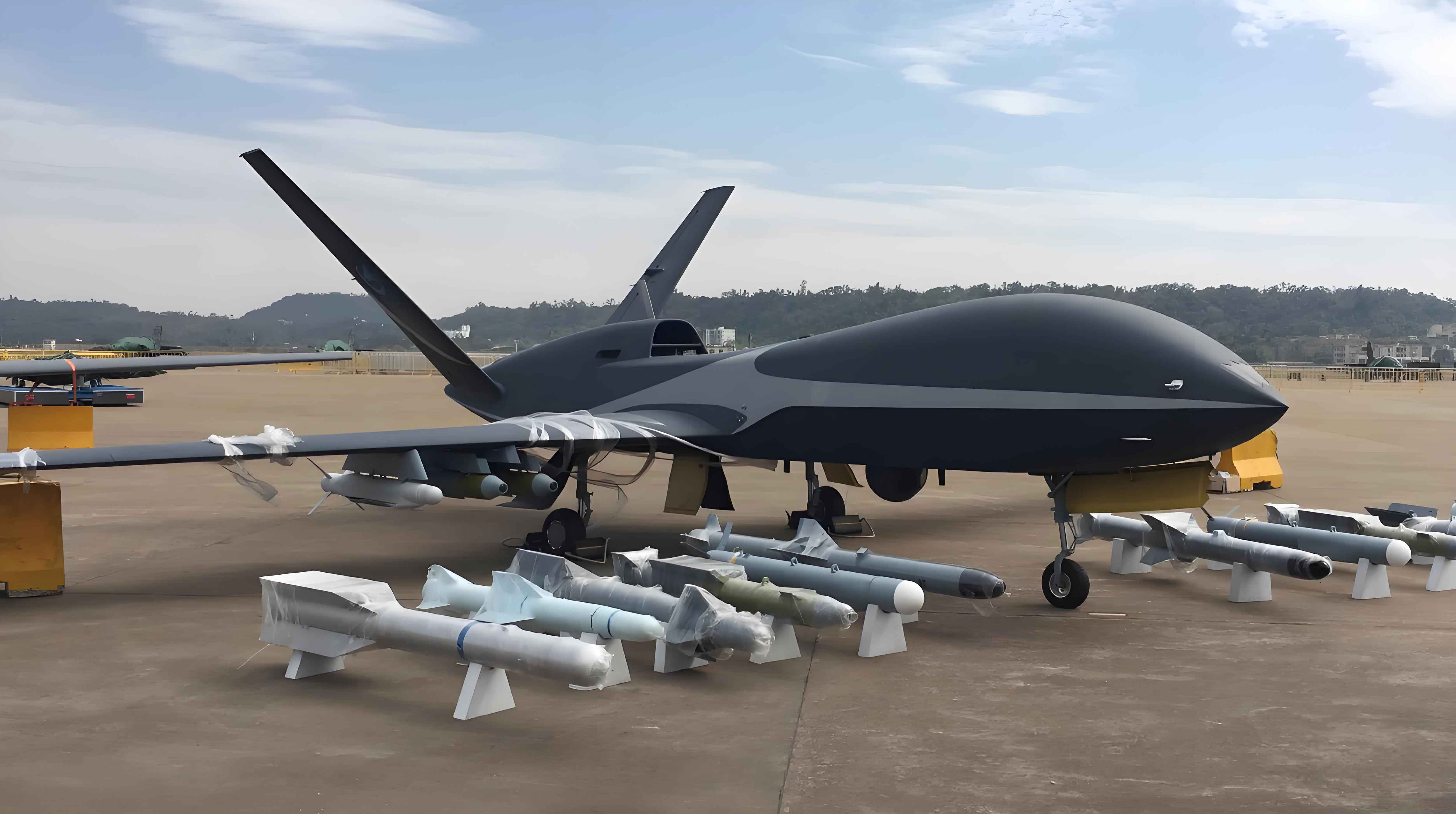
The隐身性能 of military drones has become a critical focus, especially as warfare shifts toward asymmetric and non-contact engagements. In my analysis, the radar cross-section (RCS) is central to stealth, defined by the radar equation: $$P_r = \frac{P_t G_t G_r \lambda^2 \sigma}{(4\pi)^3 R^4}$$ where \(P_r\) is received power, \(P_t\) transmitted power, \(G_t\) and \(G_r\) antenna gains, \(\lambda\) wavelength, \(R\) range, and \(\sigma\) the RCS. Minimizing \(\sigma\) through shaping and materials is essential for military drones to evade detection. For instance, reducing RCS by 10 dB can decrease detection range by approximately 44%, as derived from $$R \propto \sqrt[4]{\sigma}$$. This underscores why nations prioritize stealth in military drone design.
| Technology | Principle | Impact on RCS Reduction | Application in Military Drones |
|---|---|---|---|
| Shape Optimization | Angled surfaces to deflect radar waves | Can reduce \(\sigma\) by 20-30 dB | Used in next-generation military drones for low observability |
| Radar-Absorbent Materials (RAM) | Absorbs electromagnetic energy | Reduces \(\sigma\) by 5-15 dB depending on frequency | Applied as coatings on military drone fuselages |
| Plasma Stealth | Ionized gas layer to scatter radar signals | Experimental; potential for >10 dB reduction | Under research for high-altitude military drones |
| Active Cancellation | Emits counter-signals to nullify radar returns | Theoretically can achieve near-zero \(\sigma\) | Considered for future military drone systems |
From my observations, the effectiveness of stealth in military drones can be quantified using the probability of detection \(P_d\), given by $$P_d = 1 – e^{-\frac{R^4}{R_0^4}}$$ where \(R_0\) is the characteristic range based on RCS. As military drones incorporate these technologies, their survivability in contested airspace improves significantly.
Long endurance is another cornerstone of military drone capabilities. I define long-endurance military drones as those with flight times exceeding 24 hours, crucial for persistent surveillance. The endurance time \(T\) can be expressed as $$T = \frac{E_{total}}{P_{avg}}$$ where \(E_{total}\) is the total energy available (e.g., from fuel or batteries) and \(P_{avg}\) is the average power consumption. For solar-powered military drones, energy harvesting adds complexity: $$E_{total} = \int_{0}^{T_{day}} P_{solar}(t) dt + E_{storage}$$ with \(P_{solar}(t)\) as solar power and \(E_{storage}\) as stored energy. This allows military drones like high-altitude platforms to achieve endurance over months.
| Drone Category | Typical Endurance Range | Altitude Operational Zone | Primary Missions | Energy Source |
|---|---|---|---|---|
| Tactical Military Drones | 6-24 hours | 0-5,000 meters | Battlefield reconnaissance, target acquisition | Internal combustion, batteries |
| Strategic Military Drones (MALE) | 24-48 hours | 5,000-15,000 meters | Persistent surveillance, communications relay | Jet fuel, hybrid systems |
| High-Altitude Long-Endurance (HALE) Military Drones | >48 hours to months | >15,000 meters | Strategic monitoring, early warning | Solar power, hydrogen fuel cells |
| Ultra-Long-Endurance Military Drones | Up to 1 year (experimental) | 20,000-30,000 meters | Continuous Earth observation, climate monitoring | Solar with advanced storage |
In my view, the demand for long-endurance military drones stems from information needs in modern warfare. The required coverage area \(A\) for surveillance relates to endurance via $$A = v \cdot T \cdot w$$ where \(v\) is velocity, \(T\) endurance, and \(w\) sensor swath width. For example, a military drone flying at 200 km/h for 30 hours with a 10 km swath can cover 60,000 km², highlighting why endurance is pivotal.
Miniaturization of military drones opens new avenues for特种作战 and urban warfare. I classify micro military drones as those with基准尺寸 under 15 cm, leveraging advances in纳米技术 and micro-sensors. The scaling laws affect performance: for instance, thrust \(F\) for propellers scales as $$F \propto D^2 \cdot n^2$$ where \(D\) is diameter and \(n\) rotational speed, while weight \(W \propto L^3\) for geometric similarity. This creates challenges in power density, but micro military drones benefit from low detectability, with RCS scaling roughly as $$\sigma \propto L^2$$ for small sizes.
| Type | Dimensions (cm) | Weight (grams) | Endurance (minutes) | Payload | Key Technologies |
|---|---|---|---|---|---|
| Fixed-Wing Micro Military Drone | 15 x 10 | 100-200 | 30-60 | Micro-camera, GPS | Lightweight composites, efficient aerodynamics |
| Rotary-Wing Micro Military Drone | 10 x 10 (rotor span) | 50-150 | 20-40 | Infrared sensor, comms relay | Brushless motors, stabilization algorithms |
| Folding-Wing Micro Military Drone | 12 x 8 (folded) | 80-120 | 25-50 | Miniature explosives, sensors | Morphing structures, nano-batteries |
| Flapping-Wing Micro Military Drone | 5 x 5 | < 50 | 10-20 | Acoustic sensor, chemical detector | Bio-inspired design, piezoelectric actuators |
I believe that micro military drones will revolutionize covert operations. Their stealth is enhanced by acoustic signature reduction, modeled as $$SL = 10 \log_{10}(P_{acoustic}) – 20 \log_{10}(r)$$ where \(SL\) is sound level and \(r\) distance. With miniaturization, military drones can penetrate denied areas, providing real-time intelligence.
Attack capabilities transform military drones into unmanned combat systems. I distinguish between suicidal attack military drones and reusable unmanned combat aerial vehicles (UCAVs). The lethality \(L\) of a military drone can be approximated by $$L = \sum_{i=1}^{n} p_i \cdot d_i$$ where \(p_i\) is probability of kill for weapon \(i\) and \(d_i\) deployment rate. For UCAVs, mission effectiveness \(E\) integrates autonomy: $$E = \int_{0}^{T} A(t) \cdot C(t) dt$$ with \(A(t)\) autonomy level and \(C(t)\) combat performance. Compared to manned aircraft, military drones offer advantages like reduced risk and lower life-cycle cost, calculated as $$C_{total} = C_{acquisition} + C_{operation} + C_{loss}$$ where \(C_{loss}\) is near-zero for military drones due to no crew.
| Feature | Suicidal Attack Military Drones | Unmanned Combat Aerial Vehicles (UCAVs) | Manned Combat Aircraft |
|---|---|---|---|
| Primary Role | One-way missions: SEAD, anti-radiation | Multi-role: air-to-ground, air-to-air, reconnaissance | Multi-role with pilot决策 |
| Endurance | Typically 2-6 hours | 12-48 hours | 6-12 hours (pilot-limited) |
| Stealth Characteristics | Small size, low RCS, but limited by payload | Advanced stealth shaping and materials | Stealth designs, but compromised by cockpit |
| Cost per Mission | Low (often disposable) | Medium to high (reusable) | High (including pilot training and safety) |
| Autonomy Level | Pre-programmed or remote-controlled | Semi-autonomous with human-in-the-loop | Fully human-controlled |
| Payload Capacity | 10-50 kg warhead | 500-2000 kg varied weapons | 1000-8000 kg weapons and fuel |
| Survivability in High-Threat Environments | Low (single use) | High (evasive maneuvers, stealth) | Medium (dependent on pilot skill and aircraft capabilities) |
From my analysis, the future of military drones in attack roles hinges on AI integration. The autonomous决策 process can be modeled as a Markov decision process with value function $$V(s) = \max_{a} \left( R(s,a) + \gamma \sum_{s’} P(s’|s,a) V(s’) \right)$$ where \(s\) state, \(a\) action, \(R\) reward, \(\gamma\) discount factor, and \(P\) transition probability. This enables military drones to adapt dynamically in combat.
Looking ahead, I foresee military drones becoming the backbone of 21st-century air forces. The convergence of technologies can be summarized with a capability index \(CI\) for military drones: $$CI = \alpha \cdot S + \beta \cdot E + \gamma \cdot M + \delta \cdot A$$ where \(S\) stealth score, \(E\) endurance factor, \(M\) miniaturization metric, \(A\) attack potency, and \(\alpha, \beta, \gamma, \delta\) weighting coefficients. As these coefficients shift toward autonomy and networking, military drones will operate in swarms, with swarm effectiveness scaling as $$E_{swarm} = N \cdot e^{-c \cdot d}$$ for \(N\) drones, \(c\) coordination factor, and \(d\) density.
In conclusion, my perspective is that military drones are not just tools but transformative agents in warfare. From stealth to endurance, miniaturization to attack, each advancement reinforces the centrality of military drones. As I project into the future, the synergy of these features will ensure that military drones dominate aerial battlespaces, reshaping strategies and doctrines worldwide. The journey of military drones, from simple reconnaissance platforms to intelligent combat systems, exemplifies the relentless march of military innovation.