
As I delve into the complexities of modern wireless communication and mobile internet security, I am struck by the rapid evolution of technologies that both empower and endanger our digital lives. The proliferation of smartphones and mobile applications has undeniably enhanced connectivity, but it has also opened Pandora’s box of security vulnerabilities, where personal data leakage and malicious attacks pose significant threats. In this context, the emergence of 5G communication technology presents a transformative opportunity, particularly in the realm of military applications. The integration of 5G with military drones is not merely an incremental improvement but a paradigm shift that redefines security, efficiency, and operational capabilities in defense sectors. In this article, I will explore how 5G networks enhance the functionality and security of military drones, while addressing the broader challenges of mobile internet security that underpin these advancements. My analysis will draw on technical insights, employing tables and formulas to summarize key concepts, and I will consistently emphasize the role of military drones as a focal point in this technological convergence.
To begin, I must outline the foundational aspects of 5G network capabilities, as they form the bedrock for advanced military drone operations. Compared to its predecessor, 4G LTE, 5G technology offers a quantum leap in performance metrics, which I can summarize through the following formula for data rate in wireless communication: $$ R = B \log_2\left(1 + \frac{S}{N}\right) $$ where \( R \) is the data rate, \( B \) is the bandwidth, and \( \frac{S}{N} \) is the signal-to-noise ratio. The substantial increase in bandwidth for 5G, often operating in the 28-40 GHz range, directly boosts \( R \), enabling faster data transmission critical for real-time military drone applications. Additionally, latency reduction is paramount; 5G achieves user-plane latency as low as 1 ms, compared to 10 ms in 4G, which I can express as $$ L_{5G} = 0.1 \times L_{4G} $$ where \( L \) represents latency. This low latency is essential for responsive control and coordination of military drones in dynamic environments. To encapsulate these enhancements, I present a comparative table below:
| Parameter | 4G LTE | 5G |
|---|---|---|
| Peak Data Rate (Downlink) | 42 MB/s | 20 Gb/s (theoretical) |
| Peak Data Rate (Uplink) | 25 MB/s | 50 MB/s (early deployment) |
| User-Plane Latency | 10 ms | 1 ms |
| Control-Plane Latency | 100 ms | 50 ms |
| Frequency Band | 700-2100 MHz | 28-40 GHz (mmWave) |
| Mobility Support | Up to 350 km/h | Up to 500 km/h |
| Connection Density | ~10,000 devices/km² | ~1,000,000 devices/km² |
This table highlights the stark improvements that 5G brings, which are instrumental for military drone operations. For instance, the high data rate allows for seamless transmission of high-resolution video feeds from military drones during reconnaissance missions, while the low latency ensures immediate response for tasks like target tracking or collision avoidance. As I reflect on these capabilities, I realize that the synergy between 5G and military drones is not accidental but a deliberate enabler of next-generation defense systems. The term “military drone” here encompasses a wide array of unmanned aerial vehicles used for surveillance, combat, logistics, and communication relay, all of which benefit from 5G’s robust network architecture.
Moving forward, I will delve into the specific applications where 5G enhances military drone functionalities. Military drones are increasingly deployed in diverse scenarios such as battlefield surveillance, search and rescue operations, precision strikes, and electronic warfare. With 5G, these applications achieve unprecedented levels of reliability and efficiency. Consider the use of Massive MIMO (Multiple Input Multiple Output) technology in 5G, which I can model using the following formula for channel capacity: $$ C = M \times N \times B \log_2\left(1 + \frac{P_t |h|^2}{N_0 B}\right) $$ where \( C \) is the capacity, \( M \) and \( N \) are the numbers of transmit and receive antennas, \( P_t \) is transmit power, \( h \) is the channel gain, and \( N_0 \) is noise spectral density. This technology allows military drones to maintain stable connections even in cluttered environments, thanks to beamforming and spatial multiplexing gains. Moreover, network slicing—a key 5G feature—enables the creation of virtual networks tailored for specific military drone tasks. For example, one slice might prioritize low-latency control signals for a swarm of military drones, while another handles high-bandwidth sensor data. I can represent this slicing concept with a resource allocation formula: $$ R_{\text{slice}} = \alpha_i \times R_{\text{total}} $$ where \( R_{\text{slice}} \) is the resources allocated to slice \( i \), \( \alpha_i \) is a weighting factor based on mission criticality, and \( R_{\text{total}} \) is the total network resources. This ensures that military drone operations remain isolated from interference, enhancing security and performance.
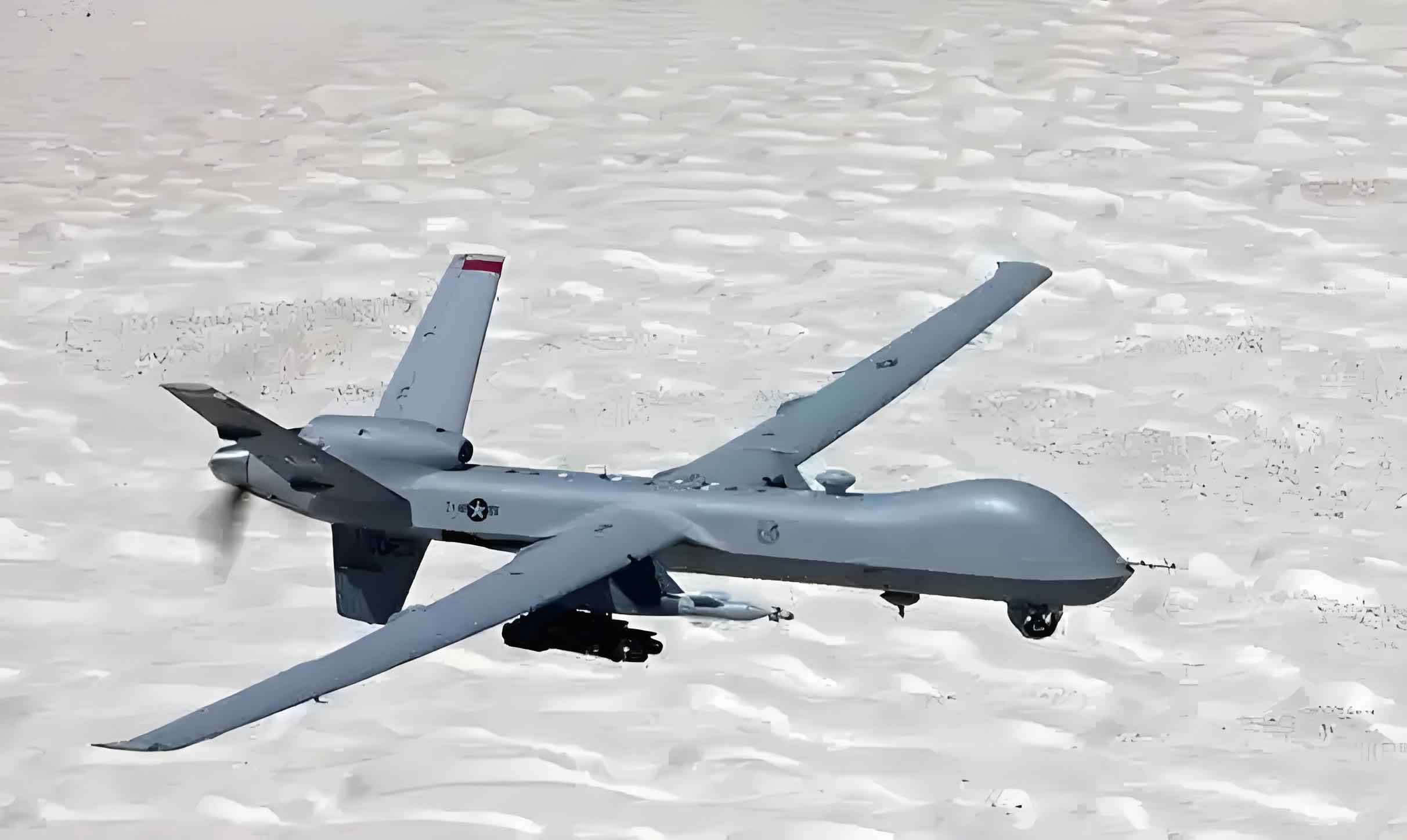
The image above illustrates a typical military drone, underscoring the physical embodiment of these advanced technologies. As I analyze this integration, I must also address the security implications. Military drones rely heavily on secure communication links to prevent interception or jamming by adversaries. 5G incorporates enhanced encryption protocols, such as those based on elliptic curve cryptography, which I can describe with the key exchange formula: $$ K = a \times b \times G $$ where \( K \) is the shared secret key, \( a \) and \( b \) are private keys, and \( G \) is a base point on an elliptic curve. This provides stronger security with lower computational overhead, crucial for resource-constrained military drones. However, the mobile internet security landscape remains fraught with risks, as highlighted in the initial discussion on smartphone vulnerabilities. For military drones, a breach could lead to catastrophic outcomes, such as unauthorized access to sensitive data or takeover of control systems. Therefore, I propose a multi-layered security framework that combines 5G’s native features with additional measures like intrusion detection systems and blockchain-based authentication for military drone networks. To quantify security robustness, I might use a risk assessment formula: $$ \text{Risk} = \text{Probability} \times \text{Impact} $$ where both factors are minimized through 5G’s low-latency encryption and real-time monitoring.
Now, I will explore the mutualistic relationship between 5G development and military drone advancement. It is evident that 5G technology propels military drone capabilities, but conversely, military drones also drive 5G innovation by serving as agile network nodes. In remote or hostile terrains, military drones can act as aerial base stations, extending 5G coverage without fixed infrastructure. This concept, known as drone-assisted networking, can be analyzed using a coverage model: $$ A_{\text{coverage}} = \pi r^2 \times N_{\text{drones}} $$ where \( A_{\text{coverage}} \) is the total area covered, \( r \) is the transmission range of a single military drone, and \( N_{\text{drones}} \) is the number of drones in a swarm. Such deployments reduce costs and increase flexibility, making 5G networks more resilient. For instance, during military operations, a fleet of military drones could establish a temporary 5G mesh network to support communication among troops and equipment. This symbiosis is further exemplified by projects like the DARPA-sponsored research at Carnegie Mellon University, where edge computing combined with 5G enables large-scale military drone coordination. I can encapsulate this with a performance metric for swarm efficiency: $$ E_{\text{swarm}} = \frac{\sum_{i=1}^{N} T_{\text{task}_i}}{N \times T_{\text{latency}}} $$ where \( E_{\text{swarm}} \) is the swarm efficiency, \( T_{\text{task}} \) is task completion time, \( N \) is the number of military drones, and \( T_{\text{latency}} \) is the network latency. With 5G’s sub-1 ms latency, \( E_{\text{swarm}} \) approaches optimal levels, allowing military drones to perform complex maneuvers like formation flying or synchronized attacks.
Despite these advantages, I must acknowledge the challenges facing the integration of 5G and military drones. Technical hurdles include signal attenuation at high frequencies, which I can model with the path loss formula: $$ PL(d) = 20 \log_{10}(d) + 20 \log_{10}(f) + 32.45 $$ where \( PL \) is path loss in dB, \( d \) is distance in kilometers, and \( f \) is frequency in MHz. For 5G’s mmWave bands, path loss is significant, necessitating dense deployment of base stations or relay nodes—a challenge for mobile military drone operations. Additionally, power consumption remains a concern; military drones have limited battery life, and 5G modems may drain energy quickly. I can express this with an energy efficiency metric: $$ \eta = \frac{R}{P} $$ where \( \eta \) is bits per joule, \( R \) is data rate, and \( P \) is power consumption. Optimizing \( \eta \) is crucial for prolonged missions. Moreover, security threats persist, such as side-channel attacks or protocol vulnerabilities, which require ongoing research. To address these, I advocate for adaptive strategies, such as using hybrid networks that combine 5G with satellite links for backup, or implementing machine learning algorithms for anomaly detection in military drone behavior. Below, I summarize key challenges and mitigation approaches in a table:
| Challenge | Description | Mitigation Strategy |
|---|---|---|
| High Frequency Signal Loss | MmWave signals are prone to blockage and attenuation, reducing range for military drones. | Deploy intelligent reflecting surfaces or use lower-frequency bands in conjunction with 5G. |
| Power Constraints | Military drones have limited onboard power, while 5G communication can be energy-intensive. | Develop energy-efficient 5G chipsets and employ solar or fuel cell technologies for military drones. |
| Network Security | Military drones are targets for cyber-attacks, risking data breaches or hijacking. | Implement quantum-resistant encryption and decentralized control systems for military drone swarms. |
| Interoperability Issues | Integrating 5G with legacy military communication systems used by military drones can be complex. | Adopt software-defined networking to enable seamless protocol translation. |
| Regulatory and Spectrum Hurdles | Military drone operations require dedicated spectrum, which may conflict with civilian 5G use. | Advocate for dynamic spectrum sharing frameworks tailored for military drone applications. |
Looking ahead, I am optimistic about the future of 5G-enabled military drones. The convergence of technologies like artificial intelligence, edge computing, and 5G will likely yield autonomous military drone systems capable of real-time decision-making. For example, AI algorithms processed at the network edge can enhance target recognition for military drones, with accuracy potentially exceeding 90%, as suggested by current trends. I can frame this with a learning model formula: $$ A_{\text{accuracy}} = 1 – e^{-\lambda t} $$ where \( A_{\text{accuracy}} \) approaches 1 as training time \( t \) increases, and \( \lambda \) is a learning rate parameter. Furthermore, the development of 6G networks may eventually surpass 5G, but for now, 5G provides a solid foundation. As I conclude this discussion, I emphasize that the security of mobile internet—whether for consumer devices or military drones—must remain a priority. The strategies outlined earlier, such as terminal management and regionalized network segmentation, are equally applicable to military contexts. For instance, securing the identity authentication and payment functions in civilian mobile apps parallels the need for secure command links in military drones.
In summary, the fusion of 5G and military drones represents a monumental leap in wireless communication security and capability. Through this article, I have examined the technical underpinnings, applications, and challenges, using formulas and tables to elucidate complex ideas. The repeated focus on military drones underscores their centrality in this evolution. As we advance, continuous innovation and cross-sector collaboration will be essential to harness the full potential of 5G for military drones, ensuring they operate securely and effectively in an increasingly connected world. The journey is just beginning, and I anticipate that military drones will continue to shape and be shaped by breakthroughs in communication technology, driving progress in both defense and civilian realms.