
From my perspective as an observer of modern naval warfare, the rise of the military drone represents a transformative shift in maritime power. The term “naval military drone” encompasses a wide array of unmanned aerial vehicles (UAVs) designed for diverse missions, deployable from surface vessels, including aircraft carriers, destroyers, frigates, and even submarines. The rapid advancement of technology has propelled these systems from simple reconnaissance tools to multifunctional assets capable of reconnaissance, communication relay, electronic warfare, and precision strikes. I believe that the integration of military drones into naval forces is not merely an enhancement but a fundamental redefinition of combat paradigms, offering a force multiplier effect that extends the reach and capability of warships exponentially.
The evolution of naval military drones is a testament to human ingenuity and technological convergence. Initially, drones were rudimentary remote-controlled aircraft used for target practice or basic surveillance. However, with breakthroughs in microelectronics, materials science, propulsion, and artificial intelligence, modern military drones have become sophisticated platforms. From my analysis, the key drivers include miniaturization, allowing deployment on space-constrained vessels, and autonomy, enabling independent operation beyond line-of-sight. The following table summarizes the developmental phases of naval military drones, highlighting their expanding roles and technological milestones.
| Phase | Time Period | Primary Role | Key Technological Features | Example Platforms |
|---|---|---|---|---|
| Early Development | 1960s-1980s | Target practice, basic reconnaissance | Radio control, simple autopilots, piston engines | Target drones, early reconnaissance UAVs |
| Expansion | 1990s-2000s | Surveillance, communication relay | GPS navigation, modular payloads, improved sensors | Scan Eagle, Pioneer series |
| Integration | 2010s-Present | Multimission: ISR, electronic warfare, strike | Stealth coatings, AI-driven autonomy, vertical take-off and landing (VTOL) | Fire Scout, advanced UCAVs |
| Future Vision | 2030s onward | Autonomous combat, swarming, hypersonic operations | Cognitive AI, hypersonic propulsion, directed energy weapons | Conceptual naval UCAVs, loyal wingmen |
In my view, the technical specifications of military drones are critical to their naval utility. Parameters such as endurance, range, payload capacity, and launch/recovery methods dictate their suitability for different vessel types. For instance, small tactical drones used on destroyers must balance size and performance. I often express the operational range of a military drone using a simplified formula that considers fuel efficiency and mission profile: $$ R = v \times t \times \eta $$ where \( R \) is the effective operational radius in kilometers, \( v \) is the cruise speed in km/h, \( t \) is the endurance in hours, and \( \eta \) is a mission efficiency factor (typically between 0.6 and 0.9 for reconnaissance missions). This formula underscores how advancements in propulsion and energy storage directly enhance a drone’s reach, making it a potent tool for extending a ship’s surveillance bubble.
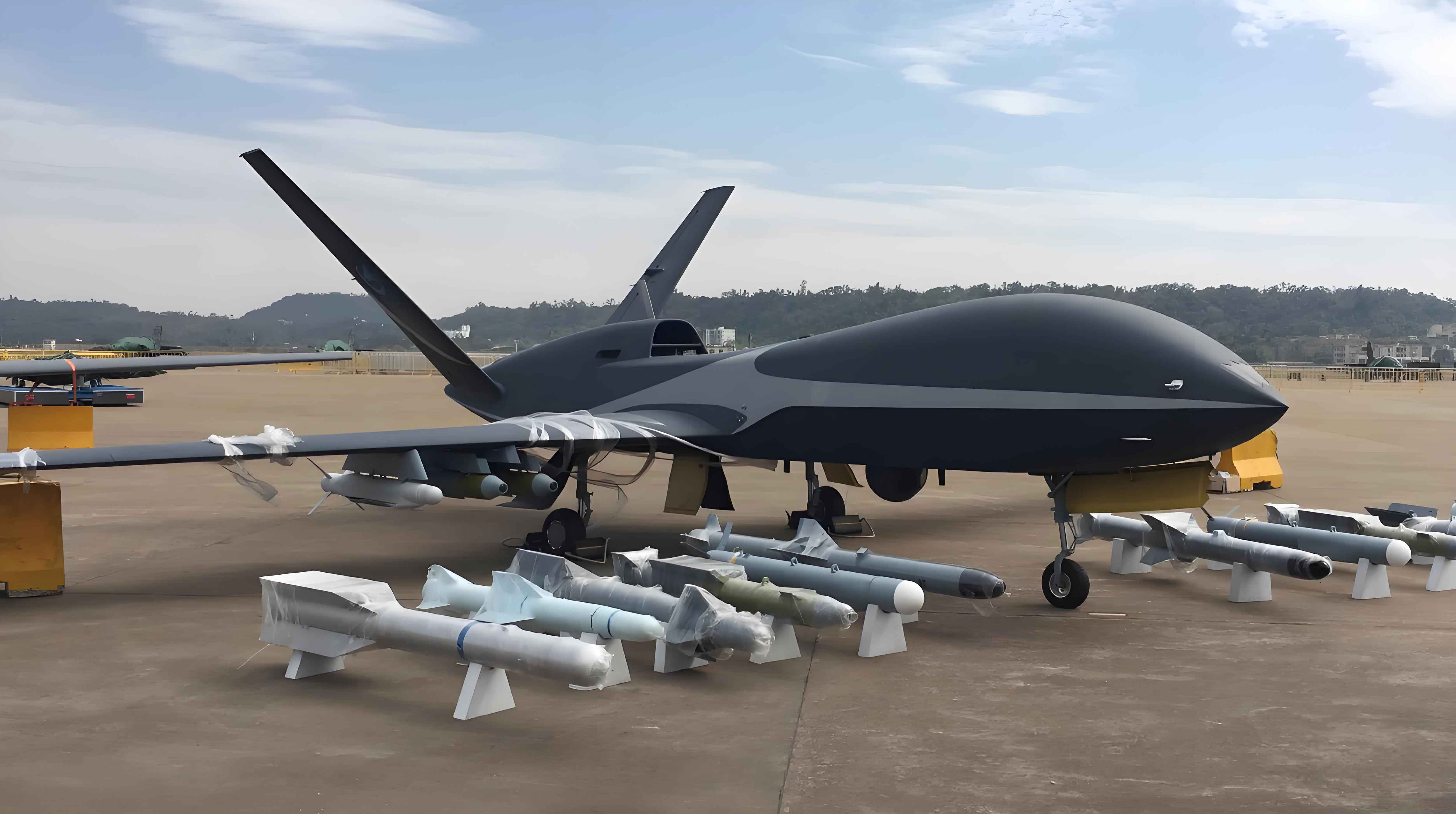
The applications of naval military drones are vast and growing. From my observations, they serve as the eyes, ears, and sometimes the fists of a modern fleet. Reconnaissance remains the most mature domain; small, stealthy military drones can loiter for hours over areas of interest, providing real-time intelligence without risking pilots. For example, a drone equipped with electro-optical/infrared (EO/IR) sensors and synthetic aperture radar (SAR) can detect threats beyond the horizon, effectively multiplying a ship’s detection range by a factor of ten or more. Communication relay is another vital role. By acting as airborne nodes, military drones enable over-the-horizon targeting for long-range missiles, overcoming the limitations imposed by Earth’s curvature. The effectiveness of such a relay can be modeled by the communication range equation: $$ P_r = P_t G_t G_r \left( \frac{\lambda}{4\pi d} \right)^2 $$ where \( P_r \) is received power, \( P_t \) is transmitted power, \( G_t \) and \( G_r \) are antenna gains, \( \lambda \) is wavelength, and \( d \) is distance. This highlights how drones positioned at altitude can maintain robust links, facilitating coordinated strikes.
Electronic warfare (EW) is where military drones truly showcase their versatility. I have studied instances where drones equipped with jammers or decoys penetrate enemy airspace to suppress air defenses or gather electronic intelligence. The advantage lies in their low observability and expendability compared to manned aircraft. In offensive roles, the progression toward unmanned combat aerial vehicles (UCAVs) is accelerating. These military drones can carry precision-guided munitions, engaging surface or air targets with minimal human intervention. The table below categorizes primary naval drone missions and their associated payloads, illustrating the multifunctional nature of these systems.
| Mission Type | Typical Payloads | Key Performance Metrics | Impact on Naval Operations |
|---|---|---|---|
| Intelligence, Surveillance, Reconnaissance (ISR) | EO/IR cameras, SAR, signals intelligence (SIGINT) suites | Endurance (>20h), altitude ceiling, sensor resolution | Extends situational awareness, enables preemptive action |
| Communication Relay | Radio repeaters, data links, satellite communication terminals | Loiter time, transmission bandwidth, altitude stability | Facilitates over-the-horizon engagement, network-centric warfare |
| Electronic Warfare | Jammers, radar decoys, electromagnetic spectrum sensors | Power output, frequency agility, stealth characteristics | Degrades enemy C4ISR, protects friendly assets |
| Strike/Combat | Air-to-surface missiles, guided bombs, anti-radiation missiles | Payload capacity (kg), attack radius, survivability | Provides scalable lethality, reduces risk to personnel |
| Anti-Submarine Warfare (ASW) | Sonobuoys, magnetic anomaly detectors, lightweight torpedoes | Endurance, acoustic processing capability | Expands ASW coverage, complements ship-based systems |
Turning to the development of military drones in China, I have followed its trajectory with interest. Starting from the reverse-engineering of captured vehicles in the mid-20th century, China’s drone programs have evolved into a diverse and advanced portfolio. Early models like the CK-1 target drone and WZ-5 reconnaissance UAV laid the groundwork, demonstrating capabilities in high-altitude operations and aerial sampling. Through the decades, research institutes and companies have proliferated, producing systems ranging from micro-drones to large, stealthy platforms. I recall seeing concepts like the “Dark Sword” unmanned combat air vehicle, which hints at ambitions for supersonic, agile military drones. The progress is evident in the variety displayed at international airshows, where Chinese firms present drones for every role, from tactical scouts to strategic spies. This domestic prowess reduces reliance on foreign technology and aligns with broader naval modernization goals.
The performance of Chinese military drones can be quantified through parameters similar to global standards. For instance, the endurance \( E \) of a reconnaissance drone is crucial for persistent coverage. It can be expressed as: $$ E = \frac{W_{\text{fuel}}}{SFC \times T} $$ where \( W_{\text{fuel}} \) is fuel weight, \( SFC \) is specific fuel consumption, and \( T \) is thrust required for cruise. Improvements in engine efficiency and aerodynamics have steadily increased \( E \), allowing longer missions. The table below provides a snapshot of representative Chinese naval drone models, inferred from public sources, showcasing their specifications and potential naval applications.
| Model/Series | Type | Approximate Size (Wingspan in meters) | Endurance (hours) | Primary Naval Missions | Notable Features |
|---|---|---|---|---|---|
| ASN-206 | Tactical Fixed-Wing | 6 | 4-8 | Reconnaissance, artillery spotting, border patrol | Rocket-assisted launch, real-time video downlink |
| WZ-9 / WZ-2000 | HALE UAV (High-Altitude Long Endurance) | >20 (estimated) | >24 (estimated) | Strategic ISR, electronic warfare, early warning | Stealthy design, satellite communication, modular payloads |
| “Sea Gull” | VTOL Unmanned Helicopter | Rotors (~4-6 diameter) | 3-5 | Deck operations on small ships, ASW, surveillance | Coaxial rotor design, compact footprint |
| “Dark Sword” Concept | Unmanned Combat Aerial Vehicle (UCAV) | ~10 (estimated) | Classified | Air superiority, deep strike, penetration | Supersonic, high maneuverability, low observable |
Looking ahead, I am convinced that the future of naval warfare will be increasingly dominated by military drones. The prospect of drone carriers—smaller, more affordable vessels hosting swarms of multifunctional UAVs—could democratize sea power. Imagine a fleet where destroyers carry dozens of small military drones for surveillance and attack, while dedicated drone motherships deploy larger UCAVs for sustained operations. The economic and tactical advantages are compelling: reduced crew requirements, lower procurement and operational costs compared to manned aircraft carriers, and enhanced survivability through distributed operations. From a strategic standpoint, nations that master drone technology will gain asymmetric advantages, able to contest maritime domains without risking expensive manned platforms.
However, challenges remain. Integrating military drones into existing naval architectures requires robust command and control (C2) networks, secure data links, and interoperability standards. Cybersecurity is a critical concern, as drones are vulnerable to hacking or jamming. Moreover, ethical and legal questions about autonomous lethal decision-making persist. Despite these hurdles, the trajectory is clear. I predict that within two decades, military drones will constitute over half of all naval aerial assets, performing roles from routine patrols to high-intensity combat. The formula for naval power is being rewritten, with the military drone at its core.
In conclusion, as I reflect on the rapid evolution of naval military drones, I see a future where these unmanned systems redefine maritime strategy. From enhancing single-ship capabilities to enabling entirely new fleet constructs, the military drone is a catalyst for innovation. Its impact extends beyond technology to doctrine, training, and geopolitics. For any navy aspiring to relevance in the 21st century, investing in drone capabilities is not optional but imperative. The journey from simple remote-controlled aircraft to autonomous, networked swarms is underway, and I am confident that this evolution will continue to accelerate, shaping the battlespaces of tomorrow.