
The evolution of the modern battlefield is inextricably linked to technological advancement, particularly in aerospace. Among the most significant developments is the proliferation and increasing sophistication of Unmanned Aerial Vehicles (UAVs), commonly known as drones. Their roles have expanded far beyond reconnaissance to encompass precision strike, electronic warfare, communications relay, and persistent surveillance. This expansion of mission profiles demands aircraft with exceptional performance: greater range, higher payload capacity, improved survivability, and enhanced maneuverability. A critical enabler for meeting these demanding requirements has been the widespread adoption of advanced composite materials. From my perspective, the shift from metallic airframes to composite-dominated structures represents not merely a material substitution, but a fundamental rethinking of military drone design, manufacturing, and capability.
Advanced composite materials (ACMs) are engineered materials made from two or more constituent materials with significantly different physical or chemical properties. When combined, they produce a material with characteristics different from the individual components. In aerospace, this typically involves high-strength, high-stiffness fibers embedded in a polymer matrix. The most common reinforcement is carbon fiber, valued for its outstanding specific strength and stiffness. Other fibers like glass, aramid (e.g., Kevlar), and more recently, ultra-high molecular weight polyethylene (e.g., Dyneema) are also used. The matrix, often an epoxy, polyester, or phenolic resin, binds the fibers together, transfers loads, and protects them from environmental degradation.
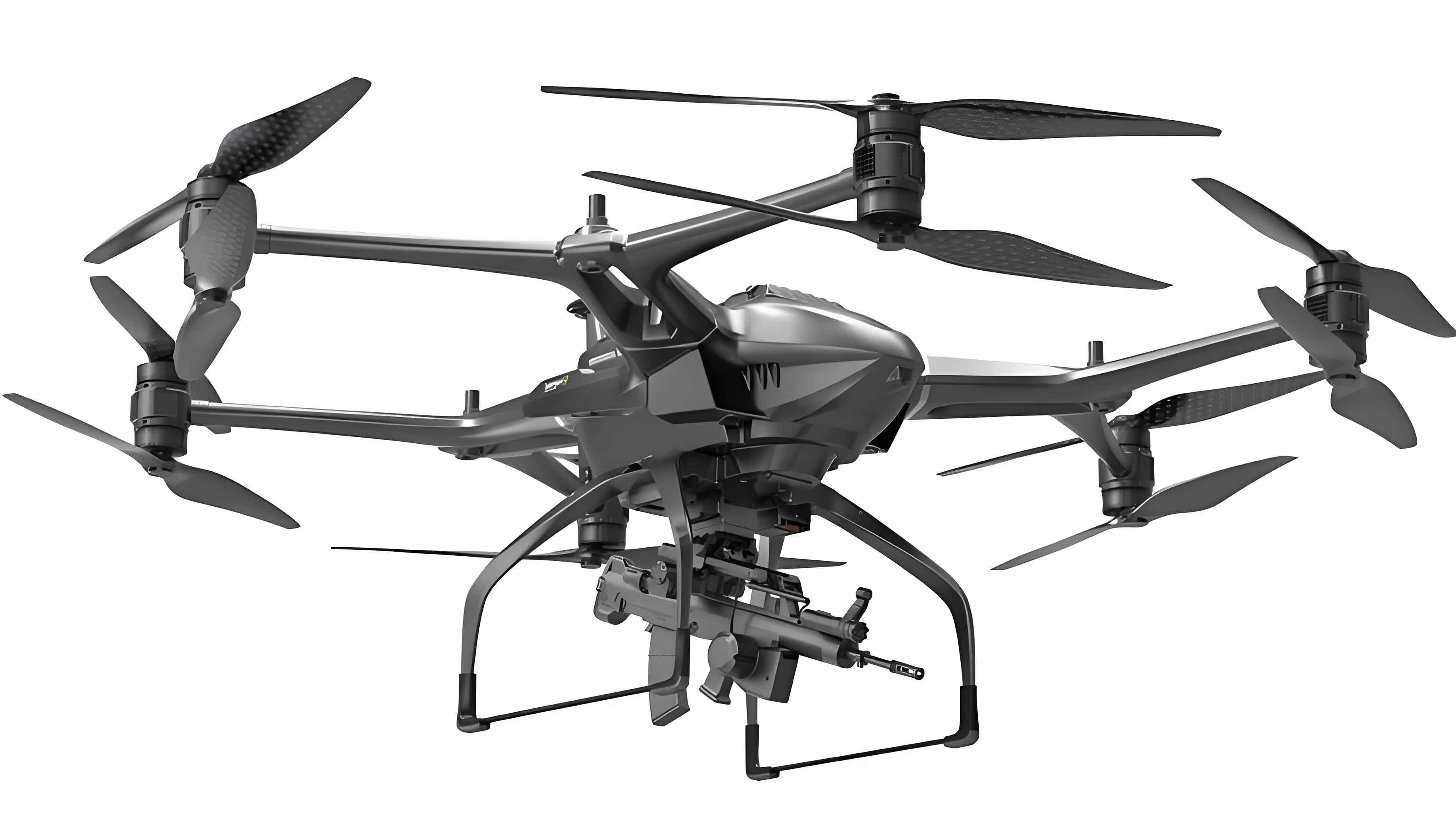
The primary advantage driving the use of composites in military drones is their superior specific properties. Specific strength (strength-to-density ratio) and specific modulus (stiffness-to-density ratio) are paramount in aerospace design, where every gram saved directly translates to extended endurance, increased payload, or improved agility.
$$
\text{Specific Strength} = \frac{\sigma}{\rho}, \quad \text{Specific Modulus} = \frac{E}{\rho}
$$
where $\sigma$ is the ultimate tensile strength, $E$ is the elastic modulus, and $\rho$ is the density.
The table below compares the specific properties of common aerospace materials, illustrating why carbon fiber composites are the material of choice for modern military drone structures.
| Material | Density, $\rho$ (g/cm³) | Tensile Strength, $\sigma$ (MPa) | Specific Strength ($\sigma/\rho$) (10⁶ cm) | Modulus, $E$ (GPa) | Specific Modulus ($E/\rho$) (10⁸ cm) |
|---|---|---|---|---|---|
| Aluminum 7075-T6 | 2.81 | 572 | 2.04 | 71.7 | 2.55 |
| Steel (AISI 4340) | 7.85 | 1720 | 2.19 | 210 | 2.68 |
| Titanium Ti-6Al-4V | 4.43 | 1170 | 2.64 | 114 | 2.57 |
| Carbon Fiber/Epoxy (Unidirectional) | ~1.55 | >1500 | >9.68 | >120 | >7.74 |
This dramatic improvement in specific properties allows for airframe weight reductions of 20-30% compared to conventional aluminum designs. For a military drone, this weight saving is directly reinvested into the mission: it can mean longer time on station, the ability to carry more sensors or weapons, or the fuel efficiency to operate from more remote locations. Furthermore, composites offer superior fatigue resistance and corrosion immunity compared to metals, which is crucial for military drones that may be stored for long periods in harsh environments before rapid deployment.
Beyond sheer structural efficiency, composites provide a decisive advantage in survivability through signature reduction. The radar cross-section (RCS) of a military drone is a key determinant of its detectability. Composites are inherently more radar-absorbent than metals, and their anisotropic properties allow for “aero-elastic tailoring” and “stealth shaping” that are difficult or impossible with isotropic metals. Engineers can design the fiber layup to control stiffness distribution while simultaneously crafting smooth, continuous curves and faceted shapes that deflect radar waves away from the source. The use of specialized fibers (e.g., glass or quartz for radomes) and embedded frequency-selective surfaces further enhances electromagnetic performance. The integration of radar-absorbent materials (RAM) into the composite laminate itself moves beyond mere surface coating, creating a structure/function integrated material system essential for next-generation low-observable military drones.
Finally, the manufacturability of composites unlocks new design paradigms. Large, complex components like wings, fuselage sections, and entire empennages can be fabricated as single, co-cured units. This “single-piece” or “unitized” construction drastically reduces the part count, eliminates thousands of fasteners (which are potential stress concentrators and radar reflectors), and simplifies assembly. This not only reduces weight but also enhances structural integrity and reliability, which are critical for a military drone operating autonomously over hostile territory.
The Evolution of Composite Military Drones: From Niche to Norm
The application of composites in military drones has followed a trajectory from secondary, non-critical parts to primary load-bearing structures. Early UAVs often featured composite skins over a metallic skeleton or used composites for non-structural fairings and radomes. Today, the most advanced military drones are overwhelmingly composite in construction.
High-Altitude Long-Endurance (HALE) military drones were among the first to leverage composites extensively due to the premium placed on weight for achieving extreme altitudes and endurance. A prime example is the RQ-4 Global Hawk. Its wings, which must provide immense bending stiffness over a 35.4-meter span, are constructed from carbon-fiber/epoxy prepregs. The wing skins use a tailored layup of unidirectional tape and fabric to optimize for both spanwise bending and torsional loads, with nomex honeycomb core providing shear stability in a sandwich construction. This design allows the Global Hawk to operate at altitudes over 60,000 feet for more than 30 hours.
The pursuit of low observability has driven another strand of development, culminating in flying-wing designs that are essentially “all-composite.” The Northrop Grumman X-47B, a carrier-capable unmanned combat air vehicle (UCAV), exemplifies this. Its entire airframe is a highly integrated composite structure. The lack of a vertical tail and the seamless blending of wing and body are only feasible with composite manufacturing techniques like resin transfer molding (RTM) and advanced automated fiber placement (AFP). This design minimizes radar-reflecting edges and cavities, giving the X-47B a very low frontal RCS. Similarly, the European nEUROn UCAV demonstrator and the British Taranis utilize carbon-fiber composites not just for structure, but as an integral part of its stealth geometry, with conformal weapon bays and serpentine engine intake ducts molded directly into the airframe.
The table below summarizes the composite usage in several iconic military drone programs, highlighting the design philosophy enabled by the materials.
| Military Drone | Primary Role | Key Composite Components & Material | Design & Manufacturing Highlight |
|---|---|---|---|
| RQ-4 Global Hawk | HALE ISR | Wings, tail surfaces, fuselage aft section (Carbon/Epoxy, Nomex honeycomb) | Tailored stiffness for high-aspect-ratio wing; large sandwich structures. |
| X-47B | Carrier-based UCAV | Entire airframe (Carbon/Epoxy, woven & unidirectional) | Tailless, blended flying wing; low-observable shaping; unitized construction. |
| MQ-9 Reaper | MALE Attack/ISR | Wings, booms, tail (Carbon/Epoxy, Glass/Epoxy) | Cost-effective design using large, bolted composite assemblies. |
| nEUROn | UCAV Technology Demonstrator | Entire airframe (Carbon/BMI, Titanium edges) | Stealth shaping with integrated bays; hot-curing for high-temperature resistance. |
Critical Technologies for the Next Generation of Composite Military Drones
Despite the proven benefits, the full potential of composites in military drones is still being unlocked. Several key technological challenges must be addressed to drive down costs, improve performance predictability, and enable even more radical designs.
1. Low-Cost Manufacturing and Sustainable Materials. Historically, aerospace-grade composites have been expensive, relying on autoclave-cured prepregs—a process with high energy, tooling, and material costs. For military drones, especially those envisioned in large numbers or for attritable missions, cost is a primary constraint. The industry is rapidly advancing out-of-autoclave (OOA) processes. These include:
- Resin Transfer Molding (RTM) and Vacuum-Assisted RTM (VARTM): Dry fiber preforms are placed in a mold, and resin is injected under pressure or vacuum. This is excellent for complex, high-volume parts.
- Automated Fiber Placement (AFP) and Automated Tape Laying (ATL): These robotic systems deposit thermoset or thermoplastic tape with precision, dramatically reducing labor and material scrap compared to hand layup.
- Thermoplastic Composites: Materials like Carbon/PEEK or Carbon/PEKK can be rapidly processed via thermoforming or welding, offering the potential for recyclability and faster cycle times.
The economic equation for a military drone program must balance performance, rate of production, and total lifecycle cost, making these manufacturing advancements crucial.
2. Integrated Multidisciplinary Design and Analysis. The design of a composite military drone is a highly coupled problem. The anisotropic nature of composites means that the structural layout (ply angles, thickness) directly influences the aeroelastic behavior (flutter speed, control reversal), which in turn affects the aerodynamic performance and stealth signature. This necessitates a structure/aeroelastic/stealth multidisciplinary design optimization (MDO) framework.
$$
\text{Minimize: } W(\mathbf{x}) \quad \text{or } C(\mathbf{x}) \\
\text{Subject to: } g_i(\mathbf{x}) \leq 0, \quad i = 1,…,m \\
\text{where } \mathbf{x} = [\text{ply angles, thicknesses, shape parameters…}]
$$
Here, $W$ is the structural weight, $C$ could be a cost or radar signature metric, and $g_i$ are constraints on stress, strain, buckling, flutter frequency, and control effectiveness. The design variable vector $\mathbf{x}$ encompasses the detailed composite laminate parameters. Only through such integrated tools can engineers truly exploit the “tailorability” of composites to create an optimized military drone airframe.
3. Damage Tolerance, Reliability, and Structural Health Monitoring. The failure modes of composites are more complex than those of metals. They are susceptible to barely visible impact damage (BVID), delamination, and matrix cracking. While composites have excellent fatigue performance, their damage progression and residual strength after impact are critical concerns for the structural integrity of a military drone.
Establishing a robust damage tolerance philosophy is essential. This involves:
– Defining allowable defect sizes based on rigorous test and analysis.
– Developing reliable non-destructive inspection (NDI) methods for field maintenance.
– Implementing accurate models for predicting damage growth under spectrum loading typical of a military drone’s life cycle.
The fatigue life $N_f$ under a spectrum of stress cycles can be modeled using a residual strength degradation approach:
$$
R(n) = R_0 – \int_{0}^{n} f(\sigma_a, R(n)) \, dn
$$
where $R(n)$ is the residual strength after $n$ cycles, $R_0$ is the initial strength, and $f$ is a function describing the strength degradation rate under applied stress amplitudes $\sigma_a$. Failure occurs when $R(n)$ falls below the maximum applied stress. Validating such models for complex composite structures on a military drone is a significant undertaking.
To enhance safety and reduce maintenance costs, there is a growing trend towards integrating Structural Health Monitoring (SHM) systems. Networks of embedded fiber optic sensors (FBG sensors) or piezoelectric transducers can provide real-time data on strain, temperature, and the presence of damage within the composite structure of the military drone, enabling condition-based maintenance and improving operational availability.
Future Frontiers: Smart Structures and Multifunctionality
The future of composite military drones lies in moving beyond passive structures to active, intelligent systems. The concept of “smart skins” or “multifunctional structures” is gaining traction. This involves integrating additional functionality directly into the composite laminate. Potential integrations include:
- Conformal Load-bearing Antenna Structures (CLAS): Embedding radiating elements and their feed networks into the wing or fuselage skin, saving weight and volume while improving aerodynamic and stealth performance.
- Energy Storage: Developing structural batteries or supercapacitors where the composite layers themselves store electrical energy to power onboard systems of the military drone.
- De-icing/Anti-icing: Incorporating conductive layers (e.g., carbon nanotube veils) that can be resistively heated to prevent ice accumulation on leading edges.
- Self-healing: Using microcapsules or vascular networks within the matrix that release healing agent upon crack formation, potentially extending the service life of a military drone in remote deployments.
The realization of these concepts will further blur the line between the airframe and its systems, leading to military drones that are lighter, more compact, and vastly more capable.
Conclusion
The adoption of advanced composite materials has been a transformative force in the development of military drones. It has enabled the leap from small, short-range surveillance platforms to persistent, high-altitude intelligence gatherers and stealthy, penetrating strike aircraft. The unique combination of high specific strength, design tailorability, and signature control offered by composites is unmatched by traditional metals. As we look forward, the trajectory is clear: the airframe of the future military drone will not simply be made of composites; it will be a highly integrated, multifunctional composite system. Overcoming the remaining challenges in low-cost manufacturing, integrated design, and damage tolerance is essential to fully realizing this vision. The ongoing innovation in composite materials and processes will continue to be a key driver defining the capabilities, and therefore the strategic impact, of the next generation of military drones.