
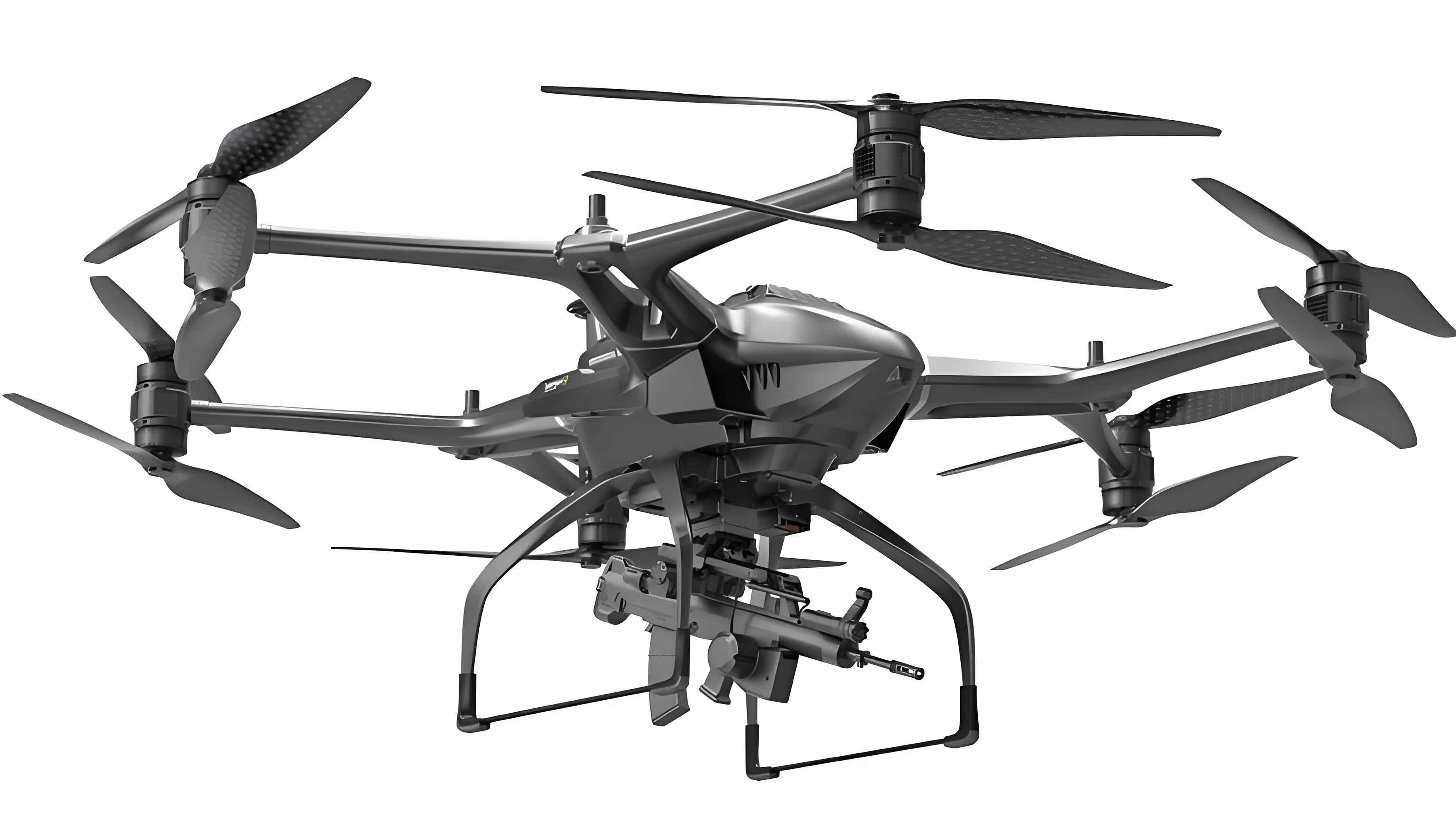
The development of military drones, or unmanned aerial vehicles (UAVs), represents a pivotal shift in modern warfare. My analysis of their evolution traces back to early 20th-century experiments, which were hampered by limitations in propulsion, control, and communication technologies, coupled with an underdeveloped conceptual understanding of their potential. Progress remained incremental for decades. The paradigm shifted decisively in the 1990s, as U.S. military drones demonstrated remarkable utility in several high-tech regional conflicts. This catalyzed a global surge in interest and investment. Entering the 21st century, the military drone has solidified its role in core missions like intelligence, surveillance, and reconnaissance (ISR), target tracking, and battle damage assessment. Today, propelled by breakthroughs in communications and artificial intelligence (AI), the operational envelope of the military drone is expanding into complex domains such as air-to-air combat and coordinated strike missions, often under the umbrella of manned-unmanned teaming (MUM-T) concepts.
Unlike their manned counterparts, a military drone—particularly medium-altitude long-endurance (MALE) and high-altitude long-endurance (HALE) systems—is a complex system-of-systems. It encompasses the aerial platform, ground control stations (GCS), and a suite of ground support equipment. This system demands attributes like agile deployment, rapid mobility, and high survivability. Consequently, support for a military drone must be a holistic, integrated endeavor. Leveraging modern information technology is no longer optional but essential to achieve rapid diagnostics, comprehensive system assessment, and ultimately, a cross-domain, precise, and agile support capability. This informational transformation is critical for ensuring that a military drone fleet can generate and sustain combat readiness swiftly and effectively.
The Concept of Integrated Support Informationization
Integrated Support Informationization refers to the systematic application of information technologies throughout the equipment maintenance and support lifecycle. It involves the deep development and utilization of all maintenance-related information resources. The goal is to informatize or digitally transform every segment—from hands-on maintenance tasks and management processes to supply chain logistics. This transformation streamlines workflows, marries information technology with core maintenance engineering, and focuses support resources directly on the maintenance mission. The result is enhanced precision, scientific rigor in decision-making, and a demonstrable increase in equipment availability and readiness.
This evolution is driven by a triad of interrelated factors:
| Driver | Description |
|---|---|
| Technology Push | The relentless advancement of core IT (e.g., cloud computing, IoT, AI) accelerates the refresh cycle for information systems, continuously pushing the boundaries of what is possible in support informatization. |
| Support Demand Pull | Current maintenance paradigms create intrinsic demands for capabilities like technical status management, optimized supply support, efficient maintenance operations, and realistic training systems. Support informatization is the necessary response to fulfill these demands. |
| Future Warfare Imperative | Future operational concepts, emphasizing multi-domain operations and agility, require a shift towards performance-based and mission-oriented support. Informatization must adapt to enable integrated, responsive support aligned with dynamic combat needs. |
Current State and Challenges in Support Information Systems
Nations with advanced air forces have consistently worked to develop sophisticated integrated support systems. At the heart of these systems lie robust information systems that enable efficient operation. The U.S. military’s approach, exemplified by its Integrated Logistics System (ILS), centralizes key functions like lifecycle data management, technical publication control, and depot-level maintenance coordination, providing crucial support to forward units.
Since the 2000s, there has been a significant push to modernize support infrastructure. New platforms are now routinely fielded with dedicated information systems such as Interactive Electronic Technical Manuals (IETM), Portable Maintenance Aids (PMA), and integrated training systems. While these tools have improved efficiency, significant challenges persist, particularly when scaling to the needs of next-generation military drone fleets.
Analysis of International and Domestic System Applications
The F-35 Lightning II’s Autonomic Logistics System (ALS) represents an ambitious vision for fully automated support. Its two pillars are the Prognostics and Health Management (PHM) system and the Autonomic Logistics Information System (ALIS). Despite its groundbreaking aims, ALIS faced substantial development delays, software defects, high false alarm rates, and data integrity issues that burdened maintainers and impacted readiness assessments. This led to the ongoing transition to the Operational Data Integrated Network (ODIN), intended to be a more stable, capable, and user-centric system. The F-35’s journey highlights the immense complexity of developing a truly autonomous support information system.
Domestically, numerous computer-based support systems are in use across various units and for different platforms. These include maintenance management systems, electronic logbooks, technical data management, and flight data analysis tools. However, a critical analysis reveals a landscape often characterized by isolated “stovepipe” systems or redundant developments. There is frequently a lack of overarching architectural planning, leading to uncoordinated support elements, dispersed information “silos,” and an inability to achieve real-time resource visibility. This fragmentation hampers comprehensive support situational awareness and limits the ability to perform intelligent, rapid support planning essential for agile military drone operations.
| Aspect | F-35 ALIS/ODIN Experience | Common Domestic Challenges |
|---|---|---|
| Development & Integration | Major schedule delays; integration complexity between PHM and information system. | Fragmented, standalone systems; lack of unified data standards and architecture. |
| Data & Diagnostics | High false alarm rates; data errors affecting health assessment. | Data silos; limited ability to correlate data across platforms and support functions. |
| User Impact & Decision Support | Increased maintainer burden; challenged management decision-making. | Poor situational awareness; low level of intelligent decision support for planning. |
| Outcome | System replacement deemed necessary (ALIS to ODIN). | Difficulty generating flexible, precise support plans rapidly. |
Distinctive Informatization Support Characteristics of Military Drones
The very nature of military drone operations imposes unique requirements on their support information systems, differing fundamentally from manned aircraft support paradigms.
- Decoupled Deployment: The core triad of a military drone system—the air vehicle, the Ground Control Station (GCS), and ground support equipment—is often physically separated and can be configured in a “one-to-many” (one GCS controlling multiple drones) or distributed manner. Support informatization must therefore enable coordinated, synchronized support for these geographically dispersed elements, rather than treating a single airframe as the primary unit of support.
- System Complexity and Data Volume: Modern military drones feature long endurance, diverse payloads (EO/IR, SAR, SIGINT, etc.), and complex avionics. This generates vast amounts of maintenance and operational data pre-, during, and post-flight. The support system must process this data at high velocity, extract meaningful insights, and provide accurate diagnostics and launch recommendations swiftly.
- Agile Redeployment and Mobilization: A key tactical advantage of military drones is rapid deployment. Support informatization must enable “tailorable” support packages. Based on mission type, duration, intensity, and operational environment, the system should intelligently configure the minimal essential set of spares, tools, and test equipment for transport, thereby reducing the logistical footprint during redeployment.
These characteristics create an imperative for support systems that enable Cross-Domain Support (coordinating across air, ground, and logistical domains), Precise Support (resource allocation based on accurate need prediction), and Agile Support (rapidly adaptable to changing operational tempo and location).
Considerations on New Technology Development and Application
To address these challenges and meet future demands for large-scale, sustained, and highly mobile operations, the next generation of military drone support must leverage a convergence of advanced technologies.
Data Link Enabled Integrated Support
The military drone data link is the digital lifeline between the platform and its controllers. Traditionally used for command and control (C2) and payload data, it is a critical enabler for integrated health management. Real-time telemetry of system states (e.g., engine parameters $\(P_{eng}\)$, $\(T_{oil}\)$), critical consumables (fuel quantity $\(Q_{fuel}\)$, battery state-of-charge $\(SOC\)$), and fault codes can be streamed to ground-based PHM systems. This enables a shift from reactive, post-flight maintenance to proactive, condition-based support, where anomalies can be detected mid-mission and maintenance actions can be pre-planned before the aircraft even lands.
Furthermore, the emergence of space-based internet constellations (comprised of Low Earth Orbit satellites) promises to revolutionize cross-domain support. By providing low-latency, global or regional secure connectivity, these networks can link dispersed military drone fleets, forward operating bases, and strategic support centers into a cohesive information web. This allows for real-time data sharing, consolidated resource management, and coordinated mission planning across vast distances.
Big Data and Advanced PHM Systems
Military drone support data exemplifies the “5V” characteristics of Big Data, as summarized below:
| Characteristic | Manifestation in Military Drone Support |
|---|---|
| Volume | Terabytes of data from millions of flight hours, sensor logs, and maintenance events. |
| Velocity | High-frequency real-time telemetry combined with periodic bulk downloads. |
| Variety | Structured (parametric data) and unstructured data (image/video from payloads, maintenance notes). |
| Veracity | Data quality issues from sensor drift, transmission errors, or incomplete logs. |
| Value | Critical insights (e.g., impending failure) are hidden within vast, low-density data streams. |
Conventional software cannot unlock this value. A cloud-based, big data PHM platform, utilizing distributed storage and computing (e.g., Hadoop/Spark ecosystems), is required. By aggregating lifecycle data—from design and manufacturing to operational usage—and applying advanced data mining and machine learning techniques, we can move beyond simple fault detection to:
- Precise Fault Isolation: Using pattern recognition on multi-sensor data to pinpoint failing subsystems.
- Remaining Useful Life (RUL) Prediction: Employing models like regression or recurrent neural networks to forecast component failure. A simplified degradation model can be expressed as:
$$ RUL(t) = \frac{L – D(t)}{dD/dt} $$
where $\(L\)$ is the failure threshold, $\(D(t)\)$ is the measured degradation at time $\(t\)$, and $\(dD/dt\)$ is the degradation rate. - System Health and Capability Assessment: Correlating component health with overall system performance metrics to assess mission readiness.
Artificial Intelligence for Intelligent Support Decision-Making
AI, particularly machine learning (ML) and deep learning, provides the cognitive engine for the future support system. By learning from historical data, an AI-augmented system can:
- Predict Resource Consumption: Model the relationship between operational scenarios (sortie rate, mission profile, environment) and the consumption rates of spare parts, fuel, and other logistics resources. This enables precise support planning.
- Generate and Optimize Support Plans: Given a set of mission tasks, the AI can evaluate fleet health status, predict support needs, and automatically generate optimized support schedules, resource allocation plans, and even training regimens for maintainers. This directly enables agile support.
- Dynamic Re-planning: In response to unforeseen events (e.g., a bird strike, unexpected attrition), the system can rapidly re-calculate and propose adjusted support strategies.
Key Capabilities for the Next-Generation Military Drone Informationized Support System
Synthesizing the needs and technologies, I envision a future military drone support system built on standardized data, integrated platforms, and intelligent applications, delivering the following core capabilities:
| Capability | Description | Enabling Technologies |
|---|---|---|
| Real-Time Support Situational Awareness | Continuous, visualized monitoring of the health status, location, and mission state of every military drone and its associated ground assets across the network. | Secure Data Links, Real-time Dashboards, IoT Sensors. |
| Comprehensive System Health and Capability Assessment | Holistic evaluation merging real-time data, post-flight downloads, and ground test results to determine airworthiness, predict RUL, and grade mission system performance. | Big Data Analytics, Advanced PHM Models, Cloud Computing. |
| Intelligent Maintenance and Support Decision Support | AI-driven generation of optimized maintenance schedules, logistics plans, and training programs based on mission requirements and fleet health predictions. | Machine Learning, Optimization Algorithms, Digital Twins. |
| End-to-End Support Process Control and Optimization | Full digital traceability and control of all support activities, with the ability to simulate (“what-if” analysis), optimize, and dynamically reconfigure support processes. | Digital Thread, Process Mining, Simulation Models. |
The implementation of these capabilities will fundamentally transform support from a cost and readiness center into a decisive combat enabler for military drone forces.
Conclusion
As the battlefield continues to evolve, the military drone is poised to play an increasingly central and sophisticated role in joint warfighting architectures. To underpin this evolution and unlock the full operational potential of military drone fleets, a commensurate revolution in support is imperative. By strategically harnessing the power of secure data networks, big data analytics, and artificial intelligence, we can design and field a new generation of intelligent support information systems. The objective is clear: to realize a truly cross-domain, precise, and agile informationized support capability that ensures military drones are not just technologically advanced platforms, but reliably ready and decisive instruments of national security.