
In modern warfare, the evolution of communication networks plays a pivotal role in shaping military strategies and capabilities. As a researcher and analyst in this field, I have observed that tactical-level integrated joint operations demand exceptionally high standards for communication network design. These operations emphasize the resolution of issues such as network formation and rapid access through the judicious application of advanced technologies, thereby providing reliable communication support. In this context, the advent of 5G communication technology has begun to significantly impact the development and deployment of military drones. Military drones, or unmanned aerial vehicles (UAVs), are aircraft operated without a human pilot onboard, controlled either remotely via radio signals or autonomously through pre-programmed systems. Over the years, drone technology has advanced by leaps and bounds, finding extensive applications in military, geological exploration, and other sectors, underscoring their immense value. To delve deeper into how 5G fosters the growth of military drones, I will first outline the fundamental aspects of the drone industry.
The drone industry has a rich history, with its first successful test flight occurring in 1917, leading to initial military applications. By the 1990s, drones entered the civilian domain, spurring the emergence of numerous private enterprises that propelled the industry forward. In terms of industrial structure, the drone supply chain can be categorized into three main segments: support and auxiliary services, hardware manufacturing, and application services. Hardware manufacturing is the core of drone research and production, encompassing control systems, technical solutions, and airframe fabrication. This segment is relatively mature and holds a dominant share in the drone market. The growth trajectory of the drone market, particularly in regions like China, is remarkably promising, with projections indicating that the civil drone market value could exceed 180 billion RMB by 2025. Such advancements provide a solid foundation for both civil and military drone development, and the integration of 5G technology is set to further accelerate this progress by offering superior communication network conditions.
| Segment | Components | Key Characteristics |
|---|---|---|
| Hardware Manufacturing | Control systems, technical solutions, airframe fabrication | Core of drone production, mature market, high technological investment |
| Support and Auxiliary Services | Maintenance, training, logistics | Ensures operational readiness and sustainability of drone fleets |
| Application Services | Military reconnaissance, civilian mapping, delivery services | Driven by end-user needs, expanding with technological advancements |
The application of 5G technology in military drones revolves around several key technological pillars that enhance their performance. First, high-bandwidth video transmission is crucial for military drones, as most models are equipped with cameras requiring 4K to 8K resolution to capture detailed aerial imagery. The real-time transmission of such high-definition video to servers necessitates communication networks with bandwidths exceeding 100 Mbps. 5G technology addresses this through advanced modulation schemes, wideband carriers, and massive antenna arrays, which mitigate signal interference and improve spectral efficiency. The data transmission rate can be modeled using Shannon’s capacity formula:
$$ C = B \log_2 \left(1 + \frac{S}{N}\right) $$
where \( C \) is the channel capacity in bits per second, \( B \) is the bandwidth in Hz, and \( \frac{S}{N} \) is the signal-to-noise ratio. By increasing \( B \) and optimizing \( \frac{S}{N} \), 5G enables higher data rates, meeting the demands of military drone operations.
Second, control signal transmission requires ultra-low latency to ensure precise maneuverability of military drones. The end-to-end delay must be kept below 20 milliseconds to maintain real-time control responsiveness. 5G new radio (NR) technology incorporates mechanisms such as uplink/downlink grant-free access, front-loaded pilots, and mini-slot structures to reduce air interface latency. The latency \( D \) can be expressed as:
$$ D = D_{\text{proc}} + D_{\text{trans}} + D_{\text{queue}} $$
where \( D_{\text{proc}} \) is processing delay, \( D_{\text{trans}} \) is transmission delay, and \( D_{\text{queue}} \) is queuing delay. 5G minimizes these components through efficient scheduling and edge computing, allowing control signals to be transmitted within a single time slot.
| Technology | Function | Mathematical Representation | Impact on Military Drones |
|---|---|---|---|
| High-Bandwidth Video Transmission | Enables real-time HD video streaming | \( R = \frac{B \times \log_2(M) \times N_{\text{streams}}}{T} \) where \( R \) is data rate, \( B \) is bandwidth, \( M \) is modulation order, \( N_{\text{streams}} \) is number of streams, \( T \) is symbol duration | Enhances situational awareness and reconnaissance capabilities |
| Low-Latency Control Signal Transmission | Ensures precise drone control | \( \tau = \frac{L}{R} + \delta \) where \( \tau \) is latency, \( L \) is packet size, \( R \) is transmission rate, \( \delta \) is fixed delay | Improves maneuverability and response in dynamic combat environments |
| Application Optimization via MEC | Reduces processing delays through edge computing | \( D_{\text{edge}} = D_{\text{cloud}} – \Delta d \) where \( D_{\text{edge}} \) is edge delay, \( D_{\text{cloud}} \) is cloud delay, \( \Delta d \) is reduction factor | Supports autonomous operations and real-time data analysis |
Third, application optimization technology leverages 5G Multi-access Edge Computing (MEC) to deploy servers at the network edge. This allows for intelligent processing of data from military drones, reducing business latency and enhancing the overall user experience. For instance, video analytics can be performed locally at the edge, decreasing the time required for decision-making in critical missions.
Turning to the reconnaissance systems of military drones, these platforms offer significant advantages over manned aircraft. Military drones are reusable, capable of operating in extreme environments such as ultra-low or high temperatures, and are not subject to human physiological limits like G-force constraints. They exhibit high survivability, stealth, and flexibility, effectively mitigating pilot casualties. In military contexts, drones are primarily used for enemy reconnaissance, guidance of heavy weaponry, and electronic warfare, substantially boosting operational capabilities. A typical military drone reconnaissance system consists of a mounting framework, video capture module, and video encoder. The framework includes components like batteries, mechanical parts, and flight control systems, providing a stable aerial platform. The video capture module employs both infrared and visible-light imaging devices, utilizing image sensors to convert scenes into electrical signals, which are then digitized and processed. Modern military drones often feature lenses with resolutions up to 12 megapixels, suitable for high-definition and motion capture. The video encoder, supported by data link and onboard communication equipment, transmits images with low latency and strong anti-interference properties. With 5G, signals are seamlessly integrated with servers, enabling efficient video packetization and transmission to the cloud.
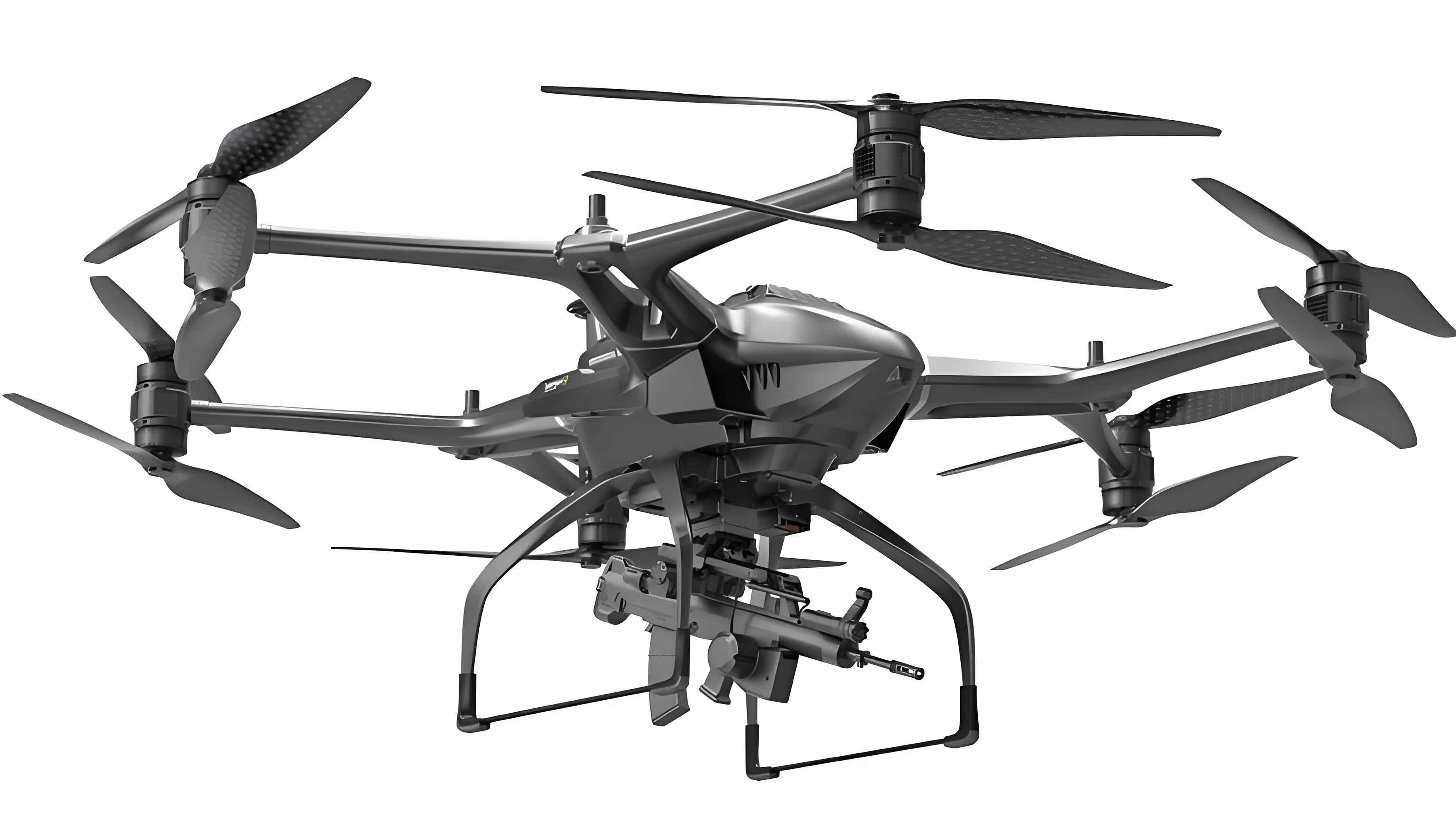
The advantages of 5G technology in military drone applications are manifold. 5G communications are characterized by high speed, low latency, and low power consumption, ensuring high reliability. By harnessing these attributes, 5G facilitates rapid air-to-air and air-to-ground data transmission, enhancing the autonomy of military drones and driving the development of intelligent equipment. This expands the operational scenarios for military drones and propels the evolution of future warfare technologies. One key benefit is meeting diverse service requirements and ensuring robust communication performance. The three-dimensional nature of aerial communication networks for military drones, where nodes move rapidly in 3D space, leads to frequent topology changes. 5G networks employ massive Multiple-Input Multiple-Output (MIMO) technology, which uses multiple antenna arrays at base stations to serve multiple users simultaneously on the same frequency and time resources. This extends signal coverage vertically, improving spatial freedom and enabling 3D beamforming to accurately locate aerial network nodes. The signal transmission capacity can be represented as:
$$ \mathbf{y} = \mathbf{H} \mathbf{x} + \mathbf{n} $$
where \( \mathbf{y} \) is the received signal vector, \( \mathbf{H} \) is the channel matrix, \( \mathbf{x} \) is the transmitted signal vector, and \( \mathbf{n} \) is noise. Massive MIMO enhances \( \mathbf{H} \) to support more spatial streams, increasing throughput for military drones.
Moreover, military drones are deployed in varied scenarios such as cluster cooperation, battlefield search and rescue, and tracking surveillance, all of which demand high transmission efficiency, authenticity, and reliability. Traditional data transmission techniques often fall short in real-time high-frequency video delivery, but 5G-based data conduits easily meet these mission requirements. Additionally, 5G network slicing technology allows for the logical partitioning of network resources based on specific business needs, creating isolated slices tailored to different applications. For military drones, this means customized slices for varying latency and bandwidth requirements, optimizing resource utilization and reducing costs. The network slicing concept can be modeled as:
$$ \text{Slice}_i = f(\text{BW}_i, \text{Latency}_i, \text{Reliability}_i) $$
where each slice \( i \) is defined by its bandwidth, latency, and reliability parameters, ensuring optimal performance for each military drone task.
| Aspect | Traditional Technologies (e.g., 4G) | 5G Technology | Impact on Military Drone Operations |
|---|---|---|---|
| Bandwidth | Up to 100 Mbps, limited for HD video | Up to 10 Gbps, supports 4K/8K streaming | Enables real-time high-definition reconnaissance and surveillance |
| Latency | 20-50 ms, may hinder real-time control | 1-10 ms, ensures precise drone maneuvering | Facilitates rapid response in combat and complex environments |
| Network Slicing | Limited or absent, rigid resource allocation | Dynamic slicing, tailored for diverse missions | Allows simultaneous execution of multiple drone tasks with customized QoS |
| Coverage | Primarily 2D, limited vertical reach | 3D coverage with massive MIMO and beamforming | Improves connectivity in aerial networks for military drones |
Despite these advancements, the integration of 5G in military drones still faces challenges due to developmental constraints. Continuous research and investment are necessary to overcome technical bottlenecks, such as spectrum allocation, security vulnerabilities, and interoperability with existing systems. Through collaborative efforts and sustained innovation, 5G technology can be more effectively embedded in military drones, realizing ideal operational models and contributing to enhanced military capabilities. The scope of 5G applications is vast, and this discussion only scratches the surface, but it is my hope that this analysis provides theoretical support for the ongoing evolution of military drone technology. As I reflect on the future, the synergy between 5G and military drones will undoubtedly reshape modern warfare, offering unprecedented levels of efficiency, autonomy, and strategic advantage. The mathematical frameworks and technical insights presented here underscore the transformative potential of this convergence, paving the way for next-generation military drone systems that are faster, smarter, and more resilient.
In summary, the marriage of 5G communication technology with military drones represents a paradigm shift in military operations. From high-bandwidth video transmission to low-latency control and adaptive network slicing, 5G empowers military drones to perform complex missions with greater precision and reliability. As development progresses, further enhancements in areas like artificial intelligence integration and swarm coordination will emerge, solidifying the role of military drones as indispensable assets in defense strategies worldwide. The journey toward fully leveraging 5G for military drones is ongoing, but the foundations laid today promise a future where these technologies drive significant advancements in security and operational effectiveness.