
The rapid expansion of the low-altitude economy is reshaping global industries, with applications such as drone logistics, urban air mobility, emergency response, and agricultural monitoring rapidly becoming operational. However, as airspace activity density increases exponentially, security threats in low-altitude areas are escalating correspondingly, making the upgrade of Counter-Unmanned Aerial Vehicle (C-UAV) systems an urgent priority. Within a comprehensive C-UAV defense framework, which typically encompasses prevention, detection, decision-making, and countermeasure stages, the accurate and rapid target detection of non-cooperative UAVs serves as the critical and foundational step for enabling subsequent neutralization actions. Among various detection technologies—including radar, radio frequency, acoustic, and electro-optical—vision-based detection using visible light or infrared cameras offers significant advantages such as intuitive visualization, high versatility, and lower cost, making it widely applicable in C-UAV systems.
Nevertheless, achieving precise detection of small-target UAVs in complex backgrounds via electro-optical means remains a formidable challenge. UAVs often operate in cluttered environments like urban landscapes, forests, and architectural complexes, where diverse background textures and dynamic non-target objects create low distinguishability between the target and its surroundings. Traditional detection models are prone to interference from high-frequency textures, birds, and other confusers, severely compromising reliability. Furthermore, when imaged from long distances, a UAV occupies very few pixels, often less than several dozen, categorizing it as a “small object.” Such small targets lack distinctive structural and textural features, causing mainstream detection models like the YOLO series to struggle in preserving their effective information during the feature extraction phase. This information is particularly susceptible to dilution in deeper network layers, leading to missed detections. Occlusions and varied viewing angles further complicate the accurate identification of UAV targets. Consequently, detecting small-target UAVs against complex backgrounds presents a significant and pressing problem.
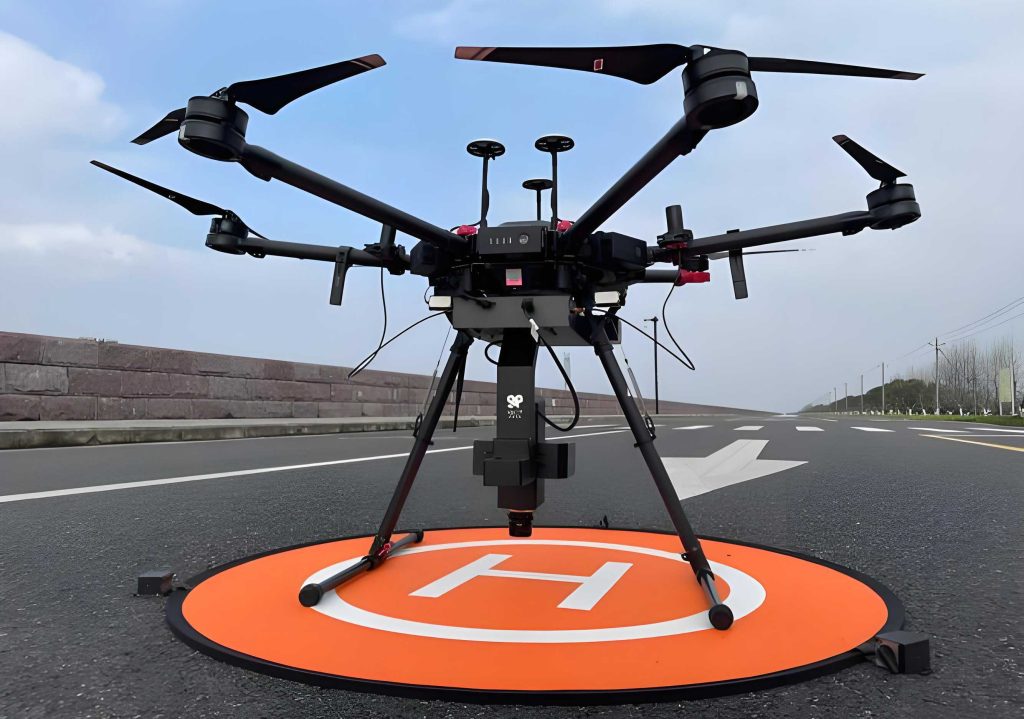
Small-target detection in complex scenes is a persistent research hotspot in deep learning. Scholars have proposed various improvements. Some researchers have employed clustering algorithms like k-means to redesign anchor boxes that better fit real UAV dimensions, thereby enhancing recognition efficiency and localization accuracy. Others have applied slicing operations to datasets to increase the proportion of small targets, allowing models to learn small-target features more effectively. Novel feature fusion structures, such as bidirectional networks from global to local contexts, have been designed to improve multi-scale feature fusion. Enhancements based on specific YOLO versions have incorporated multi-scale dilated convolutions to strengthen the extraction of detailed features for small UAV targets. While these methods have improved performance to some extent, issues of false positives and missed detections for small UAV drones in complex backgrounds persist.
To address these challenges, we propose an enhanced target detection method for C-UAV systems based on the high-performing YOLOv11 single-stage object detector. Our goal is to improve the detection accuracy for small UAV drones in complex scenarios and mitigate errors. The primary contributions of our work, termed YOLOv11-drone, are as follows:
1. We designed a Partial Spatial-Channel Synergistic Attention module (C2SCSPSA). By integrating the Spatial and Channel Synergistic Attention (SCSA) mechanism, which combines channel and spatial attention, this module enhances the model’s feature extraction capability for UAVs, increasing its focus on the drone target amidst clutter.
2. We propose a Small-Target oriented multi-level Feature Pyramid Network (STFPN). This network modifies the original feature fusion pathway of YOLOv11 by adjusting the output feature map scales and reusing shallow-layer features. This design significantly reduces the model’s parameter count while enhancing its focus on small targets by making fuller use of shallow semantic information.
3. We introduced the Efficient Intersection over Union (EIoU) loss function to replace the original one. EIoU decouples the aspect ratio penalty term, allowing the model to converge faster and improve regression accuracy by more directly minimizing the discrepancies in width and height.
1. Related Work: From Two-Stage to Efficient One-Stage Detectors
Current deep learning-based object detection algorithms are broadly categorized into two families. Two-stage detectors, such as the R-CNN series and its descendants like Faster R-CNN and Mask R-CNN, first generate region proposals and then perform classification and regression. This process yields higher accuracy but suffers from high computational cost and slower inference speeds, making them less suitable for real-time C-UAV applications. In contrast, one-stage detectors like SSD and the YOLO series perform classification and localization directly in an end-to-end manner. They offer significantly faster speeds, though sometimes at a slight cost to precision. The YOLO family, with its numerous versions, continuous evolution, relatively high accuracy, rapid detection, strong adaptability, and straightforward architecture, has garnered considerable attention for real-time tasks.
The latest iteration, YOLOv11, is increasingly being applied across various vision domains. It employs CSPDarknet53 as its backbone network, using standard convolutional blocks (CBS) and C3K2 modules for downsampling and feature extraction to generate multi-scale feature maps. A spatial pyramid pooling fast (SPPF) module is introduced to increase the diversity of feature representation. The neck utilizes a Path Aggregation Network (PANet) to allow direct interaction between low-level and high-level features. Finally, a decoupled head separately predicts class and location information. We selected YOLOv11 as the base for our C-UAV target detection module due to its balanced performance.
2. The Proposed YOLOv11-drone Framework
Detecting small UAV drones in complex backgrounds is frequently hindered by interfering background information and the inherently low pixel count of the targets, leading to subpar detection accuracy with frequent false positives and misses. To tackle this, we propose YOLOv11-drone, an enhanced detection framework optimized for small targets. The overall architecture is depicted below, with key modifications in the attention mechanism, feature fusion network, and loss function.
2.1 The C2SCSPSA Attention Module
The original C2PSA module in YOLOv11 enhances feature extraction by combining Cross-Stage Partial (CSP) structure with Partial Self-Attention (PSA). While effective, it does not explicitly prioritize spatial and channel information. We introduce the Spatial and Channel Synergistic Attention (SCSA) mechanism to refine this module. The SCSA block consists of a Shared Multi-Semantic Spatial Attention (SMSA) module and a Progressive Channel-wise Self-Attention (PCSA) module.
The SMSA employs multi-scale depth-wise separable 1D convolutions (with kernels 3, 5, 7, 9) on four sub-features, followed by a shared convolution for alignment. This captures unique semantic spatial structures within each sub-feature at different receptive fields, enabling the extraction of both local and global contextual information—crucial for small drone detection. The sub-features are then concatenated, normalized via Group Normalization (GN) to mitigate semantic interference, and processed through a sigmoid function to generate spatial attention weights.
The PCSA first uses progressive average pooling to compress features, reducing computational cost while preserving the multi-semantic spatial information from SMSA. It then applies an input-aware self-attention mechanism, leveraging the spatial guidance from SMSA to perform finer adjustments on channel features, enhancing semantic consistency and discriminability.
The synergistic use of SMSA and PCSA allows spatial attention to guide channel learning, enabling channels to focus on critical spatial regions, while channel attention refines spatial details. We replace the multi-head self-attention in the original PSA block with the SCSA mechanism, creating the SCSPSA block. Finally, we integrate this into a CSP structure to form the final C2SCSPSA module. This design enhances the model’s multi-scale feature extraction capability and increases its focus on small UAV drone targets in complex backgrounds.
The operation of the SCSPSA block within the C2SCSPSA module can be described as follows. Given an input feature map $\boldsymbol{X} \in \mathbb{R}^{B \times C \times H \times W}$, it first undergoes an initial projection and channel split:
$$\boldsymbol{F} = \text{Conv}_{1\times1}(\boldsymbol{X}) \in \mathbb{R}^{B \times C \times H \times W}$$
$$\boldsymbol{F_1}, \boldsymbol{F_2} = \text{Split}(\boldsymbol{F})$$
The split feature $\boldsymbol{F_1}$ is then processed by the SCSA block and a Feed-Forward Network (FFN):
$$\boldsymbol{F_1′} = \text{BatchNorm}(\boldsymbol{F_1} + \text{SCSA}(\boldsymbol{F_1}))$$
$$\boldsymbol{F_1”} = \text{BatchNorm}(\boldsymbol{F_1′} + \text{FFN}(\boldsymbol{F_1′}))$$
The output is obtained by concatenating the result with $\boldsymbol{F_2}$ and applying a pointwise convolution:
$$\boldsymbol{Y} = \text{Conv}_{1\times1}(\text{Concat}(\boldsymbol{F_1”}, \boldsymbol{F_2}))$$
where $\text{Split}$ denotes channel splitting, $\text{BatchNorm}$ is batch normalization, $\text{Conv}_{1\times1}$ is a 1×1 convolution, and $\text{Concat}$ is the concatenation operation.
Integrating this with the CSP structure, the final C2SCSPSA module processes the input $\boldsymbol{X}$ as:
$$\boldsymbol{X_1}, \boldsymbol{X_2} = \text{Split}(\boldsymbol{X})$$
$$\boldsymbol{Y} = \text{Conv}_{1\times1}(\text{Concat}(\text{SCSPSA}(\boldsymbol{X_1}), \boldsymbol{X_2}))$$
where $\boldsymbol{X_1}, \boldsymbol{X_2} \in \mathbb{R}^{B \times \frac{C}{2} \times H \times W}$.
2.2 The STFPN Feature Fusion Network for Small Targets
YOLOv11 employs a PAFPN structure for multi-scale feature fusion, which effectively aggregates features from different backbone levels. However, for small-scale targets, excessive downsampling reduces image resolution, and shallow-layer semantic information often fails to propagate adequately to the detection head, diminishing performance for tiny objects that heavily rely on detailed spatial features. To address this, we designed the STFPN, which preserves more shallow spatial features to improve detection of small UAV drones.
The original backbone performs 8x, 16x, and 32x downsampling, outputting feature maps P3, P4, P5 at scales 80×80, 40×40, and 20×20, respectively. When a target is smaller than 32×32 pixels, its information is often lost on the deeply downsampled P5 feature map. Excessive downsampling can dilute spatial information detrimental to small target detection.
Our STFPN modification shifts the entire fusion network upward. We remove the final 32x downsampling stage from the backbone, limiting the maximum downsampling to 16x and producing a 40×40 feature map. This reduces model parameters and prevents the loss of small-target information due to excessive network depth. To fully utilize shallow features more beneficial for small drone detection, we introduce the feature map from the 4x downsampling stage (160×160) into the fusion network. Furthermore, we perform additional downsampling on the P2 and P3 level features and fuse them channel-wise with the original fusion pathway features. This design allows the model to capture the fine-grained details of smaller UAV targets more effectively.
2.3 The EIoU Loss Function
YOLOv11 uses the Complete IoU (CIoU) loss for bounding box regression. The CIoU loss is defined as:
$$\mathcal{L}_{CIoU} = 1 – IoU + \frac{\rho^2(\boldsymbol{b}, \boldsymbol{b}^{gt})}{c^2} + \alpha v$$
where $IoU$ is the intersection over union, $\rho$ is the Euclidean distance between the centers of the predicted box $\boldsymbol{b}$ and the ground truth box $\boldsymbol{b}^{gt}$, $c$ is the diagonal length of their minimum enclosing rectangle, $\alpha$ is a weight parameter, and $v$ measures aspect ratio consistency:
$$v = \frac{4}{\pi^2} (\arctan\frac{w^{gt}}{h^{gt}} – \arctan\frac{w}{h})^2$$
While CIoU considers center distance and aspect ratio, it struggles to measure the true discrepancy in width and height independently. Also, when the predicted box and target box almost completely overlap (IoU ≈ 1), the gradient of the CIoU loss becomes very small, potentially leading to vanishing gradient issues.
We adopt the EIoU loss, which decouples the aspect ratio term of CIoU into the width and height differences separately. The EIoU loss is formulated as:
$$\mathcal{L}_{EIoU} = 1 – IoU + \frac{\rho^2(\boldsymbol{b}, \boldsymbol{b}^{gt})}{c^2} + \frac{\rho^2(w, w^{gt})}{C_w^2} + \frac{\rho^2(h, h^{gt})}{C_h^2}$$
where $C_w$ and $C_h$ are the width and height of the minimum enclosing rectangle of the two boxes. EIoU allows the model to update parameters specifically to reduce width or height discrepancies without the confounding effect of a coupled aspect ratio penalty, leading to faster convergence and improved regression accuracy for localizing small UAV drones.
3. Experiments and Analysis
3.1 Dataset
To emphasize complex backgrounds and small-scale UAV drones, we primarily constructed a custom dataset. The images feature backgrounds from complex public security areas such as university campuses, playgrounds, and parks, with UAV drones captured from long distances. The drones are primarily DJI Mavic 2 and DJI Mavic Air models. To enhance dataset robustness, we incorporated part of the publicly available DUT-ANTI-UAV dataset, which contains images of various drone models against diverse backgrounds, often as small targets. Our combined dataset comprises 6,761 images, split into training and validation sets in a 7:3 ratio, with the majority being small-target UAV drone images in complex scenes.
3.2 Evaluation Metrics
We evaluate model performance using several key metrics: detection accuracy via mean Average Precision (mAP), model size via the total number of parameters (Params), computational complexity via Floating Point Operations (FLOPs), and inference speed via Frames Per Second (FPS). mAP is the primary metric, computed from Precision (P), Recall (R), and the Average Precision (AP) per class.
$$P = \frac{TP}{TP + FP} \times 100\%$$
$$R = \frac{TP}{TP + FN} \times 100\%$$
$$AP = \int_0^1 P(R) dR$$
$$mAP = \frac{1}{N_{cls}} \sum_{i=1}^{N_{cls}} AP_i$$
Here, $TP$, $FP$, and $FN$ denote true positives, false positives, and false negatives, respectively, and $N_{cls}$ is the number of classes (1 for our case). We use mAP@0.5 (IoU threshold=0.5) and mAP@0.5:0.95, which averages mAP over IoU thresholds from 0.5 to 0.95 in steps of 0.05. To specifically evaluate small-target performance, we report mAP@0.5:0.95 for small objects (area < 32² pixels).
3.3 Experimental Setup
Experiments were conducted on a system with an Intel i5-13600KF CPU, an NVIDIA RTX 4070 GPU (12GB), 32GB RAM, running Windows 11. The framework was PyTorch 2.4.0 with CUDA 12.1. Common hyperparameters were used for generalization: 100 training epochs, batch size of 16, input image size of 640², initial learning rate of 0.01, and momentum of 0.937.
3.4 Results and Discussion
3.4.1 Ablation Study
To validate the effectiveness of each proposed component, we conducted ablation studies on our custom dataset using YOLOv11n as the baseline. The results, controlled for variables, are presented in the table below.
| Exp. | C2SCSPSA | STFPN | EIoU | Params (M) | FLOPs (G) | mAP@0.5 (%) | mAP@0.5:0.95-Small | FPS |
|---|---|---|---|---|---|---|---|---|
| 1 | × | × | × | 2.59 | 6.4 | 91.4 | 24.6 | 89 |
| 2 | √ | × | × | 2.54 | 6.4 | 92.0 | 25.0 | 88 |
| 3 | √ | √ | × | 0.99 | 9.3 | 94.6 | 39.6 | 79 |
| 4 | √ | √ | √ | 0.99 | 9.3 | 95.5 | 39.6 | 83 |
Each module contributes to accuracy improvement. The STFPN brings a substantial boost in mAP@0.5 (from 92.0% to 94.6%) and small-target mAP (from 25.0% to 39.6%) while dramatically reducing parameters by about 62% (from 2.54M to 0.99M). The EIoU loss further refines accuracy to 95.5% and recovers some inference speed (from 79 to 83 FPS). The C2SCSPSA module provides a solid initial gain. Qualitative results, including heatmap visualizations, confirm that the improved model exhibits higher activation focus on small UAV drone targets in cluttered scenes and reduces instances of missed and false detections compared to the baseline.
3.4.2 Comparison with State-of-the-Art Detectors
We compared YOLOv11-drone against other leading lightweight detectors. The results are summarized below.
| Model | Params (M) | FLOPs (G) | mAP@0.5 (%) | FPS |
|---|---|---|---|---|
| YOLOv7-tiny | 6.01 | 13.2 | 89.0 | 66 |
| YOLOv8n | 3.01 | 8.2 | 91.2 | 71 |
| YOLOv9-tiny | 2.65 | 11.0 | 93.0 | 60 |
| YOLOv10n | 2.70 | 8.3 | 91.7 | 65 |
| YOLOv11n (Baseline) | 2.59 | 6.4 | 91.4 | 89 |
| YOLOv11s | 9.43 | 21.5 | 94.7 | 65 |
| YOLOv11-drone (Ours) | 0.99 | 9.3 | 95.5 | 83 |
Our YOLOv11-drone achieves the highest mAP@0.5 (95.5%), a 4.1% absolute improvement over the baseline YOLOv11n, while using only 38% of its parameters. It also outperforms the larger YOLOv11s model in accuracy with merely 10% of the parameters. Although the FLOPs increase due to the more complex feature fusion, the inference speed of 83 FPS remains highly competitive and sufficient for real-time processing in subsequent C-UAV tracking and countermeasure stages.
3.4.3 Generalization Experiment
To assess the generalization capability of our approach, we evaluated YOLOv11-drone on the public VisDrone2019 aerial image dataset. The results are shown below.
| Model | mAP@0.5 (%) | Params (M) | FPS |
|---|---|---|---|
| YOLOv8n | 30.1 | 3.01 | 168 |
| YOLOv10n | 29.0 | 2.70 | 150 |
| YOLOv11n | 30.2 | 2.59 | 146 |
| YOLOv11-drone (Ours) | 30.8 | 0.99 | 112 |
With less than half the parameters of the baseline models, our method still achieves a superior mAP@0.5 of 30.8%, demonstrating its robust generalizability and effectiveness for small-target detection tasks across different domains.
4. Conclusion
The accurate detection of UAV drones is the critical first step for effective C-UAV systems. In this work, we proposed YOLOv11-drone, an enhanced detection framework designed to address the challenges of low accuracy, false positives, and missed detections for small-target UAV drones in complex backgrounds, thereby providing reliable support for subsequent tracking and neutralization tasks.
Our key innovations include: (1) The C2SCSPSA module, which integrates spatial and channel synergistic attention to boost feature extraction and focus; (2) The STFPN, a small-target oriented feature fusion network that enhances shallow feature utilization, reduces parameters by 62%, and significantly improves small-object detection precision; and (3) The adoption of the EIoU loss function for faster convergence and better regression accuracy.
Extensive experiments on a custom complex-background UAV drone dataset show that YOLOv11-drone achieves a state-of-the-art mAP@0.5 of 95.5% with high efficiency. Its strong performance on the public VisDrone2019 benchmark further validates its general applicability for small-target detection. This work demonstrates the feasibility and advancement of our approach for real-world C-UAV applications. Future work may explore further architectural optimizations and integration with temporal information for tracking.