
As we in Western Europe reflect on our defense strategies, the evolution of military drones stands out as a critical domain. We have consistently embraced the potential of these unmanned systems, recognizing their transformative role in modern warfare. Our armed forces have been proactive in deploying military drones, primarily focusing on small reconnaissance and tactical variants, whether domestically developed or acquired from allies. These military drones have seen action in recent conflicts, such as the Kosovo War, where they provided substantial intelligence, enhancing our reconnaissance networks. However, we acknowledge that our current military drone capabilities often lack real-time processing and lag behind global technological leaders. This gap has spurred us to formulate ambitious plans, driving innovation in military drone design and deployment for both near-term needs and long-term supremacy.
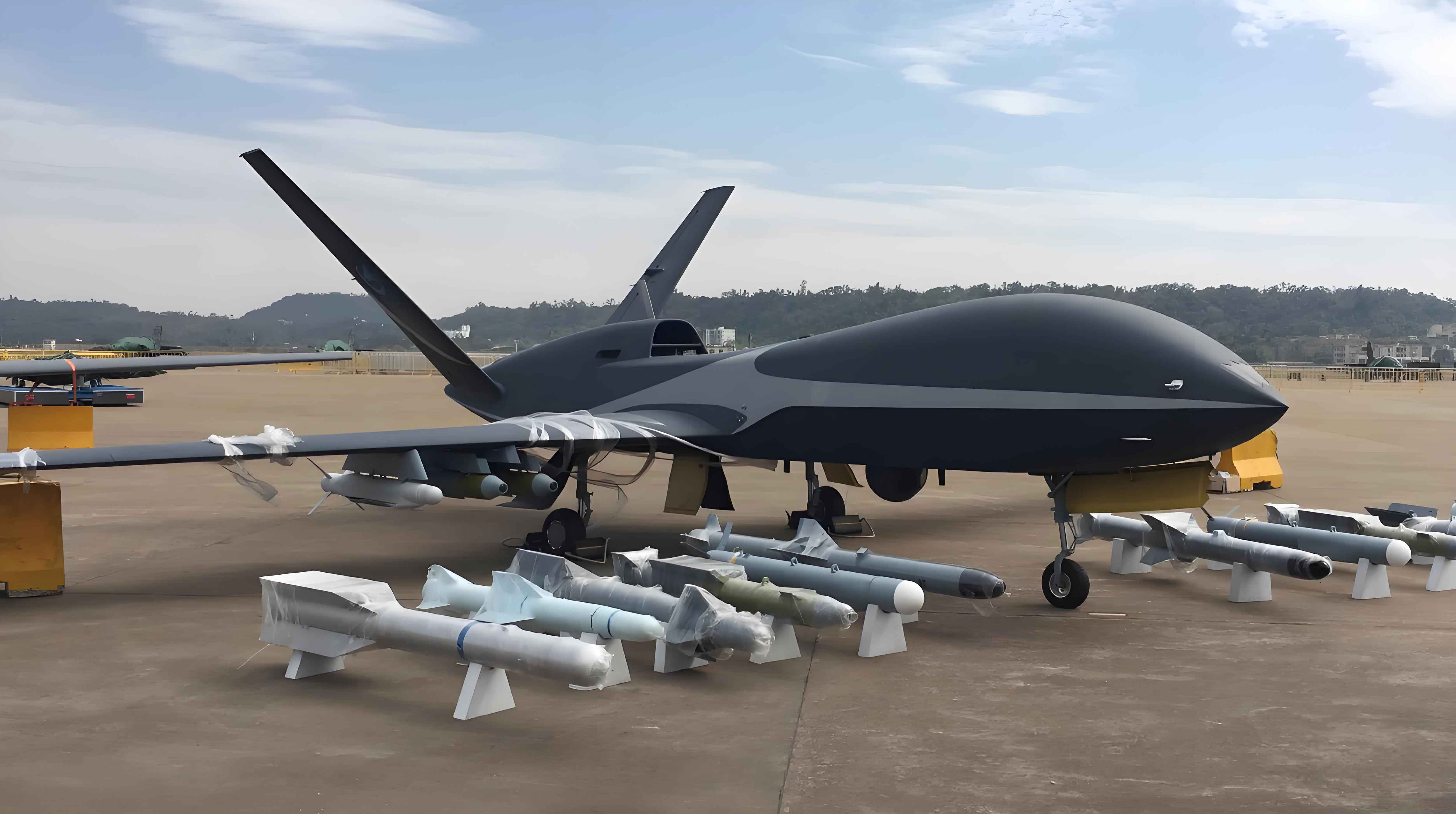
Our military drone inventory is diverse, yet it emphasizes compact systems for surveillance and tactical support. In operations like Kosovo, various military drone models were deployed, contributing to NATO’s intelligence gathering. Despite their utility, these military drones exhibit limitations in advanced processing, which we are addressing through ongoing research. The table below summarizes key characteristics of our typical military drone assets in service, highlighting areas for improvement.
| Drone Type | Primary Role | Endurance (hours) | Range (km) | Real-Time Processing |
|---|---|---|---|---|
| Small Reconnaissance Military Drone | Surveillance | 2-6 | 50-100 | No |
| Tactical Military Drone | Target Acquisition | 8-12 | 150-300 | Limited |
| Medium-Altitude Long-Endurance (MALE) Military Drone | Intelligence Gathering | 20-30 | 1000+ | Under Development |
We evaluate our military drone performance using metrics like operational efficiency. For instance, the effectiveness \( E \) of a military drone in surveillance can be modeled as:
$$ E = \frac{A \times R}{T} $$
where \( A \) is area coverage rate (in km²/h), \( R \) is reliability factor, and \( T \) is response time (in hours). Our current military drones often have lower \( E \) due to higher \( T \), pushing us to innovate.
Our approach to military drone development is shaped by national priorities. In Germany, we focus on cost-effective multi-role platforms that can handle surveillance, electronic warfare, and attack missions within a single military drone system. This minimizes logistical footprints and enhances versatility. In France, we prioritize multi-sensor military drones with both high and low-speed capabilities, integrating advanced payloads for diverse scenarios. The United Kingdom, meanwhile, pursues highly networked military drones with multiple sensors, aiming for seamless integration into broader command structures. These distinct philosophies guide our respective military drone projects, ensuring tailored solutions for our defense needs.
Looking at near-term plans, we have initiated several military drone programs to bridge capability gaps. In France, we are developing a Multi-Sensor Multi-Mission Military Drone System to replace older models, scheduled for deployment around 2025. This military drone will excel in battlefield intelligence, target positioning, and electronic warfare. Additionally, we are adapting the Heron-based MALE military drone as a transitional solution, with procurement of several systems planned. Our combat military drone project features a tailless design with composite materials for stealth, controlled via satellite links from fighter aircraft. We are also exploring micro military drones for urban warfare, investing in key technologies like artificial muscles and micro-electromechanical systems. The table below outlines French near-term military drone initiatives.
| Project Name | Type | Key Features | Planned Deployment | Estimated Cost (billion €) |
|---|---|---|---|---|
| Multi-Sensor Military Drone | Tactical | Electro-optical, infrared, radar | 2025 | |
| MALE Military Drone (Heron-derived) | Medium-Altitude | Data relay, target定位 | 2024 | |
| Combat Military Drone | Attack | Stealth, satellite control | 2030+ | |
| Micro Military Drone | Miniature | Indoor operations, low Reynolds number aerodynamics | 2028 |
In Germany, our near-term military drone efforts include the Euro Hawk, a high-altitude long-endurance (HALE) military drone derived from the Global Hawk, set to become Europe’s first such system by 2010. We are also advancing the Typhoon combat military drone, designed for anti-tank and anti-aircraft roles with autonomous guidance. This military drone uses composite materials and can be transported easily, with plans for thousands of units. The performance of such military drones can be analyzed through equations like the kill probability \( P_k \) for a combat military drone:
$$ P_k = 1 – e^{-\lambda \cdot A_t} $$
where \( \lambda \) is the threat density and \( A_t \) is the area covered by the military drone’s sensors. Our designs aim to maximize \( P_k \) through enhanced sensors and autonomy.
For the United Kingdom, the Watchkeeper MALE military drone is a cornerstone, featuring multi-sensor suites including synthetic aperture radar and laser designators. This military drone ensures interoperability with NATO forces and is slated for service around 2025. We are also developing a multi-role military drone for maritime patrol and combat tasks, with trials beginning in 2024. These military drones represent our commitment to maintaining a technological edge. The following table compares key parameters of near-term military drones across our nations.
| Country | Military Drone Project | Endurance (h) | Max Speed (Mach) | Payload Capacity (kg) | Primary Mission |
|---|---|---|---|---|---|
| France | Multi-Sensor Military Drone | 12 | 0.5 | Reconnaissance | |
| Germany | Euro Hawk Military Drone | Surveillance | |||
| UK | Watchkeeper Military Drone | Multi-role | |||
| Germany | Typhoon Combat Military Drone | Attack |
Our long-term vision for military drones emphasizes collaborative development to reduce costs and enhance capabilities. Under the European Capability Action Plan, we have prioritized military drones for rapid reaction forces, leading to joint projects by the European Aerospace Defence and Space Company. We are co-developing three advanced military drone systems: the European Long-Endurance Military Drone (ELE), the European Combat Military Drone (ECM), and the European Reconnaissance Military Drone (ERD). These military drones are in conceptual stages, with target initial operational capabilities around 2030-2035. The ELE military drone, for instance, is designed for aerial surveillance with parameters like a wingspan of 20 meters and a payload of 1000 kg. We model its endurance \( T_e \) using:
$$ T_e = \frac{W_f}{SFC \cdot T} $$
where \( W_f \) is fuel weight, \( SFC \) is specific fuel consumption, and \( T \) is thrust. Optimizing this equation is key to our ELE military drone design.
The European Combat Military Drone aims for high-speed, deep-penetration attacks with a maximum speed over Mach 0.9 and a combat radius of 1500 km. This military drone will carry precision weapons and emphasize stealth and electronic warfare. Similarly, the European Reconnaissance Military Drone focuses on high-speed reconnaissance at sea level, with a speed of Mach 0.8 and a 1000 km radius. Our design requirements for these future military drones include high autonomy, cost-effectiveness, survivability, and global deployability. The table below summarizes their projected specifications.
| Military Drone Type | Wingspan (m) | Length (m) | Max Takeoff Weight (kg) | Effective Payload (kg) | Operational Capability Timeline |
|---|---|---|---|---|---|
| European Long-Endurance Military Drone | 20 | 15 | 1000 | 2030 | |
| European Combat Military Drone | 10 | 12 | 1000 (internal) | 2035 | |
| European Reconnaissance Military Drone | 8 | 10 | 500 | 2032 |
We are investing heavily in research to overcome technical hurdles. For military drones, sensor fusion is critical; we use algorithms like:
$$ F = \sum_{i=1}^{n} w_i S_i $$
where \( F \) is the fused output, \( w_i \) are weights, and \( S_i \) are sensor inputs from electro-optical, infrared, and radar systems on our military drones. This enhances target recognition and tracking. Additionally, we explore aerodynamic efficiencies for military drones, such as the lift-to-drag ratio \( L/D \), which impacts endurance:
$$ \frac{L}{D} = \frac{C_L}{C_D} $$
where \( C_L \) and \( C_D \) are coefficients for lift and drag. Our designs aim for high \( L/D \) to extend the operational range of military drones.
Cost management is paramount in our military drone programs. We analyze lifecycle costs \( C_{lc} \) for a military drone system as:
$$ C_{lc} = C_d + C_p + C_o + C_m $$
where \( C_d \) is development cost, \( C_p \) is production cost, \( C_o \) is operational cost, and \( C_m \) is maintenance cost. By collaborating across borders, we reduce \( C_d \) and \( C_p \) for next-generation military drones. Our goal is to field affordable yet cutting-edge military drones that meet diverse mission profiles, from reconnaissance to strike roles.
In conclusion, our journey with military drones in Western Europe is one of continuous adaptation and innovation. We have moved from basic surveillance tools to envisioning autonomous, networked systems that dominate the battlespace. Through near-term upgrades and long-term collaborations, we are committed to advancing military drone technology, ensuring they remain integral to our defense posture. The future will see our military drones evolving with greater autonomy, stealth, and multi-role capabilities, solidifying our strategic advantage in an era where unmanned systems redefine warfare.