
As an integral part of the unmanned aerial vehicle family, vertical take-off and landing unmanned aerial vehicles, commonly referred to as VTOL UAVs, have garnered significant attention and development worldwide due to their flexible take-off and landing capabilities, ease of deployment and recovery, and high mobility. These VTOL UAVs eliminate the need for dedicated runways, allowing operations from confined spaces such as ship decks, rugged terrain, or urban environments, making them invaluable for military, surveillance, and civilian applications. In this article, I will explore the current development status of VTOL UAVs across various nations, focusing on key models and their technical specifications, followed by an in-depth analysis of the critical design and manufacturing technologies that enable their advanced performance. Throughout, I will emphasize the importance of VTOL UAVs in modern aerospace, using tables and formulas to summarize data and principles, and ensure the keyword “VTOL UAV” is frequently reiterated to underscore its relevance.
The evolution of VTOL UAVs can be traced back to the mid-20th century, with early experiments in rotary-wing and tilt-rotor designs. Today, advancements in materials, propulsion, and control systems have propelled VTOL UAVs into sophisticated platforms capable of missions ranging from reconnaissance and targeting to logistics and electronic warfare. The flexibility of VTOL UAVs lies in their ability to hover, transition to forward flight, and land vertically, which demands unique engineering solutions compared to fixed-wing UAVs. This article will delve into these aspects, providing a comprehensive overview that highlights the global progress and technological underpinnings of VTOL UAVs.
Development Status of Foreign VTOL UAVs
The global landscape of VTOL UAVs is diverse, with numerous countries investing in research and deployment. Below, I will discuss notable VTOL UAV models from the United States, Russia, Canada, Germany, and other regions, summarizing their features and performance metrics. These VTOL UAVs exemplify the state-of-the-art in vertical take-off and landing technology, each tailored for specific operational roles.
United States VTOL UAV Programs
The United States has been a pioneer in VTOL UAV development, with programs such as the Fire Scout series and the Eagle Eye tilt-rotor UAV. The Fire Scout VTOL UAV family, including the RQ-8A, MQ-8B, and MQ-8C, is primarily designed for naval operations, offering surveillance, targeting, and attack capabilities. These VTOL UAVs are based on modified helicopter platforms, with enhancements in endurance, payload, and autonomy. For instance, the MQ-8B VTOL UAV builds on the RQ-8A by incorporating redundant flight controls and increased fuel capacity, while the MQ-8C VTOL UAV expands size and weight for greater range and payload. Another innovative VTOL UAV is the Eagle Eye, a tilt-rotor design that combines the hover efficiency of helicopters with the speed of fixed-wing aircraft, enabling rapid deployment from ships for coastal patrol and reconnaissance missions. The success of these VTOL UAVs underscores the U.S. commitment to advancing vertical take-off and landing systems.
To quantify the performance of U.S. VTOL UAVs, I present a table summarizing key technical specifications. This comparison highlights the evolution within the Fire Scout series and the unique attributes of the Eagle Eye VTOL UAV.
| Model | Rotor Diameter (m) | Length (m) | Max Speed (km/h) | Endurance (h) | Max Take-off Weight (kg) | Powerplant |
|---|---|---|---|---|---|---|
| RQ-8A VTOL UAV | 8.40 | 6.97 | 231 | 6 | 1,202 | Rolls-Royce 250-C20W turboshaft |
| MQ-8B VTOL UAV | 8.30 | 4.50 | 278 | 8 | 1,293 | Rolls-Royce 250-C20W turboshaft |
| MQ-8C VTOL UAV | 8.50 (estimated) | 7.80 | 230 (cruise) | 24 | 2,700 | Rolls-Royce 250-C20R turboshaft |
| Eagle Eye VTOL UAV | 2.49 (prop-rotor) | 5.46 | 389 | 6 | 1,125 | Rolls-Royce 250-C20R turboshaft |
These VTOL UAVs demonstrate a trend toward increased endurance and payload capacity, driven by improvements in aerodynamics and propulsion. The Eagle Eye VTOL UAV, in particular, showcases the tilt-rotor concept, where the prop-rotors can tilt between vertical and horizontal orientations, enabling efficient hover and high-speed flight. The transition dynamics of such VTOL UAVs can be modeled using equations of motion. For example, the lift generated during hover for a VTOL UAV can be expressed as:
$$L = \frac{1}{2} \rho v^2 S C_L$$
where \(L\) is the lift force, \(\rho\) is the air density, \(v\) is the induced velocity through the rotor disk, \(S\) is the rotor disk area, and \(C_L\) is the lift coefficient. For a VTOL UAV in hover, \(v\) is related to the thrust \(T\) by momentum theory: \(T = 2 \rho A v^2\), where \(A\) is the rotor area. This fundamental principle underpins the design of rotary-wing VTOL UAVs, ensuring sufficient lift for vertical take-off.
Russian VTOL UAV Developments
Russia has also invested in VTOL UAV technology, with the Kamov Ka-137 being a prominent example. This multi-purpose unmanned helicopter is designed for ecological monitoring, reconnaissance, and patrol missions. The Ka-137 VTOL UAV features a coaxial rotor system, which eliminates the need for a tail rotor, providing compactness and enhanced maneuverability. Its spherical fuselage minimizes drag, and the use of composite materials reduces weight and radar signature. The Ka-137 VTOL UAV exemplifies how vertical take-off and landing capabilities can be leveraged for civilian and military applications in challenging environments. With a maximum speed of 175 km/h and an endurance of several hours, this VTOL UAV is well-suited for persistent surveillance tasks. The coaxial rotor design offers advantages in hover efficiency, as the counter-rotating rotors cancel out torque, reducing energy loss. The thrust for a coaxial VTOL UAV can be approximated as:
$$T = 2 \times \left( \frac{1}{2} \rho v^2 S C_T \right)$$
where \(C_T\) is the thrust coefficient for each rotor. This configuration is common in VTOL UAVs requiring stable hover and compact footprints, such as the Ka-137.
Canadian VTOL UAV Innovations
Canada has contributed to the VTOL UAV field with the CL series, including the CL-227 Sentinel and CL-327 Guardian. These VTOL UAVs are characterized by their unique “flying peanut” shape, with a central fuselage housing counter-rotating rotors. The CL-227 Sentinel VTOL UAV, developed in the 1980s, was designed for battlefield surveillance and naval reconnaissance, while the CL-327 Guardian VTOL UAV offers enhanced range and payload capacity. These VTOL UAVs utilize turboshaft engines and composite materials to achieve lightweight structures and low observability. The CL series VTOL UAVs demonstrate the versatility of vertical take-off and landing systems for both land-based and maritime operations, often deployed from small vessels or mobile ground units. The aerodynamic efficiency of such VTOL UAVs can be analyzed using drag equations, where the drag force \(D\) is given by:
$$D = \frac{1}{2} \rho v^2 S C_D$$
with \(C_D\) as the drag coefficient. Minimizing \(C_D\) through streamlined designs is crucial for VTOL UAVs to extend endurance during forward flight.
The following table compares key parameters of Russian and Canadian VTOL UAVs, illustrating the diversity in design approaches.
| Model | Rotor Configuration | Length (m) | Max Speed (km/h) | Endurance (h) | Max Payload (kg) | Powerplant |
|---|---|---|---|---|---|---|
| Ka-137 VTOL UAV | Coaxial rotors | 2.33 (height) | 175 | 4 | 80 | Hirth 2706-R05 piston engine |
| CL-227 Sentinel VTOL UAV | Counter-rotating rotors | 1.64 (height) | 142 | 6 | 45 | Williams WTS34-16 turboshaft |
| CL-327 Guardian VTOL UAV | Counter-rotating rotors | 1.84 (height) | 157 | 8 | 100 | Williams WTS117-5 turboshaft |
German VTOL UAV Advancements
Germany has developed the Seamos VTOL UAV, a ship-based unmanned helicopter for maritime reconnaissance and target acquisition. The Seamos VTOL UAV employs a coaxial rotor system driven by a single turboshaft engine, similar to Russian designs, but with enhancements in avionics and sensor integration. This VTOL UAV is capable of autonomous take-off and landing, using laser trackers and motion sensors for precise control. The Seamos VTOL UAV highlights the importance of smart landing systems in vertical take-off and landing operations, especially in dynamic naval environments. Its composite airframe reduces weight and corrosion, essential for saltwater operations. The Seamos VTOL UAV represents a European approach to VTOL UAV technology, focusing on reliability and multi-mission adaptability.
To provide a broader perspective, I include a summary of additional VTOL UAVs from other countries, such as Israel’s AirMule and China’s developments, though the latter is not covered in detail here to align with the focus on foreign models. The global proliferation of VTOL UAVs indicates a growing recognition of their strategic value. For instance, Israel has pioneered VTOL UAVs for tactical logistics, while European consortia are exploring hybrid-electric VTOL UAVs for urban air mobility. These trends underscore the rapid innovation in vertical take-off and landing systems.
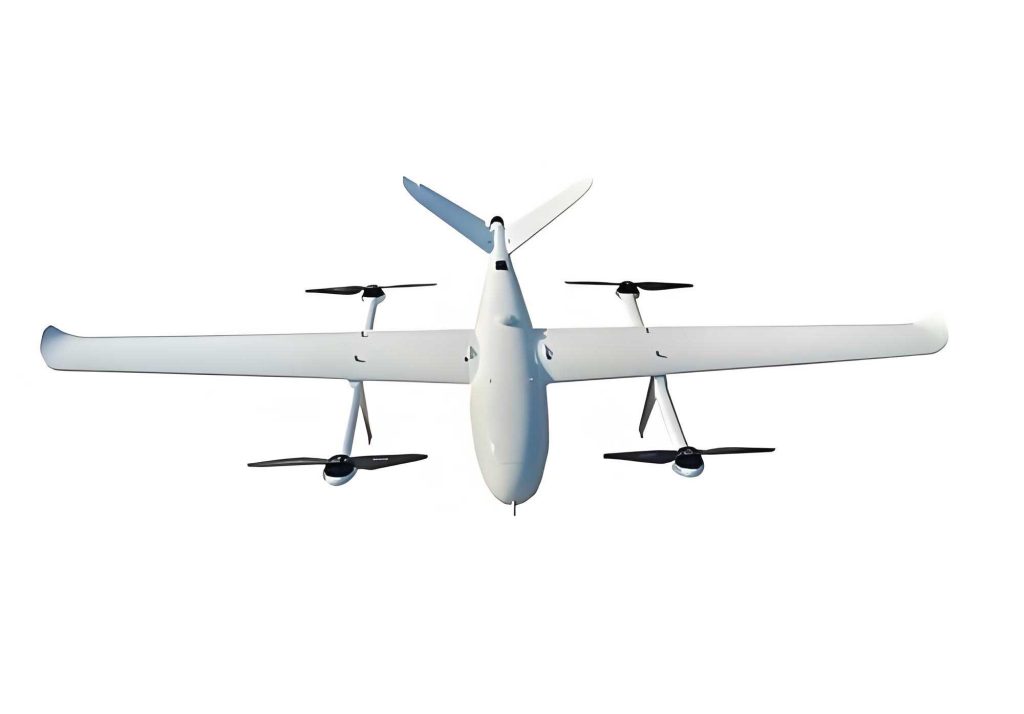
The image above illustrates a typical VTOL UAV in operation, showcasing its compact design and rotor configuration. Such visual aids help contextualize the technical discussions, but the focus remains on the analytical aspects of VTOL UAV development.
Key Technologies in VTOL UAV Design and Manufacturing
The performance and reliability of VTOL UAVs hinge on several core technologies. These encompass aerodynamics, materials, propulsion, and control systems, each contributing to the unique capabilities of vertical take-off and landing platforms. In this section, I will delve into these technologies, using formulas and tables to elucidate principles and trade-offs. The keyword “VTOL UAV” will be frequently referenced to maintain thematic consistency.
High-Speed Rotor Technology
High-speed rotor technology is fundamental to VTOL UAVs, as it directly impacts lift generation, payload capacity, and maneuverability. Unlike fixed-wing UAVs that rely on forward speed for lift, VTOL UAVs use rotating wings to produce vertical thrust. Increasing rotor speed enhances lift, but it also introduces challenges such as noise, vibration, and aerodynamic losses. For a VTOL UAV, the rotor tip speed \(v_t\) is a critical parameter, given by \(v_t = \omega R\), where \(\omega\) is the angular velocity and \(R\) is the rotor radius. The lift force can be derived from blade element theory, integrating along the rotor blade:
$$L = \int_0^R \frac{1}{2} \rho (\omega r)^2 c C_l dr$$
where \(r\) is the radial distance, \(c\) is the chord length, and \(C_l\) is the section lift coefficient. To maximize efficiency, VTOL UAV designers optimize rotor geometry and materials. Advanced composites like carbon fiber allow for lighter, stiffer blades that can operate at higher speeds without deformation. For example, the Fire Scout VTOL UAVs use tailored rotor blades to achieve a balance between hover efficiency and forward flight performance. The power required for hover in a VTOL UAV can be estimated as:
$$P = \frac{T^{3/2}}{\sqrt{2 \rho A}}$$
where \(P\) is the power, \(T\) is the thrust, and \(A\) is the rotor disk area. High-speed rotors reduce the disk loading \(T/A\), improving hover efficiency but demanding robust transmission systems. This technology is pivotal for VTOL UAVs tasked with heavy payloads or long-endurance missions.
Efficient Aerodynamic Design
Efficient aerodynamic design is crucial for VTOL UAVs to minimize drag during forward flight and transition phases. While hover efficiency depends on rotor performance, cruise efficiency relies on streamlined airframes and wing configurations. For tilt-rotor VTOL UAVs like the Eagle Eye, the transition from vertical to horizontal flight involves complex aerodynamics, where the prop-rotors tilt and the wings generate lift. The lift-to-drag ratio \(L/D\) is a key metric, expressed as:
$$\frac{L}{D} = \frac{C_L}{C_D}$$
where \(C_L\) and \(C_D\) are the lift and drag coefficients, respectively. VTOL UAV designers use computational fluid dynamics (CFD) to optimize shapes, reducing \(C_D\) through features like smooth contours and retractable landing gear. Composite materials further enhance aerodynamics by enabling complex geometries with low weight. For instance, the Seamos VTOL UAV incorporates a coaxial rotor system within a slender fuselage to reduce parasitic drag. Additionally, wing design for hybrid VTOL UAVs can be analyzed using the Prandtl lifting-line theory:
$$C_L = 2\pi \alpha \left( \frac{AR}{AR + 2} \right)$$
where \(\alpha\) is the angle of attack and \(AR\) is the aspect ratio. High \(AR\) wings improve cruise efficiency but may compromise hover stability, necessitating trade-offs in VTOL UAV configurations.
Smart Take-off and Landing Control Systems
Smart take-off and landing control systems are essential for VTOL UAVs to operate autonomously in challenging environments, such as moving ship decks or gusty conditions. These systems integrate sensors, algorithms, and actuators to stabilize the UAV during critical phases. For a VTOL UAV, the control law for vertical landing can be modeled using a proportional-integral-derivative (PID) controller:
$$u(t) = K_p e(t) + K_i \int_0^t e(\tau) d\tau + K_d \frac{de(t)}{dt}$$
where \(u(t)\) is the control input (e.g., rotor thrust), \(e(t)\) is the error in position or velocity, and \(K_p\), \(K_i\), \(K_d\) are gain constants. Modern VTOL UAVs, like the Seamos, employ laser rangefinders and inertial measurement units (IMUs) to provide real-time data for these controllers. Machine learning techniques are also being explored to adapt to unpredictable disturbances. The importance of robust control cannot be overstated for VTOL UAVs, as failed landings can lead to significant damage. Furthermore, redundancy in flight control systems, as seen in the MQ-8B VTOL UAV, enhances reliability. The dynamics of a VTOL UAV during landing can be described by equations of motion:
$$m \ddot{z} = T – mg – D_z$$
where \(m\) is the mass, \(\ddot{z}\) is the vertical acceleration, \(T\) is the total thrust, \(g\) is gravity, and \(D_z\) is vertical drag. Smart controllers adjust \(T\) to achieve a soft touchdown, critical for preserving the VTOL UAV’s integrity.
Composite Materials Technology
Composite materials technology plays a pivotal role in VTOL UAV manufacturing, enabling lightweight, strong, and stealthy structures. Composites such as carbon fiber reinforced polymers (CFRP) and glass fiber offer high strength-to-weight ratios, which are ideal for rotor blades, fuselages, and wings. For a VTOL UAV, weight reduction directly translates to improved endurance and payload capacity. The stress-strain relationship for a composite laminate can be expressed as:
$$\{\sigma\} = [Q] \{\epsilon\}$$
where \(\{\sigma\}\) is the stress vector, \([Q]\) is the stiffness matrix, and \(\{\epsilon\}\) is the strain vector. By tailoring layup sequences, designers can optimize for specific loads, such as the cyclic stresses on VTOL UAV rotor hubs. Additionally, composites can be molded into aerodynamic shapes that reduce radar cross-section, enhancing stealth for military VTOL UAVs. For example, the Fire Scout series uses composites extensively to achieve low observable characteristics. The use of composites also facilitates modular designs, allowing for easier maintenance and upgrades of VTOL UAVs. A table comparing material properties relevant to VTOL UAVs is provided below.
| Material | Density (kg/m³) | Tensile Strength (MPa) | Advantages for VTOL UAVs |
|---|---|---|---|
| Aluminum Alloy | 2,700 | 300 | Good machinability, moderate weight |
| Carbon Fiber Composite | 1,600 | 1,500 | High strength, lightweight, corrosion-resistant |
| Glass Fiber Composite | 2,000 | 1,000 | Cost-effective, good impact resistance |
| Titanium Alloy | 4,500 | 900 | High temperature resistance, durable |
These materials enable VTOL UAVs to withstand operational stresses while minimizing mass, a key consideration for vertical take-off and landing performance.
Propulsion and Power Management
Propulsion and power management are critical for VTOL UAVs, as they dictate range, speed, and mission flexibility. Most VTOL UAVs use turboshaft or piston engines, but there is a growing trend toward hybrid-electric and all-electric systems for reduced noise and emissions. The power required for a VTOL UAV in hover can be derived from momentum theory:
$$P_h = \frac{T^{3/2}}{\sqrt{2 \rho A}}$$
while for forward flight, the power \(P_f\) includes parasite and induced drag components:
$$P_f = \frac{1}{2} \rho v^3 S C_D + \frac{T v}{2}$$
Efficient power management involves optimizing engine performance across flight regimes. For instance, the Rolls-Royce engines in U.S. VTOL UAVs are tuned for high altitude and hot conditions, common in operational theaters. Battery technology is also advancing, with energy density \(\eta\) (Wh/kg) being a key metric for electric VTOL UAVs. The endurance \(E\) of an electric VTOL UAV can be approximated as:
$$E = \frac{\eta m_b}{P}$$
where \(m_b\) is the battery mass and \(P\) is the average power consumption. Hybrid systems combine internal combustion engines with batteries to extend the range of VTOL UAVs, useful for long-endurance surveillance missions.
Integration of Avionics and Sensors
The integration of avionics and sensors is a key technology for VTOL UAVs, enabling autonomous navigation, obstacle avoidance, and mission execution. Modern VTOL UAVs are equipped with GPS/INS systems, radar, electro-optical/infrared (EO/IR) cameras, and data links. The navigation equation for a VTOL UAV using INS can be written as:
$$\dot{\mathbf{v}} = \mathbf{R} \mathbf{f}^b – 2\boldsymbol{\Omega}_{ie} \times \mathbf{v} + \mathbf{g}$$
where \(\mathbf{v}\) is the velocity vector, \(\mathbf{R}\) is the rotation matrix, \(\mathbf{f}^b\) is the specific force in the body frame, \(\boldsymbol{\Omega}_{ie}\) is the Earth’s rotation rate, and \(\mathbf{g}\) is gravity. Sensor fusion algorithms combine data from multiple sources to improve accuracy, essential for VTOL UAVs operating in GPS-denied environments. Additionally, modular payload bays allow VTOL UAVs to swap sensors for different missions, enhancing versatility. The Seamos VTOL UAV, for example, integrates maritime radar and EO/IR pods for comprehensive surveillance. The advancement in miniaturized avionics has been a game-changer for VTOL UAVs, reducing size and power requirements while increasing capability.
Future Trends and Conclusion
The future of VTOL UAVs is poised for significant growth, driven by technological advancements and expanding applications. Emerging trends include the development of urban air mobility VTOL UAVs for passenger transport, swarming capabilities for coordinated missions, and artificial intelligence for fully autonomous operations. Hybrid-electric propulsion systems will likely become standard, offering quieter and more efficient VTOL UAVs for civilian use. Moreover, advancements in materials science may lead to bio-inspired designs that enhance aerodynamic efficiency. The continued integration of VTOL UAVs into national airspace systems will require robust regulatory frameworks and sense-and-avoid technologies.
In conclusion, VTOL UAVs represent a dynamic and evolving segment of aerospace technology, with global developments showcasing a wide array of designs and capabilities. From the Fire Scout series in the U.S. to the Ka-137 in Russia, these VTOL UAVs demonstrate the versatility and strategic importance of vertical take-off and landing systems. The key technologies—high-speed rotors, efficient aerodynamics, smart control systems, composite materials, and advanced propulsion—are the bedrock of their performance. As research progresses, VTOL UAVs will undoubtedly play an increasingly vital role in military, commercial, and humanitarian domains. By understanding and leveraging these technologies, stakeholders can drive innovation and ensure the safe, effective deployment of VTOL UAVs worldwide.
Throughout this article, I have emphasized the keyword “VTOL UAV” to highlight its centrality in discussions of unmanned aerial systems. The use of tables and formulas has provided a structured way to analyze technical aspects, from performance metrics to aerodynamic principles. As the VTOL UAV landscape continues to evolve, ongoing study and collaboration will be essential to overcoming challenges and unlocking new potentials for these remarkable machines.